
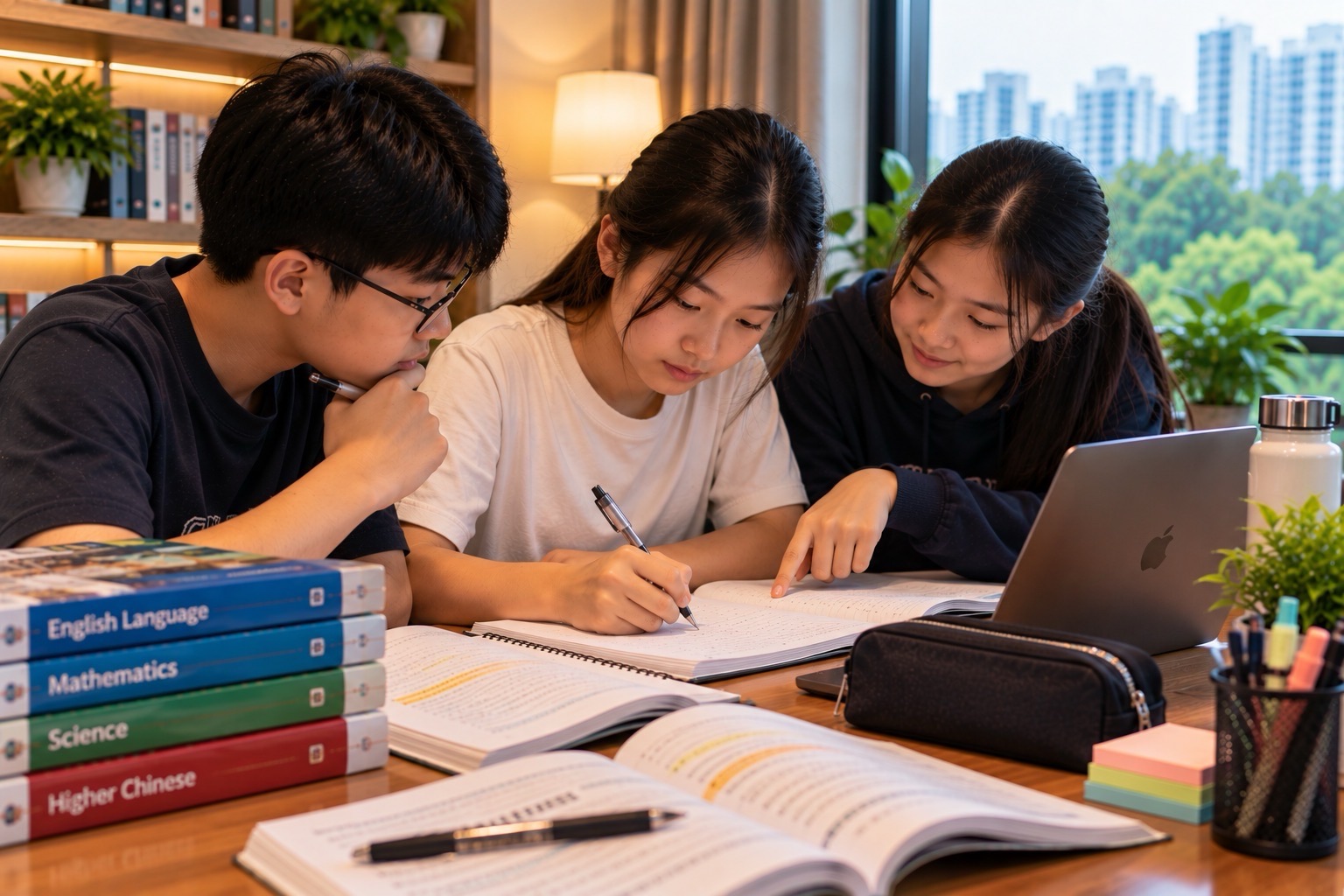
By Secondary 4, a student can own three neat folders of Chemistry notes and still freeze when a paper begins with an unfamiliar reaction. The shelves are full; the retrieval system is unreliable. That is why the most productive final-year tuition often looks less like a new textbook and more like a well-organised workshop: find the fault, repair it, test it again and practise under realistic conditions.
Secondary 4 Punggol Chemistry tuition is useful when it turns O-Level Chemistry revision, Pure Chemistry, Combined Science Chemistry, chemical calculations, qualitative analysis and practical exam preparation into connected, examinable skills. A tutor must help the learner select the right concept without a chapter heading, justify an answer precisely and manage time without sacrificing accuracy. Good Chemistry support is not measured only by how many past-year papers are completed; it is measured by how many previously unreliable decisions the student can now make unaided.
Families searching for Secondary 4 Chemistry tuition Punggol, O-Level Chemistry tuition Singapore, Chemistry 6092 revision, Chemistry practical exam tips, G3 Chemistry SEC, Combined Science Chemistry tuition or small-group Chemistry tutorials often need a plan that starts immediately with evidence. Here is what that plan should contain, why it works and what parents can check as examinations approach.
Get the exact examination right before choosing resources
A Secondary 4 student sitting the 2026 Singapore-Cambridge GCE O-Level and a Secondary 4 student sitting the 2027 Singapore-Cambridge Secondary Education Certificate (SEC) are not in precisely the same administrative examination context. For the 2026 O-Level cohort, Pure Chemistry is syllabus 6092. Chemistry-containing O-Level Combined Science options include Science (Physics, Chemistry) 5086 and Science (Chemistry, Biology) 5088. The subjects are not interchangeable.
For the 2027 SEC G3 cohort, SEAB lists Chemistry K324 and separate G3 Combined Science subject codes. The correct paper structure and syllabus scope must be checked for that examination year. Do not apply an old paper’s label blindly to a different cohort or offer Pure Chemistry topics as compulsory Combined Science content without checking.
Two official starting points are the SEAB 2026 O-Level school-candidate syllabuses and the SEAB 2027 SEC G3 school-candidate syllabuses. Use the student’s current subject entry and school guidance when selecting practice, especially for practical assessment and the depth required in structured answers.
Why the final year is a retrieval problem
A student may know ionic bonding on Monday, organic reactions on Tuesday and electrolysis on Wednesday. An actual examination can put them alongside one another. The paper rarely says, ‘This is Chapter 7, use Formula B.’ It presents a chemical situation and expects the candidate to recognise the relevant ideas.
That is why simply reading chapter summaries is insufficient. Retrieval needs to be practised without the labels that make an answer obvious. Mixed-topic questions are not designed to trick students; they are a way of checking whether the learner understands which idea applies to a new problem.
A good tuition plan works in cycles. Diagnose the first error, repair the missing concept, practise it in a focused setting, remove the chapter cue, add timing only when accuracy has stabilised, and retest with a new question.
The first diagnostic: what does the latest paper actually say?
A tutor should request useful evidence where available: recent school worksheets, common-test scripts, preliminary examination papers, practical notes and examples of calculations that caused difficulty. The goal is not to judge the child on one mark but to identify patterns.
Useful categories include misread data, incorrect formulae, unbalanced equations, wrong mole ratios, weak mechanistic explanations, uncertain qualitative analysis, missing practical improvements, slow pacing and incomplete checking. The tutor can then connect each category to one teachable habit.
Suppose a learner loses marks in three numerical questions. One mistake is a unit conversion, another is an incorrect chemical ratio, and the third is a misread question asking for excess reactant. Calling all three ‘carelessness’ hides the problem. Specific diagnosis makes revision efficient.
Rebuild Chemistry’s three languages
Final-year Chemistry repeatedly shifts among three perspectives.
- Observable: bubbles, colour changes, precipitates, temperature change, a measurable volume or a recorded mass.
- Particle-level: atoms, ions, molecules, bonding, collisions and electron transfer where the relevant syllabus uses these models.
- Symbolic and quantitative: formulae, balanced equations, amounts of substance, concentrations and data relationships.
A strong answer knows when to switch. A question may begin with a visible observation, ask what particles are doing, then demand a balanced equation. A tutor should train those transitions intentionally, not as separate islands of notes.
This is also a useful checking method. Does the proposed equation describe the substances in the question? Does the particle explanation support the observed result? Are the calculation units consistent with the quantity requested?
A worked Chemistry calculation: the reason matters more than the arithmetic
Consider an examination-style neutralisation problem. A sample of 25.0 cm³ of 0.100 mol/dm³ hydrochloric acid is completely neutralised by 20.0 cm³ of sodium hydroxide solution. Find the sodium hydroxide concentration. Use the reaction HCl + NaOH → NaCl + H₂O, which gives a 1:1 mole ratio.
Convert volume first: 25.0 cm³ is 0.0250 dm³. The amount of HCl is 0.100 × 0.0250 = 0.00250 mol. At complete neutralisation for this reaction, NaOH is also 0.00250 mol. Its volume is 0.0200 dm³, so the concentration is 0.00250 ÷ 0.0200 = 0.125 mol/dm³.
A student who memorises ‘multiply then divide’ may get this particular example right. A student who understands the equation knows why the amount of NaOH equals the amount of HCl here—and why the assumption would need to change if the balanced reaction ratio were different.
The best tutor asks, ‘Where did that ratio come from?’, ‘Why were the volumes converted?’ and ‘Does the final unit match concentration?’ before celebrating the number on the calculator.
Mixed-topic questions expose hidden weakness
A question about a metal reacting with acid might combine reactivity, observations, gas testing, balanced equations and stoichiometry. Another may join electrolysis and redox, demanding attention to which species gains or loses electrons and why the electrode product changes under specified conditions.
Students need a decision routine rather than a catalogue of answer templates.
- Underline what the question actually asks: observation, explanation, calculation, comparison or evaluation.
- Identify the relevant substances, conditions and data.
- Choose the chemical model or principle.
- Write any equation or calculation relationship that must govern the answer.
- Give the explanation at the requested level of precision.
- Check units, balance, states or qualifying conditions when relevant.
Teaching this routine takes time at first. Its benefit is that the learner can use it when the next question looks unfamiliar.
Chemistry practical preparation is more than memorising test colours
Practical Chemistry checks how students observe, handle information and draw justified conclusions under defined instructions. Revision may involve laboratory skills, qualitative analysis, measurement, tabulation, planning or evaluation according to the actual syllabus.
An observation should be recorded accurately. A precipitate is not the same thing as a solution ‘turning into a colour’. A test result should be distinguished from an inferred ion or substance. When a question asks how to improve an experiment, a candidate must identify the actual weakness and propose a change that addresses it.
For example, ‘repeat the experiment’ is not universally sufficient as an improvement. Does the task concern random variability, uncontrolled temperature, inappropriate apparatus, a systematic error or missing control? Repetition may help estimate variability, but it does not automatically correct an unsuitable instrument or a biased setup.
A tutor can teach this reasoning using written scenarios and real school evidence. Any use of reagents, heating or practical apparatus belongs under the required school or laboratory supervision, never as improvised home Chemistry.
Read the companion eduKate Punggol Chemistry practical guide for a closer look at observational accuracy and experimental reasoning.
Structured responses: one missing mechanism can lose the point
‘The reaction goes faster because it is hotter’ states a trend but may omit the requested explanation. When collision theory is relevant, a fuller answer should discuss the particles’ kinetic energy and the proportion of collisions with sufficient energy, within the syllabus’s expected explanation.
Similarly, ‘an ionic compound has a high melting point because the bonds are strong’ may be too vague. The candidate needs to identify the giant ionic lattice, strong electrostatic attraction between oppositely charged ions, and the considerable energy needed to overcome that attraction. Precision is a skill that can be taught and checked.
Avoid writing long essays for a one-mark question. The aim is the smallest complete answer that addresses the command word and necessary mechanism. A tutor can show why a concise, correct sentence is more effective than an unfocused paragraph.
Organic Chemistry should become a decision tree
Organic Chemistry can seem intimidating because the formulas look similar. Rather than memorising entire pages, teach the student to identify the type of compound, the relevant structural feature, the reaction class and the conditions specified within the syllabus.
What tells you whether a compound is an alkane or an alkene? How does a carbon–carbon double bond change the relevant reactions? What does a functional group communicate? Can the learner distinguish ethanol from ethanoic acid and describe the specific transformation required by a question?
For polymers, students should recognise the monomer relationship and represent the repeat unit carefully where examined. They should also distinguish the chemistry of the process from a broader discussion about plastic use and environmental impacts.
Our Secondary 4 Organic Chemistry, alkanes, alkenes and polymers guide provides a focused companion to this final-year revision plan.
How to revise qualitative analysis intelligently
A common weak approach is to read test tables repeatedly and assume the knowledge will appear under pressure. A stronger approach combines active recall with interpretation. First, retrieve the relevant observations for syllabus-prescribed tests. Then look at a set of results and ask which inference is justified, which possibilities remain and which additional observation distinguishes them.
Be careful with generalisations. Similar-looking precipitates or colour descriptions are not sufficient by themselves to identify every unknown species. An exam answer must use the complete evidence and the specific test conditions. Students also need to distinguish observed result, chemical inference and follow-up test.
When revising, speak the logic aloud. ‘This observation suggests A, but B remains possible until the next test’ is a more powerful mental habit than memorising one table without understanding how to use it.
Past-year papers: more pages do not automatically mean more learning
Past-year papers can be valuable, provided they match the student’s pathway and are reviewed thoughtfully. A rushed paper followed by copied corrections produces little usable information. A stronger routine includes an attempt under appropriate conditions, marked analysis, precise error labels, targeted repair and a later retest with a fresh question.
Students should also practise checking. Before submitting a calculated answer, inspect the equation, mole ratio, conversion and unit. Before submitting an explanation, inspect the command word and missing mechanism. Before submitting an experiment response, check whether the proposed conclusion is supported by the stated observations.
The teacher can use a simple principle: accuracy first, then transfer, then speed. Timing an inaccurate method only makes mistakes happen faster.
A six-week final-year Chemistry revision cycle
The order and weight must respond to the actual proximity of school and national examinations, but the structure can look like this.
- Week 1—Audit: analyse recent papers by error type, topic and question format. Establish a practical baseline.
- Week 2—Repair Chemistry foundations: revisit bonding, formula writing, equations and concentrations where they explain recurring errors.
- Week 3—Strengthen application: mix redox, rates, energetics, acids and salts, reactivity and organic topics as appropriate to the student’s pathway.
- Week 4—Practical reasoning: practise observations, qualitative analysis, data handling, planning and meaningful improvements.
- Week 5—Timed performance: use suitable past or specimen questions with realistic pacing and independent checking.
- Week 6—Retest and refine: revisit previously missed question types with fresh variants, then narrow the remaining work to high-impact needs.
For a learner very close to the examination, the plan may need to be compressed; for an earlier start, it can be expanded. The purpose is not to promise complete coverage in six weeks. It is to prevent revision from becoming random.
What a useful 3-pax Secondary 4 tutorial looks like
A three-student Chemistry tutorial allows a teacher to inspect the first wrong decision in each learner’s work rather than only announce the final answer. In a 1.5-hour weekly small-group lesson, students can receive a short diagnostic, explicit repair, structured and quantitative practice, and an independent retest. The balance changes as the examination approaches.
One student may need stronger equation control, another better practical observations, and a third help finishing written responses on time. A successful small group adapts tasks without losing the value of comparison and discussion. The group size is a teaching condition, not a grade guarantee.
Parents can read the wider Punggol Chemistry revision guide for the learning cycle beyond individual topics.
How parents can make Chemistry revision calmer and more effective
Ask the student for one representative question from the error journal rather than a huge stack of notes. What was the original answer? Which part of the reasoning failed? What is the corrected explanation? Could the learner solve another version without the solution beside them?
Encourage a weekly plan that distinguishes teaching, independent practice and genuine rest. Chemistry needs focused attention; endless late-night rewriting can create the appearance of effort without strong recall. Good revision is accountable but not frantic.
If the student is anxious, make goals measurable and narrow: ‘Today I will balance five equations and explain two wrong ratios’ is more useful than ‘I will finish Chemistry’. Realistic targets give the learner a sense of control.
Frequently asked questions about Secondary 4 Chemistry tuition
Is Pure Chemistry tuition the same as Combined Science Chemistry tuition?
No. Although core chemical ideas overlap, their syllabus scope and assessment requirements are different. Confirm the student’s subject and year before selecting papers, practical preparation or topic depth.
Is O-Level Chemistry 6092 still relevant?
Yes for 2026 O-Level Pure Chemistry candidates. The 2027 SEC G3 Chemistry subject uses the code K324. Check the latest official SEAB information relevant to the individual student’s examination year rather than assume that an old code applies forever.
Should a student do a full paper every day?
Not necessarily. Full papers develop integration and pacing, but they are most useful when followed by careful analysis and repair. A few focused questions targeted to a known recurring error may have higher value than another unreviewed full paper.
Can tuition improve Chemistry practical skills without an experiment every week?
Yes, certain aspects can be taught through data, diagrams, safety reasoning, planning and observation analysis. Hands-on skills, however, require appropriate supervised laboratory opportunities according to the school’s assessment requirements. A written worksheet does not replace all practical experience.
What should we bring to a first Chemistry consultation?
Bring the current school syllabus or subject details, one recent school assessment, an example of a difficult calculation or structured response, and any practical feedback. These reveal far more than a general statement that Chemistry is ‘weak’.
When is tuition not the right next step?
If the learner consistently applies concepts independently, manages current work comfortably and is meeting their goals, extra tuition may not be needed. The useful decision is whether targeted help fills a genuine gap.
The reason for final-year Chemistry tuition: dependable decisions
The final examination does not reward students merely for the beauty of their notes. It asks them to select the right Chemistry, reason from supplied evidence, calculate accurately and communicate under time pressure. Those are skills a learner can practise, improve and test.
That is why Secondary 4 Punggol Chemistry tuition can make sense: it transforms scattered knowledge into dependable decisions. The journey that began with matter and particles in lower-secondary Science, grew through formulas and bonding in Secondary 3, and now culminates in precise examination work should feel like one connected story—not four unrelated years of chasing marks.
Explore the eduKate Punggol Secondary 1–4 Chemistry progression: Secondary 1 — Matter and lower-secondary Science · Secondary 2 — Science revision and subject choices · Secondary 3 — Bonding, equations and the mole.


