
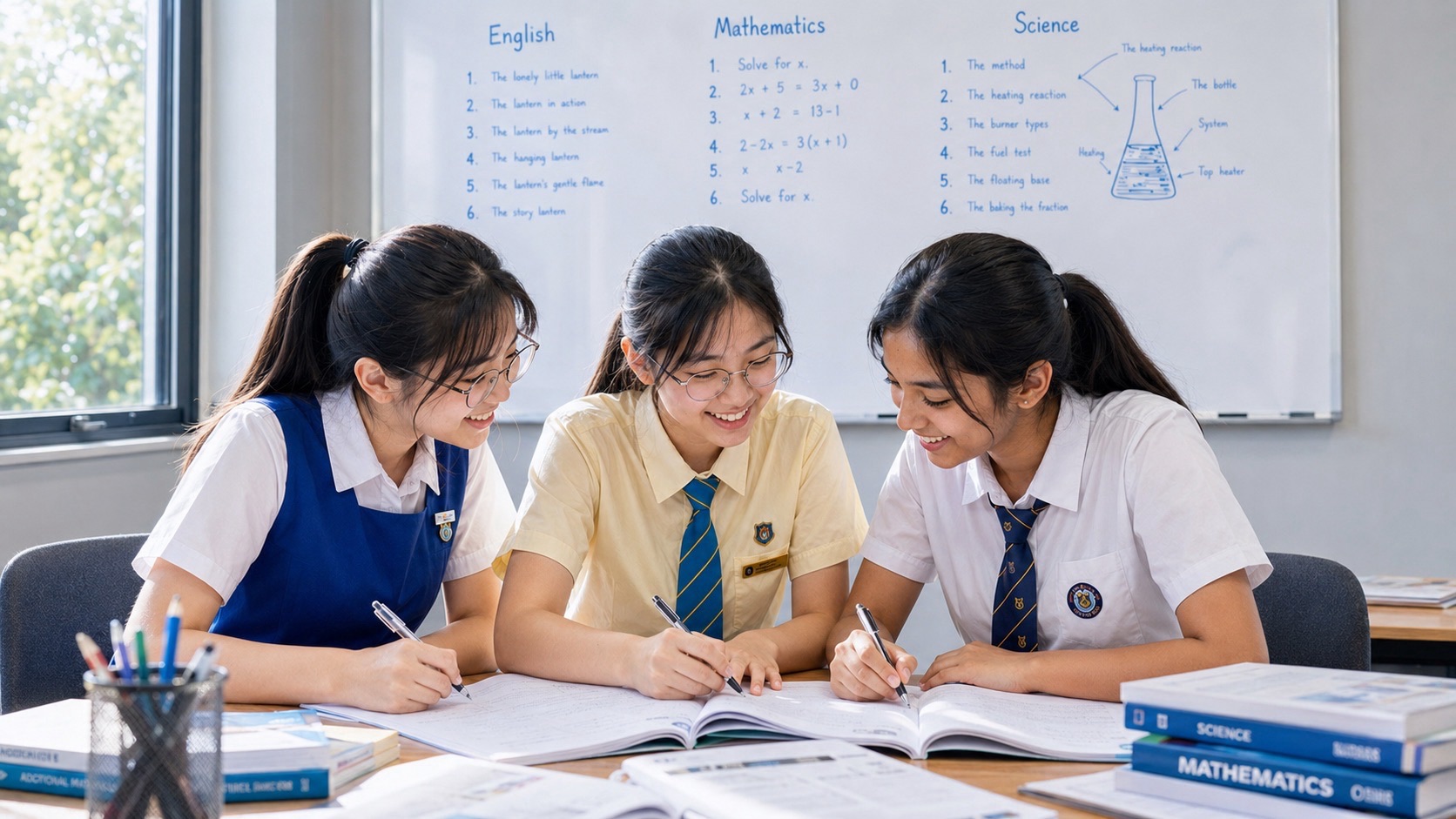
A Secondary 2 learner can tell you what an atom is, name three separation methods and recite a definition of a compound. Then the school paper shows an unfamiliar diagram and everything becomes less certain. The student has studied, but the knowledge has not yet learned how to travel. Secondary 2 is an excellent moment to fix that.
Secondary 2 Punggol Chemistry tuition can help students consolidate lower secondary Science revision, particularly particles, elements, compounds, mixtures, scientific representations and evidence-based answers, while preparing for the more demanding Science pathways in Secondary 3. Chemistry-focused tuition at this level should build conceptual readiness and school assessment skills; Secondary 2 is generally still an integrated Science stage, not an automatic separate Pure Chemistry examination course.
For families searching Secondary 2 Science tuition Punggol, Sec 2 Chemistry tuition Singapore, Science exam revision, Secondary 3 subject combination, Pure Chemistry vs Combined Science or 3-pax Science tutorials, the real decision has two parts. First, what is stopping the learner from understanding today’s Science questions? Second, what evidence will help the family discuss tomorrow’s subject choices without turning the decision into a status contest?
Why Secondary 2 deserves its own tuition strategy
Secondary 1 establishes the habit of observing and explaining. Secondary 2 asks learners to bring more ideas together and prepares them for subject-level choices. A child who can answer an isolated question about a mixture may still struggle when the question asks for both a separation method and a particle-level justification. A student who memorises definitions may hesitate when a table or diagram is reorganised.
This is the year when ‘I read the whole chapter’ becomes an unreliable measure of preparation. Recall, explanation and transfer matter more. Tuition is worth considering when a tutor can identify the gap precisely and build the student’s independence rather than just add practice volume.
- Consolidate concepts that might otherwise remain disconnected.
- Improve interpretation of tables, experimental descriptions and particle diagrams.
- Build the habit of answering exactly what the question asks.
- Practise retrieval from memory rather than recognising highlighted notes.
- Gather evidence about readiness and interest before choosing upper-secondary sciences.
The transition from matter to chemical identity
One useful diagnostic asks a student to distinguish element, compound and mixture without relying solely on textbook sentences. For instance, pure water is a compound of hydrogen and oxygen; air is a mixture of gases; oxygen is an element. But naming examples is only a starting point.
What makes an element different from a compound? What does a chemical formula represent? Why is a mixture not the same as a substance with a fixed chemical composition? Can the child explain how a compound’s properties can differ from those of its constituent elements?
These questions reveal whether the student has constructed a clear model. A memorised definition can mask a misunderstanding such as ‘anything with two kinds of particles is a compound’. The tutor’s job is to uncover that wrong mental shortcut and replace it with careful reasoning.
Schools may introduce or revisit particular chemical ideas in different terms. A well-aligned plan follows the student’s actual syllabus and coursework instead of assuming an identical sequence across every Secondary 2 class.
The invisible grammar of chemical formulae
At the appropriate school level, Science symbols are a new form of reading. Compare O₂ and H₂O: both involve small numbers placed below the line, but the number of different elements and the arrangement of atoms are not the same. The subscript is not an ornamental mark. It changes what the formula represents.
A tutor may ask the learner to interpret a particle diagram before introducing a written formula, then move back from the formula to a verbal explanation. Can the student identify one type of atom or more than one? Can the student distinguish a molecule from a mixture of separate particles? Can they describe the difference between the number of atoms in one molecule and the number of molecules shown?
The aim is not to race through an entire upper-secondary Chemistry syllabus. It is to make the representation trustworthy, so a formula no longer feels like a password that must be remembered by shape alone.
A worked thinking exercise: sand, salt and water
Imagine a sample containing sand, salt and water. A question asks how sand can be removed, then how solid salt may be obtained from the remaining liquid. The answer depends on properties, not on reciting a list of laboratory apparatus.
Step 1: Identify that sand is insoluble while salt is dissolved in water. Step 2: Select filtration to collect the sand as the residue, leaving salt solution as filtrate. Step 3: Recognise that a suitable evaporation or crystallisation procedure may recover the dissolved salt under supervision. Step 4: Explain why filtration does not remove dissolved salt.
Now change one detail. If the question asks the scientist to collect pure water instead of salt, the previous final step may not accomplish the purpose. A suitable distillation setup can collect condensed water, subject to the experiment’s required conditions. The learner must read the goal before selecting the method.
That last distinction is what examination transfer looks like: knowing when a familiar answer no longer fits. Laboratory heating and glassware should be left to supervised school settings; the reasoning exercise itself can be discussed safely using a diagram.
Three common errors that quietly cost marks
Error 1: treating an observation as an explanation
‘The mixture turned cloudy’ records something that could be seen. ‘A reaction produced an insoluble substance’ is an interpretation that needs appropriate context and evidence. The two may belong together, but they are not interchangeable.
Error 2: giving a definition instead of answering the scenario
If a question asks why filtration cannot remove dissolved sugar, defining filtration by rote is incomplete. The answer must connect filtration to the fact that dissolved particles pass through ordinary filter paper with the solvent.
Error 3: concluding more than the evidence supports
A sudden colour change might be relevant to a reaction; by itself, it does not prove every proposed chemical process. A strong answer stays within the observations or data supplied, rather than inventing extra results.
These are not merely ‘careless mistakes’. They are teachable reasoning habits that affect Science throughout secondary school.
How Science examination revision changes in Secondary 2
Students benefit from separating recognition, retrieval and transfer. Recognition is when the answer looks familiar in notes. Retrieval is when the student can produce it without looking. Transfer is when they can use the idea after the question changes the material, diagram or experimental goal.
An effective revision session moves through all three. Begin with a few short, closed-book prompts, attempt a new structured question, explain the answer verbally, then inspect the school’s marking expectations. The tutor should not correct every sentence immediately. Students need a genuine chance to discover where their reasoning succeeds and where it breaks.
To make progress visible, classify errors into categories: concept, vocabulary, diagram, question interpretation, experimental reasoning and missing evidence. Different errors call for different repairs. A second copy of the textbook is not a universal solution.
What about choosing Pure Chemistry or Combined Science in Secondary 3?
The decision should be informed by the school’s subject offering and eligibility criteria, the learner’s interest, evidence from classroom learning, workload across other subjects and future study interests. A single good or bad paper is not enough information. Neither is the assumption that one route always defines a student’s intelligence or potential.
In general, Pure Chemistry and Chemistry within Combined Science are different curricular and assessment routes at upper-secondary level. Families should inspect the applicable current MOE/SEAB syllabus for the child’s examination cohort rather than treat online advice from an older year as definitive. The Singapore-Cambridge SEC examination begins with the 2027 cohort, so the relevant code and papers depend on the year the student will sit the examination.
A sensible discussion asks: Does the learner enjoy explaining chemical phenomena? How secure are the Science foundations? Does the school’s course structure make the desired combination available? What other subjects and activities must fit alongside it? What does the learner, not only the parent, want to study?
No tuition centre can promise a subject combination. What focused tuition can do is supply better evidence about readiness and address remediable gaps before choices are finalised.
A diagnostic conversation before making that choice
The student could be given five short prompts. Ask them to interpret a particle diagram, distinguish mixture from compound, propose a separation method with reasons, read experimental results and explain an unfamiliar example using a familiar model. Allow independent thinking time before helping.
A tutor looks beyond raw marks. Did the student identify the relevant idea unaided? Could they explain the reason for a method? Did they use evidence accurately? Were mistakes caused by gaps in Science or by reading the wording too quickly?
The result becomes a map for the next few weeks. A student with sound understanding but weak test organisation requires different teaching from one who has learned definitions without understanding particles.
What a 3-pax tutorial can offer at the right moment
In a three-student small group, the tutor can see three different attempts at the same question. One child may confuse atom and molecule; another may understand the model but misread a key word; the third may rush an otherwise correct conclusion. During a 1.5-hour weekly tutorial, those differences can be made visible through quick checks, coached reasoning and fresh individual retests.
Small-group tuition is not a magic label. It becomes valuable when the teacher uses that visibility. The questions should be matched to the student’s school work and adjusted as the child grows. The aim is independent Science thinking, not a growing stack of completed worksheets.
For adjacent material, see Secondary 2 atoms, molecules and periodic table basics and the eduKate Punggol Chemistry tuition learning aim. The previous stage in this progression is building reliable matter-and-particle explanations; this stage tests whether students can transfer them.
A practical term plan for Secondary 2 families
An eight-week illustrative plan works best when the starting weaknesses are visible; it is not a substitute for the school’s actual scheme of work.
- Weeks 1–2: diagnose topic gaps, weak reasoning steps and comprehension of question language.
- Weeks 3–4: repair foundational matter and particle ideas; revisit relevant formulae and separation concepts at the student’s syllabus level.
- Weeks 5–6: use short structured responses, scientific diagrams, tables and investigative scenarios without giving chapter hints.
- Week 7: rehearse school-style examination pacing and how to check whether a conclusion answers the question.
- Week 8: retest fresh tasks, evaluate improvement and discuss upper-secondary options using more than a single grade.
Families should be able to ask, ‘What can our child now do unaided that was difficult last month?’ That is more precise than asking only how many pages have been covered.
A parent-friendly revision routine that does not swallow the week
Try two short sessions between school lessons. During the first, ask the student to explain three key ideas from memory and draw one particle model. In the second, use a novel question and ask the child to point to the evidence supporting the conclusion. Keep an error log, and ask for a new example when the correction is complete.
Do not answer too quickly. A brief silence while a child reasons is productive. ‘Why do you think that?’ is more useful than ‘You know this already’. If the learner is repeatedly stuck, take the evidence to the tutor; that is the information targeted teaching needs.
Rest also belongs in a sensible plan. A child comparing subject combinations needs clarity and confidence, not an atmosphere in which every school worksheet feels like a referendum on the future.
Frequently asked questions about Sec 2 Chemistry tuition
Does my child study Pure Chemistry already in Secondary 2?
Usually no. Chemistry-related ideas are taught within lower-secondary Science. ‘Secondary 2 Chemistry tuition’ is best understood as targeted Science help that strengthens foundations for upper-secondary Chemistry pathways.
Should we begin Chemistry tuition before choosing subjects?
Only if there is a worthwhile learning objective—such as repairing conceptual weakness, improving Science assessment answers or exploring readiness. Tuition should not be sold as a guaranteed route into Pure Chemistry.
Is studying ahead better than revising current Science chapters?
Not automatically. Moving ahead can be motivating for a learner whose foundations are secure. If basic particle models, scientific vocabulary or experiments remain confusing, repairing those first will usually make later learning more productive.
What is a good way to check revision progress?
Ask for a fresh, unfamiliar question that requires an explanation. If a student can select the correct concept, justify it and check the conclusion without notes, the learning is becoming more robust.
How does the SEC change Chemistry preparation?
The first SEC examinations are in 2027. Preparation should follow the student’s actual cohort, subject level and official syllabus. The SEAB G3 SEC subject list for 2027 is a useful official starting point, not a reason to impose a 2027 paper on a different cohort.
Secondary 2 is a preparation year, not a verdict
The best thing tuition can do in Secondary 2 is give the learner more control over what they understand. Strong ideas become easier to retrieve; incorrect shortcuts become visible; and subject choices can be discussed calmly with evidence. Chemistry then stops being an intimidating label on next year’s timetable and starts to look like a subject with ideas the student can genuinely learn.
That is why Secondary 2 Punggol Chemistry tuition can be worth having: not for a premature race to the final examination, but for the clearer thinking and readiness that make Secondary 3 a promising next chapter.
Explore the eduKate Punggol Secondary 1–4 Chemistry progression: Secondary 1 — Matter and lower-secondary Science · Secondary 3 — Bonding, equations and the mole · Secondary 4 — Exam revision and practical preparation.


