
Two Secondary 3 students walk past the same stretch of Punggol Waterway. One thinks of weekend family outings and a place to relax. The other thinks of a daily route to school that becomes crowded at particular times. A photograph of the waterway may show one shared landscape, yet the two students see different meanings. Neither must be wrong. Geography asks why a place can be important in more than one way—and what evidence would help us understand those experiences.
Why have Secondary 3 Punggol Geography tuition for Geography in Everyday Life, sense of place and fieldwork? Because upper-secondary Geography asks learners to use geographical concepts and methods to investigate the spaces they inhabit, the meanings people attach to places and the environmental choices that shape communities. Targeted Sec 3 Geography support can help students design answerable questions, interpret different representations, distinguish observations from opinions and justify a sustainable-development decision with evidence.
This guide gives parents a specific, school-aligned reason to consider support rather than another generic promise of better marks. The activities below are teaching scenarios, not actual research projects, resident surveys or official SEAB examination extracts. A student’s registered G-level and Geography or Humanities combination determines the exact syllabus and assessment requirements.
Geography in Everyday Life is a real upper-secondary curriculum cluster
The 2027 G3 Geography K329 syllabus includes a Geography in Everyday Life cluster covering Thinking Geographically, Sustainable Development and Geographical Methods. It identifies key ideas such as people’s relationship with nature in neighbourhoods and the ways people acquire a sense of place. It also includes an extended fieldwork experience for students following that full G3 Geography syllabus.
Do not assume the same fieldwork duration, paper structure or breadth applies to every learner. G3 Humanities (Social Studies, Geography) uses the separate K335 Geography elective syllabus, while G2 syllabuses also have their own specifications. Use the SEAB 2027 G3 syllabus index and G2 syllabus index to identify the student’s actual route before buying tuition books or planning practice.
This matters for parents because ‘Geography’ may sound like one universal school subject. In reality, upper-secondary combinations differ in scope. Good tuition begins with the right identity card: school, level, registered subject, current topics and assessment rules.
Reason 1: A place is not the same as a dot on a map
A map can tell us where a park or neighbourhood is located. It does not by itself tell us why that place matters to different people. Geographers distinguish physical space from place as space to which people attach experiences, memories, relationships and meaning.
For example, a waterfront might be a route for a commuter, a family meeting point, a habitat-adjacent landscape, an exercise setting and a commercial opportunity. A student studying ‘sense of place’ should recognise the variety without pretending to know what every resident feels.
A weak answer says, ‘Everyone loves Punggol Waterway because it is beautiful.’ The claim about everyone is not established. A stronger answer says, ‘People may attach different meanings to a waterfront according to their experiences: some associate it with recreation, others with familiar journeys or social activities. Evidence from appropriately gathered observations or responses would be needed to establish which views are widespread in a particular group.’
The second version has not become dull. It has become defensible. It separates a possible geographical relationship from an unsupported fact about a population.
Reason 2: ‘Sense of place’ is shaped by experience and representation
Students can explore how repeated routines, significant events and media representations influence what a place means to people. Someone who passes a location daily may build a different relationship with it than a first-time visitor who has only seen promotional photographs. Both experiences are informative, but they answer different questions.
Imagine a fictional neighbourhood brochure showing a public square when it is quiet and sunny. An interview with a user who visits during a peak period may describe crowding and difficulty finding seating. The representations need not be mutually exclusive. A good Geography student asks about time, perspective, purpose and the evidence behind each claim.
The tutor can turn that into a small comparison task: identify the message of each representation, describe what is directly shown, suggest why experiences might differ and explain what further information would help. These are useful Geography moves and also excellent habits for reading digital media responsibly.
Reason 3: Geographical concepts organise the world
Geography is not simply a collection of named countries and landforms. Concepts such as place, space, environment and scale help students decide what to investigate. A topic becomes manageable when the learner knows which lens to use.
- Place: what meanings and experiences attach to this location?
- Space: where are features located, and what pattern do they form?
- Environment: how do physical and built surroundings interact with people and other living things?
- Scale: does the issue concern one site, a neighbourhood, a city, a region or the world—and over which period?
- Connection: how do movements, relationships and processes link places and consequences?
The tutor should avoid treating the concepts as five words to memorise. Instead, the student practises selecting the lens that makes the question answerable. A question about where greenery is distributed may use space; a question about how different groups experience greenery may use place; a question about environmental effects might combine scale and environment.
In the 2027 G3 syllabus, geography is explicitly used as a lens through which students examine everyday experiences. The more precisely students can frame a question, the less likely they are to fill an answer with correct but irrelevant information.
Reason 4: A good research question is a small piece of intellectual design
Fieldwork can feel intimidating because the teacher does not hand out all the information in advance. Students need to identify an issue, decide what to observe or ask and justify a method. A vague question such as ‘Is Punggol a good place?’ is difficult to investigate responsibly because ‘good’ has not been defined.
Worked question design: from opinion to an answerable inquiry
Start with: ‘Do people like the neighbourhood?’ It is broad and sensitive to who gets asked, what ‘like’ means and which features matter. Narrow it to a safer illustrative classroom question: ‘How do two public representations of the same neighbourhood emphasise different features of the environment?’
That question can be investigated by selecting comparable, publicly available materials, defining a coding scheme for features mentioned and discussing what each representation does not show. It does not require collecting personal information from strangers or claiming a representative opinion survey.
A tutor can teach the child to distinguish the research question, the method and the conclusion. Each must support the other. A method chosen for convenience may generate attractive data that cannot answer the question. The skill is to recognise that problem before the work begins.
Reason 5: Qualitative and quantitative evidence need different handling
Quantitative information includes counts, distances, durations and measured values. Qualitative information includes observations, descriptions and accounts of experience. Neither is automatically superior. Their value depends on what the question is trying to find out and whether the method is sound.
Imagine a fictional observation records 12 people using a public space in one ten-minute interval and 25 in another. Those counts describe the two intervals, but they do not prove the space is always twice as popular at one time. The time of day, weather, event schedule and counting method could affect the result. A student’s conclusion must stay within the scope of the evidence.
Now imagine two invented descriptions: ‘I enjoy the shade’ and ‘I would like more seating.’ These illustrate different possible user priorities, but a pair of comments does not establish the preferences of a neighbourhood. A thoughtful Geography answer recognises that qualitative views can be detailed while remaining limited in representativeness.
A good tutor asks the learner to choose methods for the question, compare results with care and describe the most important limitation without dismissing the entire investigation.
Reason 6: Geographical methods are not simply a project template
The 2027 G3 full Geography syllabus identifies Geographical Methods as part of Geography in Everyday Life and specifies an extended fieldwork experience. It also tests geographical skills and investigation thinking in its examination structure. Students need to understand how data are collected, processed and interpreted, and how risks or method limitations may affect findings.
For a student undertaking fieldwork, the tutor should help with conceptual preparation, research design and interpreting feedback while ensuring that work submitted remains the student’s own. A paid tutor should not quietly fabricate data, write invented interview responses or complete an investigation in the pupil’s name.
Parents also need practical boundaries: any site visit must be appropriate to the child’s age, follow school instructions and protect personal safety. Avoid collecting identifiable information without proper permission. Public maps, photographs and class-provided datasets can often provide excellent practice without intrusive observation.
Reason 7: Sustainable development is a judgement, not a slogan
Geography in Everyday Life connects local experiences with the larger question of sustainability. A proposed change in a neighbourhood may improve convenience while introducing environmental pressure or affecting how different groups use a space. Responsible analysis begins with an aim, identifies relevant consequences and weighs evidence.
Take a fictional decision: adding a paved path through a landscaped area to improve access. A student could discuss the potential effect on walking convenience, vegetation, maintenance and users with different mobility needs. The judgement should identify which criteria are relevant and whether a design adjustment might reduce trade-offs.
A weak answer says, ‘Build the path because people need it’ or ‘Never build it because trees are important.’ A stronger response recognises competing needs and uses the specific context to propose a qualified decision. This is not indecision. It is geographical judgement.
A complete worked response: evidence without overreach
Fictional task: Two promotional images of a neighbourhood show different uses of a waterfront. Image A shows a quiet walking route; Image B shows a busy gathering space. Explain why these representations might lead viewers to develop different impressions of the place.
Weak response: ‘Image A is peaceful and Image B is noisy because the place has changed.’ The images may not show sound, and the time and location may differ. The student has turned an impression into an unproved claim.
Stronger response: ‘Image A highlights a calm recreational setting, while Image B emphasises social activity. These differences may shape what viewers expect from the waterfront, even though the images alone cannot show the full range of experiences or explain why the scenes differ.’
A further evaluative question could ask what other sources are needed. Candidates might suggest observations at comparable times, a broader sample of representations or appropriately designed inquiries. The answer should explain why that evidence would help instead of listing every imaginable data source.
What good Secondary 3 Geography tuition teaches first
- Distinguish place from location: use a familiar example without assuming everyone’s feelings.
- Select concepts: frame one geographical question through place, space, environment or scale.
- Plan a method: decide which evidence could answer the question and what limitations matter.
- Interpret representations: compare photographs, maps or accounts without overclaiming.
- Explain a relationship: connect a geographical feature or experience to a plausible consequence.
- Evaluate independently: weigh a fictional management response against clear criteria.
- Transfer: apply the same method to a different, unfamiliar community.
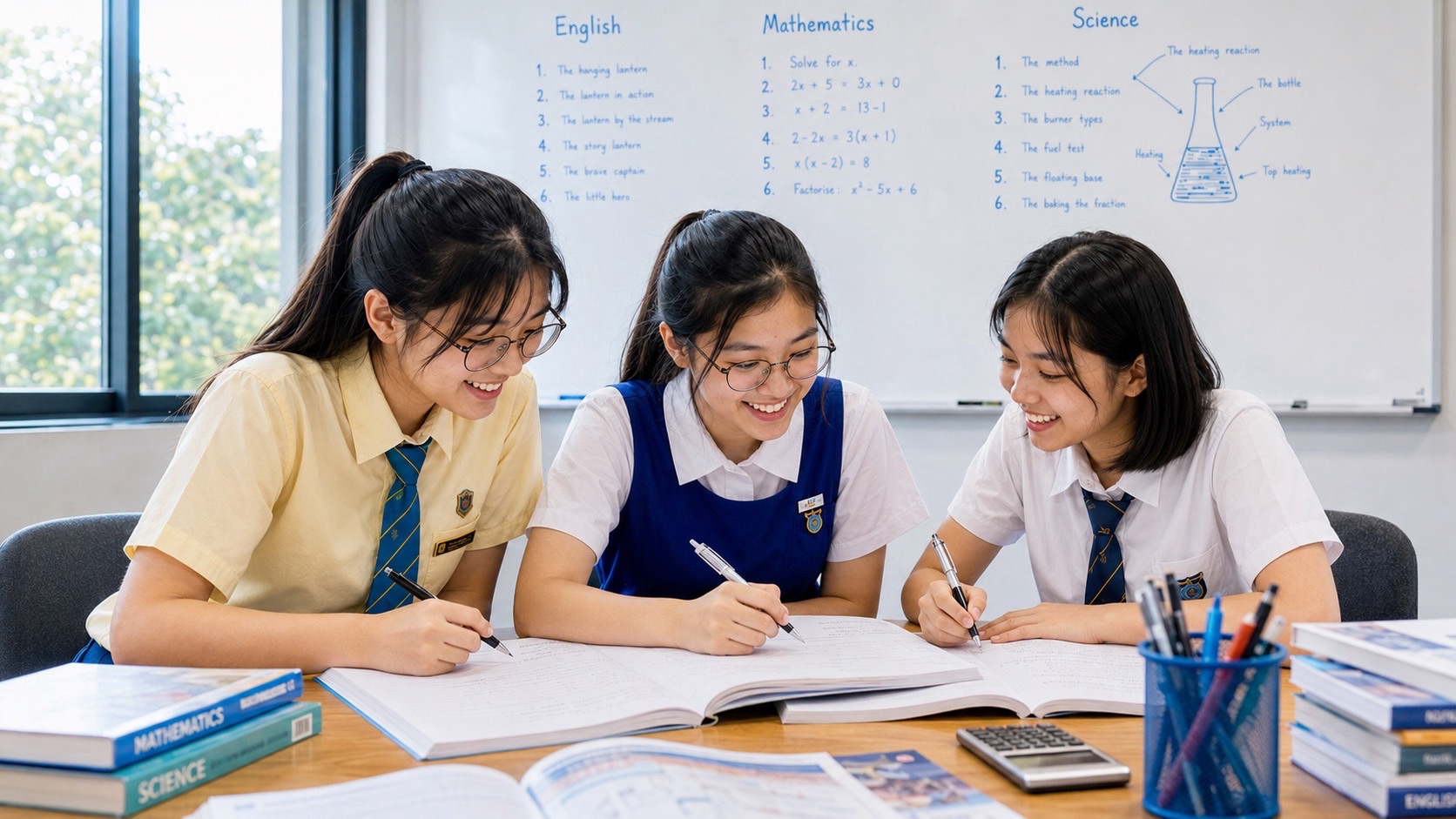
In a three-student tutorial model, conversation can help because students bring different interpretations of the same place. But useful discussion still requires tutor correction and individual work. Current Geography-specific lesson availability and arrangements must be confirmed directly; the value of a small group is the quality of each learner’s reasoning, not the number three alone.
An illustrative four-week learning sequence
- Week 1 — Place and identity: compare how a familiar neighbourhood can mean different things to different users.
- Week 2 — Concepts and questions: turn a vague opinion into a specific geographical question using an appropriate conceptual lens.
- Week 3 — Methods and evidence: evaluate a constructed dataset alongside different representations and describe limitations.
- Week 4 — Sustainable decision: practise a structured judgement and repeat the thinking on an unfamiliar setting.
This is a sample plan, not a promise that every school completes a full investigation in four weeks. Students on G3 separate Geography should follow the longer fieldwork requirements when applicable; students on elective or G2 routes should follow their own syllabus and school activities. A good tutor works with the learner’s actual course rather than replacing it with a generic package.
When tuition adds value—and when it may not
Targeted tuition may help when a Secondary 3 student confuses observation with opinion, writes vague geographical questions, treats one respondent as representative of everyone, misuses maps and photographs or cannot evaluate a proposal with evidence. Those are teachable gaps.
Another student may already conduct a thoughtful investigation, respond to teacher feedback and enjoy learning independently. Such a child may need only occasional extension, not another weekly lesson. The family should decide using real school work and workload, rather than assuming the subject’s difficulty alone requires tuition.
Frequently asked questions
Is sense of place only about liking or disliking a neighbourhood?
No. It concerns the meanings, memories, relationships and experiences through which people connect with places. Different users can attach different meanings without either being automatically incorrect.
Does every SEC Geography student have the same extended fieldwork requirement?
No. The 2027 G3 separate Geography K329 syllabus specifies a 10-week extended fieldwork component within its programme. Do not apply that duration automatically to G3 Humanities elective Geography or to G2 without checking the relevant syllabus.
Can a student use Punggol Waterway for a Geography investigation?
A familiar location can inspire an age-appropriate, supervised question. It is not automatically an approved school fieldwork site, and observations should not be presented as research findings until a suitable method is used.
How can a parent help with sense-of-place homework?
Ask what the question means, what evidence the child selected and whose perspective might be missing. Avoid substituting your own view of the neighbourhood for the child’s explanation.
What shows that Geography tuition is working?
The student can formulate a specific question, explain the choice of evidence, distinguish what is known from what is merely possible and defend a judgement in a new context without prompting.
Read across the four-year Punggol Geography series
In Secondary 1 Geography: Rainforests and Mangroves, learners explain physical environments. In Secondary 2 Geography: Transport Accessibility, they study relationships between places and people’s journeys. Secondary 3 adds the meanings of places and geographical inquiry. Finally, Secondary 4 Geography Evaluation Techniques draws these strands together in reasoned final-year responses.
For related learning, use our Secondary 3 data-response and case-study guide, the geographical investigation and report-writing article and the sustainable urban neighbourhoods article. Each provides a distinct perspective; the official syllabus is the final reference for what the child is assessed on.
The takeaway for Punggol parents
A familiar place can be the doorway into mature Geography. The student learns that a map is not an entire experience, an image is not a community’s full story and a good decision should respond to evidence and the people it affects.
The strongest reason to seek Secondary 3 Punggol Geography tuition is that it helps a learner move from an interesting observation to an answerable question and a responsible judgement. If the student is already doing that confidently, protect their independence. For guidance, visit eduKate Punggol and verify Geography-specific tutor availability, location, fees and lesson structure.


