
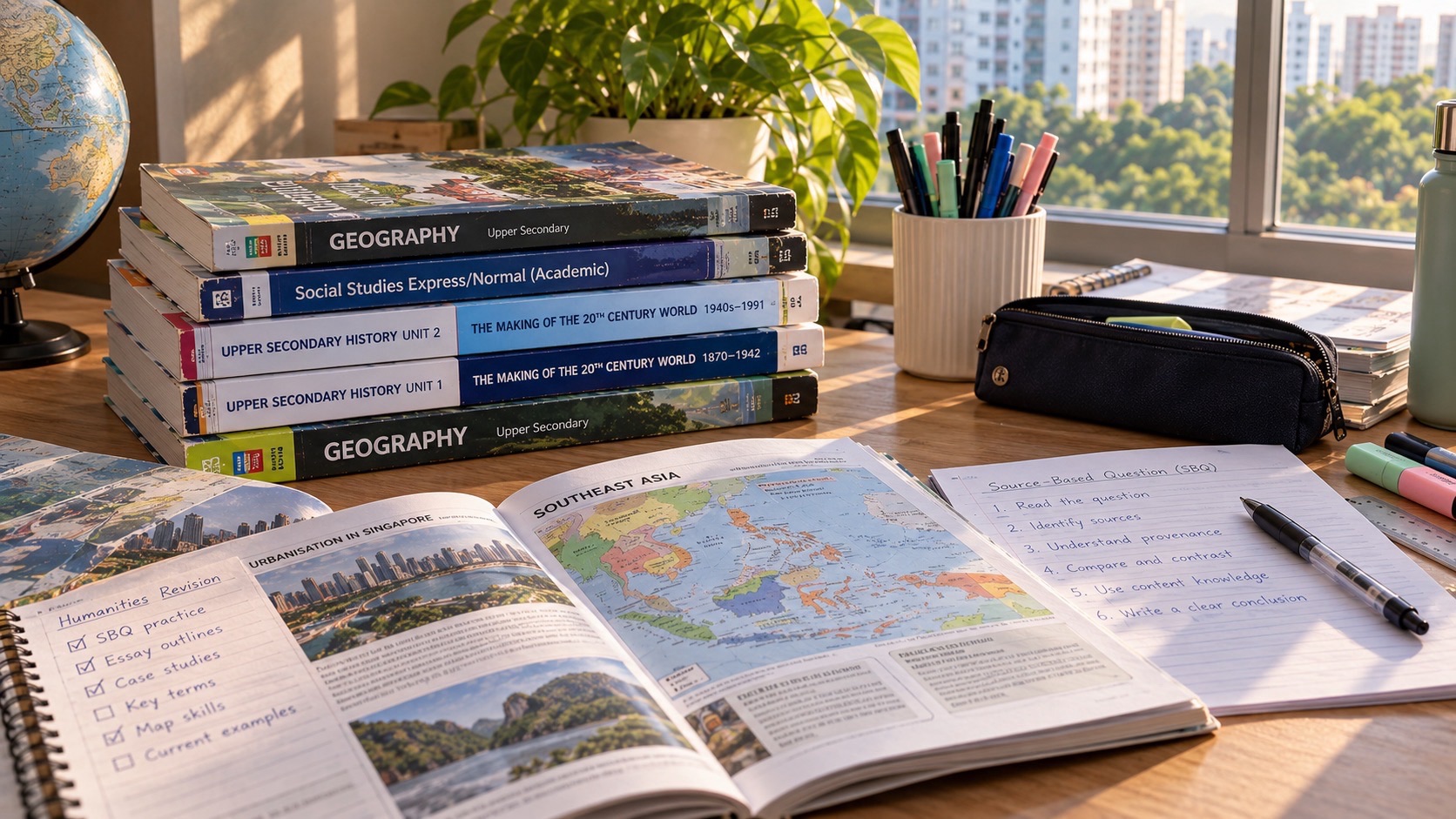
A Secondary 1 student can return home with a new Geography notebook, three highlighters, a neatly labelled file and a surprisingly unsettling question: “What exactly am I supposed to study?” For families searching for Secondary 1 Geography tuition in Punggol, lower secondary Geography revision notes or Geography study skills, that question matters more than the number of pages a student has copied. Beautiful notes are welcome. Notes that become useful thinking are the real goal.
Secondary 1 Punggol Geography tuition should teach a student how to learn Geography, not merely how to fill a Geography notebook. The child learns to turn maps, photographs, diagrams and class explanations into a small, retrievable set of ideas; distinguish observation from inference; practise the command words in school assessments; and verify understanding on a changed question. The tutor’s task is to repair a weak learning method before it becomes four years of reading notes without being able to use them.
Imagine a Punggol family on a Sunday afternoon. One child opens a Geography chapter about the environment, reads it three times and declares revision complete. Another closes the book, draws a simple relationship between a place, its physical features and how people use it, then explains the diagram without help. Both have spent time studying. Only the second has produced evidence of what they can remember and explain when the textbook is no longer open.
This article is the practical companion to our earlier guide on Secondary 1 Geography map reading, weather and geographical inquiry. That guide concentrates on subject foundations; this one takes a close look at revision notes, self-testing, errors, short school assessments and the habits that allow those foundations to stick. Specific chapters and assessment formats vary by school and G-level, so tutors should refer to the actual school scheme and current official curriculum rather than assume every Secondary 1 class uses the same sequence.
Find the part you need: why notes fail · diagnosis · three-note system · worked example · revision tests · inside tuition · weekly routine · parent questions.
The hidden problem: a Geography notebook can look complete while learning is unfinished
Geography is visually generous. Textbooks contain photographs, colourful maps, graphs, diagrams and examples from everyday life. That makes it pleasurable to highlight and reorganise. The difficulty appears when a student is given an unfamiliar source and no longer knows which part of the notes is relevant. Recognition feels like understanding while the book is open; independent retrieval reveals what the learner truly controls.
A common scene in the first term is a child spending forty minutes copying definitions but not completing a single explanation from memory. The copied notes are not wasted, but they do not tell us whether the student can identify the right concept in a changed question. A tutor should not praise or reject note-taking in the abstract. They should ask what job a note is supposed to perform.
For some students, the first obstacle is vocabulary. They confuse pattern with distribution, or weather with climate. For others, it is evidence selection: they can read the map key but overlook it when answering. A third group can talk about Geography beautifully yet leaves their written explanation without a cause. All may produce similarly messy test answers, but each needs a different repair.
The first tutoring decision is therefore a diagnostic one. We should know whether the student needs to understand more, remember more, select better or write more precisely. Calling everything “poor revision” hides the instructional choice.
Why Secondary 1 Geography feels new after Primary school
Children arrive with useful experiences from Primary Science, Social Studies and the places they live. Secondary Geography asks them to use these experiences in a more deliberate language of place, space, scale, environment and geographical inquiry. The challenge is not the absence of curiosity. It is learning how to support a geographical claim.
In Primary school, a child may answer a question about a park by naming what is present. In Geography, they may need to describe the distribution of features, identify how conditions vary between sites or explain a relationship involving physical and human processes. A list of things is not yet a relationship. A photograph can show a feature, but not necessarily its cause or impact.
In Punggol, paths, MRT and LRT connections, greenery, housing and waterfront spaces offer familiar starting points. They are teaching contexts, not substitutes for the data and cases specified in a school’s curriculum. The student must learn to make sense of an unfamiliar town or region as confidently as a familiar neighbourhood.
A good Secondary 1 study system therefore prioritises transfer: can the child use an idea learned in one example when the next question changes the map, time frame, type of evidence or place?
What happens in the first Geography revision diagnostic
A tutor can inspect three small pieces of work: an original school answer, a set of the student’s own notes and a fresh question using a comparable idea. The original answer shows performance under school conditions; the notes reveal how the student organises knowledge; the fresh task reveals whether learning survives without the book.
The tutor might choose a simple map with a school, pathway and waterway; a rainfall graph with labelled axes; and one explanation prompt. They ask the learner to narrate the first thought after reading each task. Does the student check the legend? Do they read units? Do they confuse the question’s command? Do they copy an impressive phrase because it looks relevant?
The most useful feedback describes the first wrong decision. “You read the height of the bar correctly but forgot it was a weekly total” is actionable. “Weak in Geography” is not. “You explained a possible cause when the task asked only for a pattern” is actionable. “Need more details” is often too vague.
After the error is identified, the tutor builds one repair question and one transfer question. The repair makes the rule clear; the transfer tests whether the child can recognise that rule without a tutor announcing it. This is how study habits become measurable.
The three-note system: concept cards, source routines and an error log
A thick revision book tries to perform too many jobs. One page explains a geographical process; the next stores a definition; another records a mistake from last month’s quiz. The child rereads everything because they cannot tell what is needed. A simpler system gives each form of note a different function.
1. A concept card answers ‘How does this work?’
A concept card contains the central idea in the student’s own words, a small labelled diagram where useful and one accurate example. A good card on rainfall and runoff might link precipitation, infiltration, surface conditions and possible accumulation of water under specified conditions. It does not need an enormous paragraph about every possible flood.
The best concept cards also include a boundary: what the idea does not establish. A graph of rainfall for one week cannot by itself establish a long-term climate trend. A map of distances cannot by itself establish the safest walking route. A card that teaches both the principle and its limit prevents overconfidence.
2. A source routine answers ‘What must I check before responding?’
A source routine is a short checklist for maps, graphs, photographs and tables. On a map, check title, key, north arrow, scale and date if supplied. On a graph, check axes, unit, interval and whether figures are totals, averages or percentages. On a photograph, separate what is visible from what is inferred. The routine should be rehearsed until the learner needs little conscious prompting.
It is tempting to print a checklist with twenty rules. That can overwhelm an early secondary student. Start with the two omissions actually visible in their work, perhaps “check units” and “use one piece of evidence”. Add another step only after the first becomes stable.
3. An error log answers ‘What went wrong the last time?’
An error log is a short record of a recurring mistake, not a place to copy entire corrections. A strong entry might say: “On the climate graph, I treated mm of rainfall as degrees of temperature. Next time I must name the variable and unit before describing the trend.” The student then proves the repair using another graph.
When the same error no longer appears in independent work, the tutor can retire the reminder. Keeping a page full of resolved mistakes can make a child feel permanently weak. The purpose of the log is to shorten the list over time, not to create a museum of every wrong answer.
What good Secondary 1 Geography notes look like
Strong notes make a student retrieve, relate and check. A note headed “Distribution” should not merely define the word. It might show two imaginary settlements—one with homes clustered around a transport node, another with homes dispersed—and ask the learner to describe the difference. A note headed “Scale” might connect a map distance to a measured real-world distance and include units.
A tutor can test a note by hiding half of it. If the child can reconstruct the diagram and explain why the arrows connect, the note is useful. If the child can only recognise the diagram when visible, the note needs to become an active prompt. Small changes in design can greatly improve revision value.
An approachable approach uses a two-column page. On the left are questions: “What does this symbol mean?”, “Which period is shown?”, “What evidence supports this conclusion?” On the right are the student’s concise answers. Folding the page turns notes into a retrieval tool in seconds.
Students should still keep school worksheets and teacher notes. The goal is not to replace approved material with a fashionable notebook style. It is to give existing material an active role: locate a specific gap, retrieve the idea, apply it and verify.
Worked example: how a useful Geography revision note is created
Suppose a teacher provides a fictional map scale of 1 cm to 200 m, and the straight-line distance between two points measures 4.5 cm. The student’s first calculation is 4.5 × 200 m = 900 m, or 0.9 km. A weak revision note copies that solution. A stronger note records the relationship—map measurement × real-world distance represented by each centimetre—and makes units visible.
The tutor asks an unfamiliar follow-up: What if the points are connected by a winding footpath? The map measurement gives a straight-line distance, not necessarily the route distance. What if the map has been enlarged after the scale was printed? The numeric scale on the original version may no longer give accurate measurements on the resized copy.
The concept card then contains just three useful ideas: use the specified scale, convert the units and state what kind of distance was measured. A student who can explain those ideas is ready for new numbers. That is a revision note with the power to travel beyond the original exercise.
The child next practises with 2.8 cm at 1 cm to 500 m. The distance is 1,400 m, or 1.4 km. After a small delay, another example uses a map with a north arrow and two possible routes. If the student can decide independently which measurements the task supports, the revision has achieved more than arithmetic repetition.
Worked example: a weather-versus-climate note that prevents common confusion
Many children know the sentence “weather is short-term and climate is long-term”. Yet when presented with a photograph of a rainy day, they may still write that the place has a wet climate. The tutor must help the concept operate during a question, not merely recite its definition.
A better note has two columns. Weather: the condition of the atmosphere at a particular time and place, such as rainfall during an afternoon. Climate: patterns measured over much longer periods, often over many years. Below the columns, the student writes: “One rainy afternoon does not establish a long-term climate pattern.”
For a transfer task, the tutor invents a bar chart showing seven days of rainfall. The learner identifies the wettest day and the quantity measured, then explains why this seven-day record alone is insufficient to characterise the location’s long-term climate. This one exercise combines source reading, careful inference and conceptual understanding.
Punggol’s occasional rainy afternoons can supply familiar conversation, but a tutor should never pretend an anecdote establishes a climate trend. That distinction is a small but important lesson in evidence literacy.
How to revise Geography command words without memorising stock essays
Secondary 1 students need to interpret the difference among identify, describe, compare, explain and suggest. A tutor teaches these through paired questions using the same source. The learner sees how the answer changes because the task changes, even when the map or graph remains identical.
With a table showing pedestrian counts at three fictional observation points, “identify the highest count” asks for one value and location. “Describe the pattern” asks how counts differ across points. “Suggest one reason” invites a plausible explanation, clearly identified as an inference rather than a measured fact.
A student may write a long response to every command because length feels safe. Tuition should make the child comfortable with concise precision. The right answer to a short observation question need not resemble an essay, and a causal explanation should contain a mechanism even when the student uses only two sentences.
Create a command-word card that names the action and shows a single good question-answer pair. Then replace the source and check transfer. Memorising lists of definitions is less useful than repeatedly deciding what each instruction requires.
Drawing diagrams that explain a process
A diagram is not useful merely because it is colourful. It should show relationships accurately. For example, a simplified urban-water diagram may show rainfall, a paved surface, the direction of runoff and a drainage outlet. The arrows should communicate the process; the labels should not contradict the physical relationships being represented.
Ask the child to explain the diagram without looking at the textbook. Can they describe why surface properties affect runoff in relevant conditions? Can they recognise which part of the diagram is not supported by the question? If an arrow is wrong, the tutor repairs the underlying idea before praising the presentation.
For visual learners, diagrams can reduce the memory burden of long sentences. For other students, a written three-step explanation may work better. A capable tutor chooses the representation that exposes the concept; students do not need identical notebook aesthetics to achieve identical understanding.
Self-testing: how to know a chapter has actually stayed in memory
A reliable revision cycle has four moves: close the book, retrieve, apply and inspect. The child closes the notes and writes or says the main idea from memory. Next they attempt a new question that requires the idea. Then they check their work against trustworthy feedback and record the first wrong move if necessary.
A student who can recite a definition but cannot use it has not finished. A student who can answer only the same example they saw in class may have memorised the surface details. A changed source, scale or question wording is a simple way to test genuine understanding without making the child sit an entire practice paper.
The tutor uses short quizzes rather than waiting for a large school test to reveal a weakness. A three-question check might ask the student to identify a pattern, explain one relationship and state one limitation of the source. The three responses reveal different aspects of learning.
Spacing matters too. A concept that was clear immediately after explanation may be forgotten after several days. Revisiting it briefly at sensible intervals teaches retrieval and stops the cycle of relearning entire chapters at every test.
Preparing for the first lower-secondary Geography tests
Early Geography school assessments may involve unfamiliar source materials, short structured answers, selected content and school-specific formats. The actual task depends on the school and subject level. A tutor should obtain the school’s scope and examples rather than import an older paper and declare it the universal test.
A practical preparation sequence begins by checking what the teacher has actually covered, collecting a few marked tasks and listing the concepts the student can independently explain. Weak concepts are repaired. Only then does the student practise short mixed questions, because tests rarely announce which notebook page must be used.
A few days before a school test, the child can review their concept cards, practise interpreting fresh maps and graphs, and retry two previous errors without looking at the correction. The aim is dependable decisions and adequate rest, not last-minute copying until midnight.
After the test, the tutor should analyse the returned script. A missed mark might come from a misunderstood term, incomplete description, unsupported inference or rushed unit conversion. The score is useful, but the pattern of errors tells the student what to do next.
What happens inside an illustrative 90-minute small-group Geography lesson
A sample session begins with a five-minute retrieval quiz on an older topic. Learners compare how they checked a graph’s axes or a map’s legend. The tutor then examines one real error from the student’s homework, identifies the first wrong decision and models a corrected approach.
The central task turns an ordinary school note into an active study resource. Perhaps a student has written five sentences about settlement patterns. The tutor asks them to reduce this to one diagram, two questions and a three-sentence explanation. Another learner may instead need a source-reading routine because their notes are adequate but interpretation is weak.
Students next attempt a changed task independently. In a small group, comparing answers can reveal that one student noticed the evidence but missed the command, while another understood the concept but chose the wrong unit. The tutor gives each learner specific feedback rather than a single class-wide correction.
The session closes with an exit ticket: state the idea, show it on a new source and identify one check that prevents the old mistake. A manageable home task reinforces this work. This is an illustrative teaching sequence, not a claim that every Punggol provider has the same timetable or guaranteed group size.
What parents should look for in a small-group Geography class
The advantage of a small group is not only having fewer people in the room. It is the opportunity for each learner to be observed while deciding what to do, not only after the answer is marked. A tutor can notice who reads the map key and who guesses; who explains a cause and who restates the feature; who can retry independently and who still needs prompting.
Good peer discussion has a clear purpose. Students compare the evidence supporting different answers and learn to explain disagreement. It should not become a competition in speaking loudly or a performance of memorised facts. The tutor should protect quieter students’ chances to reason aloud.
If your child needs intensive individual pacing, a one-to-one arrangement may be more suitable. If the child benefits from carefully guided discussion, a small group can be useful. The deciding question is whether the teacher can identify and repair this student’s actual learning bottleneck.
A workable weekly Geography revision rhythm
Families with CCAs, homework, travel and siblings need a small routine that survives ordinary life. After a lesson, a child can spend ten minutes reconstructing one concept card. A few days later, they attempt an unfamiliar map or graph. Before the next lesson, they retry one error from the log and explain the correction in their own words.
This sequence is deliberately lighter than copying an entire chapter after dinner. Its value comes from retrieval and changed-task application. If a child is struggling with other subjects or sleep, the tutor should reduce the quantity while protecting the most informative task.
A parent can ask, “Show me one thing you understood this week and one question you can now solve without notes.” This is more informative than asking how many pages were completed. A child who can explain the connection between the question and evidence is beginning to own the learning method.
An occasional family conversation about Punggol’s waterways, shade, routes and buildings can make Geography welcoming. Keep observations accurate and modest. Nobody needs to turn every walk into a full geographical investigation.
Measuring improvement without waiting for a dramatic grade jump
A simple progress record uses two comparable but not identical tasks several weeks apart. One might require map interpretation, another graph reading and another a short explanation. Record accuracy, evidence use, units, clarity and how much help the child needed. The changed-task condition helps prevent the false impression created by repeated familiar worksheets.
Progress may appear as a child starting the question correctly, checking a legend, keeping units consistent or realising that one photograph cannot establish a long-term pattern. These behaviours precede many score improvements because they repair the small decisions that assessments repeatedly demand.
The student should also show growing independence in organising notes. At first, the tutor may model a concept card. Later the child decides which relationships belong on it and which detail is unnecessary. A learner who can build their own useful retrieval prompts is becoming less dependent on tuition.
Repair, stabilisation and extension in Secondary 1 Geography
Repair is appropriate when foundational source skills or key concepts are missing. The tutor isolates the first wrong move, teaches the principle and tests a new example. A learner who cannot read graph units should not be buried under long evaluation essays.
Stabilisation fits students who understand during class but perform inconsistently in homework or tests. The tutor focuses on delayed recall, mixed questions, error checks and use of a repeatable routine. The goal is to make sound decisions reliable, not occasionally impressive.
Extension suits a learner who already works accurately. The tutor can introduce richer sources, comparisons of viewpoints, data limitations and small inquiry design tasks. Extending Geography means increasing depth of reasoning and transfer, not rushing through an upper-secondary syllabus simply to appear advanced.
The pathway can change. A student may need repair on graph reading and extension on interpreting environmental choices. Good teaching remains flexible because learners are not uniformly strong or weak across every Geography skill.
MOE syllabuses, subject levels and avoiding the wrong revision notes
Singapore’s lower-secondary Geography learning is framed by MOE and implemented through school programmes. For reference, the MOE Lower Secondary Geography syllabus describes the subject’s geographical concepts and inquiry emphasis. Under Full Subject-Based Banding, a student’s G2/G3 arrangements and individual school approach should be checked directly.
Do not assume a set of internet notes is correct merely because it has the words “Secondary 1 Geography” in the file name. Check its source, age, terminology, geographical examples and fit with the student’s school assessment. An older guide may be helpful for a transferable skill but incomplete for a particular school’s current unit.
When details are uncertain, ask the child to show the official school outline or teacher’s current material. Good tuition uses the accurate target, not the biggest pile of free worksheets.
Five practical fixes when your child’s study method is not working
- When the notes look excellent but test answers are weak: close the notes and set a fresh task requiring the idea.
- When the child copies model answers: ask them to explain the mechanism and then change the context or numbers.
- When graph questions repeatedly fail: make variable and unit identification the compulsory first step.
- When the child writes too much: practise identifying the command and selecting only relevant evidence.
- When revision turns into arguments: reduce the homework load, choose one small independent task and use precise feedback.
Parents do not need to become examiners. The most powerful question is often “How do you know?” If the child can point to a map symbol, a labelled axis or a relevant concept, praise the evidence. If the child is unsure, that uncertainty becomes a useful question for the next tutorial.
Useful eduKate Geography learning routes
For the subject foundation, follow What Happens in Secondary 1 Punggol Geography Tuition: Map Reading, Weather and Inquiry. For a specialised map-reading repair, see The Core Aim of Punggol Geography Tuition: Secondary Map Reading Skills.
When the issue lies in source selection, Geographical Data Interpretation and Evidence provides the deeper route. Our underlying model of diagnosis, first-principles repair, guided correction and independent transfer is informed by the immutable eduKateSG Clementi small-group tutorial benchmark; Geography uses the same care for learning processes without copying the Mathematics content or making unsupported local class promises.
Next in the four-year Punggol Geography learning progression: Secondary 2 Geography Fieldwork and Report Writing examines how to turn a good question into an ethical investigation, select fair samples, present data and explain limitations. This is a next-stage guide, not an instruction to rush ahead before the present foundation is stable.
Secondary 1 Punggol Geography tuition: parents’ questions
How many pages of Geography notes should my child prepare?
There is no meaningful ideal number. A smaller set of notes that the student can use to recall and apply concepts independently is better than a beautiful volume that works only while open. Check whether the child can answer a changed question without seeing the note.
Is it better to memorise Geography definitions or practise questions?
Both have a role, but they must be connected. Accurate vocabulary makes an answer precise; varied questions reveal whether the child understands and can apply it. A sensible tutorial pairs a short retrieval task with a source-based application and an independent correction.
Should I buy an extra Secondary 1 Geography assessment book?
Only after identifying a specific gap and checking syllabus fit. School tasks and a few carefully chosen unfamiliar questions may already provide enough evidence for diagnosis and practice. More books do not automatically make revision clearer.
What if my child remembers facts but cannot explain them?
Ask for a simple cause–process–outcome chain with labelled arrows, then have the learner turn it into two or three sentences. A tutor can identify whether the missing element is conceptual understanding, geography vocabulary or written organisation.
What if my child reads a graph wrongly every time?
Treat axis labels, units, intervals and the difference between totals and rates as a teachable procedure. Start with an accessible example, then apply the routine to a different graph without hints. The second performance shows whether the fix transferred.
Do Secondary 1 students need O-Level practice already?
They primarily need reliable foundations, school-aligned learning and a sound method for reading unfamiliar sources. Some higher-level questions can enrich a ready learner, but early high-stakes drilling should not replace age-appropriate geographical understanding.
How quickly should I expect visible progress?
Progress depends on the starting point. Early signs include accurate use of units, better selection of evidence, clearer explanations and less dependence on notes. Compare independent attempts on comparable tasks before drawing conclusions from one score.
How can I help if I never studied Geography at this level?
You can ask the student to explain what a source shows and how they know. You can help them maintain a modest routine and collect marked work for feedback. The tutor should handle subject-specific correction and help the learner become independent.
The bridge into Secondary 2 starts with a method, not a pile of paper
A Secondary 1 child who can organise a concept, retrieve it after a few days, interpret a source and build a concise evidence-based answer is well placed for Secondary 2. The next year’s problems may involve more connected environmental systems, urban decisions and geographical investigations, but the underlying study method remains useful.
The nicest outcome is also ordinary: a student opens their own notebook, asks a good question, tries a fresh source and notices an error before anyone else points it out. That is the moment revision notes become learning tools rather than homework decorations.


