
A wet pavement near Punggol Waterway can become a surprisingly good Science question. A student sees the reflection of a lamp, hears bicycle tyres on the path and feels warm air escaping from a sheltered walkway. Three ordinary observations; three quite different physical explanations. The interesting part is learning how to tell them apart.
Secondary 1 Punggol Physics tuition, properly understood, builds the Physics strand of lower-secondary integrated Science. It teaches students to explain light, forces, energy transfer, measurement and physical change using observations, diagrams and evidence. It is not a separate Pure Physics examination subject at Secondary 1. The purpose of this guide is to show parents and students what a useful lesson would do, which misconceptions it should find and how the learning should progress into Secondary 2.
A good first lesson does not ask a child to memorise twenty equations. It asks a better question: What, precisely, do you think is happening? The answer gives the tutor or teacher somewhere meaningful to begin.
Service note: This is an educational guide, not confirmation of a currently available Secondary 1 Physics class at eduKatePunggol. The Tuition at eduKatePunggol service map is the current route for subjects, availability and consultations.
The short answer: what actually happens?
Useful support usually has a recognisable sequence. A tutor starts with a real question or a school-paper error, watches the student make a prediction, helps build a defensible model, moves between words and a diagram, then asks the student to explain an unfamiliar version without prompts. The final test is whether the idea survives after the adult stops talking.
For Secondary 1 Physics foundations, those jobs are especially concrete:
- Notice: describe what can genuinely be observed, without inventing a cause.
- Model: choose a force, ray, particle or energy-transfer representation that fits the situation.
- Measure: name the quantity, unit, instrument and possible sources of uncertainty.
- Predict: state what should change if one condition changes.
- Check: compare the prediction with evidence and revise the explanation.
- Transfer: use the same idea in a new scene, not merely a familiar worksheet picture.
This is the bridge between Primary Science descriptions and the quantitative, disciplinary Physics students may encounter from Secondary 3. A student who owns the bridge can learn harder chapters with less guessing.
What is really taught in Sec 1: Science first, Physics within it
Singapore’s lower-secondary G2/G3 Science framework uses themes such as Scientific Endeavour, Diversity, Models, Interactions and Systems. Physics-related learning includes the ray model of light, applications of forces and transfer of energy, heat transfer, electrical systems and the physical properties of matter. Schools can order these topics differently, and G1, G2 and G3 learning expectations are not interchangeable.
That means a family should not assume a topic is ‘missing’ simply because a neighbour’s school taught it earlier. A responsible tutor checks the student’s subject level, textbook, topic sequence and assessment evidence before deciding what to repair or introduce.
The central change is intellectual, not cosmetic. A Primary pupil might say, ‘The mirror bounces light back.’ A Secondary 1 student should become able to draw a ray, identify the surface and the normal, and explain how a reflection prediction can be tested. The everyday sentence was a beginning. The scientific representation is the next step.
For a syllabus-facing route, read the MOE lower-secondary Science framework, then return to the student’s school materials for the actual year plan.
The first fifteen minutes: a diagnostic, not a verdict
Imagine a learner arriving with a recent test marked 58%. It is tempting to declare the child weak in Science. But one score cannot tell us whether the problem is conceptual understanding, language, a poor diagram, a missing unit, weak retrieval or a question read too quickly.
A useful diagnostic might offer three short prompts. First, two people push a trolley in opposite directions: what does the trolley’s resultant force mean? Second, draw how light from a torch reaches a mirror and then an observer. Third, if one metal spoon feels warmer than a wooden spoon in the same room, does that prove their temperatures differ?
The student’s first explanation matters more than the first mark. A child who correctly calculates two forces but draws them in the wrong direction has a representation problem. A child who says ‘the metal has more cold’ needs a mechanism. A child who understands the diagram but cannot write the explanation needs help connecting language to evidence.
The tutor should identify the earliest broken link, not recite the chapter from page one because the answer was wrong.
Physics idea one: measurements are arguments with units
In Physics, a number without a quantity can be almost meaningless. A distance of 20 is not enough: 20 metres, centimetres or kilometres describe different worlds. An observation of ‘faster’ also needs care. Faster than what, and measured how?
A Secondary 1 learner should practise choosing suitable instruments, reading scales, recording units and distinguishing precision from accuracy. On a ruler, the zero position matters. On a measuring cylinder, viewing position matters. With a stopwatch, reaction time can matter. These are not fussy examination extras. They explain why different people can measure the same event and disagree.
Try a simple reasoning task. Two students record the time taken for a toy car to travel along a measured track: 4.2 seconds and 4.8 seconds. Before averaging, ask whether they used the same start signal, whether the car began from the same point and whether the distance was measured consistently. Repetition is helpful, but repetition does not automatically fix a systematic mistake.
The deeper habit is to ask what the measurement can justify. If a graph is drawn from only two readings, the line may suggest a relationship but cannot establish that it holds over every possible value.
Worked example: why the mirror angle is not measured from the surface
Suppose a ray of light strikes a plane mirror. The angle between the incoming ray and the normal is 35°. The normal is an imaginary line drawn perpendicular to the mirror at the point of incidence.
Question: What is the angle of reflection?
Answer: 35°, measured between the reflected ray and the normal. Under the law of reflection, angle of incidence equals angle of reflection.
Now change the wording: ‘What angle does the reflected ray make with the mirror surface?’ The answer becomes 55°, because the mirror surface is 90° from the normal. The physical situation has not changed; the reference line has.
This is a perfect Sec 1 diagnostic. A learner may know the rule yet place 35° beside the wrong line. We would not cure that by assigning thirty more identical calculations. We would ask the student to label the normal, then explain why two different-looking numerical answers can both be correct to different questions.
A useful transfer challenge is to rotate the mirror while keeping the incident ray fixed. Ask for a new diagram before doing arithmetic. The drawing is the reasoning.
Physics idea two: a force is an interaction, not a synonym for movement
Students meet forces before they meet formal dynamics. That is a gift, provided we use it well. A moving bicycle can continue moving when the rider stops pedalling for a while; ‘moving’ and ‘having a forward resultant force’ are not the same statement. Friction and air resistance influence what happens next.
At Secondary 1, the first important moves are identifying which object is being considered, who or what exerts a force on it, the direction of each force and the combined effect. A force arrow must have a meaning, not merely point towards the answer.
Worked example: A trolley is pushed with 12 N to the east while friction acts with 7 N to the west. The resultant horizontal force is 12 − 7 = 5 N east. We have found the combined force, not the trolley’s speed. The speed would require information about how the trolley moves over time.
Make one change: friction rises to 12 N while the push remains 12 N. The resultant horizontal force becomes zero. That does not necessarily mean the trolley is stationary. It means the horizontal forces balance; a moving trolley could continue with constant velocity under the appropriate conditions.
This distinction—force versus motion—will matter enormously in upper-secondary Physics. It is worth establishing before formula memorisation becomes tempting.
Physics idea three: energy moves and changes form
Consider the experience of walking from a shaded corridor into sunlight. Students may say that ‘heat came from the Sun’, which points in a useful direction but leaves the mechanism vague. We ask what energy was transferred, what absorbed it and which observations indicate a temperature change.
A sound explanation might identify radiation from the Sun reaching a surface, energy being absorbed and the surface warming. It should not claim that every material warms at the same rate or that a warm surface proves one exclusive mechanism without evidence.
A battery-powered fan provides another approachable example. Energy stored chemically in the battery is transferred electrically in a working circuit; some of that energy becomes kinetic energy of the moving fan and surrounding air, with additional energy transferred to the environment. Energy does not simply ‘disappear’ because the fan becomes warm or makes a sound.
The goal is not a decorative energy flow chart. The goal is to keep track of what is changing and where the energy goes. A useful tutor asks the learner to redraw the chart when the fan is unplugged or the battery is depleted.
Physics idea four: heat and temperature are different questions
One common misconception hides behind a familiar experience: touching a metal handrail and a wooden surface that have been in the same room. The metal may feel colder. That sensation alone does not show that its temperature is lower.
A careful explanation considers how rapidly thermal energy is transferred between the skin and the materials. A material that conducts thermal energy away from the hand more readily can feel colder even when both materials have been in the same surroundings long enough to be at approximately the same temperature.
Notice the correction. We have not told the child that feelings are silly or irrelevant. We have distinguished a real sensation from an unsupported temperature inference. Science becomes more interesting when everyday experience is treated as evidence to examine, not a mistake to dismiss.
For a simple follow-up, ask students to identify how they would measure temperature fairly and why hand-touch alone is not a reliable thermometer.
Physics idea five: models are useful because they leave things out
A ray diagram does not show every feature of light. A simple circuit diagram does not look like the physical tangle of wires on a table. A force arrow is not an invisible stick attached to an object. A model keeps the features needed to reason about a question.
This is both the strength and limitation of scientific models. A ray model is powerful for predicting reflection in familiar situations. It cannot by itself explain every phenomenon involving light. A particle model can support explanations about heating, but a simple sketch of identical spheres is not a photograph of matter.
A mature learner can say, ‘This model is useful for predicting X, but it does not represent Y.’ That sentence is more valuable than confidence built from pretending the model contains the whole universe.
What a ninety-minute tutorial could look like
The following is an illustrative lesson design, not a published timetable or promise that this particular class is running. The rhythm makes the reasoning visible and shows families what to ask any prospective provider.
- 0–10 minutes — retrieval: three small questions from previous topics, answered without notes.
- 10–25 minutes — diagnosis: one fresh misconception exposed through explanation, diagram or measurement.
- 25–45 minutes — explicit teaching: rebuild the key idea using a concrete example, a representation and precise language.
- 45–65 minutes — guided questions: move from familiar examples to changed conditions while the tutor checks each student’s thinking.
- 65–80 minutes — independent transfer: an unfamiliar scenario without step-by-step prompts.
- 80–90 minutes — feedback and next step: classify the error, repeat a key explanation from memory and set one focused practice task.
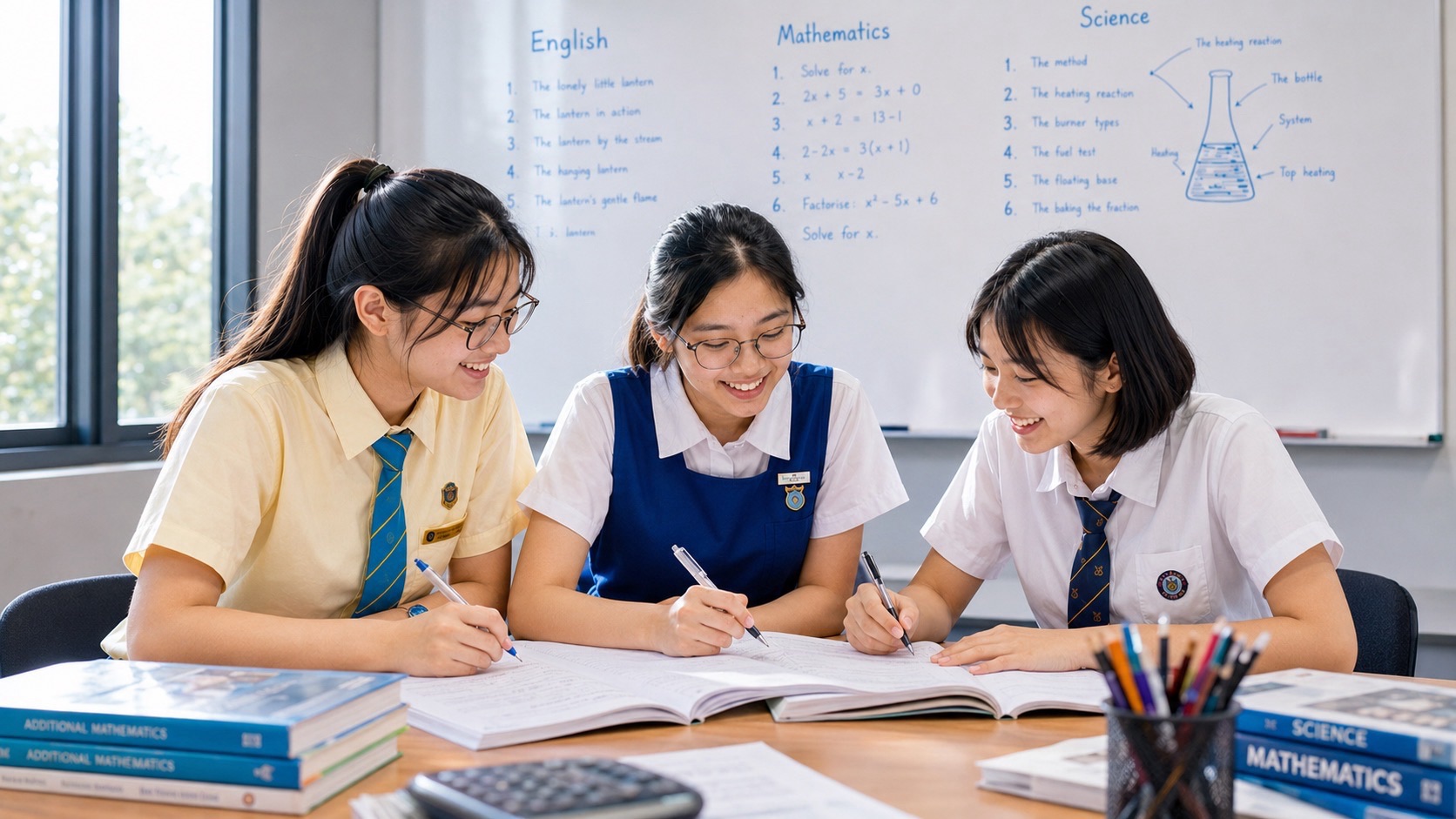
A three-student group can make this design useful because one child can predict, a second can challenge the prediction and a third can propose a test. But small groups are not automatically good. The tutor must check that every learner is engaged and that the pace matches their needs.
Why diagrams often matter more than extra notes
A sentence can disguise confusion. ‘Light reflects to the eye’ may sound acceptable, but the student may have drawn the ray moving in the wrong direction. ‘The forces cancel’ might conceal a missing force or a direction error.
A disciplined diagram names the system, labels the quantities, shows direction with arrows where appropriate and uses only the details needed. It should be possible to read the diagram even without its author standing beside it.
In practice, we would ask a learner to explain the picture aloud. If the explanation changes midway, we have found a place to teach. When the learner can redraw and explain it later without help, the representation has started to become a tool rather than a copy.
The answer-writing shift: evidence before explanation
Sec 1 school questions increasingly ask students to interpret tables, graphs and experiments. A weak answer often begins with a correct-sounding scientific fact and then ignores the evidence given.
Take a simple experiment comparing the travel times of toy cars released on two different ramps. A student should identify the independent variable, the measured outcome and any conditions that need controlling. Only after reading the actual data should the student say which car took less time over the specified distance.
A stronger explanation has three pieces: claim → evidence → mechanism. ‘Car A took less time over the same distance in the recorded trials’ is a claim grounded in observations. A further explanation about the ramp must be supported by how the experiment was controlled; otherwise a different starting point could be an alternative cause.
Being precise is not the same as writing more. Often it means removing a sentence that the evidence cannot defend.
Full Subject-Based Banding: match the learner, not the label
Students may encounter lower-secondary Science at different subject levels under Full Subject-Based Banding. The subject level matters for pace, mathematical demand, scope and expected detail. It should inform the teaching plan, not become a judgement about the child’s curiosity or long-term potential.
For a student who is still learning to read a graph, an excellent first step may be to describe axes, units and trends accurately. A more confident student may be ready to design a stronger control or interrogate an idealised model. Both can be doing meaningful Physics reasoning.
Ask any tutor: Which exact capability is this question testing, and what would success look like without help? If the answer is merely ‘more challenging worksheets’, the instructional plan is unfinished.
Three learner routes: catch up, keep up, move ahead
Catch up does not mean replaying every Primary Science chapter. We might discover that the student confuses measured temperature with heat transfer, or cannot read a ruler consistently. The repair should target that dependency, then return to the school topic.
Keep up means increasing reliability. The learner can understand during a lesson but forgets after a week, or can answer a labelled question but not recognise the idea when the setting changes. Retrieval and mixed questions help expose that fragility.
Move ahead is not a race into Secondary 3 equations. A student ready for extension can investigate why a model has limits, compare two explanations, design a better measurement or solve a novel scenario. Depth is a form of advancement.
These routes can coexist. The same child may be extending in light and repairing graph-reading. That is much more useful than giving the child one permanent label.
The difference between understanding and recognising a worked solution
A student watches a tutor complete a ray diagram and says, ‘That makes sense.’ It probably does. Recognition is real, but it is not the final goal.
The next task should remove the model answer. The student redraws the diagram, labels the normal, explains the angle choice and predicts a changed situation. A day or two later, the same reasoning returns in a new question. Only then do we learn whether the idea was retained.
That is why a small number of carefully sequenced questions may produce more learning than a tall stack of completed worksheets. The questions are chosen to reveal what the learner can generate independently.
How parents can see progress before test marks change
There are early signals worth noticing. The child begins a question without waiting for a hint. The written diagram contains useful labels. Units appear without a reminder. A correction includes a reason. A graph explanation names the axes rather than describing a vague rise. The child can say which part remains uncertain.
A useful home check takes five minutes: ask the student to explain one changed example from the week, without reading the note. Do not demand a miniature lecture. Ask, ‘What would you measure?’ or ‘Why does that arrow point there?’ If the student can explain and revise a claim, that is progress.
School marks remain important evidence, but a single score can fluctuate with topic mix and assessment design. Look for repeated independence across several tasks.
When tutoring may help—and when it may not be needed
Extra support can be useful when the child repeatedly mixes observation with inference, loses marks on labelled diagrams, memorises definitions without applying them, avoids explanation questions, forgets work shortly after teaching or feels overwhelmed by the shift to secondary expectations.
But a child who is learning confidently, meeting school requirements and enjoying independent Science exploration may not need additional tuition. More hours are not automatically a better education.
If tuition is considered, bring two marked questions and ask the provider to show how they would diagnose the cause of each wrong answer. An educationally sound response should distinguish concept, measurement, representation, language, retrieval and assessment strategy.
A small practice set to try at home
Try these without looking at notes. The goal is reasoning, not speed.
- A reflected ray makes an angle of 20° with a mirror surface. What angle does it make with the normal? 70°. Explain why.
- A push of 9 N east and a resistive force of 4 N west act on one object. What is their resultant horizontal force? 5 N east. What does that number not tell you? It does not directly give the object’s speed.
- Two objects in one room feel different to the touch. Can you conclude their temperatures differ? No. Explain which measurement would help.
- Two classmates time the same rolling car but use different starting marks. Will repetition alone fix the comparison? No. Standardise the start and distance first.
If a response is wrong, ask where the reasoning changed direction. That first incorrect choice determines the next useful practice.
Frequently asked questions
Is there a standalone Physics subject in Secondary 1 Singapore?
Usually, Physics-related concepts are taught within integrated lower-secondary Science, not as a standalone upper-secondary Pure Physics examination course. Check the student’s school syllabus and subject level.
Should a Secondary 1 student begin memorising O-Level Physics formulas?
Not as the first priority. Accurate measurement, units, diagrams, scientific explanation and understanding of simple physical relationships are more productive foundations. Some equations may be used at the school’s pace.
How does Sec 1 Science tuition differ from a Science enrichment activity?
Both can be valuable. Tuition often addresses specific school learning and assessment needs; enrichment may give more room for exploration. What matters is whether the task improves understanding, evidence use and independence rather than only producing an exciting demonstration.
Does a three-student group guarantee individual attention?
No. A small group makes each learner’s reasoning easier to observe, but quality still depends on diagnosis, questioning, compatibility and purposeful independent work.
Can my child improve without tuition?
Yes. Consistent school learning, careful corrections, retrieval and well-chosen independent questions may be sufficient. Seek extra support when a specific obstacle persists and cannot be resolved with the resources already available.
Where the learning goes next
Secondary 1 installs the language of physical explanations. Secondary 2 connects those explanations into systems: light, forces, energy, heat and electricity become less like separate chapters and more like relationships that must be selected from evidence. Secondary 3 later increases the mathematical and disciplinary resolution, while Secondary 4 tests whether that understanding survives mixed-paper pressure.
Continue to What Happens in Secondary 2 Punggol Physics Tuition — Forces, Energy and Electricity. For the wider lower-secondary route, see Secondary 1 Science Study Guide at eduKatePunggol and the eduKate Secondary Science Shelf.
For learning structure, the important reference is not a promise of faster marks. It is the move from being able to repeat an answer to being able to explain why the answer survives a change in circumstances. That is what a first good year of Physics thinking makes possible.


