
SEC G3 Combined Humanities Literature tuition in Punggol should begin with the correct subject route, not a generic pile of Literature examination questions. Parents searching for G3 Humanities K337, Combined Humanities Social Studies and Literature tuition, SBQ and SRQ practice, unseen poetry skills or 2027 SEC G3 Literature revision need to know what the papers actually examine and how the two disciplines differ.
The core aim of Punggol tuition for 2027 SEC G3 Humanities (Social Studies, Literature in English) K337 is to build two distinct but complementary forms of evidence-led reasoning: critical evaluation of information about society and close interpretation of the artistic choices within literary texts. Students should learn to answer Social Studies sources and structured responses while also handling prescribed prose and unseen poetry independently, without letting rehearsed templates replace understanding.
There is something quietly powerful about studying both. Social Studies asks why people claim particular things about communities and how we can evaluate them. Literature asks why writers choose a particular word, voice or scene and what it does to a reader. Both teach perspective and good judgement, but each deserves its own careful method.
The Core Aim in One Sentence
Choose the right evidence for the right task, explain it precisely and make a judgement that another careful reader can follow. The student’s goal is not a longer answer; it is a better-supported one.
The Official 2027 SEC G3 Humanities K337 Papers
According to the official K337 syllabus for 2027, Social Studies Paper 1 lasts 1 hour 45 minutes and contains a source-based case study plus structured-response questions. Literature in English Paper 2 lasts 1 hour 40 minutes and contains studied prose and unseen poetry. Each component accounts for 50% of the combined Humanities subject.
The Social Studies paper comprises a compulsory 35-mark source-based section and compulsory structured responses worth 15 marks in total. The Literature paper requires two answers: one on the school-selected prose text and one on a chosen unseen poem, each worth 25% of the overall combined subject.
Full G3 Literature in English is a different subject, K331, and includes a Drama paper. This combined Humanities route, K337, uses a Prose and Unseen Poetry paper. The official SEAB G3 subject list distinguishes them. Parents should not buy a Drama revision pack assuming that it is a compulsory part of K337.
Why the Difference Between SBQ and Literature Analysis Matters
Social Studies source-based questions may require candidates to identify a message, draw an inference, compare sources, evaluate a source’s usefulness or reliability, and form a judgement with evidence. The producer, purpose, context and corroboration of an informational source can matter significantly.
Literature instead asks how a writer makes meaning through language, form and structure. A fictional narrator may withhold information for dramatic effect; an image may suggest contradictory emotions without reporting an external fact. A student who evaluates a poem as if it were a government report has misunderstood the task, even if the paragraph contains technically accurate quotations.
Did You Know? A Source Can Be Useful Without Being Fully Reliable
A public advertisement might not give an independent measure of a product’s effectiveness, but it can be an excellent source for showing what its advertiser wants the audience to believe. Students should distinguish a source’s message, its possible purpose, and how far its factual claims can be trusted.
A good tutorial asks for the precise question before deciding how to evaluate evidence. If asked about utility, the learner should not automatically write a generic reliability judgement. If asked to compare two sources, describing each separately without identifying a meaningful similarity or difference is rarely enough.
The Three Social Studies Issues
- Exploring Citizenship and Governance: how citizens and institutions work for the good of society.
- Living in a Diverse Society: how societies respond to differences and manage relationships.
- Being Part of a Globalised World: how interconnectedness creates opportunities, consequences and choices.
The official source-based case study can address any of these broad issues. Revision should therefore build concepts and transferable source-handling methods instead of predicting one favourite theme. Students also need the subject knowledge that helps them interpret unfamiliar material.
A Worked Original SBQ Example: The Punggol Walking Route
Consider these fictional classroom sources about whether to build a new sheltered walking route. They are not real government statements or examination sources:
Source A, fictional community newsletter: “Every resident wants a new shelter, and it should be the town’s first priority.”
Original teaching example created for eduKatePunggol
Source B, fictional student survey: “Forty out of fifty students surveyed said they would use the route more often if it were sheltered.”
Source B gives some support to the idea that shelter could help a group of students. It does not establish that every resident supports the scheme or that this must be the town’s first priority. Students should notice the gap between the survey’s limited sample and Source A’s much broader claim.
An improved answer could explain that both sources present shelter positively, but they differ in scope and evidential strength. The newsletter’s interest or purpose may be relevant to its framing, while further representative evidence would be needed to establish residents’ priorities. Judgement becomes stronger when it acknowledges limits.
Social Studies Structured-Response Questions
The K337 Social Studies examination includes two structured-response questions: one worth seven marks and another worth eight. Their demands involve constructing explanations, considering factors or strategies and, where required, making an informed judgement. A bare list of policies or a stack of examples does not explain why something would work.
Practise the chain: state the factor or strategy, show its mechanism, give a specific relevant illustration, then assess its significance when the question demands judgement. A tutor should check that the child is actually answering the question rather than simply reciting a memorised case study.
The Literature Paper: One Prose Response and One Unseen Poem
For the Literature component, the syllabus provides a choice of a passage-based question or essay prompts for the student’s prescribed prose text. Section B provides two unfamiliar poems, each with its own question; the candidate chooses one. A Singapore text appears as one of the unseen-poetry options each year.
The best Literature student reads a prompt closely, identifies which details could support a response, and explains how the words or structural choices create the effect. Both prose and poetry value accuracy, inference, personal engagement and coherent expression, but neither rewards unfounded storytelling.
Which Prose Book Should a K337 Student Revise?
The official list contains How We Live Now (edited by Yu-Mei Balasingamchow), All the Light We Cannot See (Anthony Doerr), Lord of the Flies (William Golding), Roll of Thunder, Hear My Cry (Mildred D. Taylor) and The Chrysalids (John Wyndham). Students follow their school’s chosen title; no student is expected to prepare all five options.
Confirm the edition with the teacher. A summary may be useful to revisit plot, but cannot substitute for studying the actual prescribed work. The K337 syllabus says that abridged versions or screenplays are not to be selected for prescribed study.
Original Prose Example: The Half-Open Gate
Zara reached the gate long after the others had gone. Someone had left it half open. She pushed it gently, then stopped when she saw the familiar blue ribbon tied to the latch. “Tomorrow,” she said, though nobody was close enough to hear her.
Original teaching example created for eduKatePunggol
The literal situation contains an open gate, a ribbon and a character speaking when no one is near. It does not tell us what the ribbon symbolises or what happened to the other people. A student should begin by noticing Zara’s sudden stop and her solitary use of “Tomorrow”.
A defensible interpretation is that the ribbon interrupts her decision and makes the place emotionally significant. The delayed movement and the word spoken to no one suggest hesitation or self-reassurance. The specific explanation matters more than the unsupported declaration that she is heartbroken.
What a Good Prose Paragraph Does
Begin with a claim answering the prompt, select a short relevant phrase and explain the writer’s choice. The analysis should tell a reader how the detail creates an effect. A paragraph that retells three events and concludes “this is effective” has not yet completed the reasoning.
Teach students to connect close reading to whole-text context when helpful. If a repeated object changes meaning across chapters, trace that development. But do not turn every passage-based response into a biography of the protagonist.
Original Unseen Poetry Example: The Sheltered Path
The rain had finished at the door.
Original teaching example created for eduKatePunggol
A single drop delayed its fall.
Beyond the shelter sunlight shone;
my shadow waited by the wall.
I stepped outside and heard once more
the quiet weather of the hall.
The poem offers an ordinary scene involving rain, shelter and movement outside. Its personified shadow “waited”, while the unusual phrase “quiet weather of the hall” invites a reading about emotional atmosphere persisting after literal rain has ended.
A student could interpret the contrast between sunlight outside and the lingering sense of indoor weather as uncertainty about leaving shelter. But the text does not tell us why the speaker hesitates. Train the learner to distinguish supported suggestion from an invented background story.
How to Approach Any Unseen Poem
- Identify the literal situation, speaker and movement through the poem.
- Circle two or three distinctive words, images, contrasts or changes of tone.
- Test an interpretation against exact phrasing rather than guessing a hidden biography.
- Answer the question actually asked, not a generic topic such as loneliness.
- Choose short quotations and explain their meaning in context.
- Check whether the conclusion is proportionate to the evidence.
The Time-Management Difference Between Papers
Social Studies lasts 105 minutes and asks several source-based and structured responses. Literature lasts 100 minutes and asks two substantial answers. A student may need different timing routines for each. For Social Studies, losing too much time on the first source can endanger later questions; in Literature, choosing an unsuitable poem may be costly.
A mock should reveal exactly where effort disappears. Is the child rereading without extracting meaning, writing unnecessarily long openings or choosing irrelevant quotations? Correct the source of lost time before prescribing more full timed papers.
Quality Matters More Than the Number of Practice Papers
A carefully corrected paragraph can change the next examination answer. By contrast, a student can complete twenty worksheets and repeat the same misread question throughout. Feedback should identify the highest-value weak link: source evaluation, task interpretation, quotation relevance, analysis of literary craft or coherence.
After correction, use a new question with the same skill demand. The student should attempt it without the model. If the repair survives a fresh task, improvement is more credible.
A Six-Week SEC G3 Combined Humanities Progression
- Week 1: verify subject K337, identify prescribed prose and collect separate Social Studies and Literature baselines.
- Week 2: strengthen Social Studies message, purpose, comparison, inference and evaluation.
- Week 3: map prose scenes, character development and literary craft.
- Week 4: use new poems to practise literal-first reading and precise interpretation.
- Week 5: rehearse structured responses and Literature question choices with targeted feedback.
- Week 6: compare fresh independent work with the baseline and practise realistic time management.
This is a flexible teaching sequence, not a syllabus-mandated calendar. When the student is already strong in source evaluation but weak in unseen poetry, the tutor can redirect time without neglecting the 50–50 importance of the components.
Three Questions That Reveal Genuine Learning
First: can the student explain why a Social Studies source supports or fails to support a factual claim? Second: can they explain how a particular literary phrase shapes meaning? Third: can they say what a question requires before writing? These questions test judgement rather than the capacity to recognise a familiar worksheet.
Parents can use them in short conversations. The aim is not to deliver a lecture, but to invite a child to point to an exact clue and explain what follows from it.
Small-Group Learning and the eduKate Teaching Principle
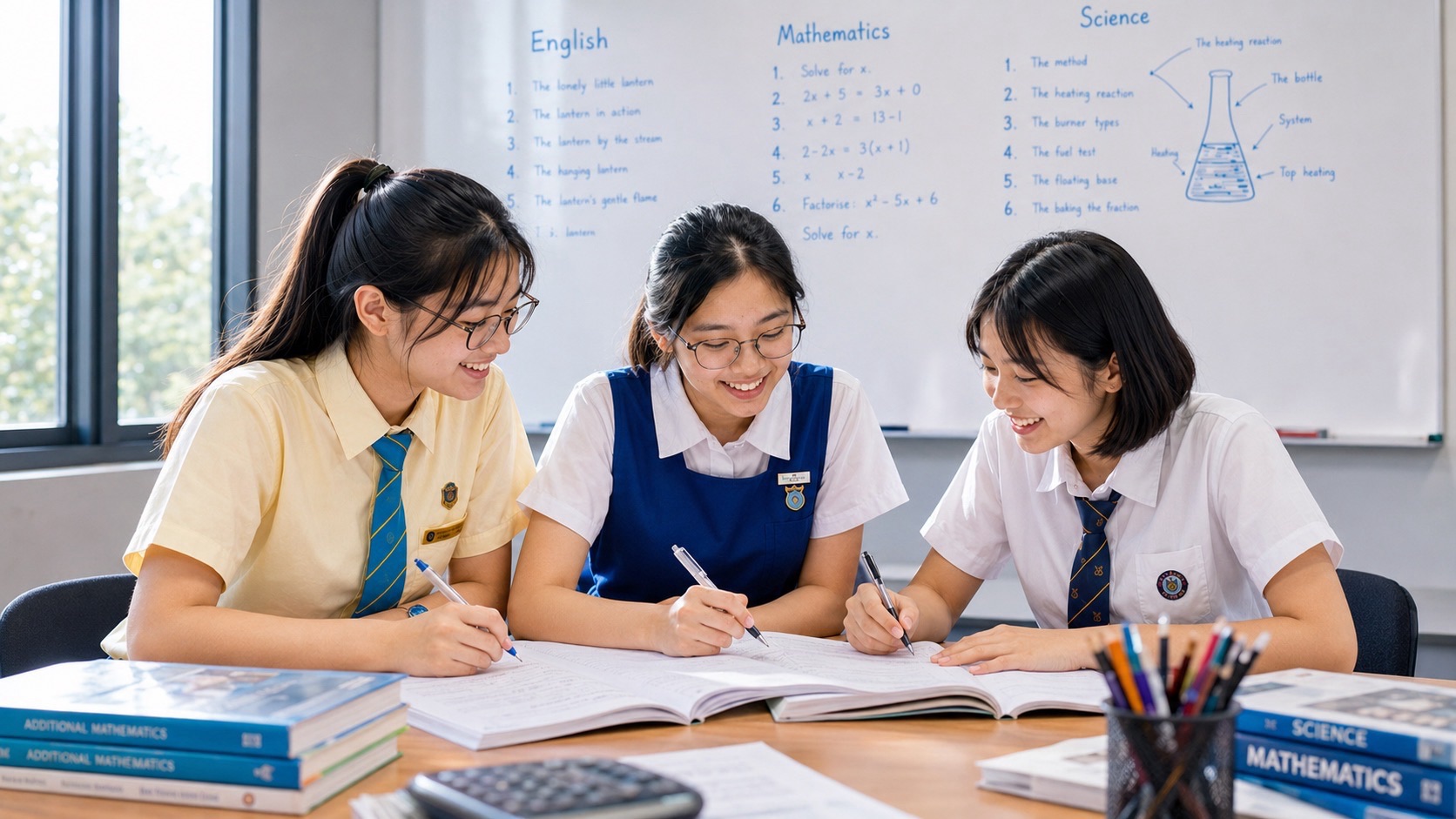
The immutable eduKateSG three-student tutorial reference illustrates careful observation, specific correction and guided practice. In a combined Humanities lesson, students can compare competing Social Studies judgements, then independently interpret a literary image using appropriate evidence.
Small-group discussion is useful when each child must justify a position. It is not an excuse to produce three identical memorised paragraphs. This illustration does not claim that a specific Punggol K337 class or vacancy is currently available.
Frequently Asked Questions
Does K337 include a Drama paper?
No. The Literature component of K337 is Prose and Unseen Poetry. Full SEC G3 Literature K331 includes Drama as a separate paper.
How much does Social Studies count?
Social Studies contributes 50% of K337; the Literature paper contributes the other 50%.
Are there unseen poetry choices?
Yes. Two poems are provided with one question on each, and candidates select one.
What should I bring to a tuition consultation?
Bring the K337 subject details, the school-selected prose title, recent marked responses in both subjects and a description of where the child feels stuck. The tutor can then diagnose rather than guess.
Can a Literature essay template be used for SBQ?
Not unchanged. Both need a claim and support, but Social Studies may require source provenance and corroboration; Literature instead examines writer’s artistic choices and their effects.
How will we know if tuition works?
Look for better performance on new sources, questions and poems, not merely polished corrections. Independent transfer is the strongest evidence of the repaired reasoning skill.
Useful eduKate Links and Official Sources
- Prose and Novel Analysis — writer’s choices and whole-text understanding.
- Unseen Poetry Analysis — fresh poems and evidence.
- Quotations and Evidence — precise support and interpretation.
- Literature Exam Preparation — revision and timing.
- Official 2027 SEC G3 Humanities K337 syllabus — definitive subject requirements.
A Closer Look at the G3 Social Studies Source-Based Case Study
The fifth source-based question in the G3 syllabus involves multiple sources and asks students to consider the case-study issue from a different perspective. This is not simply an instruction to copy quotations from every source. A coherent answer should work out which sources support the proposed judgement, which sources complicate it, and how the competing information relates to the precise question.
A practical tuition exercise places three short, fictional sources on one page. Ask the student to summarise the issue in one sentence, identify genuine agreement or disagreement, then explain which evidence could support a tentative conclusion. After that, change the question. A student who can adapt to a different perspective has learned more than someone who memorised an answer to one fixed prompt.
G3 SRQ: Why an Overall Judgement Must Be Explained
The 2027 K337 structured-response scheme distinguishes G3 reasoning demands. Question 6, worth seven marks, can involve multiple strategies or causes and requires a Singapore context. Question 7, worth eight marks, involves two factors or perspectives, with a judgement on relative importance or a balanced conclusion. This means that a simple list of benefits, even if accurate, may not satisfy what the question demands.
Teach pupils to compare mechanisms rather than adjectives. If one proposed strategy addresses an immediate problem while another changes behaviour over time, explain the time horizon and likely conditions of success. The judgement should follow the reasons already developed. An unsupported final line saying “therefore factor A is most important” does not turn description into evaluation.
A Provenance and Corroboration Workshop
One small-group activity begins with a mock public statement, a limited survey and an extract from a fictional meeting record. Students identify each source’s purpose and audience, then compare what the sources genuinely establish. They should also consider what could not be known from the supplied evidence. The goal is not to pronounce every source trustworthy or biased; it is to form a cautious, inspectable judgement.
At the end, let each learner write an independent paragraph with a different judgement, provided it is supported. Invite a peer to challenge the evidence. This exercise develops the habit of revising a conclusion when a contradiction appears, an important form of critical thinking beyond the examination.
Literature Essay Questions: Build an Argument Across Scenes
For a whole-text prose question, the student needs a coherent selection of moments. For example, a question about a character’s changing sense of belonging may require an initial scene of exclusion, a later challenge, and a final moment that transforms the earlier interpretation. Choosing three famous scenes because they are familiar is not enough. The paragraphs should form a progression that directly answers the examiner’s focus.
A useful planning task asks students to reject one tempting quotation. Why is it attractive? Why does it not quite answer this prompt? That deliberate act of not using evidence teaches relevance. Once the learner can select and exclude material independently, examination writing becomes less dependent on memorised model essays.
Unseen Poetry: A Five-Minute First-Reading Discipline
A short opening routine can help when the student initially feels lost. Read the poem once for the literal situation; read again for movement, voice and any tonal shift; underline two words worth analysing; paraphrase the question; then form a tentative claim. The five-minute duration is only a practice scaffold, not an official division of the examination. Adjust it to the student’s real reading pace.
If an unfamiliar phrase resists immediate interpretation, mark it and continue. Later lines may clarify the comparison. The first reading is permitted to be incomplete, but an eventual examination answer must be sufficiently grounded. Students can be curious about ambiguity without resorting to dramatic unsupported stories about the speaker’s life.
The Difference Between Useful Revision and Mere Activity
A large stack of completed papers may look reassuring, but it does not prove that the learner can transfer a repaired skill. After each source exercise or Literature paragraph, record the first weak link. Was the source’s claim overgeneralised? Did the poem’s analysis invent a backstory? Did a prose paragraph list events without explaining the writer’s choices? Then practise that exact repair on new material.
The next practice set should measure the same skill without recycling the same surface example. This is how a tutor can distinguish genuine learning from familiarity. The child may complete fewer worksheets while making more reliable progress, especially when feedback is clear enough to guide the next unaided attempt.
A Parent’s Two-Subject Progress Checklist
- Social Studies: Can the child identify a claim, evaluate source limits and justify conclusions when evidence disagrees?
- Structured responses: Can the child explain causes or strategies and make the judgement actually requested?
- Studied prose: Can the child select scenes relevant to a fresh question rather than retell the whole book?
- Unseen poetry: Can the child use specific language and structural observations without inventing facts?
- Independent transfer: Can the child do these things on new tasks with less prompting than before?
Use this checklist after several weeks rather than demanding daily proof of improvement. If one skill remains unstable, ask the tutor for a targeted demonstration and a comparable fresh question. The discussion can stay practical, encouraging and grounded in the child’s actual work.
The Core Aim: Two Kinds of Responsible Reading
Social Studies teaches students to question and weigh claims about people and society. Literature teaches them to attend to the subtle work of language and imagination. When the two skills are taught accurately, learners grow into more thoughtful and independent writers.
That is the core aim of Punggol SEC G3 Combined Humanities Literature tuition: precise question-reading, relevant evidence, fair judgement and independent writing across both components. Properly taught kids shine a bright light into the future.


