
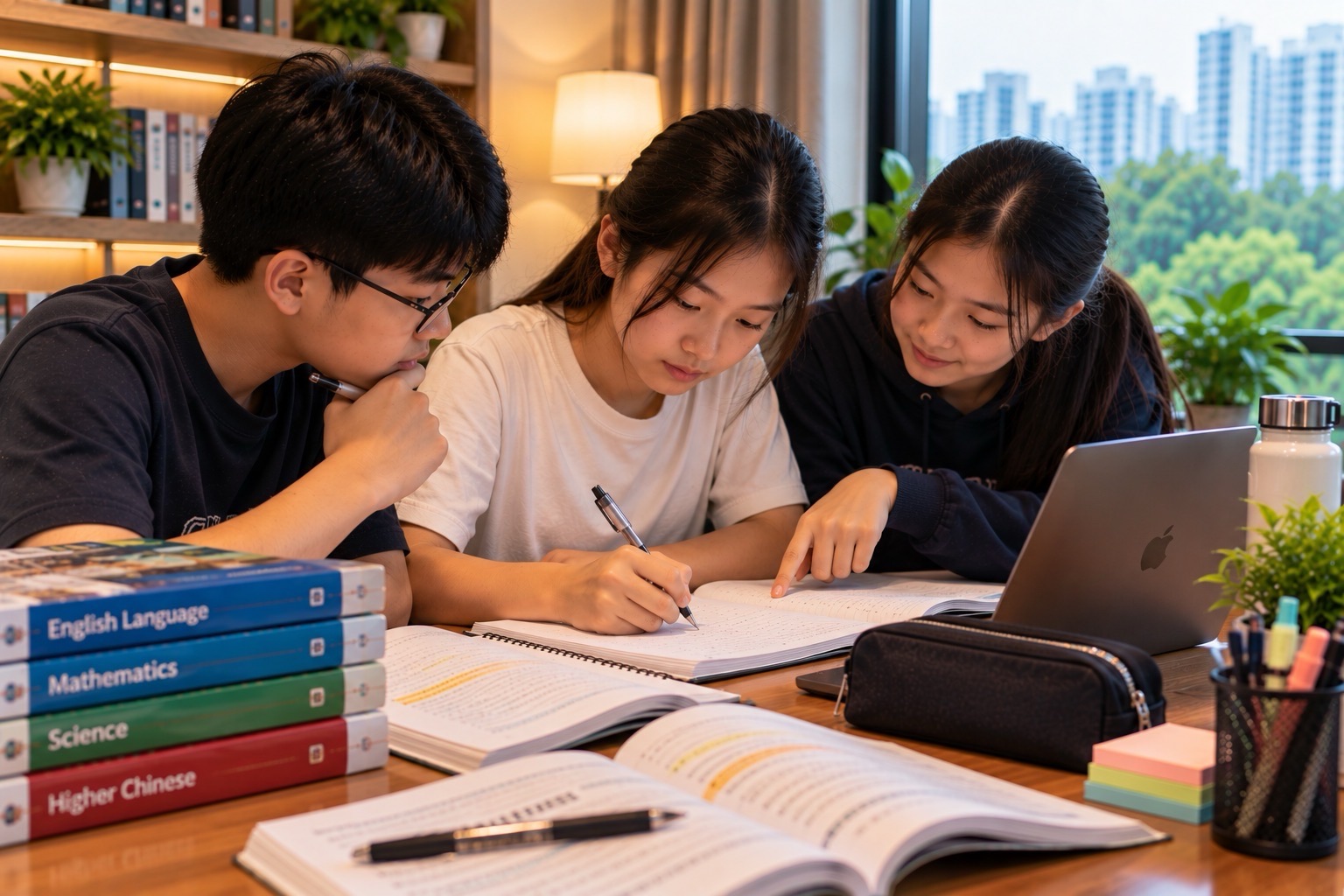
SEC G2 Literature Paper 1 tuition in Punggol matters when a Secondary student can read a novel comfortably but struggles to turn that familiarity into a relevant answer, or when an unfamiliar poem produces an immediate “I don’t understand it”. Parents searching for SEC G2 Literature K228 Paper 1, G2 Prose and Unseen Poetry, Literature exam revision, poetry analysis tips and studied-text essay writing often need a focused guide to the paper rather than another general Literature worksheet.
The core aim of Punggol SEC G2 Literature Paper 1 tuition is to help a student choose and answer one studied-prose question and one unseen-poetry question independently, using accurate reading, relevant evidence and clear explanation of writer’s choices. The method should make a familiar novel usable for a fresh prompt and make an unfamiliar poem approachable without depending on the tutor’s interpretation. Those two achievements develop complementary skills in memory, analysis and judgement.
The happiest transformation is when a child opens a new poem and begins asking questions rather than searching for the “right” answer hidden in somebody else’s notes. Literature rewards attentive curiosity. With a good routine, unfamiliarity becomes something to investigate, not a reason to surrender the first five minutes.
Official 2027 SEC G2 K228 Paper 1 Format
The 2027 SEC G2 Literature in English syllabus K228 sets Paper 1: Prose and Unseen Poetry at 1 hour 40 minutes, worth 50% of the subject. There are two sections and candidates must answer one question in each section. Each answer contributes 25% of the total Literature mark.
Section A, Prose: for each of the five prescribed prose options, one passage-based question and two essay questions are provided. Candidates answer one question on their school-selected book. Section B, Unseen Poetry: two unseen poems appear, each with one question, and candidates choose one. One unseen-poetry question each examination year is set on a Singapore text.
This is K228, full G2 Literature in English. The combined Humanities G2 route is K231 and has a different overall paper combination. Full K228 also includes Paper 2 Drama in a separate 90-minute sitting. Checking the code protects students from preparing the wrong subject structure.
The Core Aim in One Sentence
Teach the learner to turn understanding into relevant written interpretation in both sections, choosing evidence for the actual task rather than copying a rehearsed answer. Paper 1 tests whether literary thinking remains useful when the context changes.
Did You Know? The Two Sections Demand Different Kinds of Preparation
In studied prose, the child may know the story so well that a scene feels obvious. That familiarity can tempt them into retelling plot instead of analysing craft. In unseen poetry, the difficulty is almost the reverse: the child may feel they know nothing, so they begin inventing a dramatic story around a few images. Both habits produce unfocused answers.
An effective programme trains precision in both directions. Use the novel to practise selecting only what the question needs. Use the poem to practise saying only what the text supports. The resulting student is less likely to be overconfident with the known and overwhelmed by the new.
Section A: Which Prescribed Prose Text Is Relevant?
The 2027 K228 prose options are How We Live Now, edited by Yu-Mei Balasingamchow; All the Light We Cannot See, by Anthony Doerr; Lord of the Flies, by William Golding; Roll of Thunder, Hear My Cry, by Mildred D. Taylor; and The Chrysalids, by John Wyndham. Schools select their assigned work; students do not study all five.
Record the exact book and school edition. The prescribed-text section disallows screenplays and abridged editions as substitutes for full works. A synopsis can refresh the storyline, but it cannot provide the close reading needed when a question focuses on tone, narrative viewpoint or a subtle change in character.
How to Choose Between a Prose Passage and an Essay
When the exam presents passage-based and essay options for the selected work, students should read each question before deciding. A familiar character name is not proof that an essay will be easier. Ask which task can be answered with relevant detail and which one suits the student’s strengths.
A passage-based question rewards close attention to specific words and the scene’s position in the work. A whole-text essay often needs selection across chapters or several stories. Practise brief outlines for both options, then explain why one provides a stronger route. Question choice is a skill that can be rehearsed, not a decision to leave to panic.
A Simple Five-Point Studied-Prose Revision Card
- Scene: What happens, who is present, and what changes?
- Perspective: Who narrates, and what knowledge is available or withheld?
- Language: Which decisive words, images or actions reveal the writer’s choice?
- Interpretation: Which relationship, idea or tension emerges, and what limits remain?
- Question uses: What kinds of prompt would this moment genuinely help answer?
Students should be able to use this card for different scenes, not merely fill it once with copied revision notes. After preparing three key moments, ask which one best answers a new question. That decision is a more authentic measure of readiness than the number of highlighted pages.
An Original Practice Extract: The Umbrella by the Door
Use this short, original fictional prose passage for an untimed warm-up. Imagine the question: How does the writer suggest that Daniel finds returning home difficult?
Daniel left his shoes beside the mat and stood without opening the door. Through the frosted glass he could see the yellow umbrella on its familiar hook. He found the house key, turned it twice in his palm and put it back into his pocket. When his sister called his name from inside, he answered, “I’m here,” but stayed where he was.
Original prose practice passage written for eduKatePunggol
The literal facts are enough to start: Daniel is outside a house, recognises a familiar umbrella, holds the key without using it and answers his sister without entering. We do not know whether the family has argued or why he hesitates. A strong student distinguishes evidence from a backstory they imagine.
The repeated handling of the key, alongside his decision to remain outside, creates a contrast between practical ability and emotional reluctance. His reply “I’m here” acknowledges his presence without completing the action of returning. The yellow umbrella may carry personal significance, but the extract does not establish what it means.
Weak Prose Answer Versus Developed Analysis
Weak: “Daniel is nervous to go home because there is an umbrella and he has a key.” The answer provides an emotion but cannot explain why the writer makes us infer it. It treats objects as automatic codes rather than literary choices.
Stronger: “Although Daniel has the key and hears his sister calling, he repeatedly handles the key instead of using it. The detail turns an ordinary act of entry into a difficult decision, while his reply ‘I’m here’ emphasises the gap between physical arrival and willingness to cross the doorway.”
The stronger answer focuses on a particular effect and its supporting language. It also resists claiming that Daniel is angry with his sister when the scene does not say so. This is the habit to transfer to the child’s actual prescribed book.
Section B: First Read the Unseen Poem Literally
Many struggling students begin by hunting devices before understanding the poem. Ask more basic questions: who or what is present, where is the speaker positioned, what movement occurs, and which words are uncertain? If the first reading remains incomplete, continue to the end and return with new clues.
Poetry interpretation becomes safer when students separate observation, inference and invention. Observation is what the wording presents; inference is a plausible meaning supported by those words; invention adds facts the poem never supplies. Creative thinking is welcomed, but an examination argument needs evidence.
An Original Unseen Poem: The Last Page
A book lay open in the sun.
Original six-line poem for G2 Paper 1 practice
The wind could turn the waiting leaves.
I placed one finger on the page
and watched the garden change its greens.
By dusk the sentence was still there.
I closed the book against the breeze.
Literally, a speaker has a book outside; wind moves leaves, while the speaker holds a page and later closes the book. “Leaves” invites an association with both pages and garden foliage, although the exact context needs careful reading. The poem leaves the book’s subject unidentified.
A defensible interpretation is that the speaker hesitates to move forward, holding a page despite changing light and a shifting garden. The final action may suggest a reluctant stopping or protective closure. The student should point to “still there”, “one finger” and the change from sun to dusk rather than inventing the death of a particular character.
How to Choose Between the Two Unseen Poems
Give students a consistent selection process. Read both question prompts, establish the literal situation of each poem and see whether there are two or three clear details suitable for analysis. Choose the one that supports a coherent answer to the specific question, not necessarily the poem containing more familiar vocabulary.
Practise choices in short untimed exercises first, then in realistic timed papers. Some learners consistently choose the shorter poem and discover too late that its ambiguity is harder for them to handle. A better habit is to test the available evidence before committing.
Singapore Unseen Poetry: Familiar Settings Still Need Analysis
The 2027 Paper 1 scheme specifies that one unseen-poetry question will be set on a Singapore text. A poem may mention a bus interchange, a corridor, tropical rain or local speech; familiarity can aid literal understanding, but should never replace attention to the exact writerly decisions.
Even if a child recognises a local setting, the poem may be playful rather than nostalgic or critical rather than affectionate. Strong interpretation comes from diction and structure. Encourage the student to ask how a location is represented, not what every Singapore poem “must” say.
Explain Figurative Language Instead of Listing It
A simile, metaphor or personification is important because it changes how a reader understands something. If a road “remembers” footsteps, ask whether the effect involves lingering absence, habitual movement, nostalgia or something else—and which words nearby support the reading.
Students can begin with a simple sentence: “By describing X as Y, the poet suggests Z because…” This scaffold should gradually disappear as the learner gains a clearer sense of literary language. Naming a device without discussing its local effect will not replace analysis.
Tone Shifts and Poem Structure
A poem can begin in delight and end in uncertainty, or move from a noisy external scene to a quiet internal thought. Line breaks, repeated words, contrasts and stanza movement are part of the meaning. Ask what the poem makes a reader expect before the final lines change that expectation.
In the original book poem, the transition from bright sun to dusk shapes our sense of passing time, while the unchanged sentence suggests that the speaker’s reading has not progressed. A student can investigate that contrast without using difficult terminology or pretending it has only one possible interpretation.
One Strong Paragraph Is Better Than Five Generic Ones
A useful G2 structure is claim → short textual evidence → explanation → relevance. The claim should be more specific than “the poem is sad”. The evidence should contain words worth analysing. The explanation should make clear how the chosen wording shapes interpretation.
For example, a student might argue that the speaker in the book poem seems reluctant to move on because they hold a page while daylight changes around them. Discussing the contrast between changing surroundings and the fixed sentence makes the point more convincing.
What the G2 Band Descriptors Tell Us
The K228 assessment criteria value generally focused answers, understanding of main concerns, relevant and developed substantiation, and clear writing. For unseen texts, stronger G2 responses show close engagement and a supported personal view, even when their style is not highly sophisticated. This matters: complexity of vocabulary is not the same as literary quality.
When a child is accurate but writes largely in plot summary, the repair is explaining the writer’s choice. When the interpretation is plausible but the quotation irrelevant, the repair is evidence selection. When the analysis is strong but the child misreads the question, the repair is task focus. The first weak link decides the lesson.
An Evidence Audit a Child Can Do Alone
- Have I answered the actual question rather than a related theme?
- Did I quote the decisive word, image, gesture or line accurately?
- Have I explained how the wording creates my suggested effect?
- Have I accidentally invented a character’s history or a poem’s setting?
- Does each paragraph add something that the previous one did not?
- Can I express the idea more clearly without adding unnecessary language?
A tutor can model this audit using one worked paragraph, then hand it back to the learner. The destination is self-correction: the child should increasingly spot their own unsupported leaps without waiting for every sentence to receive red ink.
Practising a 100-Minute Paper Responsibly
The official Paper 1 duration is 100 minutes, but SEAB does not prescribe a single minute-by-minute plan for prose and unseen poetry. Tutors can rehearse reading questions, choosing a prose task and poem, planning briefly and completing both answers. The correct allocation depends on the learner’s reading pace and writing efficiency.
Observe where time vanishes. Does the child reread poems repeatedly without extracting any meaning? Do they produce a long general introduction to the novel? Do they leave the second question incomplete? A useful correction targets the actual bottleneck instead of shouting “write faster”.
What a Small-Group SEC G2 Literature Lesson Might Do
Three learners may select different details from the same unseen poem. One notices the repeated verb; another a structural contrast; the third a change in viewpoint. The tutor asks which interpretation best fits the question and then requires separate independent paragraphs. The immutable eduKateSG small-group tutorial reference illustrates the value of closely observed reasoning, sequenced practice and corrective feedback.
The teaching principle does not automatically establish the availability or class size of any specific G2 Literature course in Punggol. What matters is that a tutor identifies the first missing move and teaches until the student can perform it on unfamiliar material.
Six Weeks to Build a Stronger Paper 1 Routine
Week 1: Baseline and exact text check
Confirm K228 and the prescribed prose book. Collect one unaided prose answer and one unseen-poetry answer. Locate the first recurring weakness.
Week 2: Prose scene accuracy
Verify viewpoint, character relationships, events and textual details. Build compact evidence maps that support more than one type of essay question.
Week 3: Passage analysis
Practise turning narrative details into statements about writer’s craft. Compare passage-based and whole-text prompt demands.
Week 4: Unseen-poetry independence
Use several fresh poems with different moods. Teach literal-first reading, selection, justified inference and identification of shifts.
Week 5: Clear analytical writing
Repair quotation integration, topic sentences, explanation and focus. Revise a weak paragraph, then test the same skill on new lines.
Week 6: Realistic Paper 1 rehearsal
Complete an appropriate full practice under time constraints. Compare with the baseline and address the remaining bottleneck before the next mock.
Frequently Asked Questions
How many questions does K228 Paper 1 require?
Two: one Section A prose question on the student’s prescribed work and one Section B unseen-poetry question. Each contributes 25% to the total subject.
Is Paper 1 completely unseen?
No. Prose is studied in advance, while Section B uses unfamiliar poems. The two parts require different preparation routines.
Do students have to memorise all five prose texts?
No. The school selects the text from the prescribed list. Revision should focus on that complete work and its literary craft.
Does the unseen poem always have a Singapore option?
The 2027 published scheme states that one unseen-poetry question will be set on a Singapore text.
Does G2 Literature require complicated literary vocabulary?
Useful terminology helps, but the stronger response interprets actual choices with clear, supported reasoning. The G2 assessment descriptors value understanding and relevance more than ornamental language.
Should we memorise full model poetry essays?
No. Unseen poetry by definition requires a response to new wording. Models can teach how an argument works, but cannot provide the particular evidence for the examination poem.
What is the best way to assess tuition progress?
Compare independent answers to different but comparably demanding prose and unseen questions. Look for better focus, more precise evidence and improved self-correction.
Continue Across the eduKate Literature Pathway
- SEC G2 Full Literature K228 Guide — complete two-paper route.
- Prose and Novel Analysis — studied literary narrative.
- Unseen Poetry Analysis — detailed close-reading methods.
- Textual Evidence — choose and explain quotations.
- Official 2027 K228 G2 Literature syllabus — paper structure and marking criteria.
- Punggol Atlas — local family learning guidance.
The Destination: Confident Thinking Across Known and Unknown Texts
Literature Paper 1 asks the student to make a familiar work useful for a surprising question, then approach a new poem with thoughtful attention. Both require the same generosity towards language and the same discipline of evidence. A learner who gains these habits has acquired something that will remain useful beyond a particular paper.
That is the core aim of Punggol SEC G2 Literature K228 Paper 1 tuition: accurate prose reading, resilient unseen-poetry interpretation, clear evidence and answers the student can construct alone. Properly taught kids shine a bright light into the future.


