
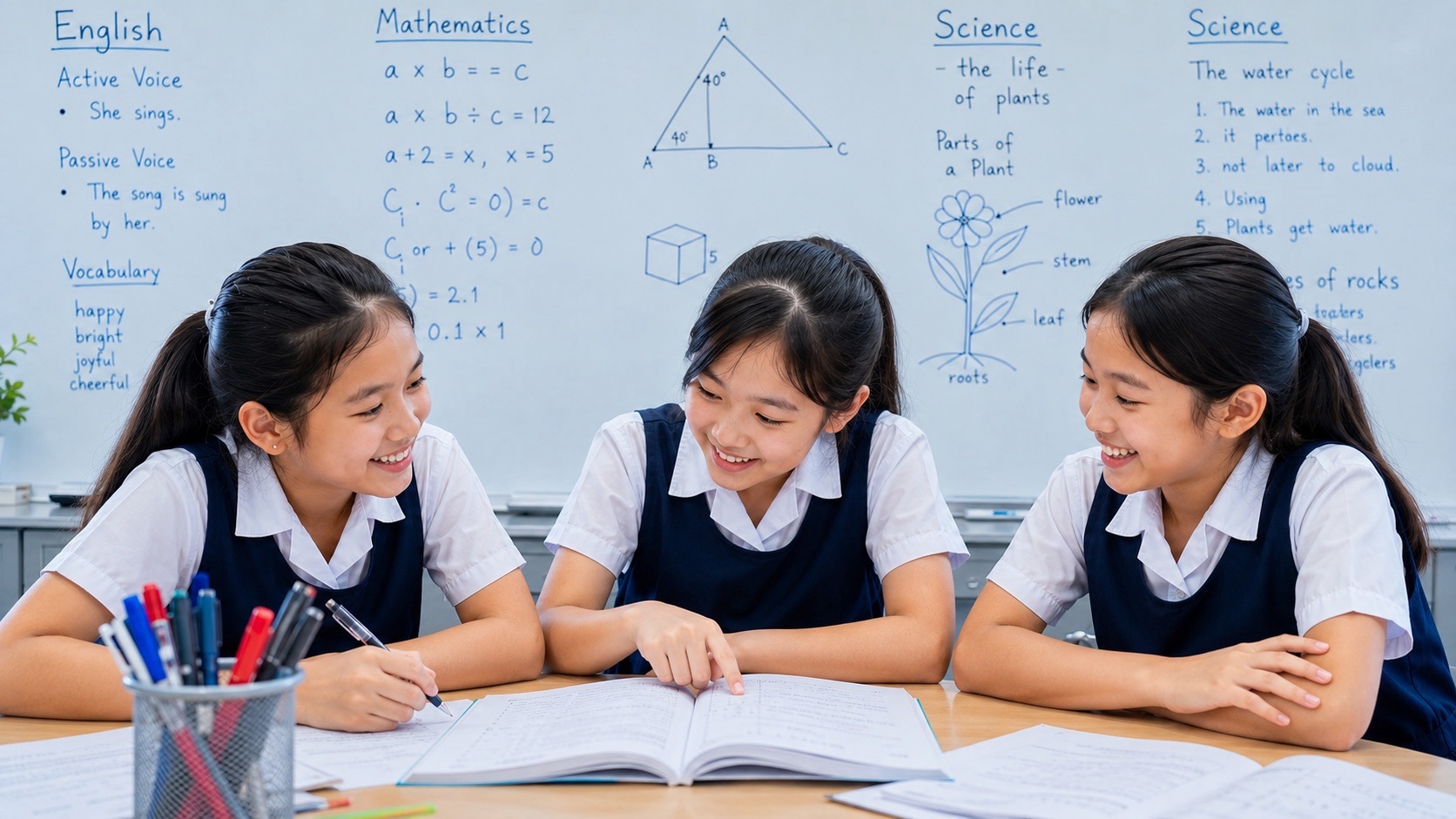
A Primary 5 student looks at a composition title and three pictures, spots an umbrella and immediately begins the dramatic rainstorm story they memorised last month. Halfway through, the child realises the actual topic is about trust, not bad weather. Parents searching for Primary 5 picture composition, P5 English composition writing, composition picture prompts or PSLE composition topic relevance often recognise this frustrating gap between fluent prose and a story that genuinely answers the question.
The core aim of Primary 5 picture-and-topic enrichment is to help students interpret the assigned theme, select a visual clue with a meaningful narrative role, and keep the character’s actions relevant from beginning to end. A picture is not merely a noun to mention in the opening. A topic is not a moral sentence to paste at the conclusion. Strong writing makes both visible through the event chain, while leaving room for the child’s own original story.
An umbrella can be evidence of kindness, a promise, a misunderstanding or an unexpected discovery depending on what the writer creates around it. The object does not dictate a single plot. The student must decide which route fits the topic and what the umbrella changes about the characters’ choices.
This article owns the visual-evidence-to-topic-relevance step within eduKatePunggol’s Primary 5 Creative Writing Enrichment progression. The broader Primary 5 Composition and PSLE Readiness article covers writing independence. The Primary 5 Ideas and Composition Planning guide compares multiple story routes. Here the focus is narrow: making the selected picture and assigned topic work together throughout an original composition.
The Core Aim: Make the Picture Part of the Event, Not a Decoration
A child may choose a picture of a bicycle, write a long story about a school argument and insert “I rode my bicycle” in one unrelated sentence. Technically the object appears, but it has not helped the reader understand the central story.
A stronger version gives the bicycle a causal role. Perhaps a student promised to lend a helmet, forgot it and must make a responsible decision before the ride. The picture now shapes the obstacle or consequence.
The pupil’s job is not to use as many pictures as possible. It is to understand what a chosen image can contribute to a relevant narrative.
A useful picture is one the story would miss if the writer removed it.
Begin With the Topic’s Meaning
Topics such as “An Unexpected Discovery”, “A Promise” and “A Thoughtful Act” describe ideas, not complete plots. The writer has to decide what would count as evidence of that idea.
For “A Promise”, a story should involve a commitment and what happens because somebody tries—or fails—to honour it. For “A Difficult Decision”, at least two plausible responses and a consequence help establish the difficulty.
This thinking should happen before the learner chooses a favourite dramatic incident. A familiar lost-wallet story may fit one theme naturally but require substantial adaptation for another.
What Can a Picture Actually Tell Us?
- Visible detail: what people, objects, positions and actions can be observed?
- Possible interpretation: what may be happening, and what is still uncertain?
- Story opportunity: what goal or conflict could the writer invent from the image?
- Topic connection: how would that goal or conflict demonstrate the assigned title?
- Consequence: what happens later because this image element mattered?
This sequence prevents children from treating their first guess as the only correct plot. One image can support many fictional interpretations.
The tutor should also remind learners not to assert private motives as facts merely because a character is looking at an object. In fiction, they can invent a motive; in observation, they should recognise the difference.
What the Official 2026 PSLE Format Says—and What It Does Not
The SEAB 2026 PSLE English Language syllabus states that Continuous Writing is at least 150 words on a given topic and includes three pictures offering different angles of interpretation. The composition must be based on at least one picture.
That is a clear reference for the 2026 examination, not a promise that every Primary 5 school assignment uses the same images, word count or assessment format. A pupil in Primary 5 during 2026 should check the applicable syllabus for their own later examination year when it is issued.
Creative writing enrichment can practise picture relevance without pretending to predict future topics or a future paper’s exact design.
Worked Example: A Promise and a Folded Letter
Use an invented practice topic, “A Promise”, with fictional picture options: a folded letter, an umbrella and a lunchbox. These are not actual PSLE pictures.
Route A: The letter as decoration
A student writes about a long sporting competition, wins a trophy, then notices a folded letter at home. The letter appears but does not contribute to the promise or central action.
Route B: The letter as an event
A pupil promises a grandparent to deliver a handwritten birthday letter before dinner. On the way home, the envelope goes missing. The protagonist must decide whether to conceal the problem or admit it and find a way to deliver the message.
Route C: The letter as a consequence
The child explains the mistake and writes a second version with help. Later, the original is found. The grandparent keeps both letters because the second records the child’s honest effort.
The letter influences the goal, obstacle, choice and ending. A reader can remove an unrelated line about weather without losing much, but cannot remove the letter without changing the entire story.
The Five-Point Relevance Check
- Title: what is this story supposed to demonstrate?
- Image: what selected detail anchors the narrative?
- Goal: why does that detail matter to the main character?
- Decision: what action turns the visual idea into the main event?
- Resolution: does the ending answer the topic and reflect the selected image’s role?
A pupil should be able to answer all five questions without inventing a different plot during the explanation.
If the topic appears only in a final moral sentence, repair the central conflict rather than adding another paragraph saying the word “promise” repeatedly.
Picture Selection Is a Planning Decision
Some children select a picture merely because it is familiar. A photo of rain may tempt them to reuse their weather vocabulary, even though another option supports a clearer character choice.
Ask which image produces the strongest link between topic and consequence. A simple note may create a better friendship story than a spectacular accident.
The learner should explain not only why they like a picture, but how they will use it.
How to Compare Three Picture Routes
Give the child one invented theme and three distinct visual cues. Write one sentence for each route. Then ask which provides the clearest goal, complication and ending.
The first idea might be humorous but too complicated to complete. The second may be coherent but predictable. The third might allow a subtle original motive with simple language.
There is no universal winning image. The strongest choice depends on the writer’s plan, fluency and the requirements of the actual task.
A Second Worked Example: The Umbrella and Trust
Take a fictional picture of a bright umbrella left beside a bench. A Primary 5 pupil wants to use it in a practice story about trust.
A weak connection
“It began raining. I used an umbrella. My friend trusted me.” The image and topic are present, but the narrative offers no evidence of trust.
A stronger connection
“Hana had lent me her bright umbrella because she knew I would return it after the afternoon class. When I discovered it was missing, I almost said I had already given it back.”
The umbrella now carries responsibility and the possibility of dishonesty. The character must decide how to respond. The story can be developed through an honest explanation and a credible effort to find or replace the item.
The final check
Remove the word “trust” from the draft. Can a reader still recognise trust or broken trust through the characters’ actions? If yes, the theme is developing rather than merely being named.
Avoid Forcing Every Picture into One Story
A writer may believe using every visual stimulus will make the answer more complete. In the 2026 PSLE format, the requirement is at least one picture, not a compulsory combination of all three.
Even outside examination practice, stuffing unrelated images into a short narrative can create disconnected subplots. More material is not automatically richer writing.
Choose the image or combination that genuinely supports the selected topic. If another element adds nothing, leave it out.
The Image Removal Test
After drafting, underline the scenes involving the chosen picture detail. Temporarily remove it from the outline. If nothing changes in the character’s goal, obstacle or consequence, the visual element may have been inserted superficially.
The repair could be changing an action so that the object matters, rather than repeating the object in several sentences.
This simple test helps learners distinguish integration from name-dropping.
What if the Picture Contains Multiple Objects?
A scene might show an envelope, a table, a clock, three people and a schoolbag. The child need not write about every item.
Select the one or two objects related to the planned plot. A clock may matter if the promise has a deadline. An envelope may matter because it contains the promised message. The colour of the table might not matter at all.
The student learns to see a picture as a collection of possible narrative clues, not a shopping list of words to use.
Character First or Picture First?
Either route can work. Some children begin by choosing the image and then inventing a character who cares about it. Others begin with the theme and a character decision, then select the image that fits.
The tutor should allow both strategies when they produce a coherent result. Requiring every child to follow one exact order can confuse a useful planning tool with a compulsory writing law.
The important check remains the same: does the selected visual detail matter to the character and topic?
What Counts as an Original Response?
A story can use common objects and still be original. A lost letter may be familiar, but one pupil tells it from the writer’s perspective while another follows the person who finds it.
Originality can arise from motive, context, a specific observation or a decision. It does not require an improbable twist, extraordinary villain or stock rescue.
Teach pupils to create their own consequences rather than borrow the entire causal chain of a model composition.
Topic Relevance Has to Survive the Middle
A strong opening may explain the title perfectly, but a later paragraph can drift into unrelated adventures. A story about keeping a promise turns into an accident, a sporting victory and an unexpected prize, leaving the promise forgotten.
During practice, ask the learner to mark where each important scene develops the central idea. If a scene does not alter the main conflict, consider shortening or removing it.
A good story can contain side details and humour. The key is that the main question remains recognisable.
Make the Picture a Cause or a Consequence
A picture element can create the problem: the broken strap on a bag causes an item to fall. It can provide a clue: a name tag identifies the owner. It can be the outcome: a repaired photograph reveals an act of care.
These are different ways of integration. Students can experiment with each, then select the role that best suits their original story.
The child should be able to answer, “What would be different if this object did not exist?”
Dialogue Can Reveal the Topic
A short exchange may help a theme become visible. In a trust story, the character might say, “I haven’t returned it. I lost it, and I should have told you earlier.”
The next response and action matter. Simply making a character announce honesty is not enough; the story needs a consequence that reveals what the confession changes.
Use dialogue when it affects the narrative rather than to increase the number of speech marks.
Specific Detail Without an Unrelated Descriptive Paragraph
The umbrella’s bent handle may help a character identify it. The faded handwriting on a letter may show why the object is precious. Such details are meaningful.
A paragraph about five kinds of clouds may be beautifully written but irrelevant to the selected image and topic. Teach pupils to choose details according to the story’s goal.
See Descriptive Writing Techniques for the broader approach to selecting rather than accumulating details.
The Difference Between a Plot Plan and a Moral Message
“I learnt to be responsible” is a statement. A plot about taking responsibility shows what happened, which options existed and what the character did.
Teach the child to demonstrate the theme through events before considering a reflective ending. If the theme is already clear from the resolution, a lengthy moral may be unnecessary.
Readers should be able to infer the central idea even if the topic title does not appear verbatim inside the prose.
Six Primary 5 Picture-Prompt Activities
1. Title Before Picture
Give an invented practice title and ask what kind of event could demonstrate it. Then show three visual options and choose the best fit.
2. Picture Before Title
Present a neutral object such as a key. Invent three different topic connections—responsibility, discovery and friendship—and show how the plot changes.
3. The Meaningful-Object Test
Write a plan in which an image element has a genuine effect. Remove it and examine what no longer works.
4. The Two-Route Comparison
Generate two different story routes using the same picture. Choose the one with the clearest central question and consequence.
5. The Off-Topic Repair
Give a lively draft whose theme disappears halfway through. Remove an irrelevant subplot and strengthen the important character decision.
6. The Unseen-Prompt Retest
After studying a letter-and-promise example, give an unfamiliar title and picture. The student should integrate a different visual clue without copying the original plot.
A Thirty-Five-Minute Learning Clinic
- Minutes 0–5: interpret a fictional assigned topic in plain words.
- Minutes 5–10: examine picture options and generate short route ideas.
- Minutes 10–14: choose a visual anchor and give it a meaningful role.
- Minutes 14–27: draft a coherent scene and story consequence.
- Minutes 27–32: check relevance through the title–image–goal–choice–resolution chain.
- Minutes 32–35: revise one weak link and explain why it now fits.
This is an illustrative teaching session, not a prescribed school or examination timing. The purpose is to isolate picture integration and topic relevance before later timed work.
At-Home Practice Without Adult Ghostwriting
A parent can ask two useful questions: “Which picture did you choose?” and “What does it make your character do?” These do not supply a plot, but they help the learner test one.
After the child writes, ask where the topic becomes visible through action. Allow the pupil to revise the actual words and events.
Do not replace the piece with a memorised model about a different topic. The learner should own the interpretation and story route.
Common Primary 5 Picture-Composition Problems
- Mentions the picture only once: give it a genuine cause, clue or consequence role.
- Chooses a visual cue for vocabulary alone: compare the picture against the topic.
- Includes every picture unnecessarily: remove unrelated visual subplots.
- Writes a theme only in the last line: develop the central decision earlier.
- Invents a wildly unrelated story: return to topic meaning and relevance.
- Describes the image instead of narrating: add a character goal and response.
- Copies a model story: change the motive, action and outcome on a fresh prompt.
Measuring Topic-and-Picture Transfer
- The pupil can explain the topic before drafting.
- Several plausible routes can be generated from one visual clue.
- The chosen image affects an important event.
- The main character has an understandable reason to care.
- The topic remains visible in the middle, not only the ending.
- The writer can reject an irrelevant but attractive plot.
- Unnecessary visual elements are left out.
- A new title and picture produce an independently relevant story.
These are developmental indicators, not official examination scoring criteria or guaranteed future grades.
How the MOE English Writing Progression Connects
The MOE Primary English Language Syllabus includes idea generation, selection, organisation, development and revision for different purposes and contexts.
Picture integration is one possible way to practise those wider decisions. The curriculum does not make any particular commercial planning grid a national rule for P5 writing.
Preparing for Primary 6
A learner who can select and develop a relevant route without adult help is better placed to practise the actual Continuous Writing task under appropriate examination conditions in Primary 6.
The next challenge is integrating timing, whole-story completion and accuracy. The child should also check the official instructions applicable to their actual exam year rather than assume they are identical to an earlier syllabus.
Continue to Primary 6 PSLE English Composition and Independent Writing once the relevance decisions are reliable.
Questions Punggol Parents Can Ask a Tutor
- How does my child decide which image best supports the assigned topic?
- Does the picture influence the plot rather than appear as decoration?
- Is the learner taught to interpret themes through actions, not stock moral endings?
- Can the child reject an irrelevant memorised plot?
- How are visual observations separated from fictional inferences?
- Does feedback inspect the entire story for topic drift?
- Will a fresh prompt show the skill without the same model essay?
A promising response is a child saying, “I liked the rainstorm story, but the letter makes my promise story work better.” That is selection, relevance and imagination working together.
Frequently Asked Questions
How do Primary 5 students write from composition pictures?
Interpret the topic, examine the pictures, select a meaningful clue and build a coherent character goal, problem, response and ending around it.
Should a P5 pupil describe everything shown?
No. Choose details relevant to the story. Visual observation is a starting point, not a requirement to list every object.
Can the same picture fit different topics?
Yes. An umbrella might support kindness, responsibility, friendship or an unexpected discovery, depending on the character’s actions.
Must pupils use all three PSLE pictures?
For the 2026 PSLE English syllabus, no: at least one of the three images is required. Check the applicable syllabus for later examination years.
Why does my child get off-topic despite fluent language?
The learner may be choosing an attractive memorised story before interpreting the theme. Practise a short relevance check before drafting and again after the central event.
Will this guarantee better composition marks?
No. Relevance is important, but writing quality also depends on coherence, development, language accuracy and the actual task’s requirements.
Continue the eduKatePunggol Creative Writing Progression
- Primary 5 Composition and PSLE Readiness
- Primary 5 Creative Writing Ideas and Composition Planning
- Primary 4 Composition and Scene Writing
- Primary 6 PSLE English Composition and Independent Writing
- Creative Writing to PSLE Composition Writing Skills
- Primary 5 English Composition: Pre-PSLE Writing Runway
- SEAB 2026 PSLE English Language Syllabus
The Primary 5 Picture-and-Topic Principle
A picture can show an umbrella, a letter or a bag. It cannot decide the whole story for the child. A theme can say “A Promise”, but the child still has to create the moment in which that promise matters.
The core aim of Punggol Primary 5 creative writing enrichment for picture composition is to bring those two sources of meaning together. When the pupil can read the task, choose a visual anchor, develop a relevant original plot and finish with a consequence that belongs to the topic, an illustration has become a real narrative opportunity.


