Your Primary 6 child sees two boxes with an average of six marbles and four boxes with an average of twelve marbles, then calculates (6 + 12) ÷ 2 = 9. If you are considering Primary 6 Mathematics tuition in Punggol, start with the actual totals. The first group contains 2 × 6 = 12 marbles; the second contains 4 × 12 = 48. Together, sixty marbles in six boxes give an average of ten marbles per box.
A Punggol Mathematics tutor should check which items are being counted. Dividing by two averages treats the two groups equally, although one contains twice as many boxes. The question asks for an average across all six boxes. Recovering each group’s total and then dividing the combined total by the combined box count answers that question directly.
Useful Primary 6 Maths tutorials should also show when averaging two averages does work: equal-sized groups allow that shortcut. This guide helps parents connect average, total and number of items, distinguish arithmetic errors from grouping errors, and assess whether Primary 6 Mathematics tuition in Punggol is helping a child handle fresh questions independently.
eduKate Punggol · Primary Mathematics · Parent questions
Find your next learning step
Start with the question closest to your family, or read the full guide in order.
Chapter index
Name the collection · Chapters 1–3
Recover and combine · Chapters 4–7
Check the conditions · Chapters 8–11
Handle fresh questions · Chapters 12–15
Review independently · Chapters 16–25
- The denominator counts data items, including repeated values
- Groups must be combined without counting an item twice
- A short home activity using six labelled boxes
- An original practice set with worked answers
- What should a Primary 6 Mathematics tutor assess?
- What progress looks like beyond reciting a formula
- Parents’ questions about averages of averages
- Keep the correction focused on the collection
- Three groups use the same total-first method
- Where should your family go next?
Ask, “An average of what, for each what?” In our example, the quantity is marbles and the items are boxes. An average of six means six marbles per box within the first group. It does not mean six boxes, six groups or six marbles altogether. The unit relationship gives the numbers their roles.
Write three labels before calculating: number of boxes, average marbles per box and total marbles. The first group has two boxes and an average of six. The second has four boxes and an average of twelve. The totals are not written directly, but they can be recovered from those pairs.
This small labelling step can reveal the problem quickly. A child who writes two under number of groups may be answering a different question from one about all the boxes. A child who writes six under total marbles has confused the group’s average with its total. Those errors need different explanations.
Keep the first prompt concrete rather than asking for a formula immediately. The child may know that an average involves division while still being uncertain about what belongs in the denominator. Identifying the items being averaged makes the denominator meaningful. We will divide by six because there are six boxes, not because six happens to be one of the numbers in the question.
CHAPTER 2 OF 25 · Name the collection
2. Average is a total shared across the number of items
For an arithmetic average, add the data values and divide their total by the number of data items. If four boxes contain three, five, seven and nine marbles, their total is twenty-four. Twenty-four divided by four gives an average of six marbles per box.
Imagine redistributing those twenty-four marbles equally among the four boxes. Each would contain six. The average describes that equal-share amount. The original boxes need not each contain six. Three, five, seven and nine remain a possible original arrangement with the same average.
This equal-sharing interpretation helps with combined groups. When we pool boxes, we pool the marbles too. The final equal-share amount must use all the marbles and all the boxes. Averaging two group labels without considering the box counts can lose that connection to the underlying collection.
Use counters if the total is small enough. The purpose is to connect the operation to a quantity, not to demand physical redistribution for every later question. Once the child understands the total and count, the written calculation can summarise the same relationship. Ask them to explain which total is being shared and how many items receive an equal share.
CHAPTER 3 OF 25 · Name the collection
3. Recover the first group’s total before combining anything
In the worked question, the first group contains two boxes with an average of six marbles per box. If the group’s marbles were shared equally, each of its two boxes would have six. Two equal shares of six make twelve, so the group’s total is twelve marbles.
The calculation is average × number of boxes: 6 × 2 = 12. This recovers a total from the average and count. The actual boxes might contain four and eight, or five and seven, or six and six. Their individual values are not supplied, but their combined total is fixed at twelve.
Ask the child what twelve now represents. It is not a new average. It is the total marbles in the first group. Write “Group A total: 12 marbles” beside the number sentence. A labelled intermediate answer is less likely to be mistaken for the final requested quantity.
Check by dividing twelve by the original two boxes. The result is six, the given average. This reverses the recovery step and confirms that the total matches the question. It does not identify the individual box amounts, and it does not need to. The total is exactly the information required for pooling the groups later.
CHAPTER 4 OF 25 · Recover and combine
4. Recover the second group’s total using its own count
The second group contains four boxes with an average of twelve marbles per box. Four equal shares of twelve make forty-eight. Its total is therefore 12 × 4 = 48 marbles. The group uses its own count of four, not the first group’s count of two.
This is a common point where a child may copy the previous multiplication without reading the second group carefully. Ask them to match each average to its corresponding box count before calculating. Six belongs with two; twelve belongs with four. A correct multiplication using a mismatched pair still produces an unsuitable total.
Label the intermediate result: “Group B total: 48 marbles.” Then check that 48 ÷ 4 = 12. Both groups now have their totals reconstructed from the given information. We can combine them without knowing the contents of each individual box.
Notice the effect of the group size. The second group has a larger average and more boxes, so it contributes forty-eight marbles to the pooled total. The first contributes twelve. Giving the two average labels equal influence would ignore the unequal number of boxes behind them. The total-first method keeps each group’s contribution visible before the final division.
CHAPTER 5 OF 25 · Recover and combine
5. Combine the totals and combine the item counts
Add the marbles: twelve plus forty-eight gives sixty. Add the boxes: two plus four gives six. The combined average is 60 ÷ 6 = 10 marbles per box. Both parts of the division describe the same combined collection.
Write the two additions separately if your child tends to lose the denominator. “Total marbles: 12 + 48 = 60.” “Total boxes: 2 + 4 = 6.” Then divide the total marbles by the total boxes. This makes it difficult to accidentally divide the pooled total by only one group’s count.
Check by multiplying the answer by the combined count. Ten marbles per box across six boxes accounts for sixty marbles. That agrees with the recovered group totals. If the child’s answer were nine, nine times six would account for only fifty-four marbles, leaving six of the given marbles unaccounted for.
The complete answer should name the average’s unit: ten marbles per box. “Ten marbles” may be understandable in a short answer, but the fuller label helps distinguish the average from the sixty-marble total. The calculation has changed the grouping, not created or removed any marbles. Every original box and every original marble is included exactly once.
CHAPTER 6 OF 25 · Recover and combine
6. Why dividing the two averages by two gives nine
The calculation (6 + 12) ÷ 2 = 9 is arithmetically correct. It finds the average of the two numbers six and twelve when those two numbers are treated as equally counted data items. That is different from finding the average number of marbles across all six boxes.
One group average represents two boxes. The other represents four. Taking their simple midpoint gives each group label one equal share of influence, regardless of how many boxes it summarises. The second group’s four boxes are therefore underrepresented relative to the first group’s two.
Explain the mismatch through equal-share versions of the groups. Replace the first group by two boxes each containing six and the second by four boxes each containing twelve. The six values are 6, 6, 12, 12, 12 and 12. Their total is sixty, and their average is ten. The twelves occur four times because four boxes belong to that group.
This explanation does not claim that the original boxes all had their group’s average amount. It uses an equivalent equal-share model that preserves both each group’s total and its count. The model makes the unequal representation visible. Once the child sees the six entries, dividing by two group labels no longer looks like the same operation as dividing by six boxes.
CHAPTER 7 OF 25 · Recover and combine
7. See one possible set of six individual box values
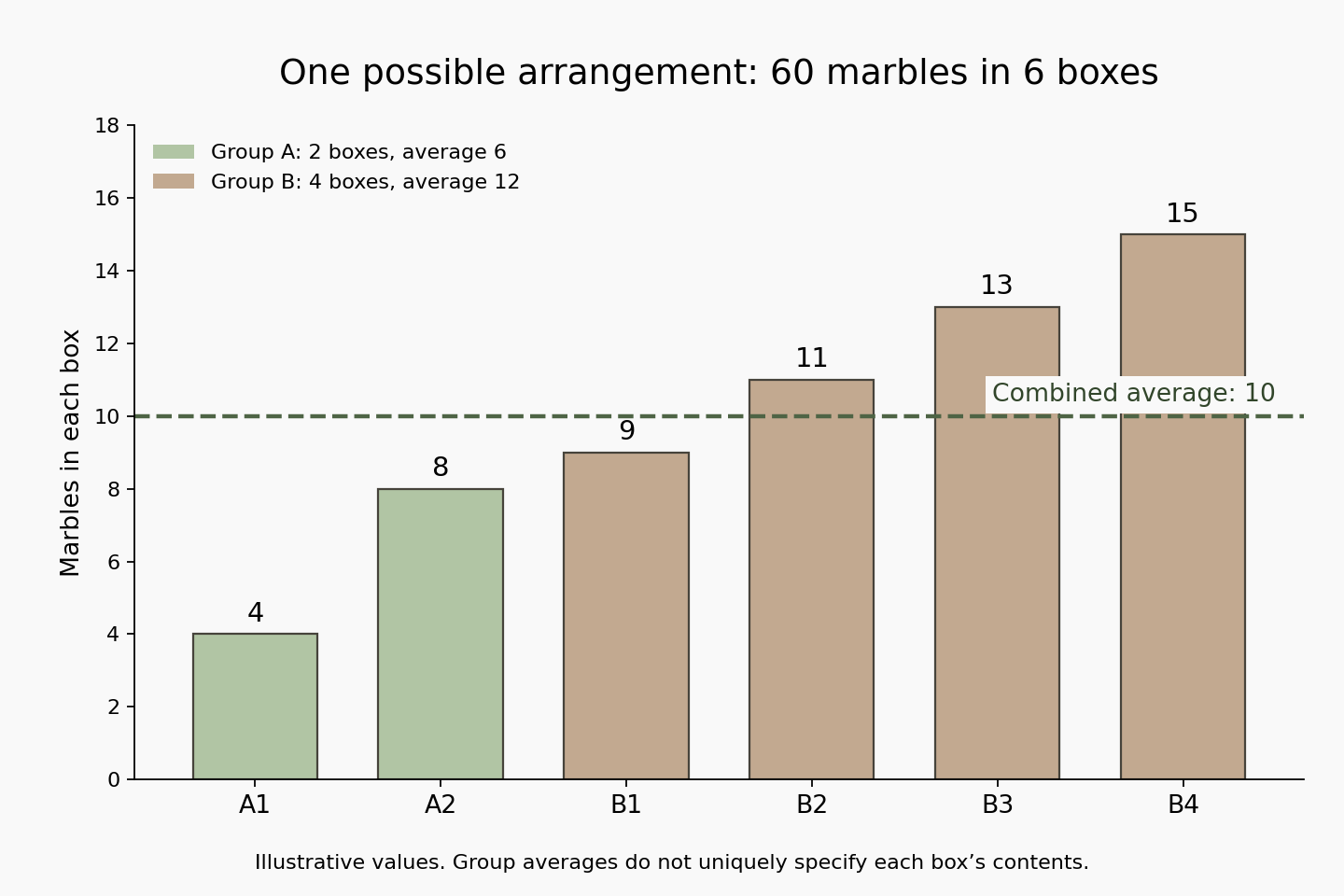
The diagram below shows one possible arrangement consistent with the worked question. Group A’s two boxes contain four and eight marbles, for a total of twelve and an average of six. Group B’s four boxes contain nine, eleven, thirteen and fifteen marbles, for a total of forty-eight and an average of twelve.

Together the six box values add to sixty. The dashed line at ten marks their combined average. Some boxes contain fewer than ten and others contain more. An average describes the equal-share level, not a claim that every original item has that value.
The individual numbers in this diagram are an illustration, not information deduced uniquely from the two group averages. Many arrangements have the same totals. What the question fixes is each group’s count and total, and therefore the combined average. The picture supplies a concrete example of those relationships without inventing a required distribution.
Ask the child to check the totals rather than judge only the height of the bars. Four plus eight is twelve. Nine plus eleven plus thirteen plus fifteen is forty-eight. Twelve plus forty-eight is sixty. Six boxes give an average of ten. The diagram supports the calculation, while its labels keep the quantities and groups clear.
CHAPTER 8 OF 25 · Check the conditions
8. When equal-sized groups make the shortcut valid
Now change the question so that both groups contain two boxes. Group A has an average of six and Group B has an average of twelve. Their totals are twelve and twenty-four marbles. Together there are thirty-six marbles in four boxes, giving an average of nine.
In this case, (6 + 12) ÷ 2 also gives nine. The shortcut works because each average represents the same number of boxes. The two groups contribute equal numbers of items to the pooled collection, so giving their average labels equal influence is appropriate.
Try three boxes in each group. The totals are eighteen and thirty-six; the combined total is fifty-four across six boxes. The average is again nine. Changing the common group size does not change the midpoint when the two counts remain equal.
This contrast is better than teaching “never average averages.” Sometimes that operation is valid for the requested pooled average, and sometimes it is not. The child should check the counts behind the averages. A useful compact rule is, “For all the items, recover totals and counts; a midpoint shortcut needs equal group sizes.” Understanding the condition makes the shortcut a choice rather than a habit applied blindly.
CHAPTER 9 OF 25 · Check the conditions
9. Equal group averages are a special case too
Suppose two boxes have an average of six marbles and four other boxes also have an average of six. The totals are twelve and twenty-four. Together, thirty-six marbles in six boxes give an average of six. The group sizes differ, but the common average remains unchanged.
The simple calculation (6 + 6) ÷ 2 also gives six. This does not prove that unequal group sizes can generally be ignored. It works here because the group averages are identical. Every group contributes the same equal-share amount per box, so combining them preserves that amount.
Use this case after the unequal-average example. It prevents the child from developing a different false rule that unequal group sizes must always produce an answer different from the average of the group labels. The structure, rather than a pattern in the last answer, decides what happens.
Parents need not introduce a formal weighted-average formula to explain this exception. The total-first calculation verifies it directly. Ask the child to recover both totals and combine the counts. The dependable method works in the general case and in the special cases. A shortcut can then be recognised as a consequence of the conditions, rather than a replacement for the meaning of average.
CHAPTER 10 OF 25 · Check the conditions
10. Two averages alone do not always determine a pooled average
If a question only says one group’s average is six and another’s is twelve, the average across all their items is not uniquely determined without counts or an equivalent relationship between the counts. One group might contain far more items than the other. That changes the combined total relative to the combined count.
For example, one box averaging six combined with three boxes averaging twelve gives totals six and thirty-six. Forty-two marbles across four boxes give an average of 10.5. Three boxes averaging six combined with one averaging twelve gives totals eighteen and twelve. Thirty marbles across four boxes give an average of 7.5.
Both examples use the same two group averages, six and twelve. Their pooled averages differ because their group sizes differ. A child who asks how many items each average represents is therefore asking a necessary mathematical question, not being difficult.
In a well-specified problem, the counts may be written directly, given through a ratio or supplied elsewhere in a table. Read all the information before deciding it is missing. If it really is absent, do not invent equal-sized groups simply to make nine possible. A clear account of what is known and what remains unknown is part of good problem solving.
CHAPTER 11 OF 25 · Check the conditions
11. The combined average should fit the group averages
With two nonempty groups whose averages are six and twelve, the average across all their items must lie between six and twelve. In the worked example, ten does. An answer such as eighteen cannot be the pooled average of those two groups under the stated conditions.
The pooled average is closer to twelve than to six because more boxes belong to the twelve-average group. There are four boxes in that group and two in the six-average group. Ten is two away from twelve and four away from six. This is a useful reasonableness check after the exact total-first calculation.
Keep the check in its proper role. “Closer to the larger group’s average” does not by itself find the exact answer. Values such as 9.5 and 10.5 could also lie on that side of the midpoint. The totals and counts determine ten precisely; the between-values check can then expose an answer that does not fit.
If the group averages are equal, the combined average equals them. If one group has no items, it cannot be treated as an ordinary nonempty group with a meaningful average from those items. Early practice should use clearly positive item counts. Making the conditions explicit helps the child understand why the check works instead of treating it as a universal slogan detached from the data.
CHAPTER 12 OF 25 · Handle fresh questions
12. Do not round a supplied average before recovering its total
Consider four boxes with an exact average of 8.5 marbles and six boxes with an exact average of twelve. The first total is 4 × 8.5 = 34. The second is 6 × 12 = 72. Together, 106 marbles in ten boxes give a combined average of 10.6.
If the child rounds 8.5 to nine before multiplying, the first total becomes thirty-six instead of thirty-four. The pooled total becomes 108 and the average becomes 10.8. The calculation has changed the given information before the question asked for any approximation.
An average number of marbles per box can be fractional even when every box contains a whole number of marbles. Thirty-four whole marbles shared conceptually across four boxes has an average of 8.5. The average is a summary of the group; it does not claim that an original box contained half a marble.
Distinguish exact from rounded source information. If a problem explicitly says an average was rounded, multiplying it by the count may not recover an exact integer total uniquely. The worked example here states exact averages. Read the question’s precision conditions and preserve the given values until a specified rounding step is required.
CHAPTER 13 OF 25 · Handle fresh questions
13. A fresh worked example changes both averages and counts
Original question: “Three children read an average of eight pages each during an activity. Two other children read an average of thirteen pages each. What is the average number of pages read across all five children?” We are averaging pages per child, and each child belongs to one group.
The first total is 3 × 8 = 24 pages. The second total is 2 × 13 = 26. Together, fifty pages were read by five children, so the average is 50 ÷ 5 = 10 pages per child. The two groups have different sizes, so their simple average of 10.5 is unsuitable.
Check that ten lies between eight and thirteen. It is closer to eight because three children belong to that group and only two belong to the thirteen-average group. Multiply ten by five to recover the pooled fifty pages. Both checks agree with the calculation and interpretation.
This example is a stronger transfer check than changing only the names in the original marble question. The larger group now has the lower average. A child who learned “the answer should be near the bigger average” without considering group size may get caught. The relevant influence comes from how many items each average represents, not simply from which average has the greater numerical value.
CHAPTER 14 OF 25 · Handle fresh questions
14. Adding a new item changes both total and count
Five boxes have an average of eight marbles, so their total is forty. A new box containing fourteen marbles is added. The new total is fifty-four and the new box count is six. The new average is 54 ÷ 6 = 9 marbles per box.
The new box is a group of one with an average of fourteen. Taking (8 + 14) ÷ 2 would give eleven and treat the original five boxes as if they were one box. This is the same unequal-group issue in a different form. The total-first method makes the change clear.
Check the direction before calculating. Fourteen is above the original average of eight, so adding that box should raise the average. Nine is higher than eight but below fourteen. The exact amount still comes from the new total and count, not from estimating a midpoint.
If the new box contained exactly eight, the average would remain eight. If it contained fewer than eight, the average would fall. These contrasts connect an added item to the group summary. They help the child see why average questions are not merely instructions to divide the numbers appearing on the page; the composition of the collection matters.
CHAPTER 15 OF 25 · Handle fresh questions
15. Removing an item also changes both quantities
Six boxes have an average of nine marbles, so the total is fifty-four. A box containing fourteen marbles is removed. Forty marbles remain across five boxes, giving an average of eight. This reverses the addition example and checks that total and count are both being updated.
The operation on the total is subtraction because fourteen marbles leave the collection. The operation on the count is also subtraction because one box leaves. Dividing forty by the old count of six would treat the removed box as if it still belonged to the group. The resulting average would answer a different, unsuitable question.
Ask your child to label the before and after states. Before: six boxes, fifty-four marbles, average nine. After: five boxes, forty marbles, average eight. A short record can prevent numbers from different stages being combined accidentally.
This is a neighbouring application of the same relationship, not a requirement to master every average problem at once. If the child is still understanding why two unequal groups cannot simply be averaged, keep the main practice there. Use adding and removing items when it helps test whether the child can carry total and count together through a change.
CHAPTER 16 OF 25 · Review independently
16. The denominator counts data items, including repeated values
For the list 6, 6, 12, 12, 12 and 12, there are six data items. Only two different numerical values appear, but repeated values still represent separate boxes. Dividing the total by two distinct values would ignore four of the boxes being averaged.
This is another way the answer nine can arise. The child may not explicitly average group averages; they may count unique values instead of the number of observations. Ask them to assign each entry to a box. Two sixes name two boxes, and four twelves name four other boxes.
The same principle applies to a list containing zero. If three boxes contain zero, six and twelve marbles, there are three boxes, and the average is eighteen divided by three, or six. The empty box contributes zero to the total but still contributes one to the count because it is an included item.
Do not confuse a recorded zero with missing information. “This box contains zero marbles” is a known value. “We do not know how many marbles are in this box” is not zero. The question must establish the data set and its values. A tutor can use these small contrasts to check whether the child understands what belongs in the denominator.
CHAPTER 17 OF 25 · Review independently
17. Groups must be combined without counting an item twice
The simple pooled calculation assumes the two groups are separate collections of items. If a box appears in both groups, adding the counts and totals would count that box and its marbles twice. The question should make group membership clear before we combine anything.
For ordinary primary practice, use two labelled sets with no overlap. The first two boxes are Group A and the next four are Group B. Every box belongs to exactly one group, so adding two and four gives six different boxes. That condition is easy to make visible with counters or a labelled diagram.
If a problem introduces overlapping groups, their separate averages and counts alone may not give the unique combined average. Information about the overlap is needed. This is an optional boundary example rather than a demand to teach set notation. Its purpose is to explain why “add totals and counts” needs a properly identified collection.
Parents can keep the practical check short: “Are these different items, and are we including each once?” The question is useful beyond averages. It helps prevent double counting in combined collections while keeping attention on the actual problem. For this guide’s worked examples, the groups are stated or illustrated as separate, so the pooled calculation includes each item once.
CHAPTER 18 OF 25 · Review independently
18. A short home activity using six labelled boxes
Use six cups, paper circles or drawn boxes and sixty counters if available. Make two boxes contain four and eight counters. Make the other four contain nine, eleven, thirteen and fifteen. Label the first pair A and the second group B. The totals are twelve and forty-eight.
Ask your child to find the average within each group. Group A’s twelve counters across two boxes give six. Group B’s forty-eight across four give twelve. Then pool all six boxes and ask for the combined average. Sixty across six gives ten. The same counters supply all three averages.
If sixty physical counters are inconvenient, use written number cards in the boxes instead. Each card states the quantity in that box. The child can add the values and count the boxes without handling a large collection. The representation should support the relationship, not turn gathering materials into the main task.
For a final turn, change the group sizes while preserving clear totals. Ask what information is needed before combining the averages. Record whether the child identifies the item counts, reconstructs the totals and chooses the combined denominator independently. A few well-chosen turns can reveal more than many questions that all happen to have equal-sized groups.
CHAPTER 19 OF 25 · Review independently
19. An original practice set with worked answers
Question A: two bags average five beads each and three other bags average ten. The totals are ten and thirty, so forty beads across five bags give an average of eight. The simple midpoint of five and ten, 7.5, treats unequal bag counts as equal and is unsuitable.
Question B: three bags average four beads and three others average eight. The totals are twelve and twenty-four. Thirty-six across six bags gives six. Here the midpoint shortcut also gives six because the group sizes match. State that condition before using the shortcut.
Question C: four containers average seven litres each and two others average thirteen litres. The totals are twenty-eight and twenty-six. Fifty-four litres across six containers gives nine litres per container. All quantities use the same unit, and the containers are separate items in the data set.
Question D: three boxes average six marbles and two others average eleven. The totals are eighteen and twenty-two. Forty across five boxes gives eight. Question E: two nonempty groups both average nine, but their counts are different. Their pooled average is nine because each group’s total is nine times its item count. Confirm by choosing small counts and recovering totals.
CHAPTER 20 OF 25 · Review independently
20. What should a Primary 6 Mathematics tutor assess?
The tutor can begin by asking the child to name average, total and number of items in one group. Can the child recover a total from a given average and count? Can they recover the average from the total and count? These observations establish whether the foundational relationship is understood before combining groups.
Next use one equal-size and one unequal-size pair. A child who obtains correct answers only in equal-size cases may be applying a midpoint habit. Ask for a brief explanation of the denominator in the unequal-size case. “Six boxes” communicates a stronger interpretation than “because averages mean divide.”
Check arithmetic separately. If the child correctly reconstructs twelve and forty-eight but adds them incorrectly, the pooling structure may be secure. If they calculate six plus twelve accurately and divide by two, the arithmetic is working while the item weighting is not. Those are different teaching needs.
When discussing Primary 6 Mathematics tuition at eduKate Punggol, bring the original average question and the child’s first working. Ask how totals and counts will be made visible and how a fresh unequal-group example will be checked. Confirm current arrangements directly. This article does not promise a timetable, class size, score or fixed number of lessons.
CHAPTER 21 OF 25 · Review independently
21. What progress looks like beyond reciting a formula
The child may begin asking how many items each average represents. That is a meaningful first change from immediately adding the two averages. The count has become part of the interpretation. They may still need support calculating the total, but the right quantity is now being sought.
A second sign is labelling intermediate answers. “Group A total twelve, Group B total forty-eight” keeps the numbers attached to their roles. A child who can explain those totals is less likely to confuse an average with a whole collection or use one group’s count for both.
A third sign is recognising conditions. Equal-sized groups permit a midpoint shortcut; unequal-sized groups generally require the totals and counts to be retained. Identical group averages remain unchanged when combined. The child can explain these cases instead of replacing one broad slogan with another.
A fourth sign is checking the final answer against the pooled total. Ten times six recovers sixty; nine times six does not. Try a fresh example on another day, including one where the larger group has the lower average. Independent success with that contrast shows more than immediate repetition of the original worked marble question.
CHAPTER 22 OF 25 · Review independently
22. Parents’ questions about averages of averages
“Should I forbid adding averages?” Teach the condition instead. The simple average of group averages gives the pooled item average when the group sizes are equal. Equal group averages are another special case. Recovering totals and counts is a dependable method that explains both the general case and the exceptions.
“Must my child learn the phrase weighted average?” The child can solve these examples through total value and number of items without a new technical label. Parents may recognise the idea as weighting groups by their counts. The useful classroom explanation is that more items contribute more entries to the pooled data set.
“Can an average of whole-number counts be a decimal?” Yes. A total of forty-two marbles across four boxes has an average of 10.5. That summary does not imply an original box contained half a marble. An average need not match a value that actually appears in the data.
“What if a reported group average was rounded?” Read the stated precision. A rounded average may not recover a unique exact total when multiplied by the count. This guide’s worked questions use exact averages. If a worksheet’s precision or group membership is unclear, clarify it before treating the answer as evidence that the child misunderstood the relationship.
CHAPTER 23 OF 25 · Review independently
23. Keep the correction focused on the collection
If your child answers nine in the first example, say, “You averaged six and twelve accurately. Now let’s check how many boxes those numbers stand for.” Put two box cards under six and four under twelve. The unequal counts become visible without dismissing the correct arithmetic.
Recover the totals together and ask how many boxes will share the combined sixty. There are six. Let the child calculate ten and then check ten times six. The correction now follows from the collection, rather than from an adult’s instruction that this question needs a different formula.
If the child is frustrated, return to a small equal-sharing example. The difficulty may be losing track of several quantities, not failing to understand division. Use labelled groups and one intermediate total at a time. Reduce the counting or arithmetic load while preserving the structure you want to teach.
Praise a specific decision: “You counted all six boxes before dividing.” That is something the child can repeat. A calm, precise success gives the next lesson a stable starting point. The aim is not to make every average question look identical, but to help the child identify the collection, preserve its total and choose the count that belongs to it.
CHAPTER 24 OF 25 · Review independently
24. Three groups use the same total-first method
Adding a third group does not require a new rule. Suppose Group A has two boxes averaging six marbles, Group B has four boxes averaging twelve and Group C has three boxes averaging eight. Their separate totals are twelve, forty-eight and twenty-four marbles. Keep each total attached to its corresponding group before combining them.
The pooled total is 12 + 48 + 24 = 84 marbles. The pooled count is 2 + 4 + 3 = 9 boxes. The combined average is 84 ÷ 9 = 9⅓ marbles per box. The fractional result is valid as an average, even though each original box contains a whole number of marbles.
Simply averaging the three group labels would give (6 + 12 + 8) ÷ 3 = 8⅔. That gives equal influence to groups containing two, four and three boxes. It does not preserve the count of items behind each average. The same issue appears with three groups as with two.
Check the correct answer against the total: nine shares of 9⅓ make eighty-four. It also lies between the lowest group average, six, and the highest, twelve. The bounds check is useful but not sufficient; the incorrect answer 8⅔ also lies between them. Recovering the total through the combined count is the stronger check for this example.
Use this extension only after the two-group structure is clear. Its purpose is to test whether the child is following a reusable relationship rather than memorising a special two-group procedure. A labelled note for each group's count, average and total can keep the extra information manageable.
If the child averages group labels automatically, continue with unequal-size contrasts and labelled totals. If the child knows the method but uses the wrong denominator, count the combined items explicitly. If rounded values or unclear membership cause trouble, inspect the question’s conditions. If arithmetic is the issue, practise that calculation separately.
The MOE Primary Mathematics syllabus lists the relationship between average, total value and number of data in Primary Six. Use your child’s current school materials to choose suitable numbers and problem complexity. The original examples here explain a parent concern; they do not predict an assessment or prescribe a homework quantity.
For wider preparation, visit Primary 6 Mathematics and PSLE Mathematics in Punggol. For a related checking habit, read why recalculating is not enough for checking. That guide extends the idea of checking whether the answer matches the requested quantity, beyond merely repeating arithmetic.
A useful starting question for a Punggol Primary 6 Mathematics tutor is, “My child divides two group averages by two even when the groups have different numbers of items. Can we recover totals and check what the denominator counts?” That gives the lesson a precise purpose and gives the child a relationship they can explain and verify.