
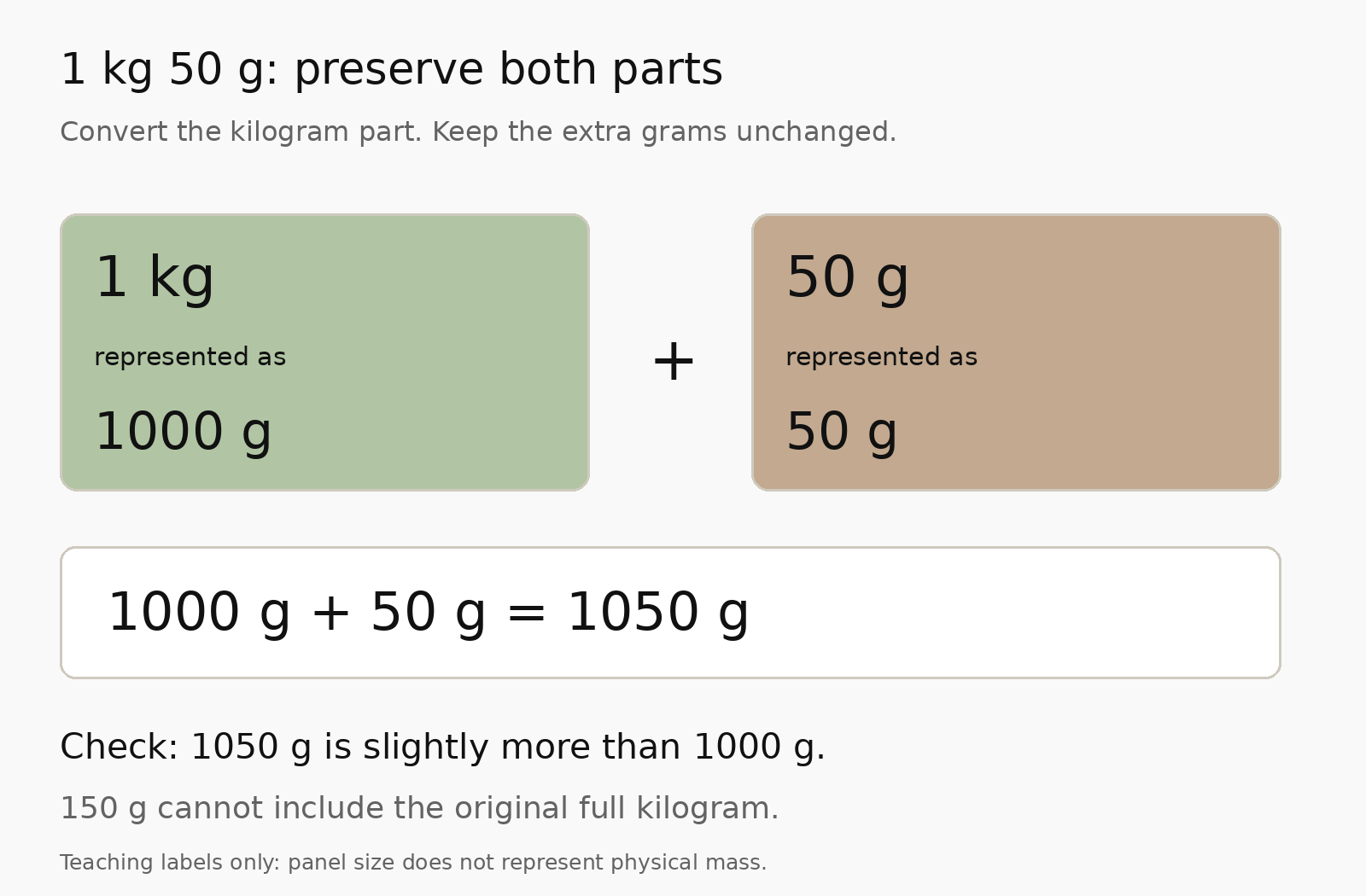
Your child converts 1 kg 50 g to 150 g. The digits may look as though they belong together, but one kilogram already represents one thousand grams. The correct conversion is 1000 g + 50 g = 1050 g. Begin by separating the two parts, converting the kilogram part, and then adding the grams that were already there.
For parents considering Primary 3 Mathematics tuition in Punggol, this is a helpful question to bring to a tutor because it reveals more than a missing zero. Your child needs to understand what the two unit labels mean, how one kilogram is represented in grams, and why the extra fifty grams is added to that amount rather than attached to a digit.
A Primary 3 Mathematics tutor can make the relationship visible with labelled mass cards, a place-value drawing and a simple check: one kilogram and fifty grams must be slightly more than one thousand grams. These Mathematics tutorials can teach a dependable conversion method without relying on a rule about joining numbers or remembering an unexplained number of zeros.
The featured diagram separates 1 kg into its equivalent 1000 g and keeps the additional 50 g as a distinct part before forming 1050 g. Its panels are teaching labels, not a scale drawing of physical objects. The size of a panel does not represent its mass.
This guide uses original hypothetical quantities for teaching. Do not treat an object's size, a packet's appearance or an invented example as a measured mass. Some arithmetic and scale-reading activities are optional extensions. Match practice to your child's current schoolwork, follow the teacher's presentation requirements, and use adult supervision if physical equipment is involved.
eduKate Punggol · Primary Mathematics · Parent questions
Find your next learning step
Start with the question closest to your family, or read the full guide in order.
Chapter index
Understand the two parts · Chapters 1–3
Convert and reconstruct · Chapters 4–10
- Use place value to explain the zero
- Replace digit joining with a three-step routine
- Keep an unchanged gram part unchanged
- Check whether the answer can fit the original amount
- Convert grams back into kilograms and grams
- Explain exact kilograms and zero remaining grams
- Regroup an extra gram amount of one thousand or more
Compare and combine · Chapters 11–15
Read the situation · Chapters 16–19
Practise and continue · Chapters 20–25
CHAPTER 1 OF 25 · Understand the two parts
1. Preserve the part your child understood
The answer 150 g may show that your child read both printed numbers and recognised that a single-unit answer was required. Those are useful starting points. The repair is to connect the kilogram label to its actual gram value before combining the parts.
Ask your child to read 1 kg 50 g aloud. “One kilogram and fifty grams” makes the two quantities more visible than reading only “one, fifty”. Point to each unit label as the child reads. Then ask which part is already expressed in grams.
Fifty grams is already in the target unit. The one-kilogram part still needs to be represented in grams. Write 1 kg = 1000 g on a separate line, then bring the additional fifty grams back into the calculation. The conversion becomes 1000 g + 50 g = 1050 g.
If your child says, “I just put the numbers together”, do not begin with a reprimand about carelessness. The child is describing a method. Explain why the method does not account for what a kilogram means. A specific replacement method will be more useful than asking for greater attention to a rule that has never been understood.
After the explanation, use a fresh value, such as 1 kg 20 g. It equals 1020 g. Ask the child to show the converted kilogram part and the unchanged gram part. This gives better evidence of understanding than asking the child to repeat 1050 immediately after seeing it written.
CHAPTER 2 OF 25 · Understand the two parts
2. Give kilograms and grams a clear relationship
One kilogram equals one thousand grams. The conversion is exact: the same mass can be described using either unit. When you write 1 kg = 1000 g, you are changing the representation, not making an object heavier.
Use a labelled card reading “1 kg” and another reading “1000 g”. Place them beside a single hypothetical parcel drawing. Say that the labels are alternative descriptions of the parcel's mass in this teaching example. They do not describe two parcels that must be added together.
If both cards remain on the table, label them “same mass, different units”. Otherwise a child might add one kilogram and one thousand grams and reasonably obtain two kilograms. The adult's demonstration needs to distinguish alternative labels from a combined collection.
For an official unit reference, the NIST mass-units resource explains the relationship between the kilogram, gram and the prefix kilo. Your child does not need the scientific definition of the kilogram to complete these primary-school examples. The relevant relationship here is that each kilogram corresponds to one thousand grams.
Keep the meaning attached to the notation. “kg” names kilograms and “g” names grams. Reading the symbols aloud can help a child who recognises the numerals more readily than the units. The unit tells us what each number counts, so it belongs in the reasoning from the beginning, not merely at the end as an answer decoration.
CHAPTER 3 OF 25 · Understand the two parts
3. Model one kilogram as ten hundreds of grams
Draw ten cards, each labelled 100 g. Their combined mass is 1000 g, so together they represent one kilogram. Count the labelled values: one hundred, two hundred, three hundred, continuing to one thousand grams.
The cards themselves are not masses of one hundred grams. They are representations. State that distinction if your child handles them physically. Adding paper cards to a real scale will not measure the hypothetical quantities printed on them.
Now place a separate card labelled 50 g beside the ten hundred-gram cards. The collection represents one thousand grams plus fifty grams, or 1050 g. Ask which cards represent the kilogram and which card represents the extra grams.
This model connects conversion to familiar place value. Ten hundreds make one thousand, and the additional fifty is five tens. The child can see that the kilogram part occupies the thousand-gram place rather than the hundred-gram place.
If ten cards are too visually busy, use one card labelled “1000 g” and briefly show its ten-hundred breakdown underneath. The useful model is the one that makes the unit relationship clear without creating a new tracking problem. A tutor can choose a representation that suits the child's current counting and place-value confidence.
Return to the original mixed-unit label after using the model. Objects and drawings help only when the child connects them to the written question. Point from “1 kg” to the thousand-gram group and from “50 g” to the fifty-gram card before writing the final single-unit amount.
In 1050, there is one thousand, no hundreds, five tens and no ones. The zero in the hundreds place keeps the fifty grams from becoming five hundred grams. The final zero records that the extra part is fifty, not five.
Write 1000 + 50 = 1050 beneath the mass labels. Then compare 1050 with 150. The number 150 contains one hundred and five tens; it does not contain the one thousand grams supplied by the kilogram.
Ask your child to build both numbers using place-value cards. This can reveal whether the difficulty is understanding the conversion relationship or writing the resulting four-digit number. A child may correctly say “one thousand and fifty grams” but write 150. That needs a notation and place-value repair in addition to the unit explanation.
Contrast 1 kg 5 g with 1 kg 50 g and 1 kg 500 g. Their totals are 1005 g, 1050 g and 1500 g. The kilogram part remains one thousand grams in every example. The extra gram part changes from five ones to five tens to five hundreds.
| Original amount | Kilogram part in grams | Extra grams | Total in grams |
|---|---|---|---|
| 1 kg 5 g | 1000 g | 5 g | 1005 g |
| 1 kg 50 g | 1000 g | 50 g | 1050 g |
| 1 kg 500 g | 1000 g | 500 g | 1500 g |
Do not teach these as three unrelated spellings to memorise. Ask what the extra mass contributes each time. Once the child sees the contributions, the zeros have a purpose. They preserve the correct places when the two gram amounts are combined. A clear expansion is more dependable than an instruction to “put enough zeros between the numbers”.
CHAPTER 5 OF 25 · Convert and reconstruct
5. Replace digit joining with a three-step routine
A useful routine is: separate the parts, express both in grams, add the gram values. For 2 kg 30 g, the parts are two kilograms and thirty grams. Two kilograms is 2000 g. Adding thirty grams gives 2030 g.
Write one line for the converted kilogram part and one line for the final total. You might use “2 kg = 2000 g” followed by “2000 g + 30 g = 2030 g”. This is short enough to use independently while showing the relationship clearly.
Digit joining gives 230, which is not the required two thousand and thirty grams. It happens to look tidy, but the printed digits have lost their unit meanings. The method cannot tell us where the thirty belongs relative to the thousands.
Use 2 kg 300 g as a contrast. This equals 2300 g. The two examples differ by 270 g because the extra parts are thirty and three hundred grams. Ask the child to read the two extra parts aloud before comparing the final answers.
Some students eventually convert familiar quantities mentally. That is fine when the underlying relationship is understood. Keep the three-step routine available for checking and for new values. The aim is not to require a long written performance for every conversion; it is to provide a method that remains correct when the number of digits in the gram part changes.
In 3 kg 70 g, only the kilogram part needs a change of unit. Three kilograms becomes 3000 g. The seventy grams is already expressed in grams and stays seventy grams. The total is 3070 g.
A child may convert every printed number by multiplying by one thousand, producing 3000 g and 70,000 g. Ask which unit each original number had. Multiplying seventy grams by one thousand would change the amount, not simply express that same amount in the target unit.
Another child may add three and seventy first, then multiply the result. That combines unlike units before accounting for their relationship. Three kilograms and seventy grams are not seventy-three kilograms or seventy-three grams.
Colour can help temporarily: mark the kilogram part in sage and the gram part in tan. Convert the sage quantity to grams and leave the tan quantity unchanged. The final addition then combines two amounts in the same unit. Reduce the colour support once the child can identify the parts independently.
Use a smaller check if the arithmetic becomes distracting. One kilogram and ten grams gives 1010 g. The child can point to the thousand and the ten. Then return to three kilograms and seventy grams. Keeping the unit decision visible helps the tutor distinguish a conversion mistake from a difficulty adding or writing the resulting whole number.
CHAPTER 7 OF 25 · Convert and reconstruct
7. Check whether the answer can fit the original amount
One kilogram and fifty grams is greater than one kilogram. Therefore its answer in grams must be greater than 1000 g. It is also less than two kilograms because the extra fifty grams is less than another thousand grams. The total lies between 1000 g and 2000 g.
The proposed answer 150 g fails that check immediately. It is less than one thousand grams, so it cannot include the original full kilogram. The correct answer 1050 g falls in the expected interval.
Use this as a reasonableness check, not as a replacement for the calculation. Many incorrect answers could still lie between one thousand and two thousand grams. For example, 1500 g passes the broad interval check but does not preserve an additional fifty grams. The exact conversion and the broad check answer different questions.
For 4 kg 80 g, expect an answer a little above 4000 g and below 5000 g. The exact result is 4080 g. If a child writes 480 g, the full four-kilogram component has disappeared. If the child writes 4800 g, the extra eighty grams has become eight hundred grams.
Ask your child to make the rough prediction before calculating. A prediction made after seeing an answer may simply echo that answer. The check becomes more useful when it is an independent expectation based on the original quantities. It can catch a scale error before the child accepts a tidy-looking number.
CHAPTER 8 OF 25 · Convert and reconstruct
8. Convert grams back into kilograms and grams
Take 1050 g and identify one full group of one thousand grams. That group is one kilogram. Fifty grams remains. The mixed-unit form is therefore 1 kg 50 g.
Use the ten hundred-gram cards again if needed. One thousand grams can be gathered into a single kilogram label while the fifty-gram card remains separate. This is the same relationship as the forward conversion, read in the other direction.
For 2075 g, there are two full thousand-gram groups and seventy-five grams remaining. The result is 2 kg 75 g. Do not read the last three digits automatically as a new number without understanding the grouping. The seventy-five is the amount left after the two kilograms have been represented.
For 2500 g, there are two full kilograms and five hundred grams remaining. The result is 2 kg 500 g. Comparing 2075 and 2500 gives another chance to explain the places occupied by the remainder in grams.
Check a reverse conversion by returning to grams. Two kilograms and seventy-five grams becomes 2000 g + 75 g = 2075 g. If that reconstructed value differs from the original, inspect the grouping and the written remainder. A forward-and-back check is useful because it tests whether the representation preserved the same amount, rather than merely whether an adult recognised the final answer as familiar.
CHAPTER 9 OF 25 · Convert and reconstruct
9. Explain exact kilograms and zero remaining grams
In 3000 g, three full thousand-gram groups use all the grams. The amount is three kilograms with zero additional grams. Writing 3 kg is enough unless the worksheet specifically asks for a mixed-unit form with a separate gram field.
If separate boxes are supplied for kilograms and grams, the entries are three and zero. Leaving a required gram box blank may look like an unfinished response. A written zero makes the absence of an additional gram part explicit.
Contrast 3000 g with 3005 g. The first is 3 kg; the second is 3 kg 5 g. Five grams is a small extra part, but it is not nothing. A child who drops the five because it looks insignificant has changed the given amount.
Next compare 3050 g and 3500 g. Their mixed forms are 3 kg 50 g and 3 kg 500 g. The full kilogram groups match, but the remaining gram quantities differ by 450 g.
These comparisons connect the reverse conversion to place value rather than a rule about cutting a number into two pieces. The child should know why thousands of grams become kilograms and why fewer than one thousand grams remain in the usual mixed representation. A remainder of zero is meaningful, just as a remainder of five or fifty is meaningful. The notation should preserve whichever amount the original number describes.
CHAPTER 10 OF 25 · Convert and reconstruct
10. Regroup an extra gram amount of one thousand or more
An extension is 1 kg 1250 g. This is a valid description of a combined amount, but the gram part contains another full kilogram. Converting both parts to grams gives 1000 g + 1250 g = 2250 g.
The same amount can be written more compactly as 2 kg 250 g. One thousand grams from the extra part has been regrouped as another kilogram, leaving two hundred and fifty grams.
Introduce this only after ordinary mixed forms are comfortable. Most early examples keep the additional gram part below one thousand, which allows a child to practise the central routine without another regrouping decision.
Do not tell the child that 1 kg 1250 g is mathematically impossible. It represents a clear amount. The issue is choosing a standard mixed representation or the form requested by the task. If a question asks for grams, 2250 g is the required form. If it asks for kilograms and grams, 2 kg 250 g is a usual regrouped answer.
Try 2 kg 1000 g as a boundary case. It equals 3000 g, or 3 kg. No additional grams remain after regrouping. Use labelled thousand-gram groups to show where the extra kilogram came from. This extension makes the unit relationship more flexible while preserving the same principle: the representation changes, but the total mass stays the same.
Compare 1 kg 50 g with 950 g. The first amount is 1050 g. The second is already in grams. Now the comparison is between 1050 g and 950 g, so the mixed-unit amount is greater by 100 g.
A child who compares one with nine hundred and fifty may choose 950 g as the greater amount. That decision ignores the kilogram unit. Ask the child to name each quantity before comparing the numerals.
For 2 kg 30 g and 2 kg 300 g, the kilogram parts match. The comparison can focus on thirty grams and three hundred grams, or both amounts can be converted to 2030 g and 2300 g. Either route works when the child keeps the units and roles clear.
When comparing 1 kg 900 g with 2 kg 50 g, convert to 1900 g and 2050 g. The second is greater by 150 g. A gram part of nine hundred does not outweigh a full additional kilogram automatically; the whole amount must be considered.
Encourage your child to state the direction of the comparison and the difference separately. “Two kilograms and fifty grams is greater” identifies the larger amount. “It is one hundred and fifty grams greater” describes the gap. A correct difference without a clear direction can still leave the original comparison question unanswered.
CHAPTER 12 OF 25 · Compare and combine
12. Order three amounts without relying on the longest number
Suppose the amounts are 980 g, 1 kg 5 g and 1 kg 50 g. Convert the mixed forms to 1005 g and 1050 g. The ascending order is 980 g, 1 kg 5 g, then 1 kg 50 g.
The string containing more printed characters does not necessarily represent the greatest amount. Unit labels and spaces change how long an expression looks. The comparison should depend on the quantity after its unit relationships have been understood.
Write the common-unit values underneath the original labels. Then arrange the original labels in the requested order. This final copying step matters: the child may correctly sort the gram totals but attach them to the wrong original amounts.
For a descending-order extension, use 2 kg 80 g, 2050 g and 1 kg 950 g. Their values are 2080 g, 2050 g and 1950 g. They are already listed from greatest to least in that sequence. Ask the child to explain why 1 kg 950 g remains below either of the two amounts above two kilograms.
Keep the number of quantities small while the conversion routine is new. Three items provide enough variation to test order and labelling without turning the exercise into a tracking challenge. Once the child can sort accurately, change the presentation: use cards, a short table or a spoken list. The same quantity comparison should survive a different arrangement on the page.
Consider a hypothetical parcel of 1 kg 50 g and another of 450 g. To find their combined mass, convert the first to 1050 g. Then add 1050 g and 450 g to obtain 1500 g, or 1 kg 500 g.
The result is greater than either starting mass, as expected when two positive masses are combined. That broad check is useful, but the exact calculation still needs to preserve both amounts.
Keep the conversion and addition on separate lines at first. A child trying to do both mentally may lose the fifty grams while concentrating on the kilogram. “1 kg 50 g = 1050 g” protects the first quantity before the addition begins.
Another route is to combine the gram parts directly while keeping the kilogram part separate. Fifty grams plus four hundred and fifty grams is five hundred grams. With the original kilogram, the answer is 1 kg 500 g. This is a meaningful method if the child can explain the two parts.
Do not require a single preferred route when another clear route is correct. Ask the child to show how the quantities were preserved and how the final unit answers the question. If the task asks for grams only, finish with 1500 g. If it asks for kilograms and grams, finish with 1 kg 500 g. A correct amount can still need a different final representation to match the instruction.
CHAPTER 14 OF 25 · Compare and combine
14. Regroup when an addition crosses a kilogram
An optional addition example combines 1 kg 650 g and 750 g. The first mass is 1650 g. Adding 750 g gives 2400 g, which is 2 kg 400 g.
Using mixed parts, the additional grams total 650 g + 750 g = 1400 g. That is one kilogram and four hundred grams. Combine that kilogram with the original kilogram to obtain two kilograms and four hundred grams.
A child may write 1 kg 1400 g as an intermediate representation. It preserves the correct amount, but if a regrouped mixed answer is required, another step is needed. Explain the step without suggesting that all the earlier reasoning was wrong.
The same labelled-card model works: gather a full thousand grams from the fourteen hundred grams into a new kilogram group, leaving four hundred grams outside. The original kilogram group remains, so there are now two full groups.
Introduce this extension after the child can convert and add within a single kilogram interval. If the addition itself is uncertain, practise 650 + 750 separately or use a place-value representation. The teacher or tutor can identify whether the obstacle is ordinary regrouping in addition, grouping grams into kilograms, or keeping the original mixed quantity intact. These are connected tasks, but a useful lesson keeps their roles distinguishable.
CHAPTER 15 OF 25 · Compare and combine
15. Subtract in a common unit to avoid a new conversion error
A hypothetical bag has a mass of 2 kg 50 g. A 300 g portion is removed. Convert the starting amount to 2050 g, then calculate 2050 g − 300 g = 1750 g. The remaining mass is 1 kg 750 g.
A child might try to subtract three hundred directly from the fifty-gram part and become stuck. Converting the whole amount to grams offers a straightforward route through the familiar whole-number subtraction.
For a mixed-unit method, one kilogram can be represented as one thousand grams. The starting amount becomes 1 kg 1050 g. Removing 300 g leaves 1 kg 750 g. Nothing has been borrowed from somewhere else; the original amount has been represented differently.
Use whichever explanation matches the child's current school method. Do not introduce a second procedure merely to make the lesson look advanced. The common-unit route is often enough to show why the subtraction is possible and how the answer should be checked.
Check by adding back the removed amount: 1750 g + 300 g = 2050 g. The remaining amount is below the starting mass and is not negative. If a result such as 2 kg 750 g appears, it is greater than the original 2 kg 50 g and cannot describe what remains after a positive portion is removed. The meaning of the story provides a useful check alongside the arithmetic.
Two hypothetical packages have masses of 1 kg 50 g and 850 g. The first is 1050 g, so the difference is 1050 g − 850 g = 200 g. The first package is two hundred grams heavier in the ordinary everyday comparison of mass used here.
This is a comparison, not a story in which a portion is physically removed from either package. Both packages keep their original masses. The subtraction measures the gap between their values.
Ask your child to identify the greater amount before calculating the difference. If the numbers are reversed without attending to the story, the child may select a subtraction that does not fit the requested comparison at this whole-number stage.
A bar drawing can represent 1050 g as a longer labelled amount and 850 g as a shorter one, with the difference marked as 200 g. The drawing need not be physically measured by the child; its numerical labels state the quantities. Make clear that an approximate sketch does not supply a new value beyond those labels.
Use the difference to reconstruct the greater amount: 850 g + 200 g = 1050 g. This check confirms that the gap fits the two original quantities. If the task asks “how much heavier”, the answer is 200 g, not 1050 g. The total mass and the difference are separate quantities, even though both appear naturally in the solution.
CHAPTER 17 OF 25 · Read the situation
17. Find the additional mass needed to reach a target
Suppose a pretend collection currently has a mass of 1 kg 50 g and the target is 2 kg. Convert both to grams: the current amount is 1050 g and the target is 2000 g. The additional amount needed is 2000 g − 1050 g = 950 g.
Check by combining the current amount with the additional amount: 1050 g + 950 g = 2000 g. That restores the target. The answer describes what must be added, not the final total after adding it.
If your child writes two thousand grams as the answer, ask what that number represents. It is the target, which is already known. The unknown is the gap between the current amount and the target.
If the current amount equals the target, the additional amount is zero. For example, a collection already at 1500 g needs zero additional grams to reach 1 kg 500 g. If the current amount exceeds the target, a positive addition is not the right action. A 1600 g collection would need a reduction of 100 g to reach 1500 g.
These are extension situations designed to keep calculation connected to meaning. Label “current”, “target” and “change needed”. A child who understands conversion but answers with the wrong quantity needs support interpreting the problem, rather than another page of kilogram-to-gram drills. The checking equation can show which role the chosen number is meant to play.
CHAPTER 18 OF 25 · Read the situation
18. Keep reading a scale separate from converting a value
If a scale displays 1050 g clearly, converting that display to 1 kg 50 g is a unit-representation task. If the child must first determine what an unlabelled tick means, an additional scale-reading task is involved. Keep the two decisions separate when explaining an error.
For an optional diagram activity, draw an interval from 1000 g to 1100 g divided into five equal spaces. Each space represents twenty grams because the one-hundred-gram interval is divided into five equal parts. The marks after 1000 g are 1020 g, 1040 g, 1060 g, 1080 g and 1100 g.
Count the spaces, not all the lines including both endpoints. Six boundary lines create five spaces in this example. A child who divides by six is using the number of marks rather than the number of equal intervals.
A pointer at the third internal step from 1000 g indicates 1060 g, or 1 kg 60 g. That reading is different from the opening 1050 g example, which would fall between marked values on this particular sketch. Do not imply every amount must sit on a labelled tick.
Use only clearly specified teaching scales here. Real equipment may have different increments, capacity and precision. The diagram activity does not verify a household scale or establish a measured mass. If the purpose is simply to repair 1 kg 50 g becoming 150 g, an already labelled value is sufficient; scale interpolation can wait until the basic conversion is secure.
CHAPTER 19 OF 25 · Read the situation
19. Distinguish an object's mass from a container's combined mass
An optional application uses a hypothetical empty container of 150 g and contents of 1 kg 50 g. The contents alone are 1050 g. The combined container and contents have a mass of 150 g + 1050 g = 1200 g, or 1 kg 200 g.
If a problem gives the combined mass and asks for the contents, the empty container's mass must be removed. From a combined 1200 g and an empty 150 g, the contents are 1050 g. That returns to the original one kilogram and fifty grams.
Label what is included in each quantity. “Contents”, “empty container” and “combined mass” prevent a correct conversion from being used in the wrong calculation. A picture of a container does not automatically tell the child whether its own mass is included in a stated value.
For real equipment, an adult should follow its instructions and clarify whether the display has been zeroed with an empty container. Do not turn this parent explanation into an equipment-calibration exercise. The hypothetical numbers are enough to teach the distinction between an amount and the total that includes it.
This application can wait if conversion is still difficult. It adds a reading decision before arithmetic. A tutor should observe whether the child preserved all the quantities, chose the correct operation and gave the requested quantity in the correct unit. Those observations reveal more than checking only whether the final answer happens to match a printed key.
CHAPTER 20 OF 25 · Practise and continue
20. Locate the actual obstacle before adding practice
Three attempts can narrow the teaching need. Ask the child to convert 1 kg to grams, then write 1000 + 50 as a whole number, then convert 1 kg 50 g to grams. The expected answers are 1000 g, 1050 and 1050 g.
If the first conversion is uncertain, rebuild the unit relationship. If the child knows the first answer but writes 150 for the second, inspect place value and zero placement. If both simpler tasks are comfortable but the mixed-unit task is not, practise identifying and preserving the two parts together.
A fourth observation is to ask for 1050 g in kilograms and grams. One kilogram and fifty grams is the expected result. If this reverse task is difficult, use full thousand-gram groups and the remainder rather than telling the child to split digits by appearance.
Ask for the child's explanation without insisting on an elaborate speech. Pointing to a thousand-gram card and a fifty-gram card can be meaningful evidence. A correct number copied from an adult is less informative than a short independent demonstration on a fresh value.
Keep the observations specific. One conversion does not diagnose a learning condition or describe the child's whole Mathematics ability. If a difficulty persists, share the exact questions, the answers and the supports that helped with the teacher or tutor. That provides a practical basis for choosing the next step and avoids interpreting every unit error as a general lack of effort.
CHAPTER 21 OF 25 · Practise and continue
21. Use a manageable home lesson and a clear tutor checkpoint
A home session can contain one forward conversion, one reverse conversion and one comparison. Use 1 kg 20 g = 1020 g, 1080 g = 1 kg 80 g, and a comparison between 1 kg 20 g and 980 g. The mixed amount is 40 g greater.
Ask your child to say the kilogram part, convert it, add the remaining grams and check against a rough expectation. When this becomes comfortable, reduce the prompts. The goal is to make the routine available independently, not to have the adult perform the same dialogue forever.
For Primary 3 Mathematics tuition in Punggol, bring an example of the child's actual working. A note such as “He said one kilogram was one thousand grams but then wrote 150” gives the tutor a different starting point from “He thought one kilogram was one hundred grams”.
A focused checkpoint could be that the child can convert a fresh mixed-unit value, reconstruct it from grams and compare it with a nearby amount without losing either component. The tutor can use objects, drawings or labels during teaching, then gradually test without those supports.
The Primary 3 Mathematics learning guide provides the wider year-level route. Confirm practical lesson arrangements directly with the provider. This focused guide does not establish current fees, class availability or a guaranteed improvement period. It gives parents a specific question to discuss: can the child preserve the same mass while changing its representation?
Offer these questions one at a time, keeping the answer section out of view. Labelled thousand-gram and smaller-gram cards can remain available if your child needs them. Record what the child completes alone and what requires a reminder.
Question A asks for 1 kg 5 g in grams. Question B asks for 1 kg 50 g in grams. Question C asks for 2 kg 80 g in grams. Question D asks for 3020 g in kilograms and grams. These directly test the conversion relationship and the placement of a smaller remaining gram amount.
Question E compares 1 kg 50 g with 990 g. Which is greater, and by how many grams? Question F asks for ascending order among 950 g, 1 kg 5 g and 1 kg 50 g. Read the requested direction of the order before rearranging the original labels.
Optional Question G combines 1 kg 50 g with 450 g and asks for the total in kilograms and grams. Optional Question H removes 300 g from 2 kg 50 g and asks for the remainder in grams. Optional Question I asks how many additional grams a collection of 1 kg 50 g needs to reach 2 kg.
Optional Question J gives a hypothetical combined container-and-contents mass of 1300 g and an empty container mass of 200 g. Find the contents' mass in kilograms and grams. For every question, name the quantity being requested and its final unit. A correct calculation can still answer a different quantity if the last instruction has not been read.
CHAPTER 23 OF 25 · Practise and continue
23. Check the answers and reconstruct the quantities
For A, one kilogram is 1000 g and the extra five grams gives 1005 g. For B, the extra fifty grams gives 1050 g. For C, two kilograms gives 2000 g and the extra eighty grams gives 2080 g. In each case, the additional gram part stays in grams.
For D, 3020 g contains three full thousand-gram groups and twenty grams remaining. The mixed form is 3 kg 20 g. Check it by returning to 3000 g + 20 g = 3020 g.
For E, 1 kg 50 g is greater because it equals 1050 g. The difference from 990 g is 60 g. For F, the ascending order is 950 g, 1 kg 5 g and 1 kg 50 g, corresponding to 950 g, 1005 g and 1050 g.
For G, 1050 g + 450 g = 1500 g, so the requested mixed answer is 1 kg 500 g. For H, 2050 g − 300 g = 1750 g. For I, the amount still needed is 950 g because 1050 g + 950 g = 2000 g.
For J, the contents have a mass of 1300 g − 200 g = 1100 g, or 1 kg 100 g. Adding the empty container's 200 g back gives the combined 1300 g. If an answer differs, inspect the unit relationship, arithmetic and requested quantity separately. This keeps the correction focused on the actual step that changed the amount.
CHAPTER 24 OF 25 · Practise and continue
24. Answer the questions parents often ask next
Should I tell my child to multiply by one thousand? That operation expresses a whole number of kilograms in grams, but a mixed quantity has an additional gram part already in the target unit. Explain what is multiplied and what is left unchanged. The relationship matters more than a shortened instruction.
Must my child use decimal kilograms? Not for the examples in this guide. Whole grams and a mixed kilogram-gram form are enough. Decimal representations can be connected later when they fit the child's learning sequence. Introducing them now is unnecessary if the immediate issue is preserving the kilogram and fifty-gram parts.
Is 1 kg 50 g the same as 1 kg 500 g? No. The first is 1050 g and the second 1500 g. The difference is 450 g. Reading the gram part aloud and expanding it in place value can make that contrast clear.
Should every conversion be written in full? Follow the teacher's instructions for schoolwork. During teaching, two short lines can make the unit change visible. Once your child explains and checks fresh examples reliably, some familiar conversions may be done mentally without losing meaning.
What if my child knows the answer with cards but not on a worksheet? Bridge the representations explicitly. Point from the kilogram label to its thousand-gram card and from the extra gram label to its unchanged card, then write the two contributions. Gradually remove the cards. A physical demonstration is useful when it helps the child read the symbols independently; it should not remain a separate activity with no connection to the printed question.
CHAPTER 25 OF 25 · Practise and continue
25. Choose the next route that matches the actual question
The immediate goal is clear: your child separates kilograms from grams, expresses the kilogram part in grams, preserves the extra grams and checks the final amount. Begin with a single fresh example that the child can explain using small labelled representations.
For wider measurement relationships, the existing measurement and unit-conversion guide connects unit work across topics. For the broader year, Primary 3 Mathematics from home to school explains how number skills begin to work together in more demanding situations.
If the difficulty is subtraction across zeros after a correct conversion, use the focused Primary 3 subtraction-across-zeros guide. If a length is read from a ruler's endpoint rather than measured between two marks, the non-zero ruler-start guide addresses that different observation.
The MOE primary syllabus page is the official starting point for curriculum documents. This article provides original teaching examples, not claims about a school's particular assessment or lesson order.
Return to 1 kg 50 g and ask your child to name both contributions. One thousand grams comes from the kilogram; fifty grams is already there. Together they make 1050 g. When that explanation survives a fresh value and a reverse check, the conversion has become a relationship the child can use rather than a pattern of digits to guess.


