
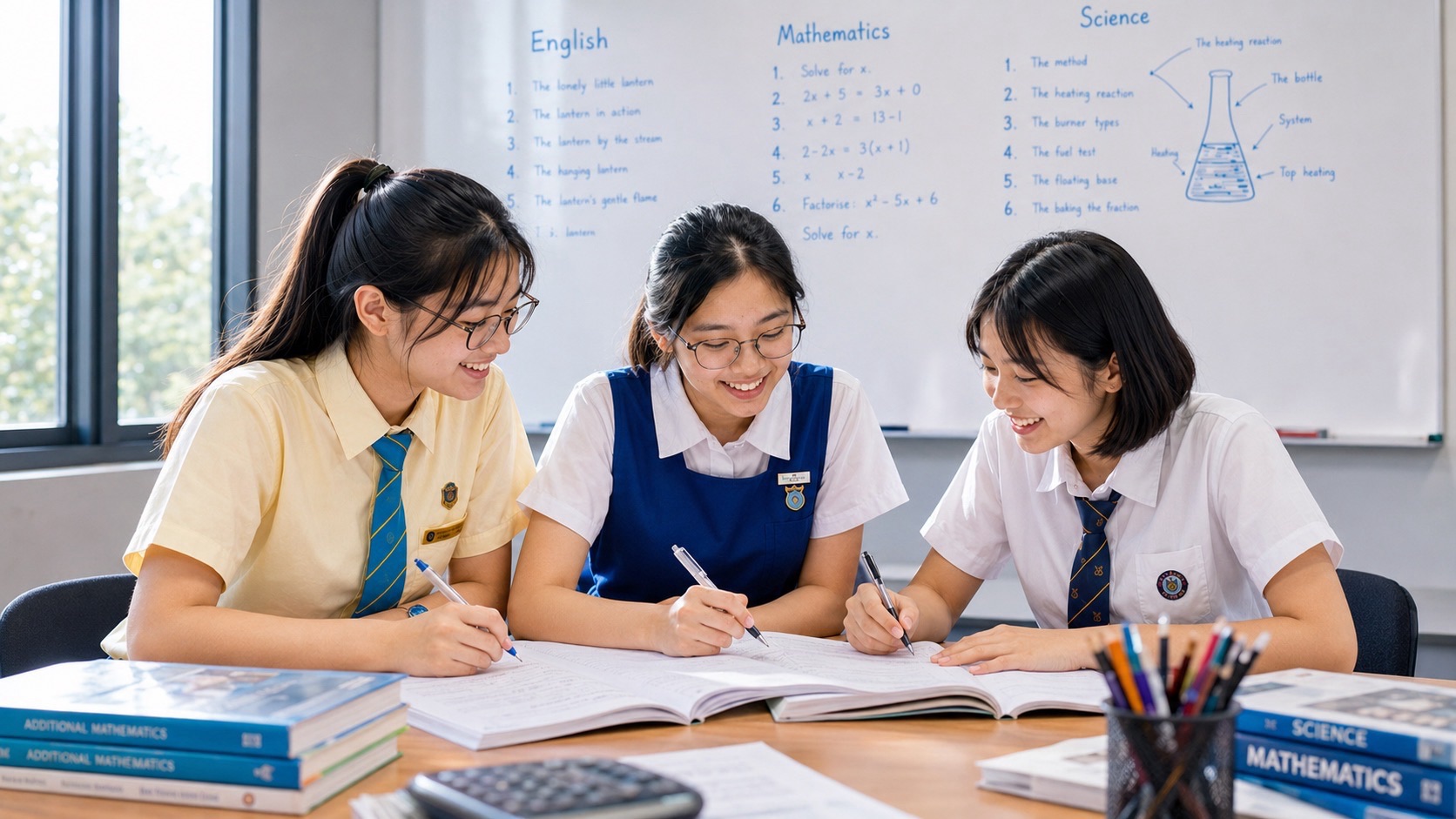
Punggol Science Tuition should teach Science variables as part of experimental reasoning, not as three labels students memorise for practical questions. “Independent variable,” “dependent variable” and “controlled variables” make sense only when students understand the question the experiment is trying to answer.
The core aim of Science variables in Punggol tuition is to help students see how an investigation is organised. The independent variable is changed deliberately, the dependent variable is measured or observed in response, and controlled variables are kept sufficiently constant so the comparison remains meaningful. When students understand this logic, unfamiliar experiments become easier to decode.
Variables Turn a Question Into a Testable Design
A useful investigation often asks how one factor affects another.
Variables identify the two sides of that relationship and protect the comparison from interference.
The Core Aim: Change One, Measure One, Control the Rest That Matters
- Independent variable — what the experimenter changes deliberately.
- Dependent variable — what is measured or observed as the response.
- Controlled variables — relevant conditions kept consistent so the comparison remains interpretable.
Independent Variable: What Are We Changing on Purpose?
Students should identify the factor deliberately manipulated across conditions.
It is not simply the first variable mentioned in the question.
Dependent Variable: What Are We Measuring?
The response must be observable or measurable.
A vague idea such as “growth” may need to become height, mass or another defined quantity.
Controlled Variables: Which Conditions Could Otherwise Affect the Result?
Not every possible factor needs to be listed.
Students should identify the variables that could meaningfully change the dependent variable and undermine the comparison.
Why Controlled Variables Matter
If an important condition changes at the same time as the independent variable, the student cannot confidently attribute the result to the factor being tested.
This is the scientific reason behind a fair test.
Primary Science Variables Should Begin With Everyday Comparisons
Primary students can learn the logic before the formal vocabulary: change one thing, observe one result, keep the other important conditions the same.
PSLE Variables Questions Often Use Unfamiliar Setups
The apparatus may look new, but the variable logic remains stable.
Students should identify what changes and what is measured before worrying about the story around the setup.
Secondary Science Variables Need Operational Precision
Secondary students may need to specify how a variable is measured, the range used and how other conditions are controlled.
The depth grows, but the core logic remains the same.
Physics Variables Often Involve Quantities
Distance, time, current, voltage, temperature, force and other quantities may form the tested relationship.
Students should connect the variable to the instrument and units used to measure it.
Chemistry Variables Often Control Reaction Conditions
Temperature, concentration, particle size, amount of substance and time may influence observed outcomes depending on the investigation.
Students should distinguish the variable deliberately changed from other conditions that must remain stable.
Biology Variables Often Need Control of Natural Variation
Living systems can vary naturally.
Students may need to consider sample size, starting conditions and consistent selection in addition to the main variables.
Variables and Fair Tests Are One System
A fair test depends on choosing the right independent variable, measuring the dependent variable appropriately and controlling relevant confounders.
See Fair Test.
Variables and Experimental Design Are One System
Once variables are clear, the method becomes easier to build.
Measurement choice, range, interval and repetition all depend on what the variables are.
Variables and Graphs Are One System
The independent and dependent variables often determine the axes of a graph.
Students should understand why the measured response is plotted against the deliberately changed condition.
Common Variable Errors
- Independent and dependent variables reversed.
- Dependent variable stated too vaguely.
- Control variable confused with control setup.
- Irrelevant conditions listed as controls.
- Important confounding variable omitted.
- Variable named without saying how it is measured.
Use “What If This Also Changed?”
After identifying a controlled variable, ask what would happen if it changed too.
This makes the reason for control visible rather than memorised.
Use “How Would You Measure It?”
A dependent variable becomes stronger when the student can specify the instrument, unit or observation used.
This connects variable identification with experimental design.
A Weekly Variables Routine
- One experiment where students identify all three variable types.
- One question asking why a control matters.
- One operational-definition question.
- One graph linking variables to axes.
- One changed-context experiment.
How the eduKate Ecosystem Connects
For the wider practical framework, use Science Inquiry Skills.
For complete experimental reasoning, see Science Experiments.
Frequently Asked Questions
What is an independent variable?
The factor deliberately changed by the experimenter.
What is a dependent variable?
The response measured or observed as the independent variable changes.
What is a controlled variable?
A relevant condition kept consistent so it does not provide an alternative explanation for the result.
Why do students confuse variables?
They may memorise labels without first understanding the experimental question and causal relationship.
The Core Aim, in One Sentence
The core aim of Science variables in Punggol tuition is to help students organise an investigation around a clear relationship: change one factor deliberately, measure the response and control the other important conditions.


