
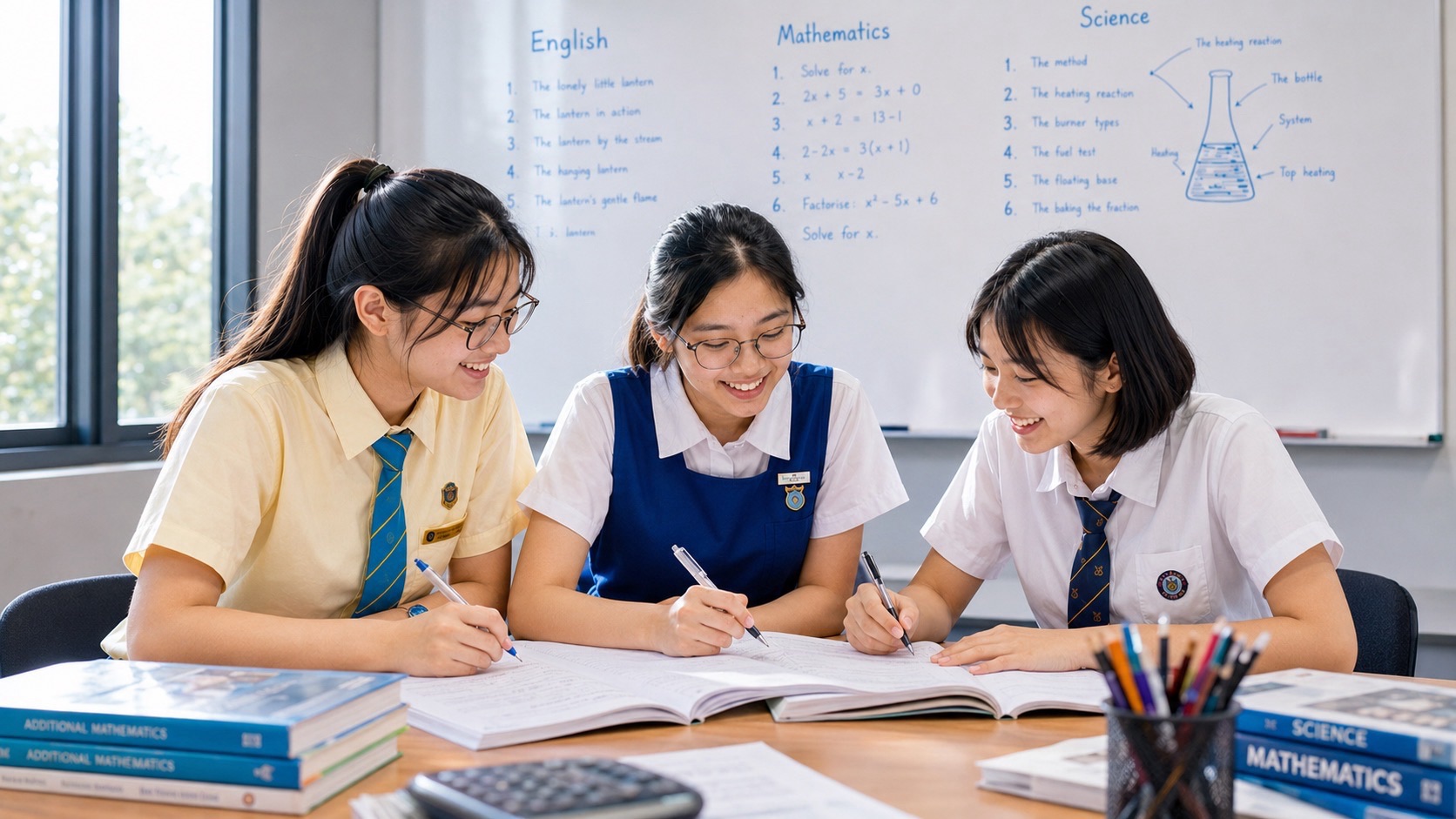
Punggol Science Tuition for strong students should not mean giving a child twice as many worksheets. Parents searching for Science tuition for strong students are often looking for extension, challenge and a way to keep a capable learner growing without turning curiosity into endless acceleration.
The core aim of Science tuition for strong students in Punggol is to deepen scientific judgement. The learner should become better at unfamiliar contexts, competing explanations, experimental design, precise modelling, transfer across representations and independent checking. Strong students need more than harder content. They need questions that make them think differently.
Explore related Science guides and choose your next reading step.
Strong Students Still Have Learning Needs
High marks can hide fragile habits. A student may be fast but careless, knowledgeable but dependent on familiar question types, or excellent at recall but weak at experimental evaluation.
Tuition should identify the next frontier rather than assuming “strong” means finished.
Extension begins with diagnosis too.
The Core Aim: Depth Before Acceleration
Acceleration can be useful when the current syllabus is secure and the learner is genuinely ready.
But depth often produces greater long-term value. Ask stronger questions within the current topic before jumping ahead.
Can the student predict? Justify? Compare models? Evaluate evidence? Explain why a plausible answer is wrong?
Novel Contexts Reveal Real Transfer
A strong learner may perform beautifully on familiar school formats.
Change the object, diagram, wording or representation while keeping the underlying concept the same.
If performance remains strong, the knowledge is becoming transferable.
Competing Explanations Build Scientific Judgement
Give two plausible explanations and ask which is better supported by the evidence.
This requires students to compare models, not just retrieve one remembered answer.
It also introduces the idea that Science advances by testing explanations against evidence.
Experimental Design Is Excellent Extension
Strong students can be asked to improve methods, select variables, choose measurements and predict sources of uncertainty.
This increases reasoning without requiring premature university-level content.
See Science Experiments.
Strong Students Need Better Error Analysis Too
High-performing students sometimes dismiss mistakes as “careless” because there are fewer of them.
That can hide important patterns: rushed graph reading, weak checking, ambiguous explanations or overconfidence on familiar questions.
A small error log can protect strong performance.
Precision Becomes the Next Challenge
When basic understanding is secure, answer quality can be improved through precision.
Can the student state exactly which variable changes? Can they distinguish observation from inference? Can they avoid vague pronouns and unnecessary extra information?
Precision separates merely correct answers from robust scientific communication.
Strong Primary Students Need Curiosity Protected
A capable Primary student should not spend every extension hour doing future PSLE papers.
Use investigations, real phenomena, classification puzzles, altered conditions and explanation.
Curiosity is not a distraction from achievement. It is one of the engines of long-term Science learning.
Strong PSLE Students Need Transfer and Calibration
At the PSLE stage, strong students often benefit from unfamiliar contexts, subtle open-ended distinctions and paper-control refinement.
The goal is not perfection through volume. It is stable reasoning under variation.
See PSLE Science Tuition.
Strong Secondary Students Need Model Flexibility
Physics, Chemistry and Biology reward students who can move among representations and choose the right model quickly.
Strong learners can compare methods, critique assumptions and explain limitations.
This prepares them for more advanced study without forcing premature content.
Pure Science Students Need Cross-Disciplinary Connections
Students taking separate sciences can benefit from seeing how energy, particles, systems, rates and evidence recur across disciplines.
Cross-disciplinary links make knowledge more coherent.
See Pure Science Tuition.
Strong G1 or G2 Students Can Be Extended Within Their Level
A strong student at G1 or G2 does not automatically need G3 materials.
Deeper transfer, practical reasoning and unfamiliar contexts can provide excellent extension while preserving current-level mastery.
Subject-level progression should follow school guidance and evidence, not prestige.
Strong G3 Students Need More Than Syllabus Speed
G3 learners can be extended through unfamiliar data, modelling, method comparison and evaluation.
The strongest extension is often harder thinking rather than faster syllabus coverage.
See G3 Science Tuition.
Use “Why Is the Other Answer Wrong?”
This is one of the simplest extension questions.
It forces the student to define concept boundaries and identify the misconception behind a distractor.
The method works especially well with MCQ.
Use “What Would Change the Answer?”
After solving a question, change one condition.
Ask which part of the reasoning breaks and which part remains valid.
This creates flexible mental models.
Use “How Else Could We Solve It?”
Strong students benefit from method comparison.
Could the same problem be understood through a diagram, graph, equation or verbal model? Which route is clearest?
Comparing methods builds judgement.
Use “What Evidence Would Convince You?”
This question pushes students beyond recall into scientific reasoning.
They must connect a claim with measurable evidence and experimental design.
It is especially valuable for strong upper-secondary students.
Do Not Confuse Fast With Deep
A fast student may finish worksheets early because the pattern is familiar.
Give a novel representation before assuming the topic is mastered.
Depth shows when the student can explain and transfer, not only finish quickly.
Do Not Confuse Memory With Understanding
A strong memory can carry a student far in Science.
Ask changed-context questions, prediction and explanation to test whether the model is genuinely understood.
Memory is valuable; model-based reasoning makes it more powerful.
Strong Students Need Productive Difficulty
If every question is easy, attention drops.
If every question is far beyond the syllabus, learning becomes fragmented.
The best extension sits just beyond automatic success and requires deliberate reasoning.
Homework for Strong Students Should Be Selective
More homework can consume time without increasing depth.
Choose fewer, richer questions that require transfer, design or evaluation.
See Science Homework.
Strong Students Still Need Retrieval
A student can understand deeply and still forget after months.
Short spaced retrieval should continue even when marks are high.
Strong performance needs maintenance.
Assessment for Strong Students Should Reveal Ceiling, Not Just Floor
A routine school paper may show that basic expectations are secure but not reveal the learner’s deeper limits.
Use unfamiliar contexts and explanation questions to reveal where growth remains.
See Science Assessment.
A Strong-Student Error Map
- Overconfidence causes careless reading.
- Familiar formats hide weak transfer.
- Answers are correct but imprecise.
- Checking is skipped because speed feels sufficient.
- Practical evaluation is generic.
- One discipline is much stronger than another.
- Old topics fade because revision is postponed.
- Extension becomes acceleration without consolidation.
Even high-performing students benefit from making these risks explicit.
A Weekly Extension Rhythm
- Short cumulative retrieval.
- One unfamiliar-context problem.
- One explanation or evaluation task.
- One experiment-design question.
- One method-comparison task.
- One personal error retest.
This can create more depth without adding excessive workload.
Parents Should Avoid Turning Strength Into Pressure
A strong Science student may enjoy the subject because it feels meaningful and interesting.
Constantly raising the bar can turn strength into anxiety.
Extension should preserve curiosity and agency.
How the eduKate Ecosystem Connects
For advanced depth, use Journey of Learning Advanced Science in Punggol | From Curiosity to Evidence, Models and Explanations.
The existing stretch-student route is The Stretch Student | Precision, Novelty and Growth Beyond More Worksheets.
For study systems, see Science Study Skills.
Frequently Asked Questions
Does a strong Science student need tuition?
Not always. Tuition adds value when it provides deeper transfer, feedback, experimental reasoning, extension or a more suitable learning environment than the student can create alone.
Should strong students learn next year’s syllabus?
Sometimes, but depth and transfer within the current syllabus should usually be secure first.
How do you challenge a strong Science student?
Use unfamiliar contexts, competing explanations, experimental design, data evaluation and method comparison rather than simply adding more worksheets.
Can a strong G2 student use G3 materials?
Selectively, but current-level depth and school guidance should come first. Harder material is useful only when it creates meaningful learning.
How do we know extension is working?
The student becomes more flexible, precise, independent and capable of explaining unfamiliar problems—not merely faster at familiar ones.
The Core Aim, in One Sentence
The core aim of Punggol Science tuition for strong students is to replace “more work” with better challenge: novelty, precision, transfer, modelling, experimental design and independent scientific judgement.
A strong student should leave tuition not simply knowing more Science, but thinking more powerfully with the Science they know.


