
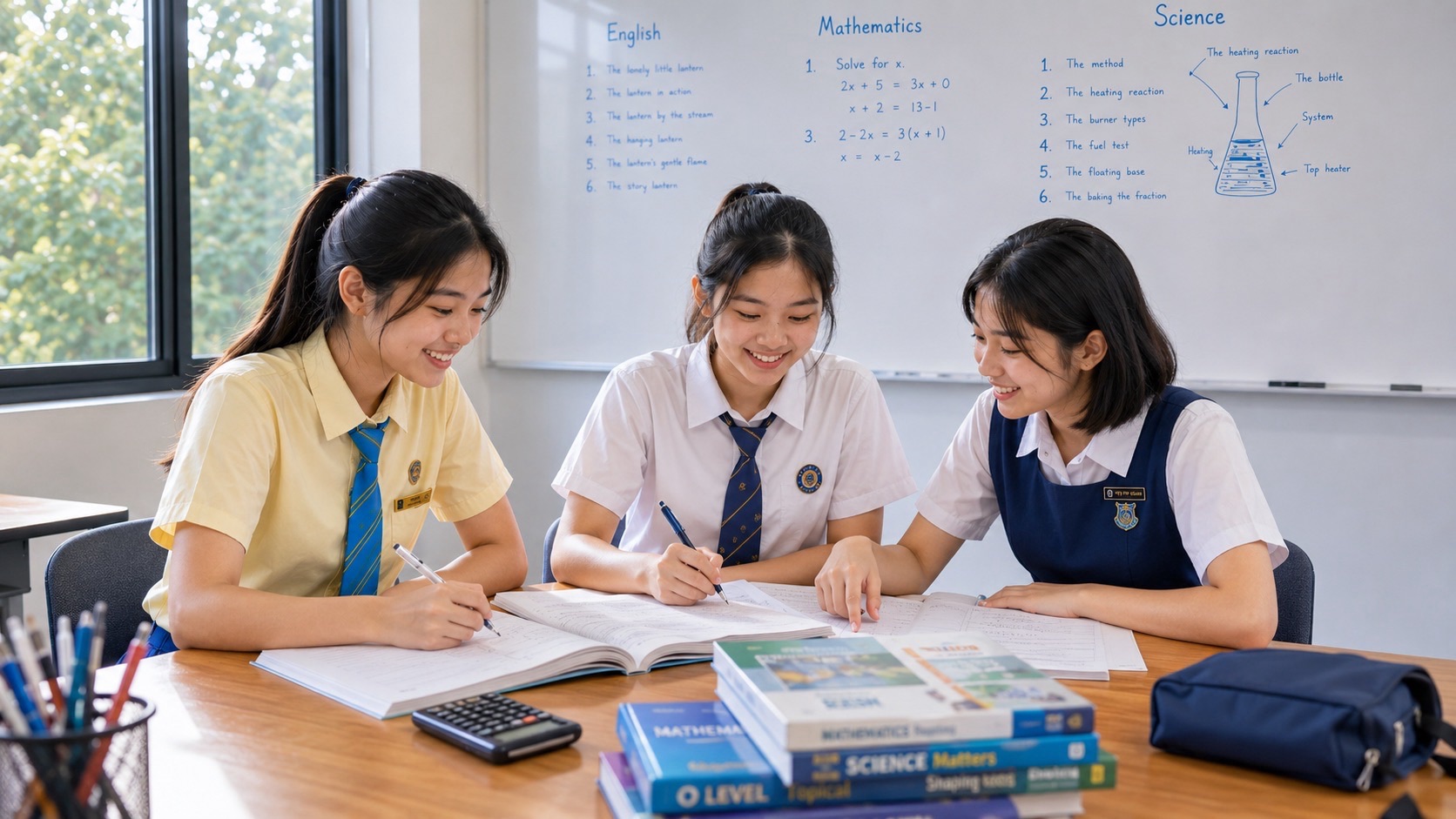
Punggol Science Tuition at G2 level should help students build strong combined-science control without turning the subject into a simplified version of something else. Families searching for G2 Science Tuition need tuition that matches the actual G2 syllabus, respects the student’s pace and still develops rigorous scientific habits: modelling, evidence, practical reasoning, calculation, retrieval and transfer.
The core aim of G2 Science tuition in Punggol is to make the student’s Science reliable. From 2027, SEAB lists G2 Combined Science as K223 Science (Physics, Chemistry), K224 Science (Physics, Biology) and K225 Science (Chemistry, Biology). The exact combination matters because each pair asks the learner to switch between two scientific languages. Good tuition makes that switching deliberate, keeps both components alive and prepares the student to answer unfamiliar questions without depending on worksheet labels.
Explore related Science guides and choose your next reading step.
G2 Science Is a Subject Level, Not a Shortcut
G2 Science should be taught for what it is: a defined subject level within Full Subject-Based Banding. It is not “less important Science,” and it should not be treated as an excuse for shallow learning.
Students still need accurate models, clear explanations, practical understanding and evidence-based reasoning. The difference is the syllabus level and assessment demand, not the value of scientific thinking.
A student who masters G2 deeply is in a stronger position than a student who is exposed to more advanced material without control.
The Official 2027 G2 Science Routes
SEAB’s 2027 G2 school-candidate syllabus list includes K223 Science (Physics, Chemistry), K224 Science (Physics, Biology) and K225 Science (Chemistry, Biology).
Families can verify the current structure through the SEAB 2027 G2 Syllabuses for School Candidates.
Tuition should begin by identifying the correct G2 combination, because Physics/Chemistry, Physics/Biology and Chemistry/Biology require different retrieval and representation patterns.
The Core Aim: Balance Two Sciences Without Fragmenting the Student
The learner should not feel as though two unrelated subjects have been placed in one timetable slot.
Physics may emphasise quantities, diagrams and relationships. Chemistry may emphasise particles, observations and symbols. Biology may emphasise systems, structures and processes. G2 tuition should teach those differences while preserving shared scientific habits.
The shared habits are what make switching possible: read the evidence, identify the model, use the correct representation, answer the command and check the result.
Physics/Chemistry G2: Switch Between Quantity and Transformation
Students taking K223 need to move between Physics-style relationships and Chemistry-style transformations.
In Physics, the student may need to read a graph, identify a quantity or use a simple relationship. In Chemistry, the student may need to interpret a reaction, observation or particle model.
Tuition should deliberately mix the two so that the learner practises identifying which scientific mode is needed.
Physics/Biology G2: Switch Between Relationships and Systems
Students taking K224 move between Physics relationships and Biology systems.
A graph can appear in both, but the explanation may be very different. A Physics graph may represent a quantitative relationship; a Biology graph may represent a living process changing with conditions.
The student must learn to read the representation first, then choose the discipline-specific model.
Chemistry/Biology G2: Switch Between Particles and Living Systems
Students taking K225 move between chemical transformation and biological process reasoning.
Chemistry often asks what particles or substances are doing. Biology asks how structures and processes interact inside living systems.
The tutor should help the student identify the scale of the question before answering.
G2 Science Should Build Strong Graph Reading
Graphs are one of the most reusable skills across all G2 combinations.
Students should follow a stable routine: axes, variables, units, scale, pattern, anomaly, then explanation.
The explanation should come only after the evidence has been read accurately.
Tables Need Valid Comparisons
A table can look simple while hiding several variables.
Students should ask which row or column creates the comparison required by the question. “At the same value of…” is a useful mental frame because it forces the learner to notice what is being controlled.
This prevents random number selection.
Diagrams Should Become Thinking Tools
Circuit diagrams, particle diagrams, biological system diagrams and apparatus drawings all represent something more than a picture.
Students should ask what each symbol or arrow means and what relationship the diagram is trying to show.
Redrawing from memory is especially useful because it exposes gaps quickly.
Practical Reasoning Should Be Continuous
G2 students need to understand how evidence is produced.
What is changed? What is measured? What remains controlled? Why is a particular instrument used? Why repeat? What conclusion is justified?
These questions should appear regularly, not only before a practical assessment.
Reliability, Accuracy and Precision Should Be Taught Carefully
Students often memorise these terms together and then use them interchangeably.
Reliability concerns consistency. Accuracy concerns closeness to the true value. Precision concerns the spread or repeatability of measurements. Resolution concerns the smallest change an instrument can distinguish.
The student should propose an improvement that matches the actual problem.
Calculations: Meaning Before Calculator
Where calculations appear, students should understand what quantity is being found.
A stable sequence is relationship, unit conversion, substitution, calculation, unit and sense-check.
This method is useful even when the mathematics is simple because it keeps the Science visible.
Scientific Vocabulary Should Be Exact, Not Overcomplicated
G2 answers benefit from correct terminology, but students do not need to sound artificially advanced.
The useful target is the smallest scientifically accurate language that answers the question.
Contrast similar terms so boundaries stay clear.
Command Words Tell the Student What to Produce
State, describe, explain, compare, calculate, suggest and evaluate require different responses.
Tuition should make the command word part of the reading routine.
A student can know the content and still lose marks by giving the wrong type of answer.
Retrieval Should Keep Both Components Alive
One component often becomes the favourite and the other becomes the avoided subject.
A good weekly system protects short retrieval in both. The weaker component can receive deeper repair, but the stronger one should not be abandoned.
This is especially important near assessment periods.
Mixed Practice Builds Switching Fluency
Topical worksheets reveal the subject in advance. Mixed assessment does not.
G2 tuition should gradually mix the two disciplines so the student learns to identify the model independently.
This switching skill becomes faster with deliberate practice.
The G2 Error Map
- Concept model inaccurate.
- Wrong discipline or model selected.
- Graph or table misread.
- Practical variable confused.
- Calculation or unit error.
- Scientific wording vague.
- Old topic not retrieved.
- Transfer fails in a changed context.
- Checking or timing weak.
The error map should lead directly to a repair and a delayed retest.
G2 Students Need More Than Topical Revision
Topical practice builds initial fluency, but cumulative assessments require selection.
After a topic is understood, combine it with older work. Ask the student to explain which model applies before solving.
This makes revision more examination-ready without turning every lesson into a paper drill.
Strong G2 Students Need Deeper Questions
A strong G2 learner can be extended without automatically moving into G3 content.
Use unfamiliar data, changed conditions, practical design, explanation of wrong answers and multi-step reasoning.
Depth can reveal readiness while preserving strong foundations.
When G2 Marks Are Weak, Diagnose Before Discussing Level
A weak result can come from many causes: concept gaps, poor retrieval, graphs, units, time management or language.
The first response should be diagnosis, not a broad judgement about the student’s level.
After targeted repair and retesting, the school and family have better evidence for any future subject-level discussion.
Movement Between Levels Should Use School Guidance
Full Subject-Based Banding creates subject-level flexibility, but changes should follow current school processes and official guidance.
Tuition can contribute evidence about consistency, readiness and learning behaviour.
The tutor should not turn level placement into a status contest.
G2 Science in Secondary 3 and 4
As students move into upper secondary, the volume and cumulative demand increase.
Secondary 3 should build stable systems, while Secondary 4 should integrate retrieval, mixed practice and final-year performance.
The pathway pages are available at Secondary 3 Science Tuition and Secondary 4 Science Tuition.
Past Papers Should Be Mapped to the Current G2 Syllabus
Older N-Level or other legacy questions may still contain useful Science.
But tuition should map them carefully to the current G2 content and demand rather than assuming perfect equivalence.
Curated practice is more useful than an unfiltered archive.
A Weekly G2 Science Rhythm
- Short retrieval from both components.
- Current school topic.
- Representation work: graph, table or diagram.
- One practical-thinking question.
- Independent application.
- Mixed switching question.
- Error-ledger update.
- Delayed retest.
A Term Rhythm: Build → Mix → Test → Repair
At the start of the term, build new concepts carefully. Mid-term, increase mixing and retrieval. Before assessments, add more timed work. After assessments, use the paper to diagnose and repair.
This keeps tuition responsive rather than permanently exam-driven.
Confidence Should Come From Method
A confident G2 student does not need every question to look familiar.
The learner should know how to begin: identify the discipline, read the evidence, choose the model, answer the command and check.
That method is more durable than memorising one perfect set of examples.
What Parents Should Ask a G2 Science Tutor
- Which G2 combination is my child taking?
- How do your materials map to K223, K224 or K225?
- How do you keep both components alive?
- How are practical and data skills taught?
- How do you diagnose recurring errors?
- How do you extend a strong G2 student?
- How do you prepare for SEC without overloading?
- How do you measure independence?
What Good G2 Progress Looks Like
- Both Science components remain retrievable.
- Graphs and tables are read accurately.
- Practical answers become more specific.
- Scientific explanations become clearer.
- Calculations show units and organised working.
- Mixed questions cause less hesitation.
- Repeated errors decrease.
- The student needs fewer tutor prompts.
How the eduKate Ecosystem Connects
The broad SEC route is The Core Aim of Punggol Science Tuition | SEC Science Tuition.
For two-discipline pathways, see Combined Science Tuition. For current syllabus mapping, use 2027 SEC Science Guide.
Final-year exam control sits at Science Exam Preparation.
Frequently Asked Questions
What is G2 Science tuition?
Science tuition aligned to the G2 subject level under the SEC framework, including K223 Physics/Chemistry, K224 Physics/Biology or K225 Chemistry/Biology.
Is G2 Science the same as the old N(A) stream?
No. G2 is a subject level within Full Subject-Based Banding. Students can take different subjects at different levels, so old whole-student stream labels should not be treated as direct equivalents.
What are the 2027 G2 Science codes?
SEAB lists K223 Science (Physics, Chemistry), K224 Science (Physics, Biology) and K225 Science (Chemistry, Biology).
Should G2 students use G3 materials?
Only selectively and with a clear purpose. The main programme should match the G2 syllabus and deepen reasoning within it.
Can a strong G2 student be extended without changing level?
Yes. Use unfamiliar data, practical design, transfer and deeper explanation before assuming harder syllabus content is necessary.
How should G2 students revise two Science components?
Protect retrieval in both, allocate deeper repair to the weaker component and use mixed questions to practise switching.
Can a student change subject level?
Subject-level flexibility exists within Full SBB, but decisions should follow school processes and current official guidance.
How do we know G2 tuition is working?
The student retrieves both components, handles data and practical questions more reliably, closes recurring errors and becomes more independent.
The Core Aim, in One Sentence
The core aim of Punggol G2 Science Tuition is to build strong, balanced and transferable control across the student’s two Science disciplines while staying precisely aligned to the 2027 SEC G2 syllabus.
G2 Science should feel coherent, not secondary. When the student can switch disciplines, read evidence, reason practically and retrieve old knowledge, the subject becomes a strong platform for the next stage.


