
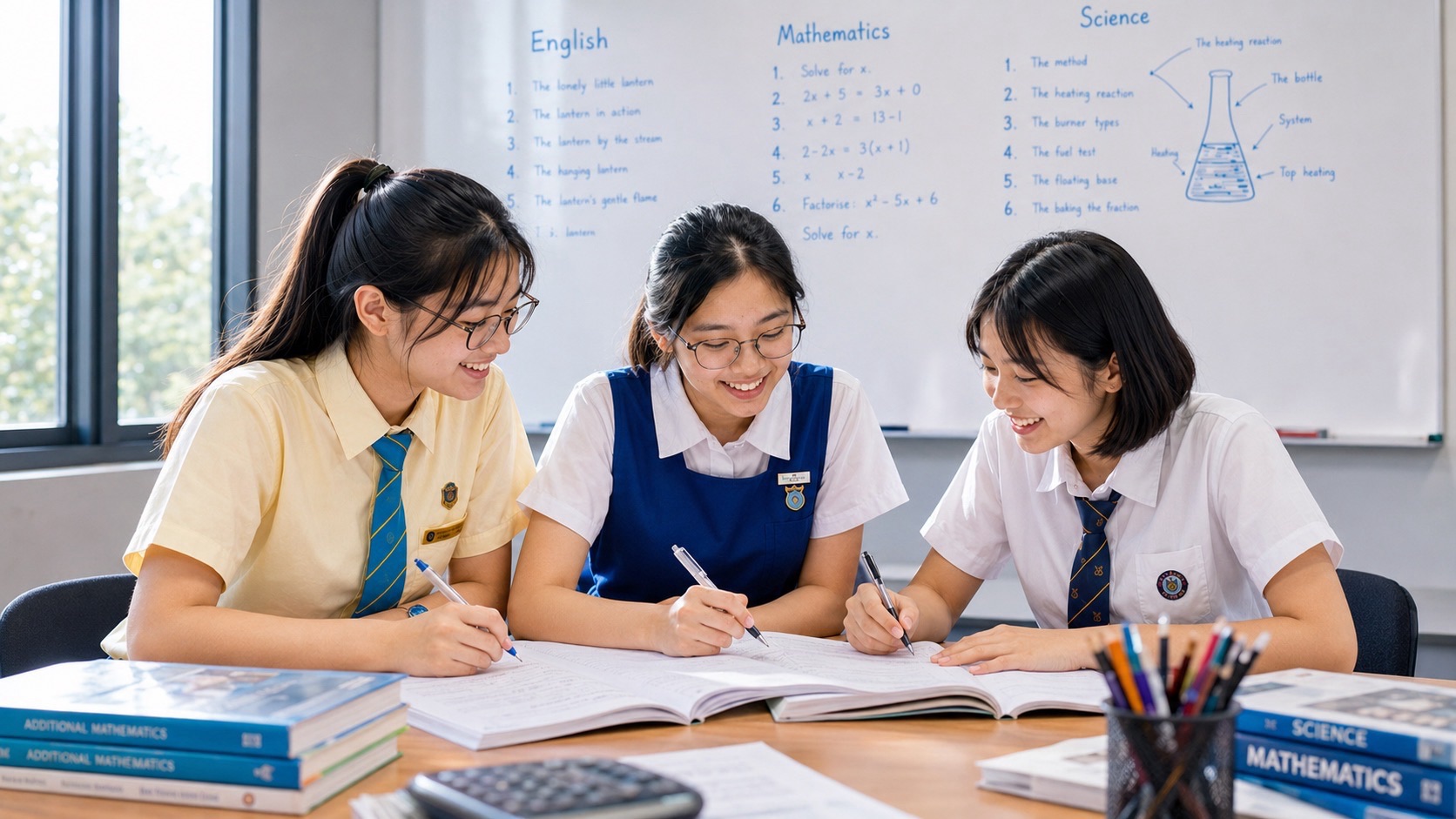
Quick Read: Critical thinking is not simply “thinking harder” or disagreeing with people. It is the disciplined process of interpreting information, examining claims, asking what evidence supports them, identifying assumptions, considering alternatives, drawing justified conclusions and correcting your own reasoning when needed.
One-sentence answer: Critical thinking means making your reasoning visible enough that evidence can support, challenge or improve it.
What the original 2015 module was trying to do
This page began as an eduKate English “Theme of the Month” for April 2015. The original module connected critical thinking to composition and comprehension. That was a good starting point because English constantly asks students to interpret, infer, justify and choose among possible meanings.
The updated article expands that idea into a general learning framework that can be used across English, Science, Humanities and daily life.
Critical thinking is not one skill
OECD work on critical thinking highlights a cluster of skills including interpretation, analysis, evaluation, inference, explanation and self-regulation. That matters because students can be strong in one part and weak in another.
- Interpretation: What does this information mean?
- Analysis: How are the parts connected?
- Evaluation: How strong is the claim or evidence?
- Inference: What conclusion is justified?
- Explanation: Can I show why?
- Self-regulation: Can I inspect and correct my own thinking?
Start with the claim
Before evaluating an argument, identify what is actually being claimed.
Compare:
- “This plant grew taller.”
- “This fertiliser caused the plant to grow taller.”
- “This fertiliser always makes plants grow faster.”
Each statement carries a stronger claim than the previous one and therefore requires stronger evidence.
Evidence is not the same as conclusion
Evidence is what we observe, measure or document. A conclusion is what we infer from that evidence.
Students often collapse the two together. Strong reasoning keeps the bridge visible:
- Evidence: The coloured water appeared in the flower’s petal veins.
- Inference: Water moved upward through conducting tissue in the stem.
The inference may be well supported, but it is still an inference.
Ask what assumption is hidden
Many arguments depend on unstated assumptions.
Example: “This student improved after tuition, therefore tuition caused the improvement.” Hidden assumptions might include:
- nothing else important changed;
- the test difficulty was comparable;
- school teaching did not change;
- the student did not independently increase practice.
Critical thinking asks whether those assumptions are reasonable.
Consider alternatives before deciding
A single explanation can feel convincing because it is the only one currently visible. Good thinking generates alternatives.
- What else could explain the result?
- What evidence would distinguish the possibilities?
- Which explanation requires the fewest unsupported assumptions?
OECD work on critical and creative thinking emphasises the value of imagining alternative theories, counterfactuals and perspectives before judgement.
Critical thinking in English comprehension
Comprehension is not only finding words in a passage. Current PSLE English assesses literal, inferential and evaluative understanding of written and multimodal texts.
- Literal: What does the text explicitly state?
- Inferential: What can reasonably be concluded from clues?
- Evaluative: How should we judge the writer’s purpose, choice or claim?
A strong answer stays anchored to the text while making the reasoning explicit.
Critical thinking in composition
Story writing also requires reasoning. A believable plot needs causes and consequences.
- Why does the character act?
- What information does the character have?
- What choice follows naturally?
- What consequence changes the situation?
- What alternative choice was possible?
A story becomes more convincing when events are connected rather than simply stacked.
Critical thinking in Science
Science gives students a clear discipline for reasoning:
- observe;
- identify variables;
- compare conditions;
- look for patterns;
- propose a mechanism;
- test predictions;
- revise explanations.
Scientific thinking is powerful because claims remain answerable to evidence.
Critical thinking in Mathematics
Mathematics requires more than calculation. Students must decide:
- which information matters;
- which representation is useful;
- which method applies;
- whether an answer is plausible;
- whether the reasoning works for all cases or only one example.
Checking a result is a form of critical thinking when the student asks whether the answer makes sense under the original constraints.
Critical thinking in Humanities and current affairs
When reading history, geography, news or public claims, students should ask:
- Who produced this source?
- When?
- For what audience?
- What evidence is included?
- What is omitted?
- Is the language descriptive or persuasive?
- What other source could confirm or challenge it?
Facts, interpretations and opinions
Students often use these labels too loosely.
- Fact claim: intended to describe something that can be checked against evidence.
- Interpretation: an explanation of what evidence means.
- Opinion: a judgement or preference, which may still be supported by reasons.
Interpretations are not automatically “just opinions”. Some interpretations fit evidence better than others.
Confidence should match evidence
Good thinkers do not sound equally certain about everything.
- “The data prove…” may be too strong.
- “The evidence suggests…” may be more accurate.
- “One possible explanation is…” keeps alternatives visible.
Calibrated language is not weakness. It shows that the student understands uncertainty.
Do not confuse scepticism with cynicism
Critical thinking does not mean assuming everyone is wrong, biased or dishonest. That is simply another untested assumption.
The stronger stance is open but demanding: accept claims in proportion to the quality of the evidence.
A practical six-question routine
- What is the claim?
- What is the evidence?
- What assumption connects them?
- What alternative explanation exists?
- What evidence would change my mind?
- How confident should I be?
Better questions improve thinking
The original 2015 module used who, what, when, where, why and how. Those remain useful, but students can go further:
- Compared with what?
- How do we know?
- What would we expect if the opposite were true?
- What is missing?
- Is this correlation or cause?
- Does this example generalise?
- What would count as a counterexample?
Self-correction is the highest-value habit
Critical thinking is incomplete if it is only directed at other people’s arguments. Students also need to ask:
- What did I assume?
- Did I ignore inconvenient evidence?
- Did I answer the question actually asked?
- Am I defending my first idea because it is mine?
- What would make me revise the answer?
OECD’s critical-thinking frameworks include self-examination and self-correction for this reason.
Common failure modes
- Jumping from one example to a general rule.
- Confusing confidence with accuracy.
- Rejecting evidence because we dislike the conclusion.
- Accepting a claim because an authority said it without checking context.
- Using a source outside its date or scope.
- Searching only for evidence that confirms the first belief.
Parents can model critical thinking
Children learn from how adults handle uncertainty. Useful phrases include:
- “I thought this at first, but this evidence changed my mind.”
- “I am not sure yet.”
- “Let’s check the original source.”
- “What else could explain it?”
This shows that changing one’s mind can be a sign of stronger reasoning rather than embarrassment.
Critical thinking and AI
AI tools can generate fluent explanations quickly. That makes critical thinking more important, not less. Students still need to check whether a response answers the question, uses reliable evidence, invents facts, overlooks alternatives or sounds more certain than the evidence allows.
The educational goal is not merely producing an answer. It is knowing when an answer deserves trust.
Source note
This update draws on OECD work that describes critical thinking through interpretation, analysis, evaluation, inference, explanation and self-regulation, and emphasises examining assumptions and alternative perspectives.
Updated from eduKatePunggol’s April 2015 English module. The page now owns the general educational mechanism of critical thinking rather than functioning as a tuition-service announcement.
Return to Wider Learning and Education
This page owns one specific wider-learning job. Use the routes below to return to the current Education owner or the complete eduKatePunggol registry.


