
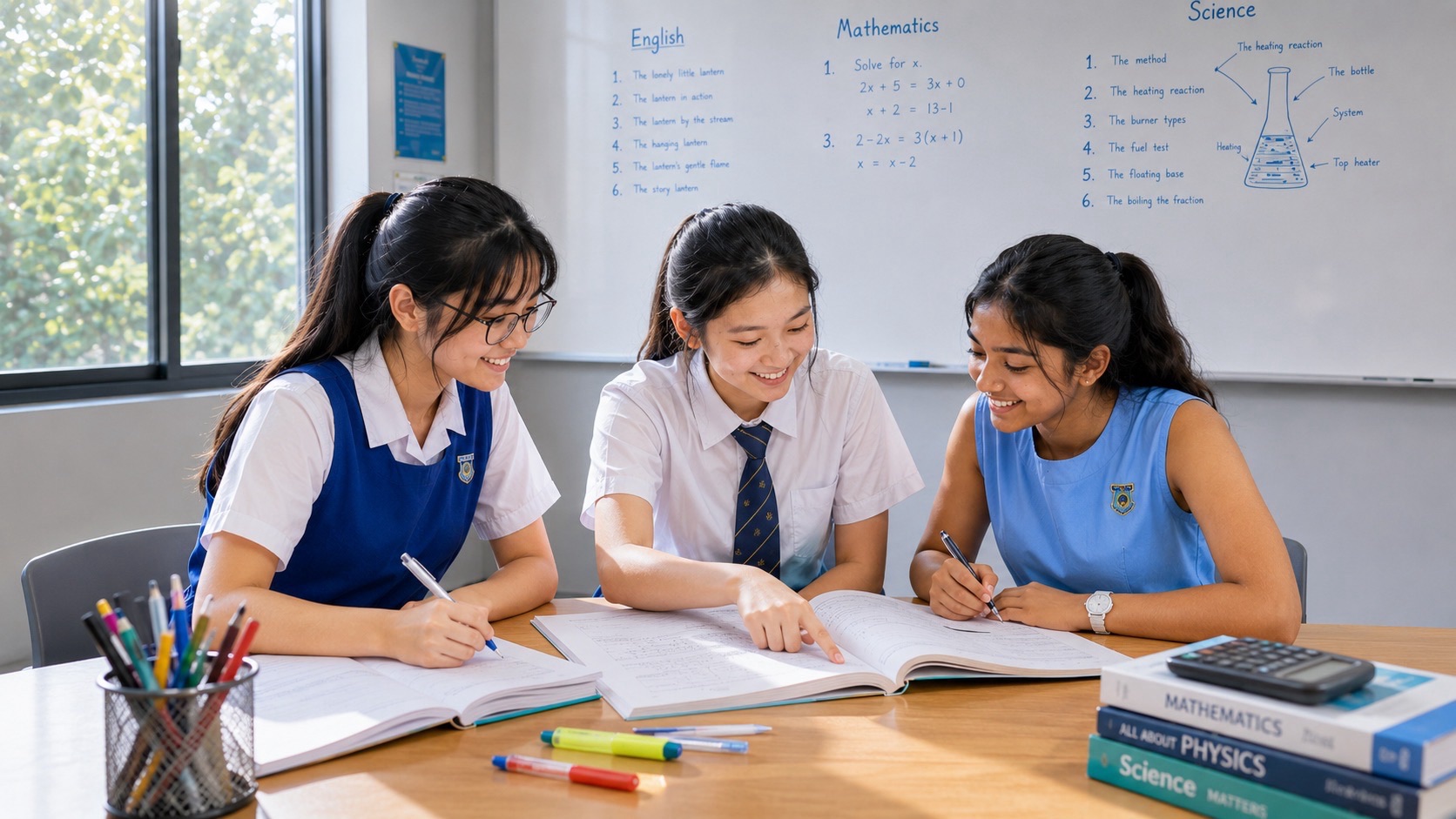
Secondary 2 Mathematics tuition in Punggol for students who are usually correct but take too long to finish homework, tests or mixed practice.
Slow but correct is not a failure.
It is evidence that the mathematical process may already be sound.
The next job is to remove unnecessary hesitation and build fluency without damaging the accuracy that is already working.
At eduKate Punggol, our premium 3-pax tutorials treat speed as an outcome of stronger recognition and cleaner execution—not as pressure to rush.
This article supports our main Punggol Secondary 2 Mathematics Tutor hub and focuses on building speed safely before upper-secondary workload increases.
Class size is limited to three students. Lessons are about 1.5 hours weekly, with timed micro-practice, method recognition, retrieval and close accuracy checks.
Arrange a parent–student consultation with eduKate Singapore
Chat with eduKateSG on WhatsApp
Visit the eduKateSG Facebook page
First Diagnose Where the Time Goes
A student can be slow for very different reasons.
- basic arithmetic is not fluent;
- the learner rereads the question several times;
- method recognition is slow;
- working contains too many unnecessary steps;
- the student checks every line repeatedly;
- calculator entry is hesitant;
- fear of mistakes creates overthinking;
- old topics must be reconstructed from scratch.
The correct speed intervention depends on the cause.
Do Not Time a Method That Is Still Unstable
Timing weak knowledge trains panic.
Before adding pressure, the student should be able to complete the method accurately under ordinary conditions.
Then the tutor can shorten the time gradually while watching whether accuracy remains intact.
The sequence is stability first, fluency second, speed third.
Recognition Speed Matters More Than Hand Speed
Many slow students do not calculate slowly.
They spend most of the time deciding what kind of question they are looking at.
That is why mixed practice matters.
A student who can recognise “this is an equation”, “this is a scale-factor question” or “this needs factorisation” begins faster without writing any faster.
For broader transfer work, see Train Transfer for Unfamiliar Questions.
Routine Questions Should Become Routine
Some mathematical movements deserve fluency because they appear everywhere.
- signed-number operations;
- simple algebraic simplification;
- fraction conversion;
- equation balance;
- percentage conversion;
- reading graph scales;
- basic formula substitution.
The student should not have to rediscover these from first principles every time.
Retrieval and spaced practice gradually move them into a more automatic layer.
Remove Unnecessary Working, Not Useful Working
Slow students sometimes write far more than the question needs.
Fast students sometimes write too little and create avoidable errors.
The goal is efficient visibility.
Keep steps that protect reasoning. Remove repetition that adds no checking value.
A tutor can often shorten a solution by teaching the student which intermediate lines are meaningful and which are simply habit.
Use Timed Micro-Sets Before Full Papers
A five- or ten-minute set is often more useful than timing an entire long paper too early.
Micro-sets isolate one skill:
- five routine algebra questions;
- three graph-reading questions;
- a short ratio set;
- a mixed recognition set;
- one mini-section under a modest limit.
The tutor can then see whether the student is becoming faster because of fluency or merely rushing.
Track Accuracy and Time Together
Speed alone is a poor metric.
We watch both dimensions:
- time falls while accuracy stays stable — good;
- time falls and accuracy improves — excellent;
- time falls while errors rise sharply — too much pressure;
- time stays high but recognition improves — more fluency practice may be needed.
This keeps speed training honest.
Five Common Causes of Slow Secondary 2 Mathematics
1. Weak retrieval
The student knows the method but needs notes or examples to bring it back.
2. Overchecking
Every line is rechecked because the student does not trust the process.
3. Slow method selection
The learner can solve once the route is known but takes too long to choose the route.
4. Excessive written detail
Working is clear but unnecessarily long.
5. Fragile basics
Simple fractions, signs or arithmetic consume too much mental time.
Why a 3-Pax Class Helps
A small class makes timing diagnostic rather than punitive.
- One student may need faster retrieval.
- One may need shorter working.
- One may need more mixed recognition rather than more calculation.
The tutor can compare time and accuracy for each learner without forcing all three to race at the same pace.
A 1.5-Hour Speed-Building Lesson
- Untimed accuracy check.
- Identify the slowest part of the process.
- Practise the exact bottleneck.
- Run a short timed micro-set.
- Review which seconds were useful and which were hesitation.
- Repeat with a small variation.
- Finish with one mixed question under realistic but not aggressive time pressure.
The student learns to become efficient without becoming careless.
Confidence Can Reduce Time Too
Some students are slow because they second-guess correct work.
Repeated successful retrieval builds justified confidence.
Once the learner knows that the method is stable, unnecessary checking decreases naturally.
This is very different from telling a worried student to “just go faster”.
What Progress Should Look Like
- Routine questions start more quickly.
- Fewer examples are needed to retrieve methods.
- Working becomes shorter but remains readable.
- The student spends less time deciding what chapter a question belongs to.
- Timed micro-set accuracy remains stable.
- Calculator entry becomes smoother.
- The learner finishes a larger proportion of school papers.
- Speed grows without a new wave of careless errors.
Secondary 2 Mathematics Under Full Subject-Based Banding
Students may take Mathematics at G1, G2 or G3 subject levels.
Speed expectations should therefore be judged against the student’s actual course, school workload and assessment demands—not against another student’s pace.
When Should Parents Pay Attention?
- Homework is accurate but takes far longer than expected.
- The child regularly leaves school-test questions unfinished.
- Simple methods are repeatedly reconstructed from notes.
- The learner checks already-correct work many times.
- Mixed questions create long pauses before the first step.
- Attempts to “go faster” immediately create careless mistakes.
These patterns suggest that speed should be built from fluency and recognition, not pressure.
Class Details
Format: Premium 3-pax small-group tutorials
Level: Secondary 2 Mathematics
Subject support: matched to the student’s current Mathematics subject level and school programme
Duration: 1.5 hours weekly
Location: 83 Punggol Central, Singapore 828761
Teaching approach:
- accuracy-first diagnosis;
- retrieval fluency;
- method-recognition practice;
- working compression;
- timed micro-sets;
- error monitoring;
- school-paper alignment; and
- gradual speed building.
What Parents Can Bring to the Consultation
- recent timed school papers;
- homework showing very long completion time;
- questions the student eventually solved correctly;
- teacher comments about pace;
- the student’s weekly Mathematics load;
- examples where rushing caused new errors.
The evidence helps us see whether the bottleneck is retrieval, recognition, basic fluency, working length or confidence.
Frequently Asked Questions
Should a slow student simply do more timed papers?
Not immediately. First identify why the student is slow. Timed practice is useful only after the underlying method is sufficiently stable.
Can speed improve without sacrificing accuracy?
Yes. The safest gains usually come from faster recognition, stronger retrieval and cleaner working rather than rushing arithmetic.
How much working should a student show?
Enough to protect reasoning and make errors auditable, but not so much that every routine step is written redundantly.
Why are micro-sets useful?
They isolate one process and make it easier to see whether speed gains are real or created by careless shortcuts.
What is the goal before Secondary 3?
A student who can complete routine Secondary 2 Mathematics with enough fluency that upper-secondary complexity has room to fit.
Helpful Reading for Punggol Parents
- Punggol Secondary 2 Mathematics Tutor | 3-Student Small-Group Tutorials
- What to Do Between Weekly Math Lessons
- Why Careless Mathematics Mistakes Keep Returning
- Train Transfer for Unfamiliar Questions
- Turn School Test Papers Into a Repair Plan
- Punggol Mathematics Article Index
Arrange a Parent–Student Consultation
Bring the questions your child can solve correctly but too slowly. We can usually identify whether the lost time is retrieval, method selection, working length, calculator use or confidence.
Properly taught kids shine a bright light into the future.


