
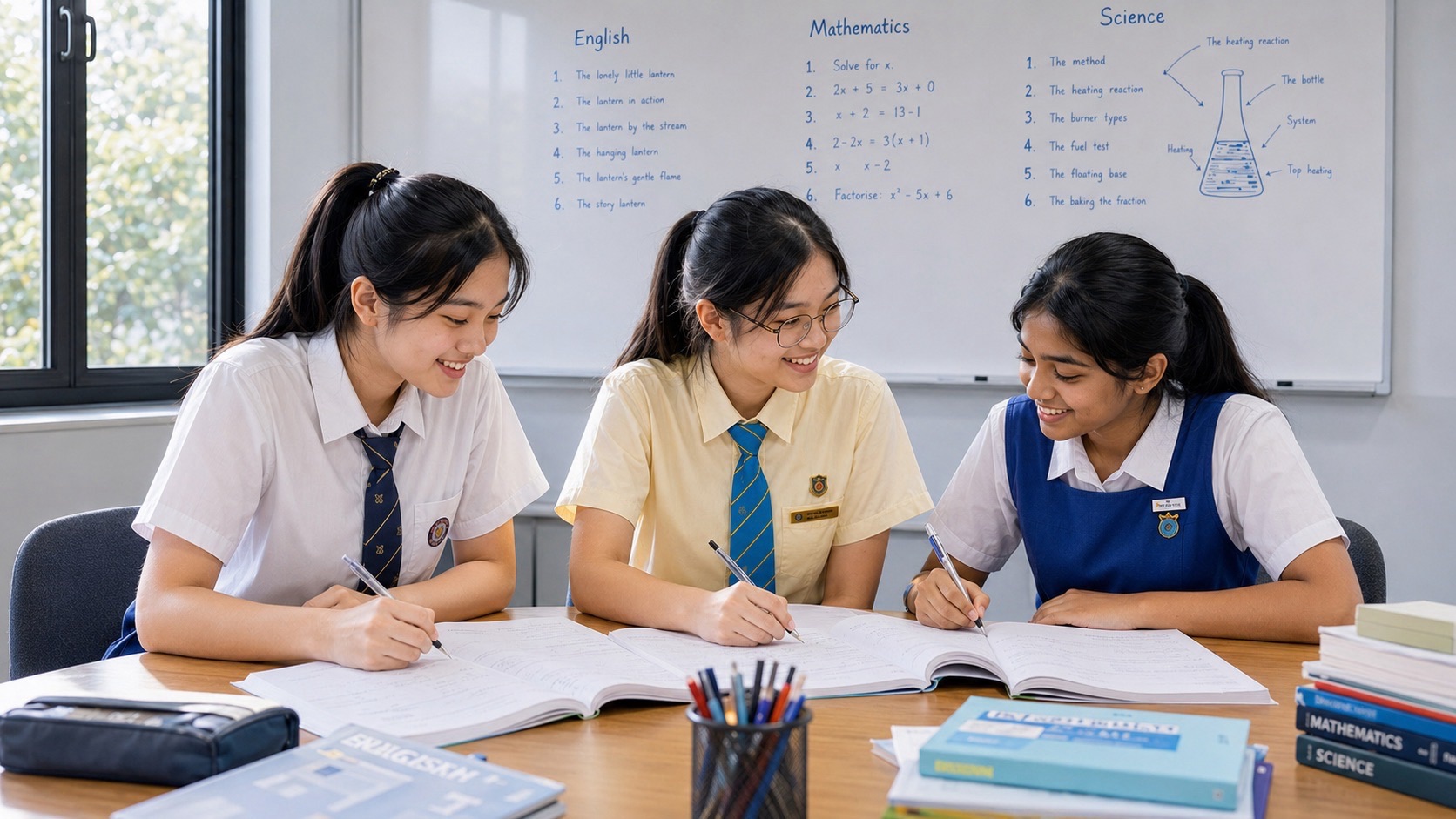
Secondary 2 Mathematics tuition in Punggol for geometry and mensuration: diagrams, angle reasoning, perimeter, area, volume, units and multi-step problem solving in premium 3-pax tutorials.
Geometry looks visual.
That can make it deceptively comfortable.
A student sees a diagram, recognises a shape and feels that the question should be easy.
Then the marks disappear through an assumed angle, a wrong unit, an incorrect measurement, a formula used on the wrong object or a diagram that was treated as if it were perfectly drawn to scale.
Good geometry is not guessing from a picture.
It is disciplined reasoning from properties.
This guide supports our Punggol Secondary 2 Mathematics Tutor hub by showing how geometry and mensuration can be made clearer before upper-secondary Mathematics becomes more demanding.
The Diagram Is Evidence, Not Decoration
A mathematical diagram carries information.
Some information is drawn.
Some is stated.
Some can be deduced from properties.
A strong student learns to separate these categories.
- What is explicitly given?
- What can be inferred from a known property?
- What only looks true because of the drawing?
- Which lengths or angles are still unknown?
- What quantity is the question actually asking for?
This prevents one of the most common geometry failures: trusting appearance instead of reasoning.
Angle Work Should Become a Chain of Reasons
Secondary 2 students often know many angle facts.
The problem is choosing the correct one and connecting several facts together.
A strong solution should be readable as a chain:
- identify the relevant property;
- use it to find one quantity;
- carry that result into the next relationship; and
- state enough reasoning that the route can be checked.
When students jump directly to an answer, they lose the opportunity to audit the chain.
Clear geometry working is not unnecessary writing. It is part of the reasoning system.
Mensuration Is Where Formula Knowledge Meets Measurement Discipline
Knowing a formula is only the beginning.
The student must still identify the correct dimensions, use consistent units and understand what the formula is measuring.
Area measures a two-dimensional region.
Volume measures three-dimensional space.
Perimeter and circumference measure distance around a boundary.
These are different kinds of quantities.
A student who treats units as an afterthought is more likely to mix them.
The Unit Check Is a Powerful Mathematics Check
Units can expose an impossible answer.
If a student calculates an area but ends with centimetres rather than square centimetres, the final form is already signalling a mismatch.
If two lengths are given in different units, the formula should not be used until the measurements have been converted into a consistent system.
We teach students to keep units visible instead of attaching them only at the final line.
This small habit can prevent surprisingly large mark loss.
Common Secondary 2 Geometry and Mensuration Errors
Assuming a diagram is to scale
The student estimates rather than deduces.
Choosing a formula before identifying the target quantity
The learner sees a familiar shape and starts calculating without first asking what must be found.
Mixing perimeter, area and volume
The student recognises a shape but not the dimension of the quantity being requested.
Using the wrong measurement
A diameter is substituted where a radius is needed, or a slanted length is used as a perpendicular height.
Ignoring units until the end
Conversion errors then become harder to detect.
Skipping reasons in angle work
The answer may be correct, but the logical chain becomes fragile and difficult to check.
How We Teach Geometry From First Principles
We begin by asking the student to name what is known.
Then we ask what property connects the known information to the unknown.
Only after that do we calculate.
This order matters.
It teaches the learner that geometry is not a hunt for formulas. It is a structured search for relationships.
For mensuration, we make the object explicit: boundary, surface or space. Then we choose the formula that matches the quantity.
Why 3-Pax Tuition Helps With Diagram Reasoning
Geometry errors are easy to hide in a completed answer.
A tutor needs to see where the student looked, what property was chosen and which assumption entered the solution.
In a 3-pax lesson, each learner can be asked to explain the diagram in their own words.
One student may understand the angle property but choose the wrong pair of lines.
Another may reason correctly but use the wrong measurement in the formula.
A third may know the mathematics but lose accuracy through unit conversion.
The tutor can isolate those differences immediately.
A 1.5-Hour Geometry and Mensuration Tutorial
- Retrieve key properties or formulas without a long warm-up.
- Read one diagram before calculating anything.
- Mark known information and identify the target.
- Explain the property connecting known and unknown quantities.
- Complete the calculation with units kept visible.
- Change the diagram or orientation so the student cannot rely on appearance.
- Mix geometry with algebra or ratio where appropriate.
- Finish with an independent transfer question.
The objective is to make the reasoning portable.
Change the Diagram to Test Real Understanding
If a student understands only one familiar picture, the skill is not yet secure.
We rotate the shape.
We change the orientation.
We remove a familiar label.
We ask for a different unknown.
We combine two shapes.
We place algebra inside the dimensions.
These variations reveal whether the learner understands the property or has memorised one visual template.
For broader topic practice, see How to Improve Circles, Arc Length, Sector Area and Mensuration.
Geometry Is Also Algebra Practice
By Secondary 2, geometry increasingly asks algebra to carry part of the solution.
An unknown angle may be written as an expression.
A length may depend on another variable.
A perimeter condition may create an equation.
This is why strong algebra and strong geometry support each other.
If symbolic manipulation is the bottleneck, read Repair Algebra Before Secondary 3.
Secondary 2 Mathematics Under Full Subject-Based Banding
Students may take Mathematics at G1, G2 or G3 subject levels under Full Subject-Based Banding.
Geometry and mensuration support should therefore follow the student’s actual subject level and school sequence.
We use school papers, worksheets and current topics to decide whether the learner needs repair, stabilisation or extension.
What Progress Should Look Like
- The student reads the diagram before calculating.
- Known and unknown quantities are separated clearly.
- Angle properties are named and applied more reliably.
- The learner stops trusting drawings that are not to scale.
- Units remain consistent throughout mensuration work.
- Area, perimeter and volume are distinguished correctly.
- Formulas are chosen for a reason.
- Geometry questions involving algebra become less intimidating.
- Working is clear enough to check line by line.
When Should a Punggol Secondary 2 Student Get Geometry Help?
Support may be useful when the student:
- guesses from diagrams;
- knows formulas but chooses the wrong one;
- loses marks through unit conversion;
- cannot explain angle reasoning;
- gets stuck when a familiar shape is rotated or combined;
- struggles when algebra is placed inside geometry; or
- performs well on routine worksheets but poorly on mixed geometry questions.
Class Details
Format: Premium 3-pax small-group tutorials
Level: Secondary 2 Mathematics
Subject support: G1, G2 and G3 Mathematics according to student readiness and school programme
Duration: 1.5 hours weekly
Location: 83 Punggol Central, Singapore 828761
Teaching approach:
- first-principles reasoning;
- diagram reading before calculation;
- guided and independent practice;
- unit and measurement discipline;
- variation and transfer;
- school-test alignment; and
- carefully paced extension.
Helpful Reading for Punggol Parents
- Punggol Secondary 2 Mathematics Tutor | 3-Student Small-Group Tutorials
- Repair Algebra Before Secondary 3
- Why Careless Mathematics Mistakes Keep Returning
- Train Transfer for Unfamiliar Questions
- Turn School Test Papers Into a Repair Plan
- Punggol Mathematics Article Index
Frequently Asked Questions
Why does my child know the formula but still get mensuration wrong?
Formula recall is only one layer. The learner must identify the correct dimensions, use consistent units, understand the requested quantity and substitute values accurately.
Should geometry answers include reasons?
When reasoning is required, reasons help make the solution logically visible. They also make errors easier to find and correct.
Why rotate or redraw familiar shapes?
Because a concept should survive changes in appearance. Rotation tests whether the student understands the property rather than one memorised picture.
Does geometry matter for upper-secondary Mathematics?
Yes. Geometry, algebra and trigonometric reasoning become increasingly connected. Secondary 2 is a useful year to stabilise diagram reading and measurement discipline.
How can parents help at home?
Ask the child to explain what is known, what must be found and which property justifies the next step. That is usually more useful than asking for faster calculation.
Geometry Should Become Reasoning You Can See
A good diagram gives the student something to think with.
A good solution turns that thinking into a visible chain.
When properties, measurements, algebra and units are all handled carefully, geometry becomes far less mysterious.
Start with the main Punggol Secondary 2 Mathematics Tutor guide.


