
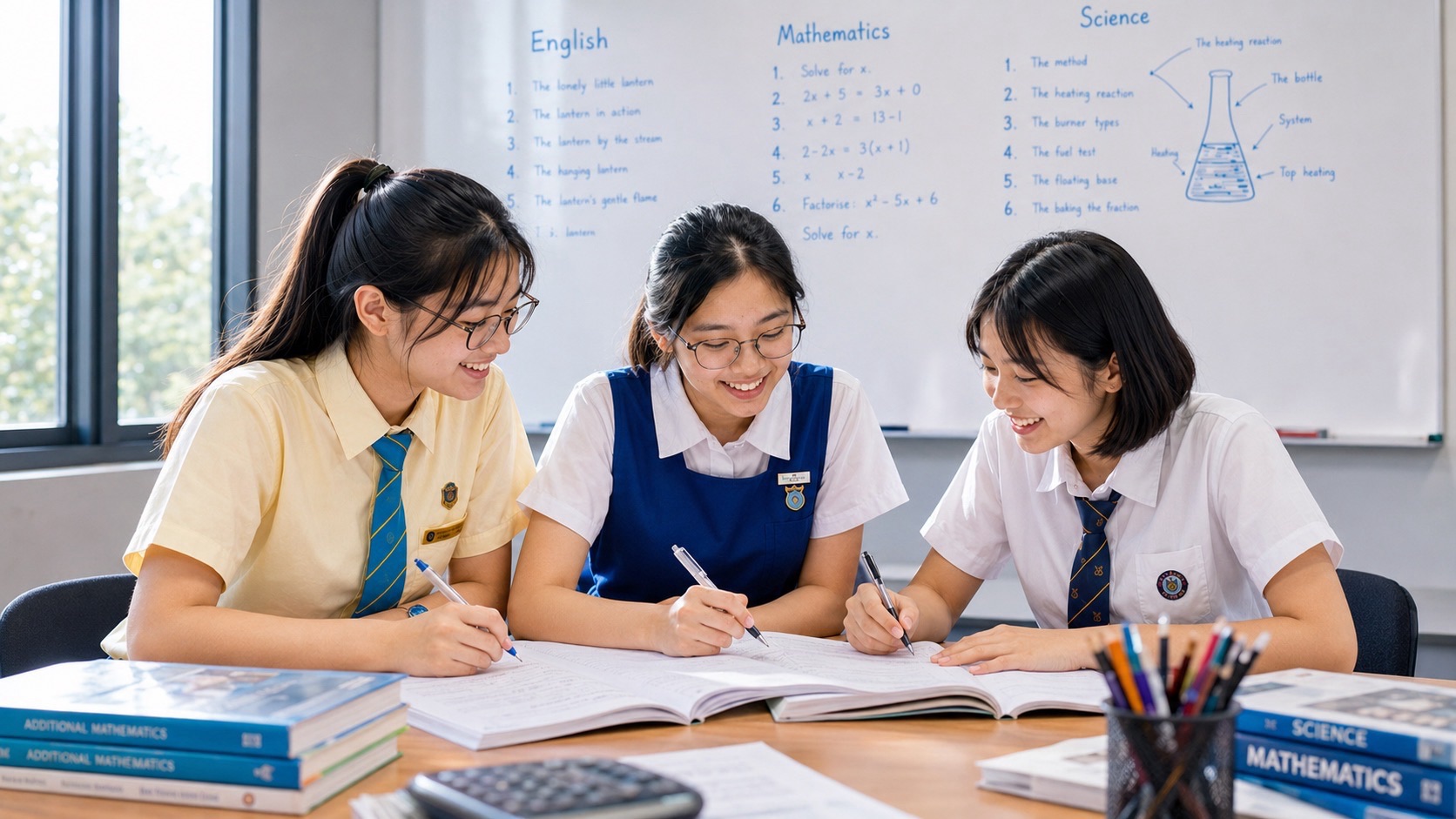
2027 SEC G1 Mathematics K110 is a complete Mathematics syllabus with its own examination design, learning goals and pathway. For Punggol families preparing for the first Singapore-Cambridge Secondary Education Certificate examinations in 2027, the most useful starting point is simple: learn the Mathematics level your child will actually sit, then prepare deliberately for that paper.
G1 Mathematics is not “a watered-down G3 paper”. SEAB lists it separately as K110, with the pre-2027 reference code 4046. The syllabus develops useful mathematical fluency, problem solving and reasoning through Number and Algebra, Geometry and Measurement, and Statistics and Probability.
At eduKatePunggol, Secondary Mathematics is taught in focused groups of up to three students in 1.5-hour lessons near Punggol MRT. For G1 students, the goal is not to race through harder-looking worksheets. It is to make the student accurate, confident and increasingly independent in the Mathematics that matters at G1, while keeping future options open through real capability.
2027 G1 Mathematics K110 at a glance
- Subject: SEC G1 Mathematics.
- 2027 subject code: K110.
- Reference code for 2026 and earlier: 4046.
- Paper 1: 1 hour 30 minutes, 50 marks, 50%.
- Paper 2: 1 hour 30 minutes, 50 marks, 50%.
- Calculator: approved calculator allowed in both papers.
- Assessment emphasis: about 65% standard techniques, 30% problem solving and 5% reasoning/communication.
The good news is that the paper becomes much less mysterious once the structure is clear. Students know what they are training for, and parents can stop guessing from old stream labels.
What G1 Mathematics is trying to build
G1 Mathematics rewards dependable Mathematics. That means a student should be able to recognise a familiar situation, choose the right operation or method, work accurately, read information carefully and explain enough working for the answer to be followed.
The syllabus is organised around three broad strands:
- Number and Algebra — number sense, arithmetic, ratios, percentages, simple algebra and relationships;
- Geometry and Measurement — shapes, measures, scale, angles, length, area, volume and spatial reasoning;
- Statistics and Probability — reading, organising and interpreting data, together with chance and simple probability reasoning.
These ideas are meant to be used, not merely remembered. The syllabus includes meaningful and real-life contexts, so revision should include questions involving money, schedules, recipes, measurements, plans, utilities, tables, graphs and everyday decisions.
Paper 1: build a reliable Number, Algebra, Geometry and Measurement engine
Paper 1 is 1 hour 30 minutes for 50 marks. It covers Number and Algebra together with Geometry and Measurement.
The paper is designed around a sequence of shorter questions followed by longer contextual questions. A useful student mindset is therefore:
- collect the accessible marks cleanly;
- show essential working;
- keep units, signs and rounding under control;
- slow down when a question becomes contextual;
- check whether the final answer makes sense.
For many students, the greatest improvement does not come from learning a new trick. It comes from stopping repeated small losses: copying a number wrongly, skipping a unit, misreading a scale, losing a negative sign or entering a calculation incorrectly.
Paper 2: Number and Algebra meets Statistics and Probability
Paper 2 is also 1 hour 30 minutes for 50 marks. It combines Number and Algebra with Statistics and Probability.
This means a student needs more than calculation. The student must be able to read information, decide what matters, interpret a table or graph and turn a written situation into Mathematics.
A strong Paper 2 routine is:
- underline the quantity being asked for;
- identify the information that is actually useful;
- choose the mathematical relationship before touching the calculator;
- write the calculation clearly;
- interpret the answer back in the context of the question.
What the 65–30–5 assessment balance means for revision
About 65% of the assessment is directed at standard techniques. That is a large share, and it tells us something important: basic competence is valuable.
A G1 student should not spend every revision session chasing unusual questions while basic percentage, arithmetic, algebra or measurement remains unstable. Routine Mathematics should become calm and dependable.
But the remaining assessment still matters. Around 30% involves problem solving, while reasoning and communication also appear. So a student who can copy a worked example but cannot recognise the same idea in a new situation will eventually hit a ceiling.
The practical balance is:
- first: make core methods reliable;
- then: mix the questions so the student must choose the method;
- then: use real-world and unfamiliar contexts;
- finally: train under paper timing.
Yes, calculators are allowed — but calculator sense still matters
An approved calculator may be used in both G1 Mathematics papers. That is helpful, but it does not replace number sense.
Students still need to know whether an answer is sensible. If a simple discount produces a price larger than the original amount, or a measurement becomes impossibly large, the student should notice.
Good calculator training therefore includes:
- entering brackets correctly;
- checking signs;
- keeping enough intermediate accuracy;
- rounding only when appropriate;
- estimating roughly before accepting the display;
- writing enough working to show the method.
A simple four-stage G1 Mathematics study plan
Stage 1: secure the floor
Start with prerequisite skills that appear everywhere: basic operations, fractions, decimals, percentages, ratio, simple algebra, units and reading graphs. If these are shaky, later topics feel harder than they need to be.
Stage 2: connect topics
Move from single-topic worksheets to mixed sets. The student should learn to recognise whether a question needs percentage, ratio, measurement, algebra or data interpretation without being told the chapter name first.
Stage 3: practise context
Use real-life questions regularly. A student should become comfortable with information that arrives as a timetable, bill, plan, graph, table, recipe or short story rather than a neat line of symbols.
Stage 4: train the paper
Once enough syllabus content has been covered, add timed sections and then full papers. Review every error by cause: knowledge gap, reading error, method error, calculator input, careless execution or time pressure.
A good weekly rhythm for Punggol students
A practical week does not need to be dramatic. It needs to be repeatable.
- One short skills block: keep arithmetic, algebra and measurement fluent.
- One mixed block: practise choosing methods without chapter labels.
- One context block: solve real-world questions slowly and clearly.
- One correction block: redo mistakes without looking at the answer.
- Near examinations: add timed sections and paper review.
The correction block is especially important. A student improves when an error becomes a repaired skill, not merely a red cross in an exercise book.
Four mistakes to avoid in 2027 SEC G1 Mathematics preparation
- Treating G1 as a temporary waiting room. Teach the level well. Strong capability creates options.
- Giving only routine drills. The paper also rewards problem solving in context.
- Depending on the calculator. The calculator computes; the student still has to think.
- Using old papers without mapping them. Older 4046 material can be useful, but the 2027 K110 syllabus should remain the authority.
For a fuller explanation of legacy resources, see Can Old O-Level and N-Level Papers Be Used for 2027 SEC Maths?.
What if a student later becomes ready for a different Mathematics level?
Full Subject-Based Banding means subject level is not a permanent label on the whole student. Schools consider subject-level movement at appropriate junctures based on readiness and their implementation arrangements.
The best preparation for a possible move is not to rush into a pile of harder worksheets. Build the present level so securely that the student has the prerequisite knowledge, confidence and learning habits to handle the next level sustainably.
Read Can a Student Move Between G1, G2 and G3 Mathematics? for the wider subject-level discussion.
Frequently asked questions about 2027 SEC G1 Mathematics K110
Is G1 Mathematics one paper or two?
Two papers. Paper 1 and Paper 2 are each 1 hour 30 minutes, worth 50 marks and contribute 50% each.
Can students use a calculator?
Yes. An approved calculator is allowed in both papers.
Should a student only practise easy questions because it is G1?
No. Students need strong standard techniques, but they also need problem solving, reasoning and confidence with real-world contexts.
Can older 4046 papers still help?
They can be useful where the content aligns, but they should be mapped to the current K110 syllabus rather than used automatically as a 2027 paper template.
Mathematics Tuition in Punggol: build the level well, then build outward
For 2027 SEC G1 Mathematics, the cleanest plan is straightforward: know K110, secure the basic techniques, practise the Mathematics in real situations, show essential working and train the two papers deliberately. Good Mathematics is not about carrying an old stream label. It is about being able to solve what is in front of you.
Families who want to discuss G1 Mathematics preparation can WhatsApp eduKatePunggol.
Official 2027 SEC G1 Mathematics references
- SEAB 2027 G1 syllabuses for school candidates
- SEAB 2027 G1 Mathematics K110 syllabus
- MOE Full Subject-Based Banding


