
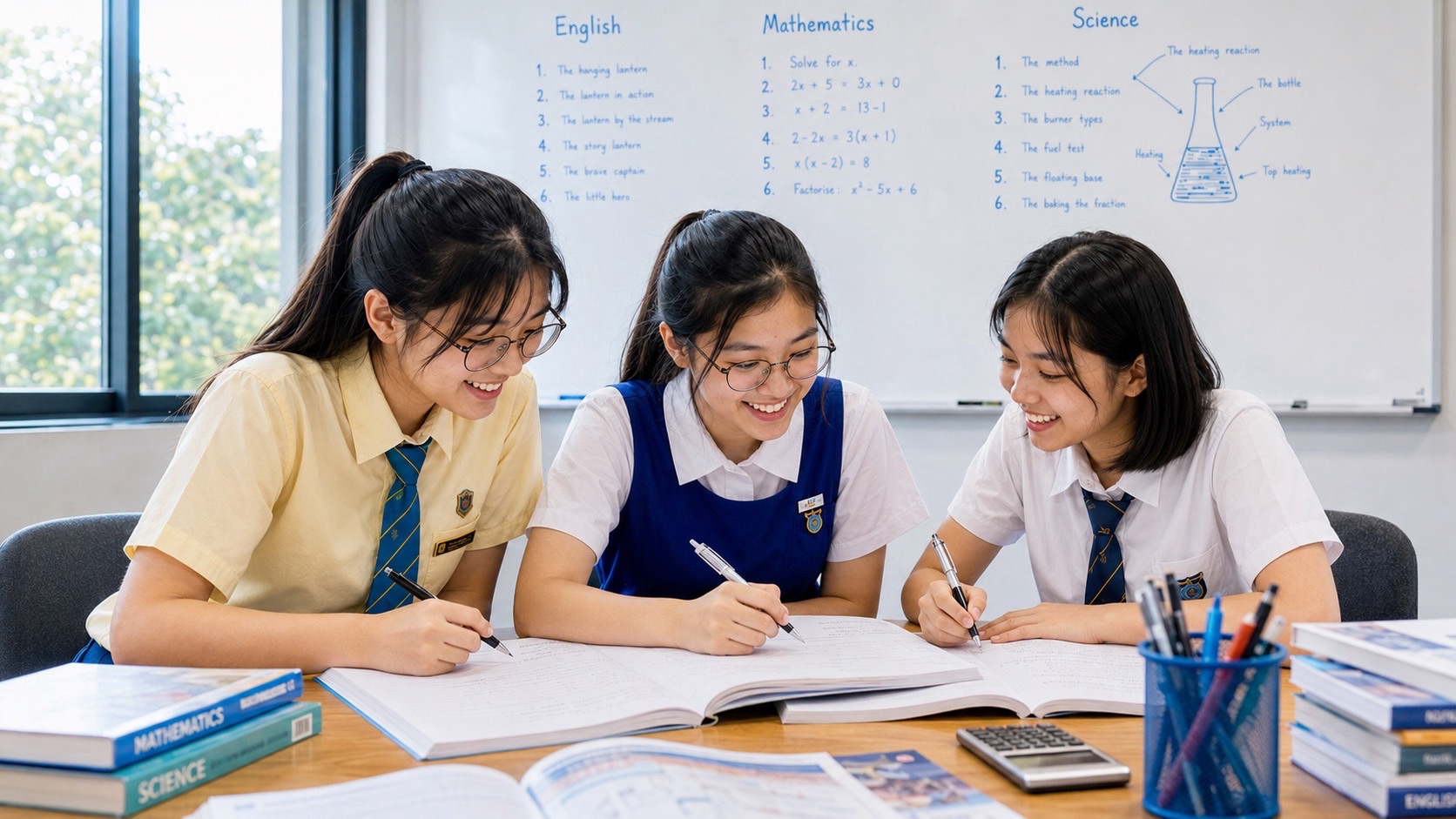
Advanced English does not grow only inside English lessons. A Punggol student can improve reading, vocabulary, writing and oral communication by learning how Mathematics handles precision, how Science handles evidence, and how wider knowledge gives language something substantial to think about.
This is where eduKate’s wider ecosystem becomes useful. English, Mathematics and Science are different school subjects, but the learner carries one mind between them. Precision learned in Mathematics can improve language. Evidence discipline learned in Science can improve argument. Wider knowledge can improve comprehension, vocabulary and oral discussion.
English becomes stronger when ideas become stronger
Students sometimes try to improve English by focusing only on sentences. But language is carrying content. A learner with little background knowledge may understand every individual word and still struggle to interpret the larger idea.
A student who knows something about climate, technology, public health, transport, energy, ecosystems, economics or social behaviour has more anchors when those topics appear in comprehension, writing or oral discussion.
This does not mean English tuition should become a general-knowledge quiz. It means language development and knowledge development can reinforce one another.
Mathematics teaches precision
Mathematics trains students to respect definitions, conditions and relationships. A symbol means something specific. A condition cannot simply be ignored because the rest of the working looks correct.
That mindset transfers well into English. Words also carry conditions. “Some”, “most” and “all” are different. “May cause” and “causes” are different. “More likely” and “certain” are different.
A mathematically disciplined reader is often more alert to qualifiers and boundaries because they have learned that small changes can alter the entire statement.
Science teaches evidence discipline
Science repeatedly asks students to distinguish observation from explanation, evidence from conclusion, and measurement from interpretation.
Those habits are directly useful in English comprehension and argument. A strong reader asks: What does the text actually state? What conclusion is justified? What is only suggested? What alternative explanation remains possible?
This is why eduKate’s Advanced Vocabulary work around words such as “suggests”, “indicates”, “supports”, “shows”, “confirms” and “proves” belongs naturally inside English reasoning. The word chosen should match the strength of the evidence.
Science also teaches explanation architecture
A good Science explanation often has a clear sequence: condition, mechanism, change, consequence. That same architecture can strengthen English writing.
Instead of writing, “This is bad for the environment,” a student can explain what changes, why it changes and what consequence follows. Instead of asserting, “Technology helps students,” the learner can describe the mechanism by which a tool changes access, feedback or practice.
The result is more developed writing because the underlying thinking is more developed.
Mathematics and English share a question-reading problem
A student can calculate correctly and still lose a Mathematics question because the target was misread. The same problem appears in English. A learner can understand the passage yet answer a different question from the one asked.
- Identify the object or topic.
- Identify the action required.
- Mark the conditions or boundaries.
- Decide what evidence or method is allowed.
- Answer the exact job.
- Verify that the response still matches the original task.
This is why FENCE™ is useful beyond one English component. It trains the habit of seeing boundaries before responding.
Wider knowledge strengthens vocabulary in context
Vocabulary is easier to remember when words belong to meaningful networks. A student who learns “ecosystem”, “biodiversity”, “conservation” and “habitat” inside Science has a richer conceptual field than a student memorising the words separately.
The same is true for technology, finance, government, transport, health, culture and education. Knowledge clusters help words become connected rather than isolated.
This is one reason the wider eduKateSG Vocabulary ecosystem emphasises context and relationships.
Reading across subjects builds representation flexibility
English texts are not always pure prose. Students increasingly meet tables, charts, diagrams, captions, maps, labels, data and mixed-media information.
Mathematics and Science train students to move between representations. A learner who can read a graph, interpret a table and connect data to a written claim has useful habits for multimodal literacy.
Advanced English includes the ability to understand how words and non-verbal information work together.
The knowledge-to-language chain
- Encounter an idea in Science, Mathematics, society or everyday life.
- Learn the vocabulary used to describe it.
- Read explanations and arguments about it.
- Distinguish evidence from interpretation.
- Discuss it aloud and hear alternative viewpoints.
- Write about it with increasing precision.
- Revise claims so wording matches the evidence.
This chain turns knowledge into usable English.
How background knowledge improves inference
Inference is built from text plus what the reader already knows. When background knowledge is too thin, the student may not see why a character’s behaviour is unusual, why a policy has a trade-off, why a scientific claim matters or why a writer’s example is persuasive.
The answer is not uncontrolled guessing. The answer is to widen the knowledge base while still requiring every inference to stay anchored to the text.
How Mathematics can improve argumentative writing
Mathematics encourages students to ask whether a conclusion follows from the information available. That same habit improves argument.
- What exactly am I claiming?
- What evidence supports it?
- Is the evidence enough?
- What assumption connects the evidence to the claim?
- Is there a counterexample?
- Should the claim be qualified?
This makes writing more careful without making it less lively.
How Science can improve descriptive and explanatory writing
Science trains close observation. Instead of saying “the water changed”, students may notice colour, temperature, rate, direction or sequence. That precision can strengthen descriptive writing too.
The same student who learns to observe carefully in Science can write more concrete descriptions, more believable narratives and more exact explanations.
How English then strengthens Mathematics and Science in return
The relationship is not one-way. Strong English helps students read complex Mathematics questions, interpret Science instructions, explain reasoning, justify conclusions and communicate procedures.
This creates a positive loop. Better English improves access to other subjects. Better subject knowledge gives English richer content. The same attention, vocabulary, reasoning and verification habits circulate through the whole learning ecosystem.
A cross-subject error audit
- Did I misunderstand an important word?
- Did I miss a qualifier such as “some”, “mainly” or “under these conditions”?
- Did I confuse evidence with conclusion?
- Did I make a claim stronger than the evidence allowed?
- Did I ignore a graph, table or diagram?
- Did I use a technical word without understanding it?
- Did I understand the idea but express it vaguely?
This audit is more useful than simply calling a mistake “careless”.
What parents can do without reteaching every subject
Parents can ask high-value questions across subjects: “What does that word mean here?”, “What is the evidence?”, “What caused that?”, “How certain are you?”, “What does the graph show?”, “Can you explain it in one clear sentence?”, “What would make your claim too strong?”
These questions reinforce language and reasoning without turning the home into another classroom.
What tutors can do in a three-student class
Small groups create opportunities to hear language being used around ideas. One student can explain a Science relationship, another can challenge the evidence, and a third can offer a clearer wording. The tutor can then correct both the thinking and the language carrying it.
This is powerful because explanation exposes hidden gaps that a short written answer may conceal.
A weekly knowledge-and-English routine
- Read one short article connected to Science, technology, society or Singapore.
- Extract five useful words or phrases and explain them in context.
- Identify one claim and the evidence supporting it.
- Summarise the central idea in two or three sentences.
- Discuss one implication or alternative viewpoint aloud.
- Write one paragraph using the new knowledge without copying the source.
- Check whether the strength of the wording matches the strength of the evidence.
How this folds into eduKate’s wider learning ecosystem
The Science Tuition lane builds evidence, explanation and observation. The Mathematics Tuition lane builds precision, structure and condition-reading. The English Tuition lane turns those capabilities into reading, writing, speaking and listening.
Together they create a more complete learner: one who can understand ideas, test claims, communicate precisely and transfer knowledge between contexts.
Continue the Punggol Advanced English journey
- The Long Journey From Primary Reading and Vocabulary to SEC English
- Secondary 3 — Build One Connected English System
- Secondary 4 and SEC — Independent Exam Control
Continue through the wider eduKate ecosystem
- How English Works
- Vocabulary by eduKateSG
- FENCE™ English Learning System
- How Education Works
- Tuition at eduKatePunggol
Advanced English grows stronger when knowledge, evidence and precision grow with it. A student who can understand the idea, name it accurately, test the evidence, explain the relationship and communicate it clearly has more than examination technique. They have language control.


