
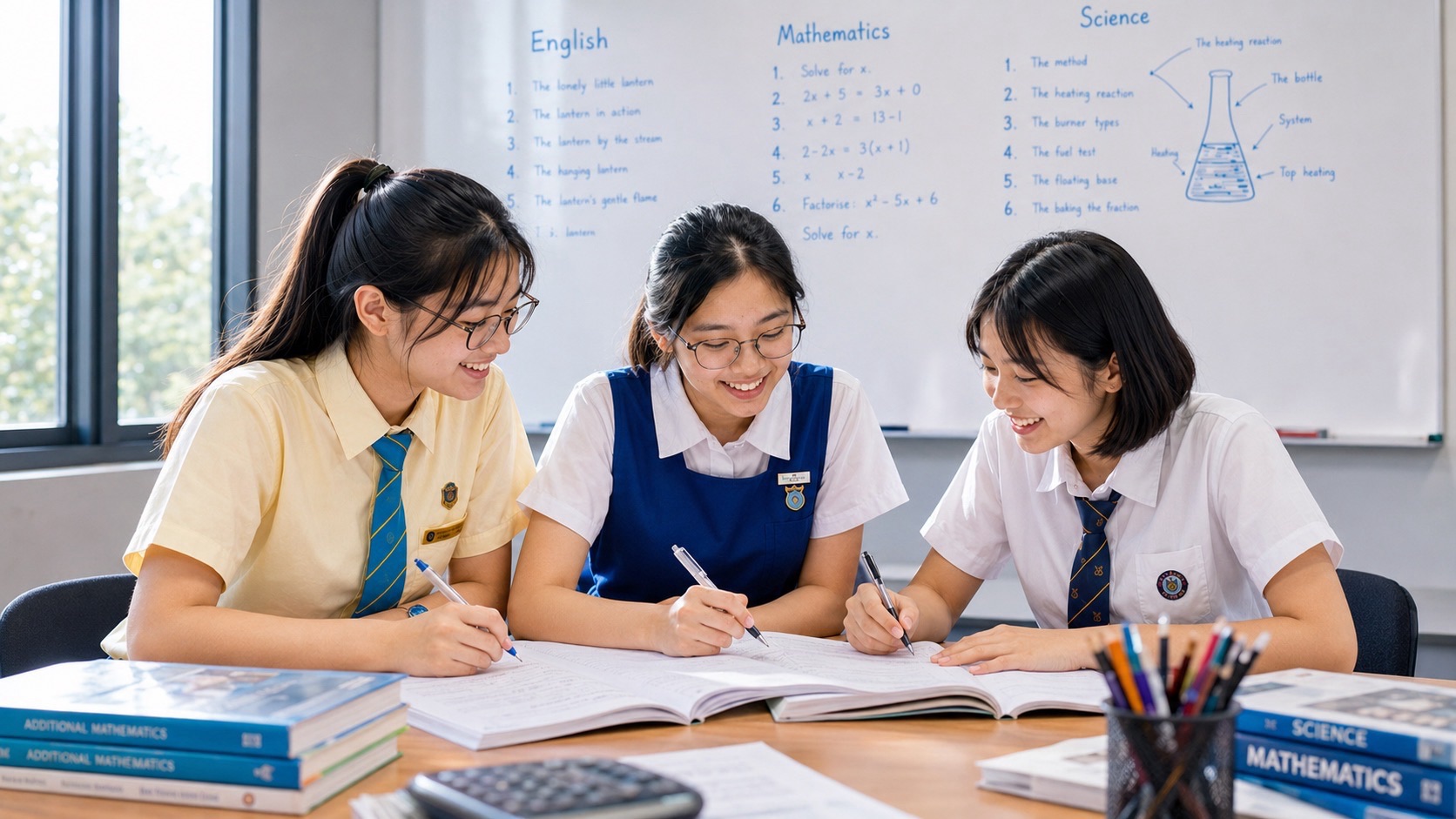
Punggol exam mornings work best when the family treats them as a small operating system, not as a dramatic exception. The objective is simple: the student should arrive at the correct place, with the correct materials, inside the required reporting window, fed, awake and mentally steady enough to begin the paper. That sounds obvious. In practice, exam morning is where several ordinary family systems suddenly have to work at once: sleep, breakfast, school bags, alarms, lifts, LRT or bus timing, rain, sibling routines, parent work schedules, permitted materials, reporting instructions and the student’s own nerves.
This guide is the Punggol-specific implementation layer. It does not replace the school’s examination instructions, MOE or SEAB rules, or subject-specific examination technique. Instead, it asks a narrower and more practical question: how does a family turn all of those requirements into a reliable morning? The focus is the chain from the previous evening to arrival at school. The same principle used throughout eduKatePunggol applies here: build the route so that a minor disturbance stays minor.
For the wider family system, see our Punggol School-Morning Departure System, Punggol Family Calendar System, Punggol Exam Week family guide and Punggol Route Planning for Students. This article connects those systems specifically to examination morning.
Exam Morning Is a Transition Problem Before It Is an Examination Problem
A student can know the syllabus and still begin the paper badly because the transition into the examination room was chaotic. The family wakes late. Breakfast becomes rushed. A calculator has no battery. The child cannot find an entry proof or stationery item required by the school. The lift takes longer than expected. Rain changes the walking route. The LRT platform is crowded. A parent discovers that the student’s water bottle has leaked into the bag. None of these events tests Mathematics, English or Science. Yet every one of them can consume attention before the paper begins.
That is why exam morning deserves its own design. On a normal school day, a five-minute delay may be absorbed by routine. On an exam morning, the family’s tolerance for delay is lower because the reporting time is less negotiable and the student is more sensitive to disruption. The system therefore needs a larger margin, fewer decisions and fewer dependencies. A good plan removes avoidable questions before the student wakes: what time to leave, what to carry, what to eat, which route to take, who is responsible for the final materials check and what happens if the preferred route is disrupted.
The essential shift is from remember everything in the morning to prepare the morning so very little has to be remembered. That is the same reason pilots, operating theatres and good classrooms use checklists. The checklist is not there because people are incapable. It is there because important details can fail when attention is loaded. Examination morning is a high-load transition. We lower the load by moving decisions earlier.
The Boundary: Logistics Must Support Learning, Not Replace It
Families sometimes respond to examinations by adding more activity: one final worksheet before breakfast, one more vocabulary list in the car, one last formula lecture while the student is putting on shoes. This feels productive because everyone is doing something. It can also create a poor trade. The morning system should protect readiness, not turn the home into a second examination hall.
Subject preparation belongs primarily to the days and weeks before the paper. The morning is for retrieval of essentials, not last-minute reconstruction of the syllabus. A short glance at a student’s own concise summary may be calming if it is already part of the student’s normal routine. A frantic attempt to teach unfamiliar content is different. The family should know which side of that boundary it is on.
A useful test is this: does the activity reduce uncertainty or create new uncertainty? Checking that the calculator is permitted and working reduces uncertainty. Discovering a new way to solve simultaneous equations at the breakfast table creates it. Confirming the reporting time reduces uncertainty. Asking the child whether every chapter has been mastered increases cognitive load without changing the answer. The morning system should narrow the student’s field of concern until the next action is obvious.
Build Backward From the Required Arrival, Not Forward From the Alarm
The strongest exam-morning plan starts at the school gate and works backward. Families often do the opposite. They choose a familiar wake-up time, estimate breakfast, assume the usual commute and hope the pieces fit. That works when the day is forgiving. Examination morning is better designed from the fixed point: the school’s required reporting time or the family’s chosen earlier arrival target.
Suppose a student must be on campus by a particular time. The family then subtracts the last walking segment, the normal transport time, an allowance for waiting, a weather allowance, a small recovery margin, breakfast, washing and dressing, and the wake-up transition. The exact numbers vary by household and school. The principle does not. Every segment has a job and every important segment has margin.
This is especially relevant in Punggol because many journeys combine vertical travel in an HDB block, walking to an LRT or bus stop, transfers, sheltered and unsheltered segments, and the final walk to school. A route that usually takes a predictable amount of time can become less predictable when rain, lift queues, a missed connection or a forgotten item enters the chain. The family does not need to catastrophise. It simply needs to stop treating the fastest observed journey as the planned journey.
A practical backward-planning sequence
- Start with the official school reporting requirement and any special examination-day instruction.
- Choose the family’s own target arrival, usually earlier than the latest acceptable moment.
- Estimate the complete door-to-school journey, including lift, walking and waiting rather than only in-vehicle time.
- Add a modest disruption margin appropriate to the route and weather exposure.
- Set the home departure time.
- Work backward through shoes, final bag check, breakfast, washing and waking.
- Move packing, document checks and device or calculator preparation to the previous evening wherever possible.
The important idea is not a universal number of minutes. It is that the family knows where its buffer sits. Hidden buffer is often accidentally consumed. A child who believes departure is 7:00 when the parent secretly hopes to leave at 6:50 will not behave as if 6:50 matters. A clear plan is more useful than an invisible margin.
The Night Before: Close Loops Instead of Creating New Ones
The night before the examination is the highest-leverage part of exam morning because it can remove entire categories of morning failure. Packing is one example, but the principle is broader. Anything that can be settled without reducing sleep should be settled. The student should not wake to unresolved decisions about clothing, required materials, transport, breakfast or where an important item was left.
A strong evening close has three layers. First, the student finishes the academic day. That may include a final light review, but it should have a stopping point. Second, the family completes the physical preparation: bag, stationery, permitted equipment, school uniform, shoes and any required documents or school-issued items. Third, the route is confirmed: reporting time, departure time, transport assumption and backup.
This matters psychologically as well as operationally. An unresolved task remains mentally active. A student trying to sleep while wondering whether a calculator is in the bag or whether the parent remembers the reporting time is carrying unnecessary load. Closing the loop says: the system is ready; you can stop managing it in your head.
The exam bag should be boring
A good examination bag contains what is required and very little drama. The exact permitted items depend on the school and paper, so the family should follow current instructions rather than a generic internet checklist. The useful method is to separate items into categories: writing instruments, paper-specific permitted equipment, school identification or documents if required, ordinary personal items allowed by the school, and any backup that is both useful and permitted.
The student should know where each important item sits. A bag can technically contain everything and still create stress if the student must empty it at the school gate to find one small object. Consistent pockets reduce search. If a calculator is used for a permitted paper, it should be checked early enough that a battery or functional problem can be solved without morning improvisation. If geometry instruments are required, they should not be borrowed from a sibling at the last minute.
The guiding question is not “what might possibly be useful?” It is “what is required, permitted and reliably accessible?” Overpacking produces another form of friction. A bag full of unrelated revision books, loose worksheets and heavy folders can hide the few items that actually matter.
Sleep Is Part of the Morning System Because the Morning Begins the Night Before
Families often talk about sleep as a health topic separate from examinations. Operationally, it is part of exam readiness. A student who loses significant sleep to last-minute revision may gain exposure to a few more facts while reducing attention, emotional control and retrieval quality the next morning. The exact sleep needs of children and teenagers vary, and families should follow appropriate professional guidance where health is concerned. The practical educational point is simpler: exam morning should not be built on an intentionally exhausted student.
A reliable family system therefore protects a realistic stopping time. The student needs enough time to put materials away, wash, settle and sleep rather than ending academic work at the exact moment the lights are supposed to go out. Parents can help by shifting their role from “continue checking whether you know everything” to “close the day cleanly.”
If anxiety keeps a student awake, the family should avoid turning the bedroom into a second revision session. Reassurance is more useful when it is concrete: the bag is packed, the alarm is set, the route is known, breakfast is decided and there is time. The family cannot guarantee the paper. It can make the environment predictable.
Wake-Up Time Should Create Movement, Not Negotiation
On ordinary mornings, families sometimes use several alarms, repeated calls, bargaining and gradual escalation. Examination morning is a poor day to discover that this wake-up pattern is fragile. The best solution is not a harsher alarm; it is a stable routine tested before the examination period.
The student should know the first few actions after waking. Get up. Wash. Dress. Eat. Final check. Leave. The sequence can vary, but it should not require ten decisions. Parents can reduce friction by removing questions that do not matter. This is not the morning to debate breakfast choices, change the transport plan for convenience or search for a different pair of shoes.
If the student normally takes time to become alert, the schedule should respect that reality instead of pretending the student will suddenly become fast because the day is important. Good systems model the actual person. The family gains reliability by planning around observed behaviour, then gradually improving the behaviour on non-exam days.
Breakfast: Familiar, Sufficient and Logistically Simple
Breakfast on exam morning should serve the student, not become a performance by the household. Families do not need to invent a special “exam food” ritual unless it is already comfortable for the child. A familiar meal that the student can tolerate, eat without conflict and finish within the schedule is usually operationally stronger than an unfamiliar elaborate breakfast that introduces new uncertainty.
The practical problem is timing. A student who is rushed may skip food even when breakfast was prepared. A student who wakes too late may be eating while looking for stationery. A family that has not decided breakfast may spend ten minutes discussing options. The solution is to integrate food into the route: the meal is chosen beforehand, the preparation is realistic and the eating window is protected.
Families should also separate general nutrition questions from examination logistics. This article does not prescribe a medical or dietary plan. The system question is whether the student begins the paper distracted by preventable hunger, thirst or a rushed stomach because the morning was poorly organised. Familiarity, moderation and adequate time are the useful operating principles.
The Final Materials Check Should Be Short Because the Real Check Happened Earlier
A morning check is useful. A morning search is not. The difference is whether the family is verifying a prepared system or trying to build it from scratch. The final check should therefore be short enough that it does not become a new delay source.
One method is a fixed sequence at the door: required school item or identification if applicable; pencil case; permitted calculator or instruments where relevant; water or personal item if permitted; keys or transit card; phone according to school rules; then shoes and departure. The exact sequence must match the student’s school and paper. It should be written or memorised from actual requirements, not copied from a generic template.
Responsibility should also be clear. Older students should increasingly own the check themselves, with the parent acting as backup rather than primary memory. Younger students may need more scaffolding. The long-term educational objective is not a parent who becomes better at packing. It is a student who develops reliable self-management while the family protects high-stakes transitions.
Travel Buffer: Protect the Paper From the Journey
A travel buffer is not wasted time. It is insurance against ordinary variation. The student may wait longer for the lift, walk more slowly in heavy rain, miss one LRT connection, encounter a crowded platform or need a minute to reorganise a wet umbrella. The buffer absorbs these events so they do not immediately become an emergency.
The buffer should be placed in the plan rather than created through panic. Leaving very early without purpose can also be unhelpful if the student then waits for a long period feeling anxious. The family should choose a sensible arrival target based on school instructions, journey reliability and the student’s needs. The point is to avoid a plan that succeeds only when every segment runs at its fastest.
Our Punggol Route Planning for Students explains the wider method: route time includes transfers, waiting and last-mile movement, not merely the time printed for a vehicle segment. On exam morning, that principle becomes stricter because the arrival deadline is more important.
Punggol Weather Is a Route Variable, Not Background Scenery
Rain, heat and other weather conditions change walking speed, shelter choices, visibility, comfort and the amount of time families spend moving between home, transport and school. Punggol families already know this from ordinary school days. Examination morning simply requires the family to convert that lived knowledge into a plan.
The family does not need to predict weather perfectly. It needs a backup that works when conditions differ from the preferred case. If the normal route has a long unsheltered segment, decide in advance what changes during heavy rain: leave earlier, use the more sheltered connection, switch to the appropriate bus or train path, or use the family’s agreed pickup plan. The useful principle is simple: design the alternative while everyone is calm, then use current official weather and transport information on the actual morning.
See Punggol Weather for Families for the broader weather-and-school-day relationship. On examination morning the rule is simple: weather should change the route or margin, not the student’s confidence in the whole day.
Arrival Is a Stage of the System, Not the End of the Commute
Families often think the system ends when the student reaches the school gate. For the student, there is another transition: from travelling to sitting for the paper. That transition deserves quiet space. A child who arrives at the last possible minute may technically be on time while still carrying the urgency of the journey into the examination setting.
A good arrival allows the student to shift states. The bag is settled. Required materials are accessible. The student follows school instructions, uses the available time appropriately and stops solving family logistics. Parents should resist the temptation to continue coaching through the gate. The handover has happened. The student now needs to enter the school’s examination process.
This is where independence matters. The family system should deliver a prepared student, not a student who requires the parent to keep managing every next step. The operational success of the morning is that the parent can stop.
Primary-School and Secondary-School Students Need Different Amounts of Scaffolding
A Primary-school child may need visible prompts and more parent verification. A Secondary-school student should usually carry more responsibility for materials, route awareness and time. The transition between those stages should be deliberate. If parents continue to perform every exam-morning task for an older student, the family may achieve short-term reliability while delaying the student’s own reliability.
The useful question is not “should the parent help?” but “what is the smallest support that keeps the system reliable while allowing the student to own the next layer?” A Primary 4 student may pack using a checklist with a parent reviewing it. A Primary 6 student may pack independently and call for a verification of special paper requirements. A Secondary 3 student may own the full process and only confirm the family departure time.
This graduated handover is consistent with the broader eduKatePunggol goal: support should build capability that can eventually operate with less support. Examination morning is a practical place to see whether that transfer is happening.
What Parents Should Say in the Final Thirty Minutes
Language matters because the family can either stabilise the morning or amplify it. Parents sometimes express care through repeated warnings: “Don’t forget anything,” “You must be careful,” “This paper is very important,” “Check every answer,” “Remember what your tutor said.” None of those statements is necessarily wrong. The problem is cumulative load. The student already knows the paper matters.
Useful final communication is operational and calm. “Your bag is ready.” “We leave in ten minutes.” “You know the route.” “Follow the school’s instructions.” “Do the paper you have prepared for.” The exact words should sound natural in the family, not scripted. The function is to close loops, not open new ones.
Parents can also avoid posturing certainty. “You will definitely get an A” may sound encouraging but turns support into a prediction. Better support focuses on controllable actions: arrive prepared, read carefully, manage the paper according to learned examination craft and recover if one question is difficult.
When Something Goes Wrong: Use a Recovery Sequence
The best system is not one that never encounters trouble. It is one that degrades gracefully. A forgotten item, delayed route or upset stomach can still happen. The family should therefore know the priority order: protect safety, obey school requirements, preserve arrival, solve only what can actually be solved and avoid turning one problem into five.
Suppose the student realises a non-essential revision booklet is at home. The correct response may be to continue to school because the booklet is not needed for the paper. Returning for it would convert a harmless omission into a timing risk. If an essential permitted item is missing, the family should follow the school’s appropriate process or obtain a replacement only if time and rules allow. The system distinguishes important from emotionally salient.
The recovery sequence can be summarised as: identify the actual requirement; check the available time; choose the smallest safe fix; keep moving. This is the same logic we use in academic recovery. Do not rebuild the whole machine because one component slipped.
If the family wakes late
Do not spend the first five minutes blaming the alarm, the child or the parent. Compress the routine deliberately. Remove optional tasks. Use the prepared bag. Choose the known reliable route. Communicate the new departure time. If school instructions require action when arrival may be affected, follow those instructions. The objective is to recover time without creating unsafe travel or additional confusion.
If heavy rain changes the route
Use the pre-decided wet-weather route or margin. The important preparation is not the umbrella; it is the family’s knowledge of which parts of the journey become slower and what alternative is realistic. A student who understands the route is less dependent on a parent improvising under pressure.
If the student becomes anxious
Return to the next physical action. Shoes. Bag. Leave. Walk. Arrive. Anxiety often expands when the mind is asked to solve the entire future at once. The family can narrow attention without pretending the examination is unimportant. If anxiety is severe or persistent, that is a broader wellbeing matter and families should seek appropriate professional support; it should not be reduced to a logistics checklist.
The Exam-Morning Checklist Should Be Short Enough to Use
A checklist that contains fifty items will be ignored. The exam-morning checklist is not the place to reproduce every school rule or every revision point. It should cover the few operational failures that the family has learned are genuinely possible.
- Reporting requirement confirmed from the current school instruction.
- Departure and target arrival times agreed.
- Bag packed the previous evening.
- Paper-specific permitted equipment checked.
- Uniform, shoes and ordinary school items prepared.
- Breakfast decided and timed.
- Transit card, keys or other routine travel essentials ready.
- Wet-weather adjustment understood if relevant.
- Alarm and backup wake-up responsibility clear.
- Student knows the next action after arriving at school.
Families can personalise the list by adding one or two recurrent issues. If a child often forgets a calculator, that belongs on the list. If another student never forgets materials but regularly leaves too late, the list should focus on time. A checklist is a response to observed failure modes, not a decorative document.
A 24-Hour Exam-Morning Timeline
The following timeline is a model, not a universal schedule. Its value is the order of operations.
The previous afternoon or early evening
Confirm the next paper, reporting instruction and any paper-specific permitted equipment. Make sure the student knows what the paper is and does not rely on a parent to discover it at bedtime. If transport will differ from the normal school route, settle it now.
The previous evening
Complete the main academic work early enough to allow a clean stop. Pack the bag. Lay out clothing. Check stationery and equipment. Decide breakfast. Confirm departure. Set the alarm. Then close the day. The student should not carry a vague sense that several important tasks remain unfinished.
Wake-up
Move directly into the familiar sequence. Avoid unnecessary phone use, family debates or new academic tasks. If the family shares bathrooms or has siblings leaving at similar times, the sequence should already account for that.
Breakfast and final readiness
Eat the planned meal. The student performs the short materials check. The parent verifies only what the family has agreed the parent should verify. Do not unpack the entire bag “just to be safe.”
Departure
Leave according to the planned time rather than waiting until the theoretical latest minute. If conditions are normal, the buffer remains unused. That is success.
Arrival
Follow school procedures. Shift from family logistics to examination mode. The morning system has completed its job.
Exam Morning and the Family Calendar
Examinations rarely affect only the student. A parent may need to start work early. A sibling may attend another school. A younger child may require supervision. A grandparent may handle the walk to school. A tuition lesson may occur later that day. The family calendar therefore has to represent exam mornings explicitly rather than treating them as an invisible variation of the normal week.
Our Punggol Family Calendar System is useful here because it treats transitions, travel and shared resources as part of the schedule. A family does not merely schedule “Math Paper.” It schedules the departure dependency around that paper. If one adult must be home for the younger sibling, another adult’s role in the exam-morning handover becomes visible.
This avoids a common failure: everyone knows the examination date, but nobody owns the logistics. Calendars should expose ownership, not just events.
Exam Morning Should Not Become a Family Performance Review
High-stakes days tempt adults to revisit every concern. “You should have started earlier.” “This is why I told you not to use your phone.” “Your last paper was careless.” These may be topics worth discussing at another time. Exam morning is generally the wrong operating window because the student cannot repair the past before leaving home.
A strong family system separates preparation, performance and review. Preparation happened before the paper. Performance happens at school. Review happens later. Mixing all three in the final twenty minutes produces noise. The parent can support the present without erasing future accountability.
This is also how we think about tuition. A useful support system does not need to speak continuously. It needs to intervene at the right point.
After the Paper: Do Not Use the Ride Home to Conduct an Immediate Autopsy
The exam-morning system ends at arrival, but families often accidentally attach a second high-pressure ritual to the day: immediate interrogation after the paper. “What did you get for Question 7?” “Did you finish?” “Was the composition topic the one we practised?” The student may want to talk, and that is fine. But the family should not assume that instant reconstruction is always useful.
If another paper follows, the priority may be recovery: eat, rest, organise the next subject and protect sleep. If the student identifies a genuine procedural issue—forgotten equipment, poor route timing, insufficient breakfast—that belongs in the family system review because it can improve the next exam morning. Detailed academic analysis can happen when it will actually guide future preparation.
The question is not “how many things can we discuss?” It is “what discussion changes the next action?”
The Exam-Morning Review: Improve the System With Evidence
After the examination period, families can review the system in five minutes. Did the student wake on time? Was the bag complete? Did breakfast fit the schedule? Was the departure realistic? Did the route margin work? Did the student arrive in a calm enough state? Which part required parent rescue? Which part can the student own next time?
Use observable evidence rather than general impressions when reviewing the morning. “Mornings are always stressful” is difficult to improve. “We lost twelve minutes because the calculator was still on the study desk” identifies a component. “We reached the LRT platform later than planned because the lift queue was longer and we had no margin” identifies another. Evidence turns frustration into design.
The family then changes one or two things. It does not need a new productivity system after every paper. The objective is a stable routine that becomes less dependent on emergency adult attention.
How This Fits the eduKatePunggol Learning System
The exam-morning guide is deliberately local and operational. It does not claim ownership of examination technique, subject knowledge or national assessment rules. Those belong with their appropriate owners. Punggol adds value where place and family routine materially change implementation: the route from home, the transport chain, weather exposure, family schedules and the practical handover into school.
This is exactly the Future Master Publish locality test. A Punggol page should not be generic advice with “Punggol” inserted into the title. The town matters here because the student actually moves through it. The article exists to make that movement part of the learning system rather than an invisible assumption.
The same architecture appears across the site. School-Morning Departure owns the ordinary morning. Exam Week owns the wider week. Route Planning owns movement logic. This page owns the high-stakes transition where those systems meet.
A Worked Family Example: The Reliable Morning
Consider a Secondary-school student whose normal weekday departure is already stable. During the examination period the family does not invent a new routine. Instead, it strengthens the known routine. The student checks the official paper requirement after dinner, packs the required items, places the bag by the usual departure point and sets out the uniform. The parent confirms only the family departure time and the transport assumption. The student then stops revision at the agreed point.
In the morning, the student follows the ordinary sequence with a little more time. Breakfast is familiar. The bag remains closed except for a quick check. The family leaves with margin. If the first LRT is missed, the plan still works. If light rain slows the walk, the plan still works. The student arrives before the latest acceptable moment, has time to settle and enters the school process without needing the parent to repeat the entire revision plan.
Nothing dramatic happened. That is the point. The strongest exam morning is often unmemorable because no component demanded emergency attention.
A Worked Family Example: The Fragile Morning
Now consider the opposite. The student studies late because the family wants “one more chapter.” Packing is postponed. The calculator is somewhere in the house. Breakfast is undecided. The parent expects the usual commute to be enough. In the morning the student wakes tired, searches for materials, eats quickly, leaves late and discovers rain. The parent becomes more urgent, the student becomes more defensive and every next action is performed under time pressure.
Notice that no single mistake created the problem. The failure emerged from several small dependencies. This is why a system view is more useful than blaming the final visible event. Saying “the rain made us late” may be inaccurate if the family left with no margin and had not packed. Saying “the student is careless” may hide a process in which adults were still making late decisions. The purpose of the review is to find the earliest controllable fracture.
Once the fracture is identified, repair is usually simple: earlier academic stop, pack before sleep, fixed breakfast, visible departure time, wet-weather margin. The system becomes stronger without increasing pressure.
The Student’s Exam-Morning Responsibilities
As students mature, they should increasingly own five responsibilities: know the paper; know the required reporting instruction; prepare the permitted materials; understand the route; and leave on time. Parents may still support all five, but ownership should migrate toward the learner.
This matters because examination logistics are a form of executive function. The student is learning to coordinate information, objects, time and transitions. Those are not peripheral skills. They are part of becoming capable of managing future secondary school, JC, polytechnic, ITE, university and work obligations.
The family therefore avoids two extremes. One extreme is abandonment: “You’re old enough, figure it out,” even when the student has not yet built the routine. The other is permanent rescue: the parent continues to carry every material, reminder and timing decision. The better route is scaffold, observe, transfer, verify and step back.
The Parent’s Exam-Morning Responsibilities
The parent is responsible for the parts that genuinely belong to the adult system: the household schedule, transport commitments the adult controls, clear communication, reasonable food availability and any support appropriate to the child’s age. The parent is not responsible for knowing every answer in the paper or guaranteeing the result.
A useful parent role is to protect the operating environment. Keep the morning predictable. Avoid adding conflict. Notice whether the plan has enough time. Help solve a real logistical problem when necessary. Then return responsibility to the student.
This is the same distinction between support and dependency that appears in good tuition. Support should increase the learner’s capacity to operate. If the same adult rescue is required every examination morning, the system has not yet transferred.
The Tutor’s Boundary on Exam Morning
A tutor can help long before exam morning by teaching the student how to prepare materials, how to understand paper requirements, how to use a revision stop point and how to separate academic review from family logistics. The tutor can also help the student build examination craft within the subject. But the tutor should not become another last-minute stream of messages that the family must process on the way to school.
If a tutor sends ten new reminders at dawn, the support system may be competing with the family’s transition. Better tutoring makes the learner more independent before the high-stakes moment. The morning itself should be quiet enough that the student can use what has already been learned.
This boundary also keeps roles honest. eduKatePunggol can support learning and family implementation; the school controls its examination procedures, and the student sits the paper.
What Not to Optimise
Not every minute requires engineering. Families can over-design mornings until the routine itself becomes oppressive. The point is not to create a military timetable. The point is to remove known failure points and preserve enough slack that normal human variation is acceptable.
Do not optimise the breakfast down to seconds. Do not make the student report every movement. Do not add tracking systems that invade privacy. Do not create a colour-coded dashboard if a ten-line checklist works. Do not measure the child against a sibling’s morning speed. Do not treat one poor morning as evidence that the entire family is dysfunctional.
Good editing keeps what carries meaning and removes what only adds noise. A well-designed exam-morning system should feel simpler over time: fewer repeated reminders, fewer last-minute searches, clearer ownership and one reliable fallback for changed conditions.
Exam Morning for Students Travelling Independently
Older students in Punggol may travel to school independently. That changes the parent’s role but not the underlying system. The student needs route knowledge, a realistic departure, sufficient stored value or travel access as appropriate, awareness of a backup route and the confidence to continue when a small disruption occurs.
Independent travel is not the absence of planning. It is planning that has been transferred. Families can rehearse the route before examinations rather than using the examination morning as the first test. If the student already travels daily, the exam adjustment may be as small as leaving earlier and carrying different permitted materials.
The educational value is substantial. The student learns that reliability is not created by anxiety. It is created by preparation plus margin.
Exam Morning for Families With Several Children
Sibling logistics can make examination mornings more complex. One child may have a paper while another has a normal school day. Their reporting times may differ. One parent may leave for work early. A younger child may need a different drop-off. The family should not expect the examining student to absorb all of that complexity.
The calendar should show who owns each transition. If a grandparent handles one child and a parent handles another, the handover should be clear the previous evening. Bags and meals should not be mixed. Transport decisions should not be deferred until everyone is standing at the door.
This is where a family system is more than a student’s checklist. The child can only be independent inside an environment that is coherent enough to support independence.
Exam Morning After a Poor Previous Paper
A difficult previous paper can distort the next morning. The student may wake thinking about mistakes, predicted marks or what classmates said. Parents may feel tempted to compensate by increasing revision or reassurance. The stronger move is to restore the current paper as the only actionable event.
The family can acknowledge the disappointment without conducting a full post-mortem. “Yesterday’s paper is finished. Today we run the same preparation system for this paper.” That keeps the student inside the present route. Academic lessons from the earlier paper can be reviewed later if they are relevant and transferable.
This is a small example of recovery architecture: stop the failure from propagating across domains. One paper should not be allowed to break sleep, breakfast, departure and the next paper.
Exam Morning After a Good Previous Paper
Success can also destabilise routine. A student may become overconfident, sleep later, reduce preparation or spend too much time discussing expected marks. The family should preserve the same operating discipline. A good previous paper is not a reason to remove margin from the next morning.
Consistency is one of the quiet advantages of a system. The routine does not swing wildly with emotion. It is strong enough to carry both disappointment and confidence.
A Five-Minute Family Debrief After the Examination Season
- Which mornings felt calm, and what made them calm?
- Which materials were repeatedly at risk of being forgotten?
- Was the departure time realistic under normal Punggol travel conditions?
- Did wet weather expose a weak route or weak buffer?
- Did the student own the bag and timing, or did an adult still carry the system?
- Which parent reminders were genuinely useful?
- What can be removed next time because it added noise?
- What one responsibility can transfer to the student?
The debrief should end with a small change, not a lecture. The family is building a reusable capability. The next examination period should require less emergency management because the student and household have learned from the previous one.
Helpful Punggol Reading
- Punggol School-Morning Departure System | Wake-Up, Breakfast, Bags, Lifts, LRT and the School Gate
- What Happens in Punggol | During Exam Week
- Punggol Family Calendar System
- Punggol Route Planning for Students
- Punggol Weather for Families
- Complete Punggol Guide
Punggol Exam-Morning System: The Final Principle
An examination morning should feel like the final few metres of a route that was prepared earlier. The student should not be carrying the whole family’s planning problem into the paper. Sleep has been protected. Breakfast is known. Materials are prepared. The route has margin. The parent knows the boundary. The student knows the next action.
That does not guarantee a result, and it should not pretend to. It does something more useful: it removes avoidable friction between preparation and performance.
The best exam-morning system is quiet. It does not need motivational theatre. It does not need a dozen new rules. It simply helps the student arrive ready to use what has already been learned.
Prepare early. Reduce decisions. Protect margin. Arrive. Hand over to the examination process. That is the Punggol exam-morning job.


