
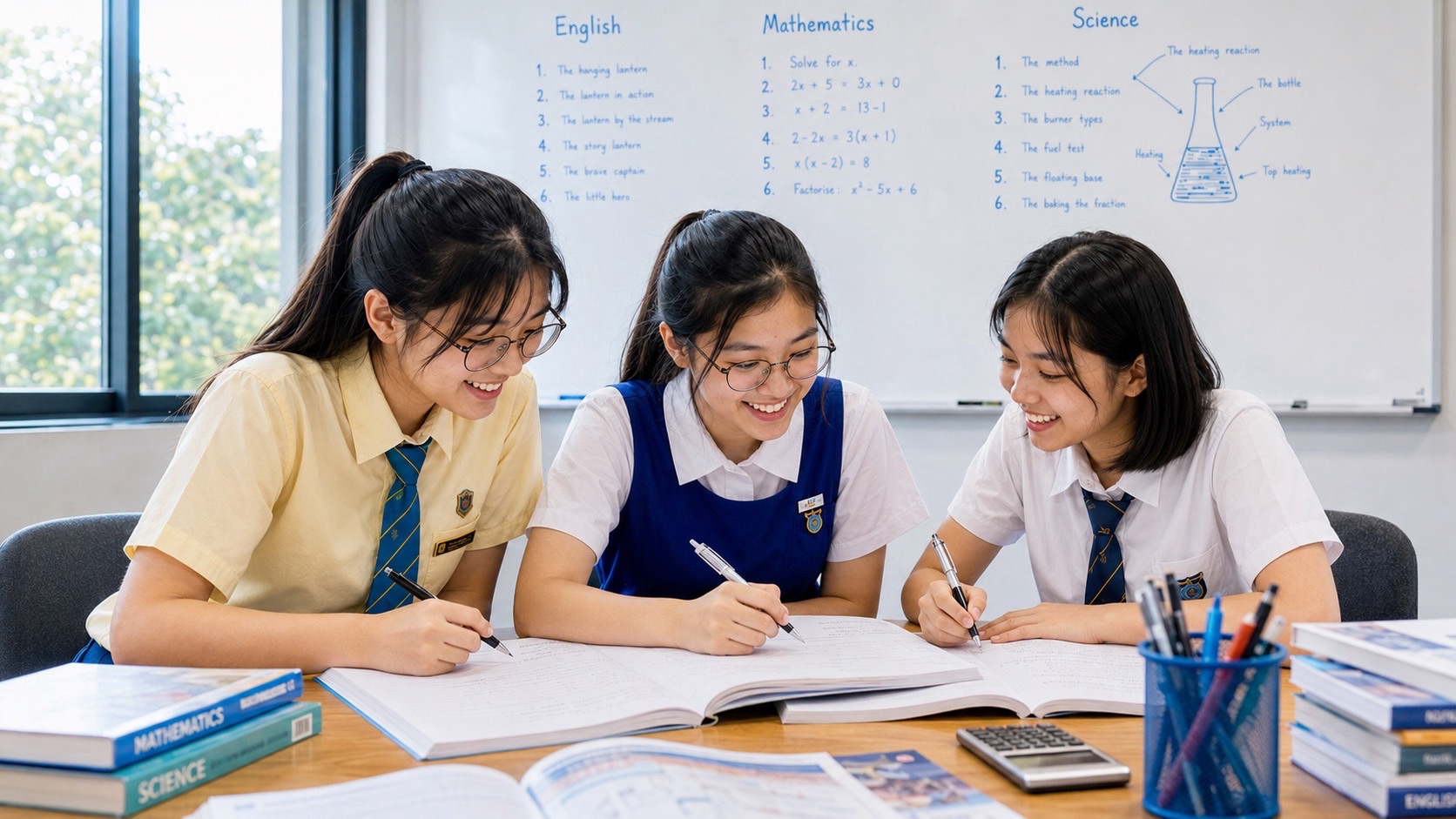
What happens if a Secondary student changes Mathematics subject level during the school year? Parents searching for G1 G2 G3 Mathematics tuition, Full SBB Math tuition, change Mathematics subject level, 3-pax Mathematics tuition or Mathematics tuition in Punggol are often asking whether the student should remain in the same tuition group after the school’s Mathematics demand changes.
Under Full Subject-Based Banding, students can offer subjects at G1, G2 and G3 levels, and MOE states that subject levels may be adjusted at appropriate junctures based on the student’s learning progress, strengths, interests and learning needs. Exact school timing and criteria are school-specific. A change in Mathematics subject level therefore deserves a fresh tuition-fit review rather than an automatic assumption that the old group still fits—or that the student must immediately leave it.
At eduKatePunggol, Mathematics is taught in groups of up to three students for 1.5 hours near Punggol MRT. The practical question is: after the subject-level change, does the student’s new Mathematics demand still overlap enough with the existing group for one coherent lesson?
The first job is to identify what actually changed
A subject-level change can affect:
- depth of content;
- question complexity;
- pace;
- symbolic demand;
- assessment expectations;
- the amount of support the student needs.
The tutor should compare the new school demand with the existing tuition programme rather than react only to the label.
Moving to a more demanding level does not always require a new group immediately
If the student already has strong foundations and the group has enough shared Mathematics, the tutor may be able to add:
- harder variations;
- more symbolic depth;
- less scaffolding;
- more demanding mixed questions;
- subject-level-specific school work.
The student can remain while the tutor monitors whether the new level is still being served properly.
Moving to a less demanding level can also remain compatible
A student moving to a less demanding level may still share important foundations with the group.
The tutor can reduce unnecessary stretch and prioritise:
- core concepts;
- fluency;
- school-aligned questions;
- confidence through stable independent work;
- assessment readiness at the correct subject level.
The key is not to continue training at a level that no longer matches the student’s school demand simply because the group previously used it.
When the existing group remains a good fit
- The core topic sequence still overlaps.
- The tutor can differentiate question demand without fragmenting the class.
- The student can still access shared explanations.
- The other students are not spending large amounts of time on irrelevant material.
- The student’s school work can be handled as a meaningful branch rather than a separate curriculum.
When regrouping becomes more likely
- The subject-level demands have diverged substantially.
- The student needs a different syllabus pace for most lessons.
- Shared explanations no longer create much value.
- The tutor has to run near-parallel programmes every week.
- The student repeatedly receives work that is too hard, too easy or irrelevant.
For the broader decision, see When Should a Student Move to a Different 3-Pax Math Group?.
Do not treat a level change as a judgment about the child
Under Full SBB, subject levels are intended to give students flexibility to learn subjects at levels appropriate to their strengths and learning needs.
The tuition response should therefore be practical:
- What Mathematics is the student now expected to do?
- Which prerequisites are secure?
- What changes in question demand?
- What should tuition stop doing?
- What should tuition add?
The first three lessons after a subject-level change
- Lesson 1: map the new school demand and compare recent work.
- Lesson 2: test whether the student can access the new level independently.
- Lesson 3: decide whether differentiation inside the current group is enough or regrouping would produce a cleaner learning path.
That prevents a permanent group decision from being made on one worksheet alone.
2027 SEC makes subject-level accuracy especially important
From 2027, graduating students sit the Singapore-Cambridge Secondary Education Certificate at the subject levels they offer. That makes it important for tuition to prepare the student for the actual Mathematics subject-level demand rather than use G1, G2 and G3 as interchangeable labels.
Frequently asked questions
Can a student change Mathematics subject level during secondary school?
MOE states that students have flexibility to adjust subject levels at appropriate junctures. The exact timing and criteria are determined within the school context.
Does changing subject level mean changing tuition group immediately?
No. Reassess the curricular overlap first. If the current group can still serve the student’s new demand without fragmenting the lesson, the student may remain. If not, regrouping may be cleaner.
Mathematics Tuition in Punggol: when the school level changes, recheck the tuition fit
Map the new demand. Check prerequisites. Adjust task depth. Watch the group overlap. Regroup only when the evidence shows the old fit no longer works.
Families who want to discuss a Mathematics subject-level change can WhatsApp eduKatePunggol with recent school work and the school’s current subject-level information.
Official reference
Continue through the Punggol Mathematics route
- Can a Student Move Between G1, G2 and G3 Mathematics?
- Same Year and Subject Level in 3-Pax?
- When to Move to a Different 3-Pax Group
- Mathematics Tuition at eduKatePunggol
Continue Through the Mathematics System
Explore the Punggol Mathematics reading library for related guides.


