
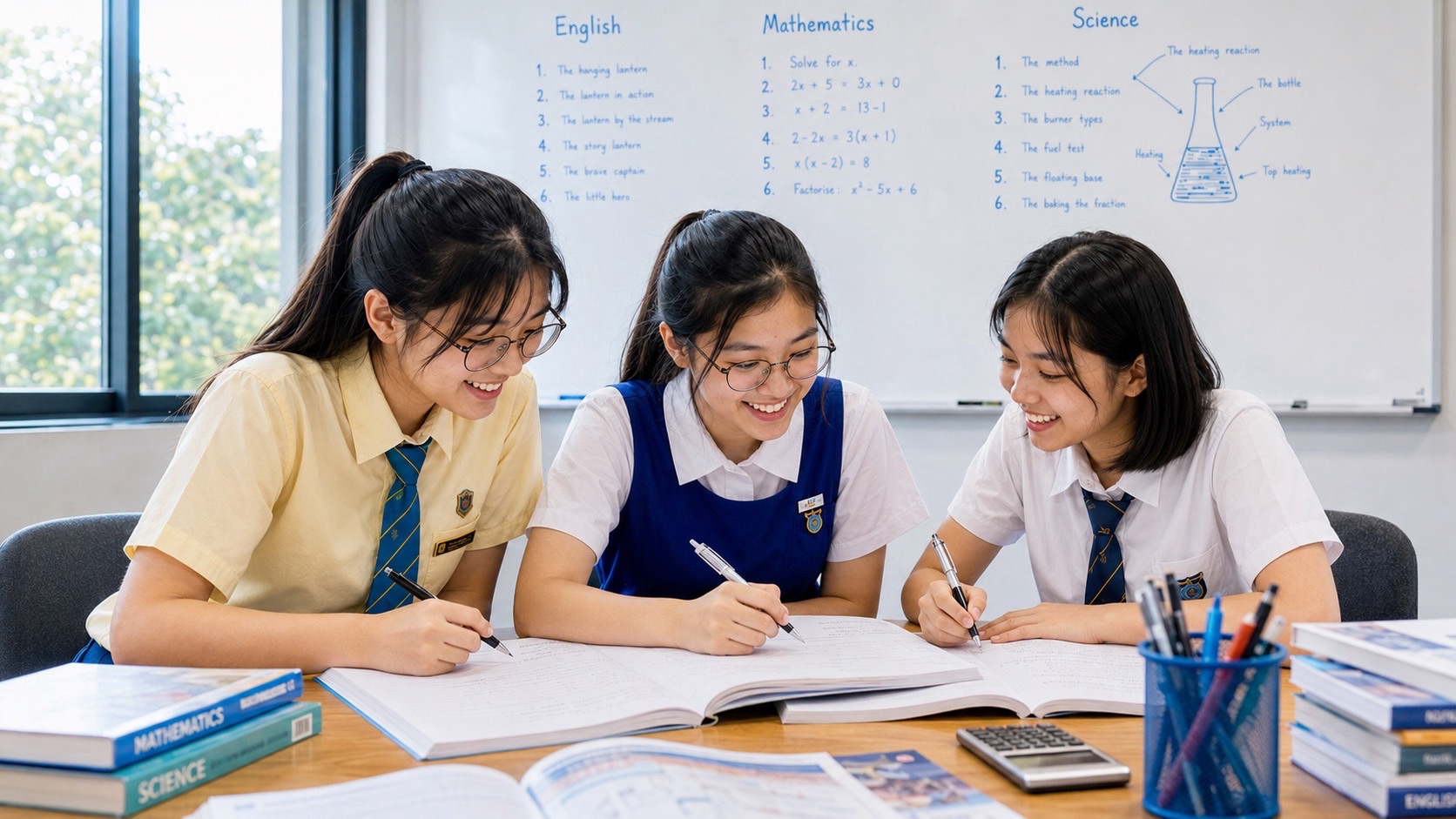
What happens if one child needs more time than the other two students in a 3-pax Mathematics tuition class? Parents searching for slower Math learner tuition, small-group Mathematics tuition, 3-pax tuition or Mathematics tuition in Punggol often worry that the child will either feel pressured to rush or hold the whole group back.
A well-run small group should avoid both outcomes. Needing more thinking time does not automatically mean the student needs a different class. The tutor can protect pace by changing question count, hint size, prerequisite support and when the class regroups. Productive talk guidance also emphasises the value of think time: students sometimes need quiet processing before they can articulate or execute a mathematical idea.
At eduKatePunggol, Mathematics is taught in groups of up to three students for 1.5 hours near Punggol MRT. The practical question is: how can the slower student get enough processing time while the other students continue doing useful work?
First diagnose why the student is slower
Slower work can come from very different causes:
- careful reasoning;
- weak arithmetic fluency;
- uncertain method selection;
- slow reading;
- poor working organisation;
- frequent checking;
- missing prerequisites;
- fear of making mistakes.
The tutoring response should depend on the mechanism.
Careful but correct is different from slow because the foundation is weak
A careful student may simply need more time to become fluent.
A student with weak multiplication, fractions or signed numbers may be slow because every later step is carrying extra cognitive load.
The first student needs practice and gradual efficiency.
The second needs prerequisite repair.
Reduce question count before reducing thinking quality
If one student needs more time, the tutor does not have to make them rush through the same number of questions.
A smaller set can still test:
- concept understanding;
- method execution;
- variation;
- one mixed question;
- one delayed retest.
Quality of evidence matters more than equal page count.
Use waiting time productively for the other students
While the tutor gives one student extra think time, the other two can work on:
- a fresh variation;
- an error-log retest;
- a mixed problem;
- an explanation prompt;
- a stretch question;
- closed-note retrieval.
This prevents the class from synchronising every student’s pace artificially.
Do not rescue the slower student too quickly
Because the tutor is aware of the pace difference, there can be a temptation to intervene early simply to keep everyone moving together.
That can create dependence.
Give enough time for a genuine attempt, then use the smallest hint that restarts thinking.
See How Tuition Works | The Help Gradient.
Do not use the faster student as the standard for everyone
Speed differences inside a small group are normal.
The relevant comparison is whether the slower student is:
- becoming more accurate;
- needing fewer prompts;
- retaining more;
- using shorter valid methods;
- finishing more work over time.
This measures progress without turning another child into the benchmark.
Primary Mathematics: fluency gaps can make everything look slow
Primary students can become slow when basic facts are not automatic enough.
Examples include:
- multiplication tables;
- number bonds;
- fraction equivalence;
- basic unit relationships.
Repairing these foundations can free more attention for problem solving.
PSLE Mathematics: slow but correct needs paper conversion
A Primary 6 student who is accurate but too slow eventually needs timed conversion.
The sequence should be:
- secure the method;
- remove unnecessary steps;
- build fact fluency;
- time short sections;
- protect accuracy as speed rises.
See Speed or Accuracy?.
Secondary Mathematics: symbolic fluency matters
Secondary students can lose time when every algebraic transformation requires conscious reconstruction.
Short targeted fluency work can make later multi-step solving substantially easier without rushing the student through concepts they do not understand.
When a small group may not be the right fit
If the student consistently requires nearly continuous one-to-one support, cannot access the shared topic, or needs a fundamentally different syllabus pace, the tutor should discuss fit honestly with the family.
Small groups work because learners have enough overlap to share the lesson while still receiving individual adjustment.
The slower-student lesson rule
- Protect understanding.
- Reduce low-value volume.
- Give think time.
- Use the smallest useful hint.
- Measure progress against the student’s own baseline.
- Add speed only after the method becomes reliable.
Frequently asked questions
Will my child be rushed because the other students are faster?
They should not be. Question count, support and regrouping can be adjusted so a slower learner gets enough processing time while the other students continue useful work.
Does slower work mean my child is weak in Maths?
Not necessarily. Diagnose whether the pace comes from careful reasoning, weak fluency, missing prerequisites, reading load or another specific mechanism.
Mathematics Tuition in Punggol: enough time to think, enough structure to keep moving
Diagnose the pace. Protect understanding. Reduce low-value repetition. Give think time. Build efficiency after reliability.
Families who want to discuss whether a child who needs more time can fit a 3-pax Mathematics class can WhatsApp eduKatePunggol.
Research references
Continue through the Punggol Mathematics route
- Three Students Learning at Different Speeds
- Speed or Accuracy?
- How Hard Should Math Practice Be?
- Mathematics Tuition at eduKatePunggol
Explore the Punggol Mathematics reading library for related guides.


