
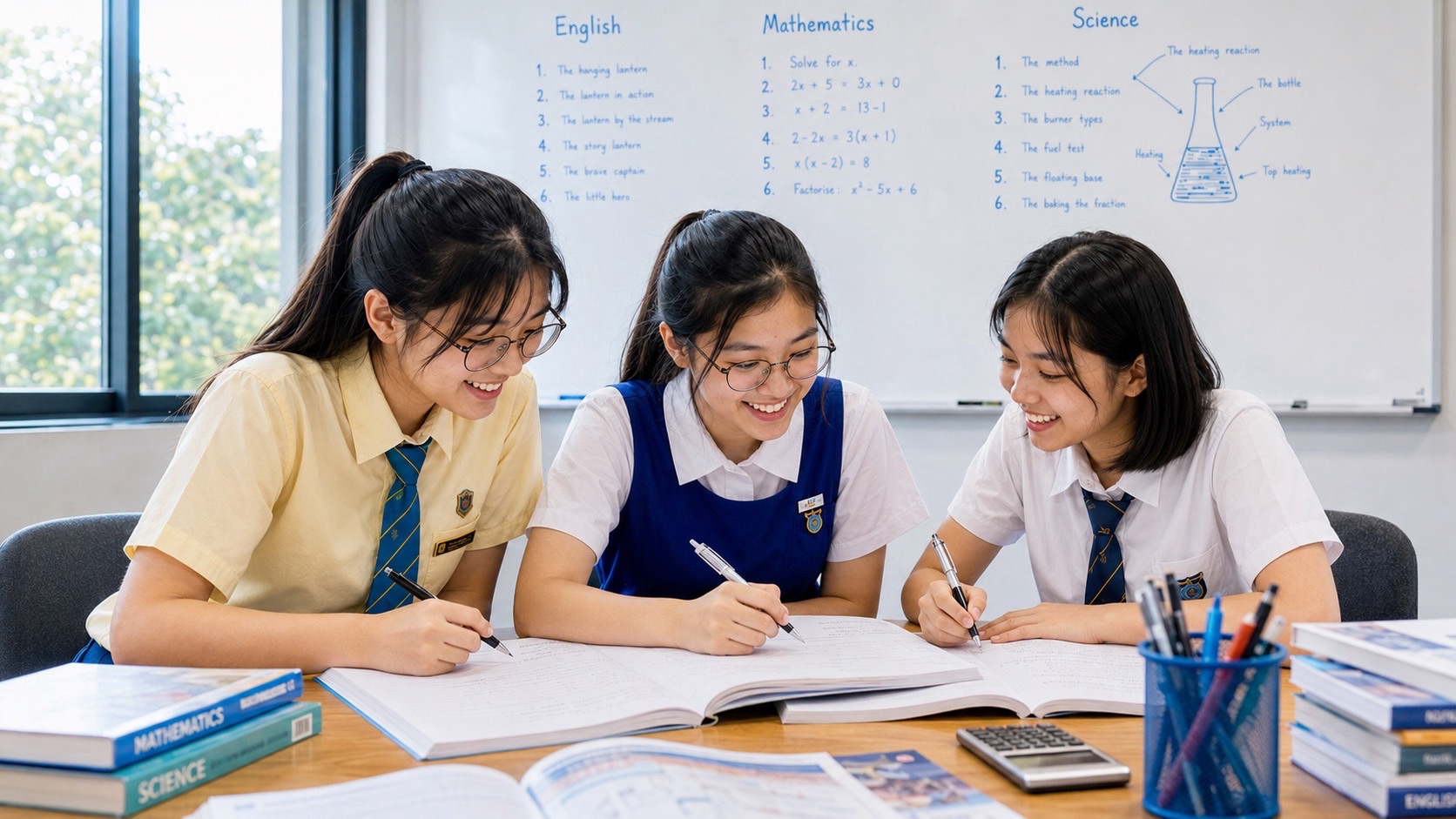
Why can one hard Mathematics question ruin the rest of an otherwise manageable paper? Parents searching for Math exam panic, one hard question ruins test, child gets stuck in Math exam, Math exam recovery or Mathematics tuition in Punggol are often seeing a performance-control problem rather than a sudden disappearance of knowledge.
A difficult question can consume far more than its own marks. The student may spend too long on it, lose track of time, carry frustration into the next section, abandon a previously sound paper plan or start doubting answers that were already correct. Research on mathematics anxiety suggests that worry can compete with working-memory and attentional resources, which helps explain why one difficult moment can impair later performance for some students. But the mechanism should be diagnosed from the paper rather than assumed from emotion alone.
At eduKatePunggol, Mathematics is taught in focused groups of up to three students in 1.5-hour lessons near Punggol MRT. The useful question is: after the difficult question appeared, what changed in the student’s decisions, timing and accuracy?
The short answer: train recovery as a separate Mathematics exam skill
A strong student does not need to solve every hard question immediately.
The student needs to know how to:
- recognise when progress has stopped;
- preserve valid working;
- mark the question for return;
- move on before the time cost becomes excessive;
- reset attention before the next question;
- return later without rebuilding everything from zero.
That sequence protects the rest of the paper.
Failure pattern 1: sunk-time escalation
The student has already spent five minutes, so they decide they must keep going because leaving would “waste” those five minutes.
Now five becomes eight.
Eight becomes twelve.
The question may still remain unsolved while several easier later marks become endangered.
Tuition should train a pre-decided exit rule based on progress, not emotion.
Failure pattern 2: one hard question changes the student’s pacing
After getting stuck, some students rush the next three questions to “make back time”.
This creates a second wave of errors:
- misread numbers;
- missed units;
- skipped working;
- calculator transcription errors;
- answering the wrong final target.
The original hard question may cost four marks. The rushed recovery can cost ten more.
Failure pattern 3: confidence collapses globally
A student may think:
“If I cannot do this, maybe I do not know anything.”
That conclusion is usually much broader than the evidence supports.
A difficult item may be:
- an unfamiliar variation;
- a topic-specific gap;
- a slow multi-step problem;
- a question the student would solve later with a fresh approach.
Train a narrower interpretation: “This question is not moving yet.”
That wording protects the rest of the paper from one local failure.
Failure pattern 4: the student erases useful partial work
When a route fails, some students erase everything.
This creates two problems:
- valid intermediate results disappear;
- the student has nothing to re-enter later.
Instead, cross out only the invalid part, preserve known information and leave a visible re-entry point.
For the broader system, see How to Re-enter Skipped Exam Questions.
The 90-second progress test
The exact time should vary with level and question size, but the principle is useful:
After a short period, ask:
- Have I identified the target?
- Have I generated a valid first step?
- Do I have a representation or equation?
- Is the solution moving?
If the answer to all four is no, staying longer may have poor expected value.
The recovery script
- Stop the current attempt.
- Circle the question number.
- Keep valid working visible.
- Write one short re-entry clue if helpful.
- Move to the next manageable question.
- Reset pace deliberately.
- Return later.
Students should practise this in tuition before they need it in a real examination.
Why return later can work
Later in the paper, several things may change:
- the student is no longer emotionally attached to the failed first route;
- a later question may reactivate the relevant idea;
- the remaining time is clearer;
- a simpler representation may occur to the student.
Returning later is not avoidance when it is part of a deliberate paper strategy.
Primary Mathematics: teach moving on before PSLE year
Primary students often believe every question must be completed before moving forward.
During school-paper practice, teach them to distinguish:
- routine question;
- question with a clear route but longer working;
- question with no current route.
Only the third category needs an early leave-and-return decision.
PSLE Mathematics: protect Paper 1 and Paper 2 differently
Paper 1 rewards efficient control without calculators. A long stall is expensive.
Paper 2 contains longer structured work, where preserving partial method and returning later can be especially important.
The student should practise recovery within the actual paper architecture rather than use one generic rule everywhere.
Secondary Mathematics: difficult symbolic questions need re-entry points
For a long algebra, graph or geometry problem, a student can leave:
- defined variables;
- a labelled diagram;
- one valid equation;
- a known theorem;
- a partial simplification.
These preserve the problem state so the student can return without reconstructing the entire setup.
Tuition should train the transition after the hard question
Do not only train difficult questions.
Train what happens after one.
In a timed section:
- place one deliberately difficult item;
- observe how long the student stays;
- observe the next two questions;
- measure whether accuracy collapses;
- teach a cleaner reset.
This turns recovery into a trained behaviour.
Frequently asked questions
Should students skip hard questions immediately?
No. They should make a genuine attempt. The move-on decision becomes appropriate when progress has stopped and the remaining time is better spent elsewhere.
Does skipping mean giving up?
No. A deliberate skip includes a planned return. It protects the paper while preserving another attempt later.
What if the child never returns?
Train visible markers and a final sweep routine so skipped questions remain part of the paper plan rather than disappearing.
Mathematics Tuition in Punggol: one hard question should cost only its own difficulty
Attempt it. Preserve valid work. Know when progress has stopped. Move on deliberately. Reset the next question. Return later with a cleaner mind.
Families who want to discuss a child whose Mathematics paper deteriorates after one difficult question can WhatsApp eduKatePunggol.
Research references
- Nature Reviews Psychology (2026) | Maths Anxiety in Children
- Frontiers in Psychology | Math Anxiety, Working Memory and Performance Meta-Analysis
Continue through the Punggol Mathematics route
- How to Recover During an Exam
- How to Re-enter Skipped Exam Questions
- Math Exam Time Management
- Mathematics Tuition at eduKatePunggol
Explore the Punggol Mathematics reading library for related guides.


