
PSLE Open-Ended Comprehension tuition in Punggol should train a Primary 6 learner to understand a passage, identify the question demand, locate or infer the required evidence, and express the answer with enough precision to earn the mark. In the official 2026 PSLE English Paper 2 format, Comprehension OE contains 10 open-ended items worth 20 marks, making it one of the heaviest individual sections in Paper 2.
The section is difficult because understanding the passage is only half the job. A child may know what happened but still lose marks by answering too broadly, omitting the relationship the question requires, copying irrelevant lines, or writing an inference without enough evidence. Strong tuition therefore separates passage understanding from answer construction.
This page is the tuition-specific owner for PSLE Open-Ended Comprehension in Punggol. It routes into PSLE Paper 2 Tuition, Primary 6 PSLE English Tuition, and the skill routes Inference and Evidence and Answer Precision. Parents can verify the official 2026 component structure at SEAB.
Read the question before writing the answer
A child can understand the passage and still answer the wrong question. Tuition should teach students to identify the exact demand before copying or paraphrasing evidence.
- Is the question asking for a fact?
- Is it asking why something happened?
- Is it asking how a character felt?
- Is it asking for evidence?
- Is it asking for a contrast, sequence or result?
- Is it asking the learner to infer something not stated directly?
Literal, inferential and language questions need different thinking
| Question type | What the learner must do |
|---|---|
| Literal | Locate and restate relevant information accurately |
| Inferential | Combine clues and explain what follows from them |
| Cause / reason | State why something happened, not merely what happened |
| Evidence | Select the specific detail that supports the claim |
| Language / expression | Interpret wording, reference or effect in context |
Evidence must support the answer, not sit beside it
Students sometimes copy a sentence that contains the right clue but fail to explain the relationship between the clue and the answer. Tuition should teach the learner to use evidence as proof.
A useful pattern is: answer → evidence → relationship. The exact wording depends on the question, but the reasoning should be complete.
Inference should be constrained by the text
Inference is not imagination. The answer should be the most reasonable conclusion supported by the passage. Tuition should ask: “Which words in the text make this inference possible?”
Question scope controls answer length
Some students write too little; others write everything they know. Both can lose marks. The learner should give enough information to satisfy the question and stop when the required relationship is complete.
| Weak answer pattern | Likely cause | Tuition response |
|---|---|---|
| Too short | Question scope not fully read | Underline required parts before answering |
| Too long | Cannot distinguish evidence from extra detail | Answer-first structure |
| Copies passage exactly | Weak paraphrase or reasoning | Explain meaning before rewriting |
| Inference has no support | Guessing from world knowledge | Evidence audit |
| Correct idea, vague wording | Weak expression | Precision rewrite |
Primary 5: build evidence habits before final-year pressure
Primary 5 is a useful year to train question interpretation, evidence location, paraphrasing and inference without relying only on full papers. The child should learn why an answer is correct.
Primary 6: turn marked scripts into a comprehension error map
By Primary 6, tuition should classify lost marks. Did the child misunderstand the passage, misread the question, miss the evidence, infer too far or express the right idea too vaguely?
Use Primary 6 Final English Calibration.
What a 3-pax comprehension lesson can reveal
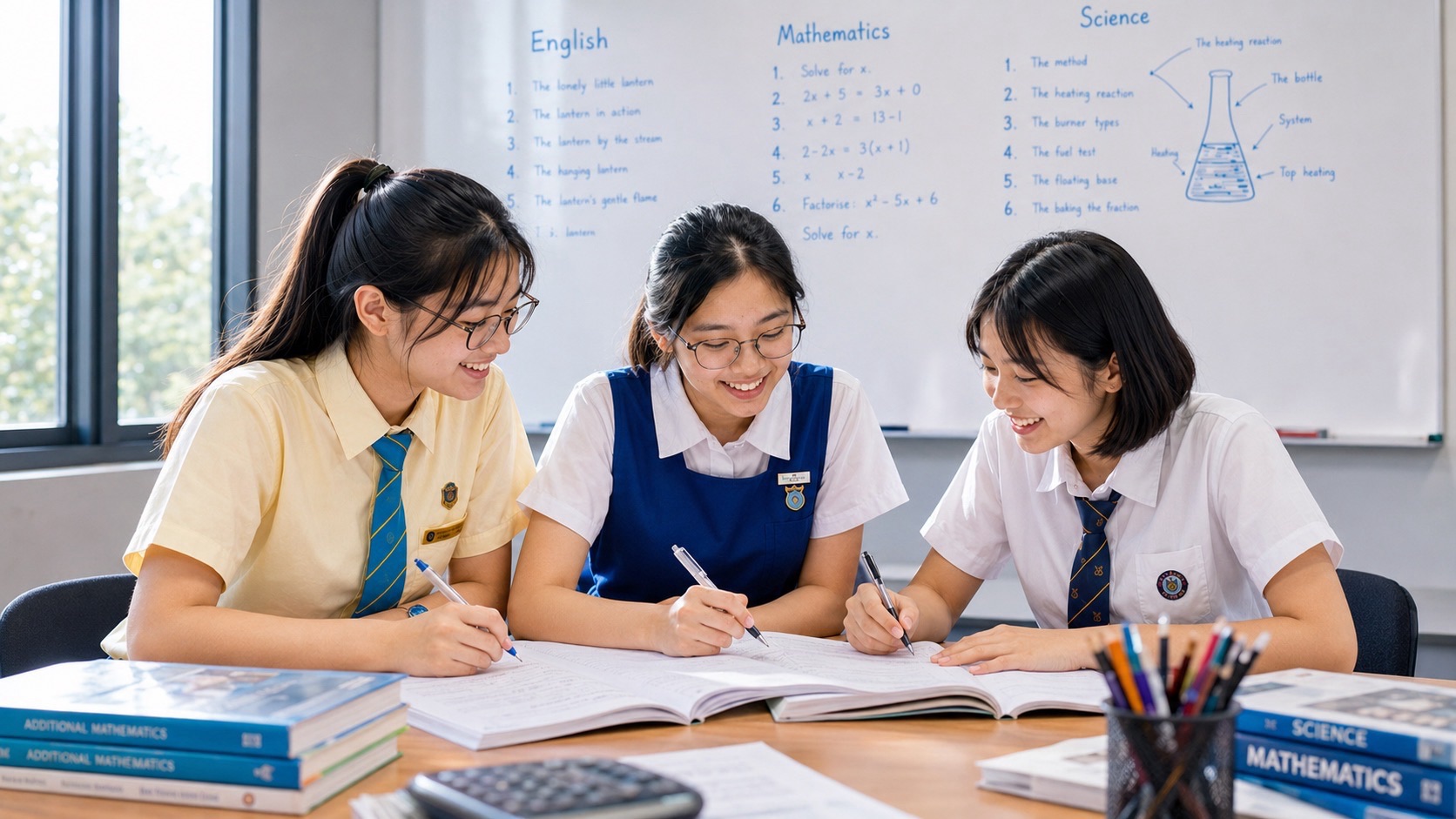
Three students can read the same passage and give different answers. Comparing those answers exposes whether the issue lies in passage meaning, question interpretation, evidence or expression. The tutor can then test each learner on a fresh passage.
Parent checklist for PSLE Open-Ended Comprehension tuition
- Can the child identify the exact question demand?
- Can relevant evidence be located?
- Can inference be supported by the text?
- Can the learner paraphrase without distorting meaning?
- Can answers be complete without becoming excessive?
- Does the skill transfer to unfamiliar passages?
- Are tutor prompts decreasing?
PSLE Open-Ended Comprehension tuition is working when the child can move from question to evidence to precise answer independently. The goal is not longer answers. It is better-controlled reasoning under Paper 2 conditions.


