
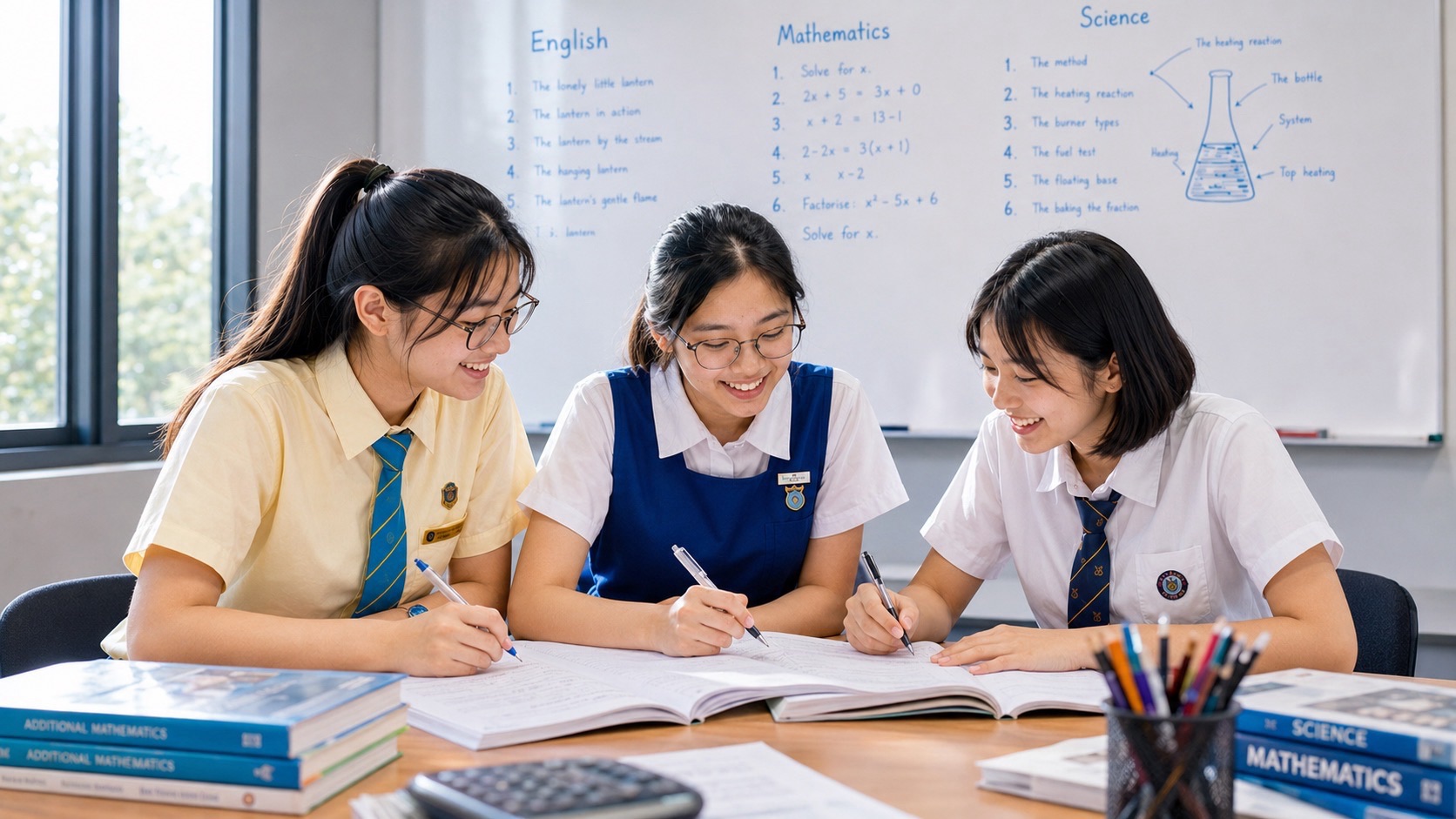
Education in Punggol eventually reaches an important transition: the timetable disappears. The child will not always have the same teachers, classrooms, subjects, homework systems or examinations organising the day. What should remain after those structures are gone?
A useful answer is an education spine: enough knowledge, judgement, agency, cooperation and learning capacity for the person to keep moving when the school structure is no longer carrying every step.
This is not a new school subject. It is the portable system that should emerge from years of subjects, routines, relationships, correction and practice.
School provides external structure first
Young learners benefit from timetables, teachers, homework deadlines, assessment dates and adults who decide what comes next. External structure makes complex learning manageable.
The long-term goal is not to remove structure too early. It is to help the learner internalise enough of it that they can operate when the structure becomes lighter.
Knowledge is the first vertebra
A person needs something to think with. Vocabulary, mathematical relationships, scientific models, historical context and subject knowledge reduce dependence on constant lookup.
The local article Modern Life Works Because Nobody Has to Rediscover Everything Alone explains why inherited knowledge is part of adult capability.
Judgement decides what to do with knowledge
Adult life contains incomplete information, conflicting goals and trade-offs. The person must decide which evidence matters, what risk is acceptable and when a decision should be revised.
School can practise this through evaluation, comparison, source checking and the disciplined explanation of why one answer is stronger than another.
Agency turns understanding into action
Knowing what to do is different from beginning. Agency includes ownership, help-seeking, planning and the willingness to act without waiting for constant external instruction.
The local Responsibility Handover page shows how families can gradually return control to the learner.
Cooperation keeps capability connected to other people
Very little adult work is completely solitary. People explain, negotiate, coordinate, depend on one another and repair misunderstandings.
Group work, CCAs, friendships and family responsibilities can all contribute to this layer when the child learns to carry a real share of the task.
Renewal keeps the system alive
The world changes. Knowledge fades. Careers evolve. A functioning education spine therefore includes the ability to learn again.
- Recognise the knowledge gap.
- Find reliable sources.
- Rebuild prerequisites.
- Practise deliberately.
- Seek feedback.
- Test the new capability in a fresh context.
Examinations are training environments, not the final destination
Tests can train retrieval, precision, time control and performance under constraint. Those are useful. But the examination system is temporary. The capabilities underneath should survive after the final paper.
The local A Test Is a Snapshot — Education Is a Longer Film article places assessments inside that longer horizon.
Tuition should strengthen the spine rather than replace it
External support is useful when it repairs a weak link or accelerates understanding. The long-term test is whether more of the learning process ends up inside the student.
The companion article The Best Tuition Outcome Is a Stronger Internal Learning System makes that standard explicit.
A parent question for each school stage
At every transition, ask: what should my child now be able to carry without the previous level of support?
Primary school may transfer bag packing, simple checking and reading routines. Secondary school may transfer planning, deadline management and more sophisticated help-seeking. Later stages should transfer more decisions about goals, methods and recovery.
The quiet standard
The timetable is temporary. Education should not be.
When school structures eventually loosen, something should remain upright inside the person: knowledge to understand, judgement to choose, agency to act, cooperation to work with others and enough learning capacity to begin again.


