
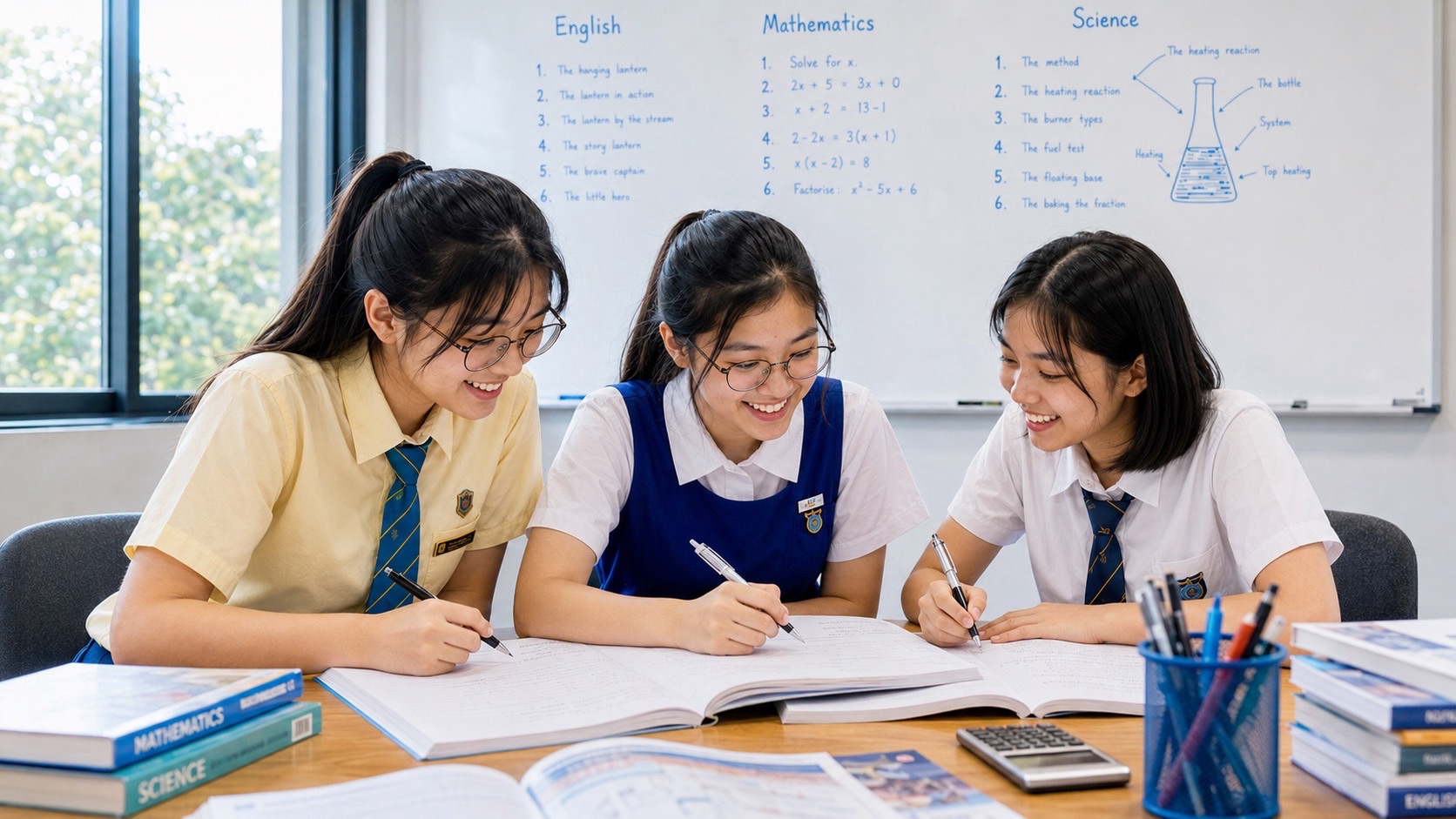
Should Mathematics tuition show worked examples first or make students solve problems independently? Parents searching for worked examples in Math, Math problem solving, guided practice vs independent practice, Math tutor gives too much help or Mathematics tuition in Punggol are often seeing two apparently opposite teaching styles: one explains and models first; the other asks the student to struggle through a problem before receiving help.
Both have a role. Worked examples can reduce unnecessary cognitive load when a student is learning a new or difficult procedure. Independent problem solving is necessary if the student is eventually expected to retrieve, select and execute the method without help. A 2026 study comparing worked examples and problem-solving sequences in mathematical equation learning found that instructional sequences including problem solving produced stronger test performance than worked examples alone. The practical lesson is not “examples are bad”. It is that examples should lead into independent solving rather than replace it.
At eduKatePunggol, Mathematics is taught in focused groups of up to three students in 1.5-hour lessons near Punggol MRT. The useful teaching question is: when should the tutor show, when should the tutor ask, and when should the tutor stop helping so the student owns the next decision?
The short answer: model → complete together → fade support → solve independently
A practical sequence is:
- Model one example. Make the reasoning visible.
- Work one example together. Ask the student to supply missing steps.
- Use a completion problem. Leave more of the solution unfinished.
- Remove the model.
- Give a fresh independent problem.
- Change the wording or representation.
- Return later without warning.
This sequence keeps explanation efficient while still training independence.
Why worked examples help beginners
A beginner can become overloaded when several decisions are new at the same time.
Consider a student learning linear equations.
The learner may need to understand:
- what an equation is;
- what equality means;
- what operation is being reversed;
- why the same transformation must preserve equality;
- how the working should be written.
A clear worked example can reduce the search burden and let the student study the structure of a valid solution.
Why worked examples can become a trap
Examples become low-value when the student studies them passively.
Common warning signs include:
- the student follows the example line by line without knowing why;
- the student asks where the matching example is before starting;
- performance collapses when the numbers change;
- the student cannot identify the method in a mixed set;
- the student says “I understand” but cannot reproduce the route later.
At that point, the worked example has become a support dependency.
Self-explanation makes worked examples more powerful
Do not ask students only to read the solution.
Ask them to explain:
- Why was this step chosen?
- What would make this step invalid?
- What changed from the previous line?
- What would happen if the number were different?
- How could the answer be checked?
This turns the example into an object of reasoning rather than a recipe to copy.
Incorrect worked examples can be useful too
Recent research has also examined the value of correct and incorrect worked examples in mathematics learning.
An incorrect example can be useful when the student is asked to find the first wrong line and explain why it is wrong.
This is especially valuable for common conceptual barriers:
- sign errors;
- illegal algebraic cancellation;
- wrong use of distributive law;
- incorrect fraction operations;
- incorrect equation transformations.
The student learns not only what to do, but how to detect a plausible-looking wrong route.
Completion problems bridge examples and independence
A completion problem provides part of the solution and asks the student to finish the rest.
This is useful because the support can be reduced gradually.
For example:
- Question 1: full worked example.
- Question 2: first two steps shown.
- Question 3: first step shown.
- Question 4: no steps shown.
- Question 5: same concept in unfamiliar wording.
The student experiences a controlled handoff rather than a sudden jump from watching to being alone.
Primary Mathematics: examples should make representations visible
For Primary students, worked examples are especially useful when they show why a representation works.
- number bonds;
- bar models;
- fraction diagrams;
- number lines;
- tables;
- written algorithms.
The example should connect the picture, language and calculation rather than display only the final arithmetic.
PSLE Mathematics: the student must eventually choose the method alone
PSLE problem sums do not arrive with the correct worked example beside them.
Upper-primary tuition should therefore move from:
- guided modelling;
- to partial support;
- to independent representation;
- to mixed problem selection;
- to timed execution.
If support never fades, tuition can create the appearance of mastery without examination independence.
Secondary Mathematics: examples should expose symbolic structure
In Secondary Mathematics, good worked examples should make symbolic relationships visible.
They should show:
- why an equation transformation is valid;
- where a sign changes;
- how an expression is factorised;
- how a graph connects to an equation;
- how a formula is applied with units.
The example should reduce ambiguity, not create it.
The expertise rule: support should change as the student changes
A worked example that is helpful for a beginner can become redundant for an experienced student.
As expertise grows, more lesson time should move toward:
- independent problem solving;
- mixed practice;
- error diagnosis;
- alternative methods;
- timed work;
- transfer.
The tutor should not keep teaching the same student as if every week were the first week.
A practical test: can the student solve without the example in sight?
After the worked example:
- close the notes;
- change the numbers;
- change the wording;
- remove the topic label;
- ask the student to solve independently.
If the student cannot begin, return to the exact missing decision rather than replaying the whole example immediately.
For cold-start diagnosis, read Why Your Child Cannot Start Unfamiliar Math Questions.
Frequently asked questions about worked examples and problem solving
Should a tutor explain before the child tries?
For genuinely new or difficult material, a clear example can reduce unnecessary search and cognitive load. The student should then move into active completion and independent solving.
Is struggle good for learning?
Productive struggle can be useful when the student has enough knowledge to make meaningful attempts. Struggle without the necessary prerequisites can simply produce confusion.
How do I know when the tutor is helping too much?
If the child performs well only while examples, prompts or confirmations are present, support has not yet faded enough to prove independence.
Mathematics Tuition in Punggol: examples should launch independence, not replace it
Show the structure. Explain the decision. Complete together. Fade the support. Change the problem. Then let the student solve alone.
Families who want to discuss a child who can follow Math examples but cannot solve independently can WhatsApp eduKatePunggol.
Research references
- International Journal of Educational Research (2026) | Sequencing Problem Solving and Worked Examples
- Education Sciences (2025) | Correct and Incorrect Worked Examples in Linear Equations
- Contemporary Educational Psychology (2025) | Teaching With Worked Examples
Continue through the Punggol Mathematics route
- Why Your Child Cannot Start Unfamiliar Math Questions
- Memorisation or Understanding?
- How Mathematical Mastery Works
- Mathematics Tuition at eduKatePunggol
Explore the Punggol Mathematics reading library for related guides.


