
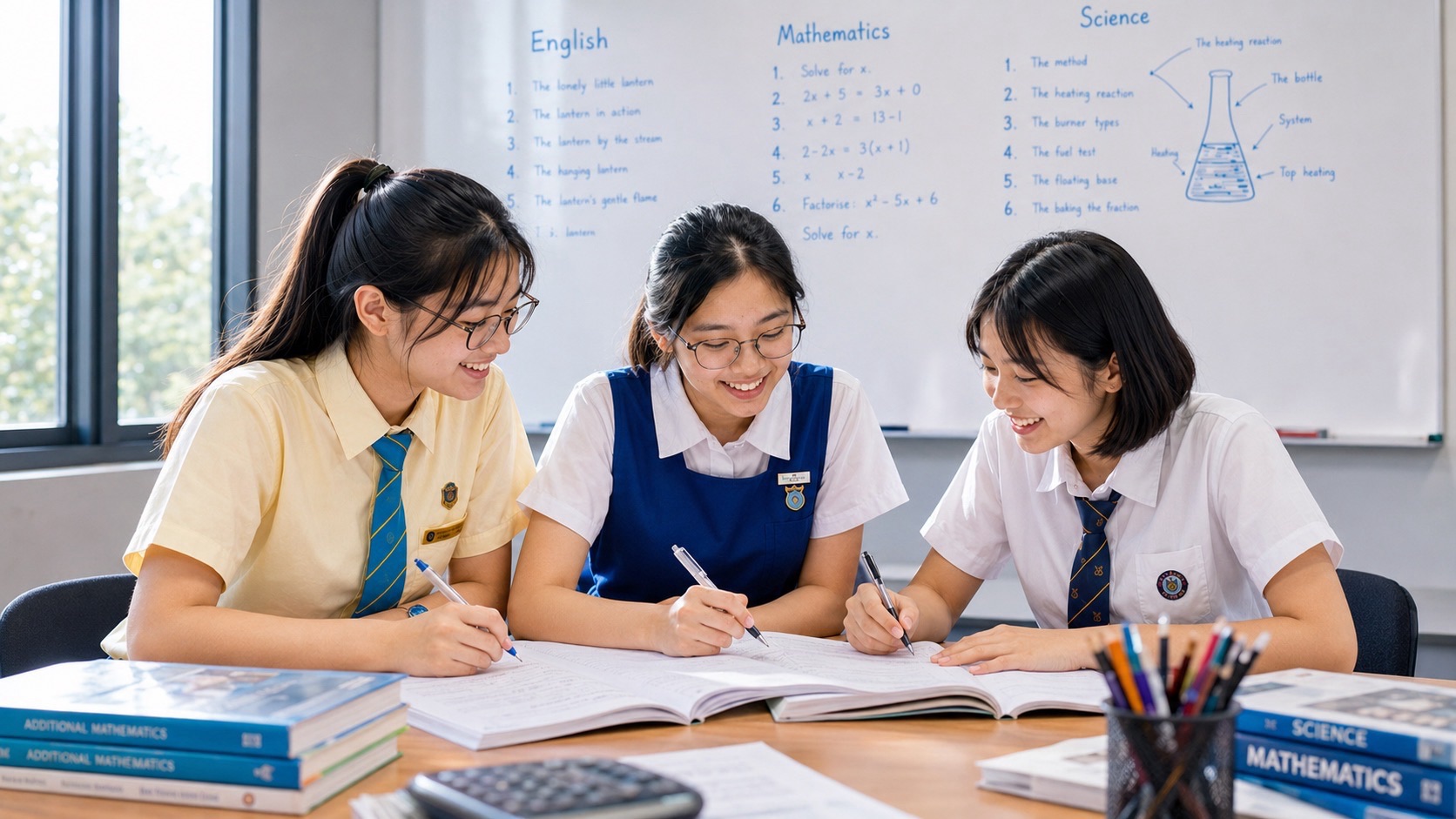
Mathematics tuition in Punggol can raise marks without yet producing independence. Parents searching for Math tuition working but child still needs help, marks improving but still dependent on tutor, Math homework dependence, how to know tuition is working or Mathematics tuition in Punggol are often seeing an important middle stage: the child is performing better, but the improvement still depends heavily on prompts, examples, reminders or tutor presence.
This is not the same as failure. Early tuition often works by adding structure around the learner: clearer explanations, targeted examples, better correction, more organised practice and external monitoring. The next job is different. The support has to become internal scaffolding—the student learns to plan, monitor and evaluate their own work without waiting for the tutor to supply the next move. Current EEF guidance on metacognition and self-regulation emphasises exactly this progression toward independent learning.
At eduKatePunggol, Mathematics is taught in focused groups of up to three students in 1.5-hour lessons near Punggol MRT. The practical question is: which part of the recent improvement belongs to the student now, and which part still disappears when the tutor steps away?
The short answer: improved marks are one progress signal, not the final one
A stronger Mathematics progress trail moves through several stages:
- Supported success. The student improves with tutor structure.
- Reduced prompting. The tutor says less and the student still succeeds.
- Closed-note performance. The learner can retrieve methods independently.
- Mixed-question selection. The student chooses the right method without a chapter label.
- School transfer. Improvement appears outside tuition.
- Maintenance. The student can keep the skill alive with lighter support.
Marks can rise at stage one or two.
The long-term goal is to move further.
Dependence signal 1: the child waits for confirmation before every step
A dependent student may know the Mathematics but still ask:
- “Is this right?”
- “Do I divide now?”
- “Should I use the formula?”
- “Is this the correct method?”
The tutor’s confirmation has become part of the procedure.
The next training step is not more explanation. It is controlled withholding of confirmation so the student learns to evaluate their own move.
Dependence signal 2: the child performs well only with the chapter label visible
A student may score highly on “Percentage Practice” and hesitate on a mixed paper containing the same percentage structure.
The method is learned.
The selection process is not.
Mixed practice is therefore part of independence because the student must decide what the problem is before solving it.
See Blocked Practice or Mixed Practice?.
Dependence signal 3: the student cannot start without a worked example
Worked examples are useful during learning.
But once a skill is supposed to be available, the student should be able to begin without matching the new question against a visible model.
Test this by:
- closing the notes;
- changing the wording;
- removing the topic label;
- asking only for the first useful step.
For the full diagnostic route, read Why Your Child Cannot Start Unfamiliar Math Questions.
Dependence signal 4: homework improves but school tests do not
Tuition homework can contain more support than school assessments.
The student may benefit from:
- topic grouping;
- examples;
- tutor reminders;
- longer time;
- immediate correction.
School tests remove many of these supports.
If marks rise mainly in tuition work, transfer has not yet been proven.
See Why Your Child Understands Homework but Fails Math Tests.
Dependence signal 5: corrections work only when the original solution is visible
A student may copy a correction accurately and still repeat the same mistake later.
The correction needs to move into:
- fresh questions;
- delayed retests;
- mixed practice;
- closed-note retrieval.
That is how the repair becomes the student’s own skill.
Marks can rise before independence because external structure is real help
A tutor can legitimately improve performance by:
- choosing the right questions;
- sequencing the difficulty;
- catching errors early;
- making representations clearer;
- forcing regular review;
- protecting practice time.
These supports matter.
The next educational challenge is to move some of those functions inside the learner.
The tutor’s job should become less visible over time
Early:
Tutor asks, “What is the question asking?”
Later:
The student asks that internally.
Early:
Tutor says, “Check your units.”
Later:
The student checks units automatically.
Early:
Tutor chooses the correction question.
Later:
The student recognises the error type and knows what kind of retest is needed.
The independence audit
Ask whether the student can:
- begin without being told the topic;
- choose a representation;
- retrieve important formulas;
- notice a wrong route;
- check a final answer;
- mark a question for later help;
- review old errors without being reminded;
- prepare for a test with a basic plan.
These behaviours show progress that may not appear immediately in grades.
Primary Mathematics: independence should be age-appropriate
A Primary 2 child should not be expected to self-manage like a Secondary 4 student.
Independence can mean:
- starting homework without repeated prompting;
- using a number line or bar model independently;
- checking simple answers;
- marking one difficult question for later help.
The standard should grow with age and curriculum demand.
PSLE Mathematics: independence means the paper works without the tutor
By Primary 6, a strong tuition programme should increasingly prepare the student to:
- read the problem independently;
- select the method;
- manage calculator use where allowed;
- control time;
- check high-risk answers;
- recover after a difficult question.
The tutor cannot enter the examination hall.
Secondary Mathematics: independence means self-regulated learning
Secondary students should gradually learn to plan, monitor and evaluate their own Mathematics work.
Current EEF guidance on metacognition and self-regulation emphasises these three processes—planning, monitoring and evaluating—as central to increasingly independent learning.
A Mathematics student can apply that by:
- planning which topics need work;
- monitoring repeated errors;
- evaluating whether a practice method is helping;
- changing strategy when evidence shows a problem.
When higher marks are still good news
Do not dismiss better marks because independence is incomplete.
Improvement can be real and still unfinished.
The correct response is to ask what the next layer should be:
- fewer tutor prompts;
- more closed-note work;
- more mixed questions;
- more delayed retrieval;
- more school-paper transfer.
Frequently asked questions about marks and dependence
If marks are improving, should tuition continue unchanged?
Not necessarily. Once supported performance improves, the programme should increasingly test independence, transfer, retention and reduced prompting.
Does needing help mean tuition is not working?
No. Help is normal during learning. The important question is whether the amount and type of help needed is decreasing over time.
What is the clearest independence test?
Give a fresh mixed question after a delay, with notes closed and no topic label. Observe whether the student can begin, choose a method and check the result with minimal prompting.
Mathematics Tuition in Punggol: improved marks should eventually become student-owned capability
Celebrate the higher mark. Then remove one layer of support. Test what survives. Keep fading until the student can carry the Mathematics alone.
Families who want to discuss a child whose Math marks are improving but who still depends heavily on tuition can WhatsApp eduKatePunggol.
Current evidence reference
- Education Endowment Foundation | Metacognition and Self-Regulated Learning (2025)
- EEF | Metacognition and Self-Regulation Evidence
Continue through the Punggol Mathematics route
- How Long Until Math Tuition Works?
- How Do You Know a Math Skill Is Truly Learned?
- How Parents Can Tell Tuition Is Working
- Mathematics Tuition at eduKatePunggol
Explore the Punggol Mathematics reading library for related guides.


