
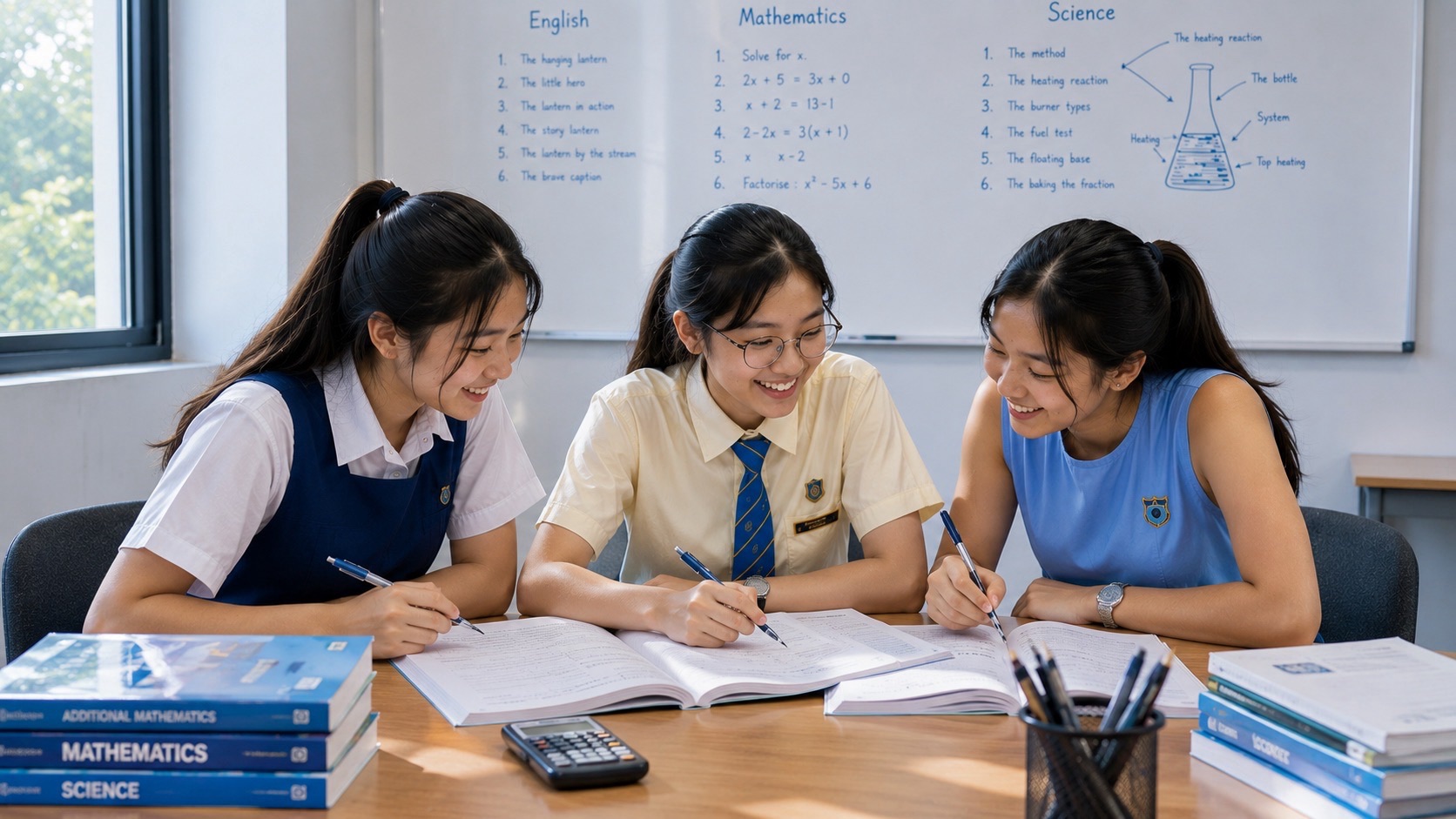
The Exam Student is the learner whose ordinary knowledge and examination performance do not match. Homework may be correct. Topical practice may look strong. The student may even explain the method clearly in tuition. Then the paper begins and something changes: time disappears, a difficult question disrupts the next three, instructions are misread, working becomes untidy, checking becomes random, or familiar knowledge cannot be retrieved quickly enough.
In the older six-pattern eduKatePunggol diagnostic, this is the Exam-Pressure Student. Atlas V2.0 uses Exam as the reader-facing entrance because the problem is not necessarily lack of knowledge. The job is to make knowledge survive the examination environment.
This is not a second learning model. PunggolOS still governs the repair: Observe → Identify → Repair → Practise → Transfer → Recheck. The Exam Student often has reliable capability under familiar conditions but needs to move toward Flexible Readiness: performance that still holds when conditions become timed, mixed and consequential.
What the Exam Student usually looks like
- Homework and tuition performance are stronger than test results.
- The student runs out of time despite knowing the material.
- One difficult item disrupts the rest of the paper.
- Careless errors increase under pressure.
- Answers become shorter, less precise or poorly organised in timed conditions.
- The learner changes correct answers without evidence.
- Checking is either absent or consumes too much time.
- The student knows topical methods but struggles when topics are mixed.
- Confidence drops rapidly once the paper feels unfamiliar.
The key distinction is between learning failure and performance failure. If the learner cannot explain or execute the idea even in calm practice, the first job is still learning. If the capability exists but collapses under examination conditions, the first job becomes execution.
An examination is a different operating environment
Lessons are forgiving. A tutor can pause. A student can ask a question. A worksheet may be topical. The order is predictable. An examination removes many of those supports.
| Lesson condition | Examination condition | New demand |
|---|---|---|
| Topic is often known. | Topics are mixed. | Select the right method without a label. |
| Help may be available. | No tutor or parent is present. | Restart independently after uncertainty. |
| Time can flex. | Time is finite. | Allocate attention and move on. |
| Errors can be corrected immediately. | Errors may remain until the paper ends. | Use selective checking and sense-making. |
| One task can be discussed deeply. | Many tasks compete for the same attention. | Sequence, switch and recover. |
Exam preparation therefore deserves its own training phase. It is not simply “more revision”.
The six examination jobs
1. Read the demand accurately
Many lost marks begin before the subject knowledge is used. The learner misreads a qualifier, misses a condition, answers a broader question than the one asked or fails to notice that a comparison requires both sides.
Exam training should therefore include deliberate instruction in task verbs, constraints, reference words, diagrams, data, units and scope.
2. Select the method
Topical practice announces the method by its location. A mixed paper does not. Mathematics students must identify structure. Science students must select the relevant concept. English students must decide what evidence and response form the question requires.
3. Protect time
Time management is not simply “work faster”. The student has to decide how much time an item deserves, notice when a route is failing, move on without emotional collapse and preserve enough time for later marks.
4. Make thinking visible
Under pressure, students often compress their working too aggressively. Mathematics steps disappear. Science explanations skip the causal bridge. English responses become vague because the learner assumes the marker can infer what they meant.
5. Check selectively
“Check your work” is too vague. The learner needs known error families: signs, units, copied numbers, pronoun references, missing comparison sides, incomplete mechanisms, question-part omissions and answer-scope errors.
6. Recover
A strong examination learner is not someone who never encounters a bad question. It is someone who can prevent one bad question from becoming a bad paper.
English exam control
English examinations require different kinds of control across reading, writing, oral, listening and language-use tasks. A student may have good language but lose marks through poor answer scope or time allocation.
- Read the question before writing the answer you wish had been asked.
- Use textual evidence without copying excessive material.
- Plan writing quickly enough that planning helps rather than consumes the task.
- Keep paragraph purpose visible.
- Reserve checking time for recurring grammar and task errors.
- Practise oral responses under live conditions rather than only reading model answers.
For PSLE specifically, use PSLE Tuition in Punggol and the specialist Primary 6 PSLE English route.
Mathematics exam control
Mathematics performance often fails at the boundary between knowing methods and selecting them.
- Identify the relationship before calculating.
- Estimate the likely scale of the answer.
- Write enough working to preserve method and checking evidence.
- Mark difficult items and return instead of becoming trapped.
- Use units and labels as part of sense-checking.
- Compare the final answer with the conditions of the question.
See How to Improve Mathematics Exam Time Management and Paper Strategy.
Science exam control
Science students can know the concept but fail to connect it to the evidence and wording on the page.
- Identify what changed and what stayed controlled.
- Separate observation from inference.
- State the mechanism or relationship that connects cause to outcome.
- Use the information provided instead of replacing it with memorised notes.
- Check whether every part of a compare/explain/suggest question has been answered.
- Use precise scientific vocabulary only where it improves the explanation.
See How to Improve Science Exam Timing, Checking and Question Triage.
When should timed practice begin?
Timing a student too early can turn confusion into a speed problem. Timed practice becomes useful when the underlying method is sufficiently stable that the clock reveals execution rather than basic misunderstanding.
A sensible progression is:
- Untimed correct method.
- Independent correct method.
- Changed question.
- Mixed set.
- Section timing.
- Full-paper timing.
- Recovery and checking under realistic conditions.
Skipping directly from step one to a full timed paper can create misleading evidence.
The first full paper should be diagnostic
A full paper is not useful only because it produces a score. It shows how the learner behaves across a sequence.
- Where did time begin to slip?
- Which question changed the learner’s confidence?
- Which errors appeared only late in the paper?
- Which methods were known but not selected?
- Which questions were abandoned too early?
- Which answers were changed from correct to wrong?
- What did checking actually catch?
The tutor should analyse the paper as a performance trace, not simply mark it and assign another one.
Careless mistakes are not one category
“Careless” often hides different causes:
| Error | Possible cause | Repair |
|---|---|---|
| Copied number wrongly | Visual checking failure. | Deliberate transfer check before calculating. |
| Missed “not” or “except” | Question decoding. | Constraint marking and reread routine. |
| Correct first step, wrong later method | Strategy switching under uncertainty. | Rollback to the first broken decision. |
| Incomplete Science explanation | Mechanism compressed under time. | Cause → process → outcome template, then fade the scaffold. |
| English answer too broad | Weak scope control. | Match answer length and evidence to the exact question job. |
The recovery routine
The Exam Student needs a rehearsed response to being stuck.
- Notice that the current route is not progressing.
- State what the question definitely gives or asks.
- Try one smaller representation or first step.
- If no useful progress appears, mark the question and move.
- Reset before the next item.
- Return later with fresh attention if time allows.
This routine protects the rest of the paper. It also reduces the temptation to keep investing time simply because time has already been spent.
What tuition should do for the Exam Student
- Separate knowledge gaps from execution gaps.
- Use real marked papers to find repeated performance patterns.
- Train mixed work before full papers.
- Teach question triage and time allocation explicitly.
- Build known checking targets.
- Practise recovery after difficult items.
- Use full papers selectively, then analyse them deeply.
- Reduce tutor prompts as examination readiness improves.
- Protect sleep and cognitive capacity near major examinations.
Primary examination students
At Primary school, the move toward examination independence should be gradual. A Primary 4 learner may still need help organising corrections. A Primary 5 learner can begin mixed retrieval and stronger timing awareness. A Primary 6 learner must increasingly carry the whole execution system alone.
PSLE is therefore not the moment to invent examination habits from zero. Good examcraft is built from earlier routines: read carefully, show thinking, retrieve after delay, check known risks and recover after mistakes.
Secondary examination students
Secondary papers add complexity. More subjects compete for revision time. Questions become more abstract. Longer papers place greater demands on pacing and stamina. Students may also face different subject levels and combinations.
The exam plan should therefore be a portfolio rather than one universal revision method. English writing, Mathematics problem solving, Science explanation and A-Math symbolic work need different practice structures even when they share the same calendar.
Family example: knows the work, loses the paper
Ryan can solve nearly every Mathematics question when the worksheet is topical. In school tests, he loses fifteen to twenty minutes on two difficult items, rushes the final section and makes several basic errors.
The initial assumption is that he needs harder Mathematics. The paper shows otherwise. His main weakness is paper governance.
Training changes to mixed sets, time checkpoints and a recovery rule. Ryan learns to cap the first attempt, leave a trace of useful working, move on and return. His mathematical knowledge barely changes. His examination performance does.
Family example: the correct answer that keeps getting changed
Aisha answers comprehension questions accurately, then changes several responses during checking because she becomes less confident as the paper progresses.
Her checking routine is redesigned: a response changes only when new evidence is found. Feeling uncertain is not evidence. The goal is not stubbornness. It is evidence-governed revision.
When the Exam Student is actually a Foundation Student
Sometimes “exam stress” is blamed because the score is low, but calm untimed work reveals the same misunderstanding. In that case, examination techniques are downstream. The learner needs foundation repair first.
Use The Foundation Student when the method itself is not reliable. Use the Exam route when capability is present but not surviving the paper.
When the Exam Student is actually a Rhythm Student
A learner who studies only immediately before tests may look like an exam-pressure student because retrieval collapses under the clock. The real issue may be that learning was never spaced or revisited enough to become durable.
Use The Rhythm Student when the weekly learning cycle is the first weak link.
The exit condition
The Exam Student is not finished when every practice paper is perfect. The useful exit condition is that performance becomes predictable enough: the learner can begin, select methods, allocate time, show evidence, recover after difficult items and finish with a checking routine that targets known risks.
The examination remains demanding. The learner simply has a system that survives it.
Where to go next
- When Do Punggol Students Need Tuition? — return to the six-pattern selector.
- PSLE Tuition in Punggol — cross-subject PSLE-year planning.
- Primary Pathway — see how exam independence develops from P1 to P6.
- Secondary Pathway — Secondary 1–4 and the later examination route.
- Learning Practice and Review — turn returned papers into the next practice decision.
- Book a Tuition Consultation — when the repeated exam-performance problem is clear.
- Punggol Atlas V2.0 — return to the whole map.
Exam preparation is not the final pile of worksheets before the paper. It is the deliberate transfer of learning into a harsher environment: mixed questions, finite time, no live help and the need to recover. The goal is not to remove pressure. It is to make capability survive it.
Back to the tuition map: Tuition Article Index · Tuition at eduKatePunggol.


