
Observation, inference and prediction are three different scientific moves, and students in Punggol often blur them together. An observation reports what can be detected or measured. An inference interprets what that evidence may mean. A prediction states what is expected to happen next if a pattern, model or relationship continues.
Parents searching for observation vs inference, observation vs prediction, Science process skills, PSLE Science inference questions or Primary Science observation questions are usually trying to help a child separate evidence from interpretation. That distinction matters because an answer can sound reasonable but still be scientifically wrong if it claims to observe something that was only inferred.
This article continues the Science Improvements In Punggol lane and connects to How Science Evidence Works, How to Write Scientific Conclusions From Evidence and How to Read Science Questions, Diagrams and Graphs.
The three-way distinction
- Observation: what can be seen, heard, measured or recorded.
- Inference: what the observation suggests about a hidden cause, state or relationship.
- Prediction: what is expected to happen under stated conditions based on evidence or a model.
Observation should stay close to the evidence
“The liquid changed from colourless to blue” is an observation. “A chemical reaction occurred” may be an inference depending on the context and evidence. The first reports what was detected. The second interprets what that change means.
A useful test is: Could another person independently record the same thing from the setup? If yes, it is likely an observation.
Inference adds an explanation
An inference moves beyond the raw evidence. It connects an observation to prior knowledge or a scientific model.
- Observation: droplets formed on the outer surface.
- Inference: water vapour in the surrounding air condensed on the cooler surface.
The inference may be strong, but it is still different from the observation itself.
Prediction looks forward
A prediction uses a pattern, model or relationship to state what is expected under a new or continuing condition.
Prediction is not guessing. A strong prediction can answer: “What evidence or scientific relationship makes this outcome reasonable?”
Use sentence starters carefully
- Observation: “The data shows…” / “The object…” / “The reading was…”
- Inference: “This suggests…” / “This may indicate…”
- Prediction: “If this condition continues, then…”
These starters are scaffolds, not templates to memorise mechanically.
Why the distinction matters in experiments
Experimental questions often move through all three steps:
- record an observation;
- infer what the observation means;
- predict what would happen if a condition changed.
If the student mixes the stages, conclusions can become stronger than the evidence permits.
Primary 3–4: use concrete examples
Ask the child to look at a simple object or setup and make three separate statements: one observation, one inference and one prediction. The distinction becomes easier when the same situation produces all three.
Primary 5–6 and PSLE: link inference to evidence
Upper-Primary students should not make an inference because it “sounds scientific.” They should identify the observation or data that supports it.
Use the Primary 5–6 and PSLE Science guide for the broader application system.
Secondary G1, G2 and G3: add uncertainty and competing explanations
Secondary students should increasingly ask whether more than one inference fits the same observation. They should also decide what additional measurement would help distinguish between competing explanations.
A 15-minute observation–inference–prediction drill
- Choose one diagram, photograph, graph or experiment.
- Write three observations only.
- Write one inference for each observation.
- Underline the evidence supporting each inference.
- Write one prediction if a condition changes.
- Explain why the prediction is scientifically reasonable.
Common mistakes
- calling an interpretation an observation;
- making an inference with no supporting evidence;
- treating prediction as a guess;
- using future tense and assuming that automatically makes a statement a prediction;
- ignoring uncertainty when several explanations fit the evidence;
- confusing a conclusion about existing data with a prediction about future conditions.
When Science tuition in Punggol adds value
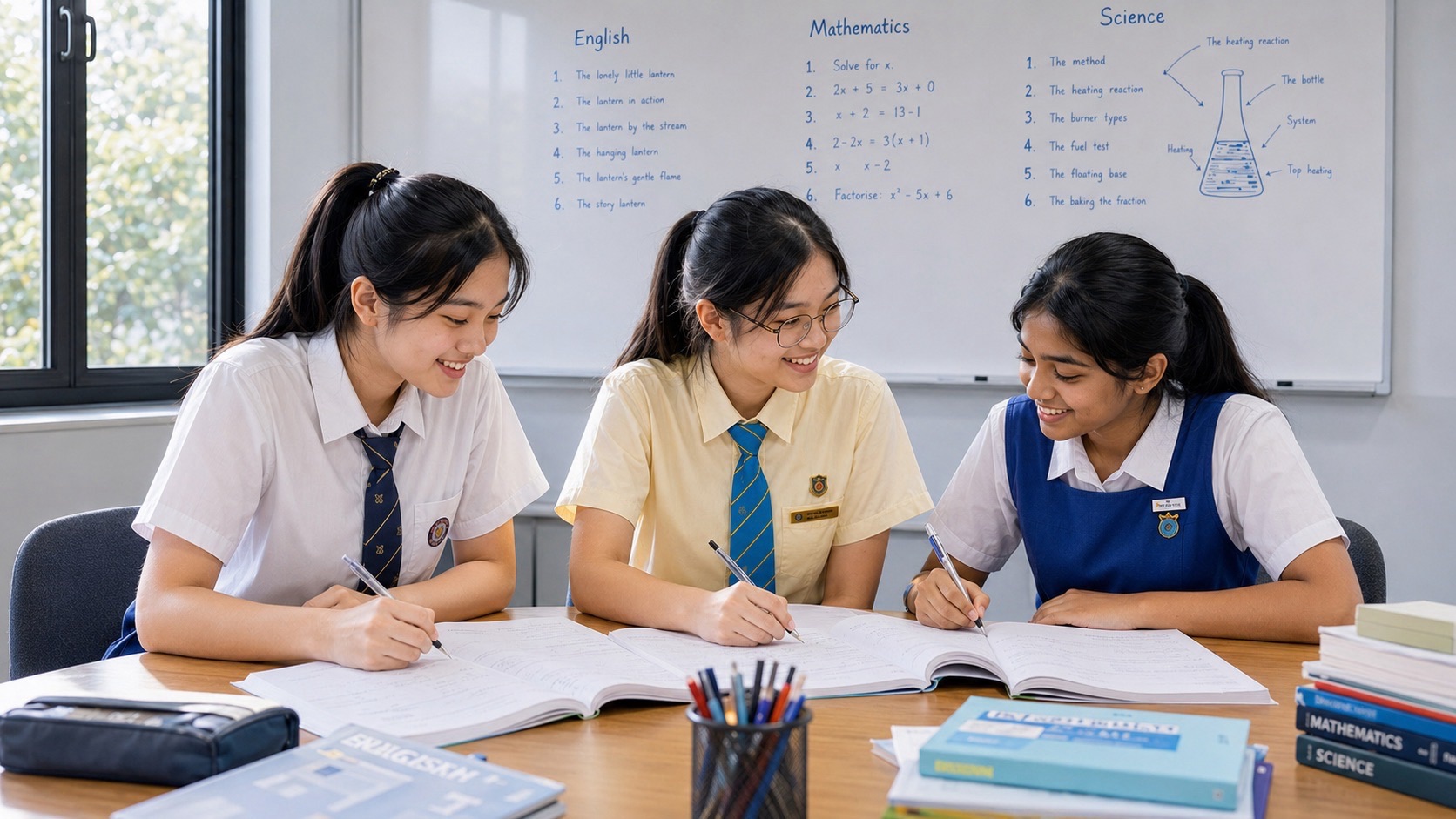
These distinctions improve fastest when students have to defend the label they chose. In eduKate Punggol’s three-student Science tutorials, one learner can make the observation, another can propose the inference and a third can challenge whether the evidence really supports it.
Parents can review Science Tuition Punggol or the Science tuition sign-up route.
Conclusion
Observation reports. Inference interprets. Prediction projects. Keep those jobs separate and Science answers become more precise, evidence-based and easier to defend.
Explore the Punggol Science reading library for related guides.


