
Mathematics tuition fees in Punggol are difficult to compare if parents look only at the price of one lesson. Searches for Math tuition fees, affordable Mathematics tuition, small group Math tuition, private Math tutor rates, Primary Mathematics tuition fees and Secondary Math tuition fees in Punggol often produce options that differ in class size, tutor experience, lesson length, diagnostic work, materials, feedback, progress tracking and how much individual attention each student actually receives.
Current 2026 parent guides from major tutoring providers frame Mathematics tuition cost in similar ways: price changes with format, tutor experience, student level, examination stakes, what is included, and whether the programme provides structured diagnosis and progress monitoring. That is a more useful comparison than asking which provider has the lowest hourly number. A cheaper lesson that does not identify the student’s real bottleneck can cost more in time than a more focused programme that makes the learning problem visible early.
At eduKatePunggol, Mathematics is taught in focused groups of up to three students in 1.5-hour lessons near Punggol MRT. Current fees and available class times should be confirmed directly because schedules and programme arrangements can change. The educational question is: what are parents actually paying for, and what evidence should show that the tuition is delivering value?
The short answer: compare total educational value, not only hourly price
A useful Mathematics tuition comparison includes:
- class size;
- lesson duration;
- tutor experience and subject level;
- whether the programme diagnoses gaps;
- whether lessons follow school, repair foundations or both;
- whether work is corrected meaningfully;
- whether parents receive useful feedback;
- whether the child becomes more independent;
- travel time and transport cost;
- materials or extra fees;
- frequency required to make progress.
The cheapest class is not automatically poor value.
The most expensive class is not automatically good value.
Value depends on what the programme changes.
Why class size changes the value calculation
Class size affects how much of the student’s mathematical process the tutor can see.
In a large class, a tutor may explain the topic well but have limited time to inspect each student’s working line by line.
In a one-to-one lesson, the tutor has maximum visibility but the family usually pays for exclusive tutor time.
A genuinely small group can sit between those formats.
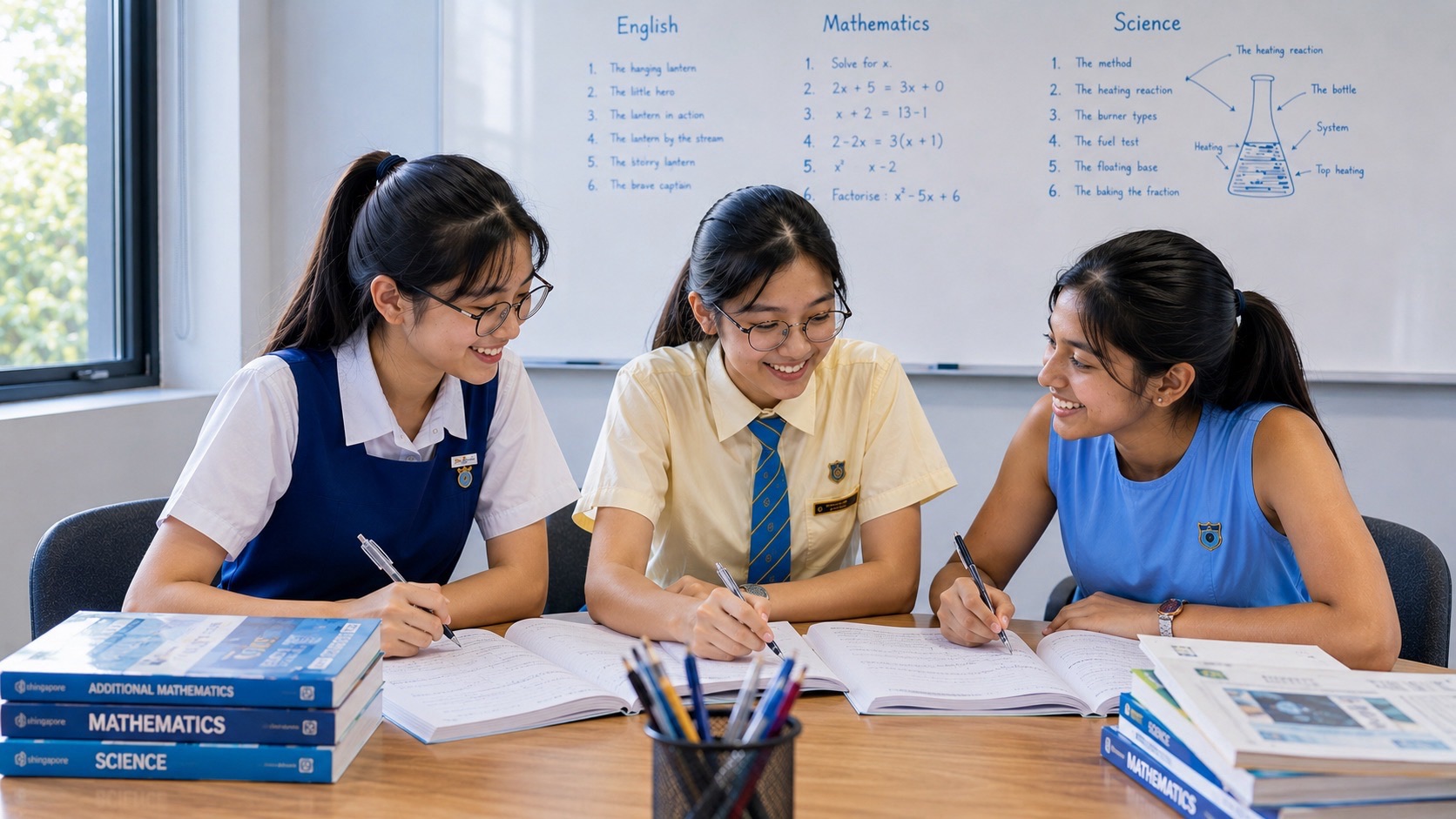
At eduKatePunggol, classes are kept to up to three students. That format is designed to let the tutor observe individual errors, ask targeted questions and still require students to work without continuous one-to-one prompting.
The value of three students is not the number itself.
The value is what the tutor can do because the number is small.
What parents should expect to be included in good Mathematics tuition
A useful programme should provide more than seat time.
- Diagnosis: where does the mathematical process first break?
- Explanation: can the tutor make the concept understandable?
- Guided practice: can the student use the idea with support?
- Independent practice: can the student use it without support?
- Correction: does feedback identify the first wrong decision?
- Transfer: can the student handle changed questions?
- Retention: does the skill survive a week?
- Progress review: is the next lesson changed by evidence?
If a programme cannot explain how these parts work, the fee is difficult to evaluate meaningfully.
The hidden cost: travel time
Parents should calculate the whole tuition commitment, not only the lesson duration.
A 1.5-hour lesson with a long journey before and after may consume much more of the child’s week than a nearby lesson.
That extra time can affect homework, CCA, dinner, reading, sleep and family logistics.
eduKatePunggol is located at 83 Punggol Central, Singapore 828761, near Punggol MRT and Waterway Point. For nearby families, shorter travel can reduce the non-teaching cost of attending in person.
The hidden cost: sessions that do not solve the right problem
A programme can appear inexpensive per lesson and still become expensive if the student attends for months without a clear diagnosis.
Suppose a Primary 5 student struggles with percentage because fraction understanding is weak.
If tuition repeatedly drills percentage procedures without repairing fractions, the student may continue needing support.
A more efficient programme identifies the dependency, repairs it and retests the percentage work afterwards.
Educational efficiency matters.
The hidden cost: dependency
Parents should also ask whether tuition is making the child more independent.
A student who performs well only when the tutor is beside them may require continuing external support indefinitely.
A stronger programme should gradually reduce prompting.
The long-term value improves when the child can eventually:
- start homework independently;
- identify the relevant method;
- check work;
- recover after an error;
- prepare for tests with less supervision.
Primary Mathematics tuition fees: what changes by year level?
The educational job changes from Primary 1 to Primary 6.
Primary 1 and Primary 2 focus heavily on number sense, place value, operation meaning and early word problems.
Primary 3 and Primary 4 widen into multiplication, division, fractions, decimals and multi-step problems.
Primary 5 and Primary 6 add percentage, ratio, rate, speed, integrated problem sums and PSLE execution.
The tuition fee should therefore be judged against whether the programme can teach the actual mathematical demands of the year, not merely whether it offers a generic “Primary Math” class.
Secondary Mathematics tuition fees: subject-level fit matters
Secondary G1, G2 and G3 Mathematics differ in syllabus depth and assessment demand.
A suitable programme needs sufficient subject knowledge to teach signed numbers, algebra, equations, graphs, geometry and statistics at the student’s actual level.
Parents should therefore ask what level the tutor regularly teaches and how the programme adapts to G1, G2 or G3 requirements.
How to compare a low-fee and high-fee option fairly
Do not compare the prices alone.
Compare the full systems.
- How many students?
- How long is each lesson?
- Who teaches the class?
- Is the same tutor present consistently?
- Is there an initial diagnostic?
- Are materials included?
- Is homework required?
- Is homework reviewed?
- Are parents told what the child is working on?
- How is progress measured?
- How easy is rescheduling?
- How much travel is involved?
This produces a much more realistic comparison than one hourly number.
What does “affordable” actually mean?
Affordable tuition is not necessarily the lowest price.
A programme is affordable when the family can sustain it without financial strain and when the educational return justifies the commitment.
Parents should also resist paying for features that do not matter to their child.
A student who needs one specific repair may not need the most elaborate package.
A student with several years of accumulated gaps may need a more structured intervention.
The value test after one month
After the first month, parents should be able to answer:
- What is my child good at?
- What is the first important weakness?
- What has the tutor repaired?
- What evidence shows improvement?
- What still requires prompting?
- What is the next priority?
If these answers are becoming clearer, the tuition is producing information as well as instruction.
For the full first-month framework, read What Should Happen in the First Month?.
Frequently asked questions about Mathematics tuition fees in Punggol
How much does Math tuition cost in Singapore?
Rates vary widely by tutor type, level, format and programme structure. Parents should check current local rates and the exact inclusions rather than relying on one universal number. Current eduKatePunggol fees should be confirmed directly.
Is small-group Math tuition cheaper than one-to-one?
Small-group tuition often reduces the per-student cost compared with exclusive one-to-one teaching, while preserving more individual visibility than a large class. The actual value depends on the group size and teaching design.
Should I choose the cheapest Math tutor?
Price is one factor. Also compare diagnosis, teaching quality, class size, continuity, travel, materials, progress monitoring and whether the student becomes more independent.
How large are eduKatePunggol Mathematics classes?
Classes are kept to up to three students and lessons are 1.5 hours. Contact eduKatePunggol for current fees, timetable and availability.
Mathematics Tuition in Punggol: value is what changes after the lesson
Compare price.
But also compare diagnosis.
Compare visibility.
Compare teaching fit.
Compare travel.
Compare progress evidence.
Compare independence.
Families who want current Mathematics tuition fees, class times and available places can WhatsApp eduKatePunggol.


