
Mathematical reasoning is what allows a student to explain why a method works, compare strategies, notice a pattern, justify a conclusion and solve a problem that does not come with a ready-made procedure. In Punggol, parents often see the need for reasoning only when a child reaches PSLE problem sums or Secondary Mathematics. The underlying skill begins much earlier: comparing quantities, explaining number relationships, spotting what stays constant and checking whether a conclusion follows from the evidence.
This Mathematics Improvements in Punggol guide develops reasoning from Primary school through SEC G1, G2 and G3 Mathematics. Current evidence from the Education Endowment Foundation highlights mathematical reasoning, problem solving, visual representation, comparing approaches and communicating strategy. Khan Academy’s proof resources similarly frame mathematical proof as a chain of logical steps connecting what is given to what must be shown. The search language may vary—logical reasoning, mathematical thinking, proof, problem solving—but the core skill is consistent: every mathematical claim needs a valid reason.
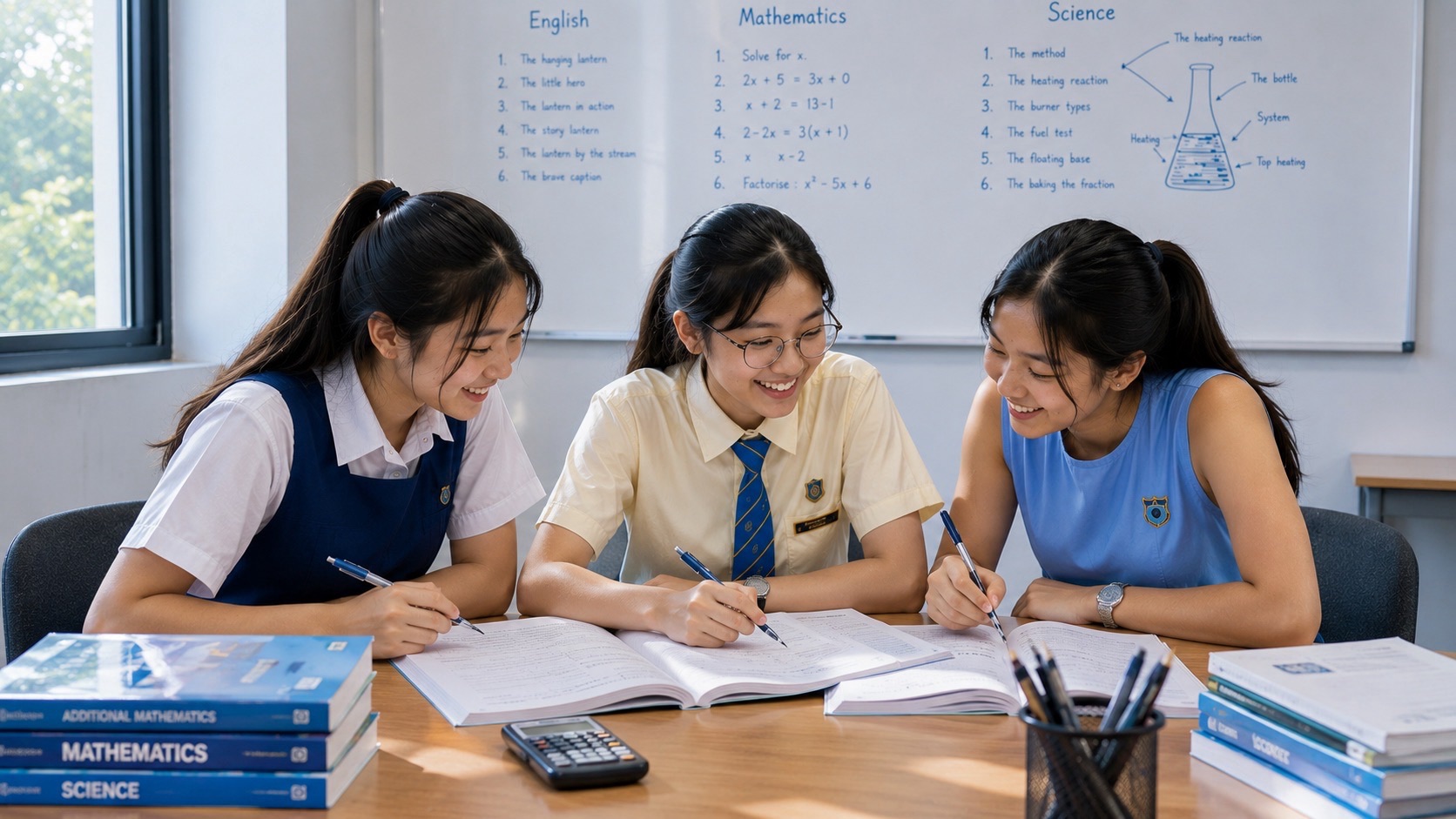
At eduKate Punggol, Mathematics tutorials are held at 83 Punggol Central, Singapore 828761, near Punggol MRT and Waterway Point, in small groups of up to three students. Reasoning becomes visible when students talk. A tutor can ask why a strategy fits, what assumption is being used, whether another method would work, and how the answer can be verified.
Reasoning is different from calculation
Calculation answers “what is the result?” Reasoning answers “why is this true?” A child may calculate 36 ÷ 4 = 9 without being able to explain the equal-group relationship. A Secondary student may solve an equation correctly without understanding why applying the same operation to both sides preserves equality.
Both are useful. Fluency supports reasoning by freeing attention, while reasoning prevents procedures from becoming blind imitation.
The five layers of mathematical reasoning
- Notice relationships and patterns.
- Represent the situation clearly.
- Make a claim or choose a strategy.
- Justify the claim with mathematical evidence.
- Check whether the conclusion still holds under a new example or representation.
Primary 1–2: reasoning begins with “how do you know?”
Young pupils can reason mathematically without formal proof. Ask how they know 8 is greater than 6, why 7 + 5 can be seen as 10 + 2, or whether two different arrangements contain the same number of objects.
The purpose is not to demand long verbal answers. It is to make relationships explicit and teach children that Mathematics includes explanation.
Primary 3–4: compare strategies
A multiplication problem can be solved by repeated addition, an array, known facts or decomposition. Comparing methods develops flexibility and helps pupils see that different strategies can express the same relationship.
Ask which method is more efficient and why. The answer should depend on the numbers and structure, not on a rule that one method is always superior.
Primary 5–6: reasoning becomes central to non-routine problems
Upper-primary problem sums frequently hide the method. The child must identify what changes, what remains constant, what the whole is, or which quantity can be found first.
This is why heuristics work best when linked to reasoning. A before-and-after model is useful because it exposes an invariant relationship, not because “before-and-after” is a magic chapter label.
Secondary Mathematics: reasoning becomes increasingly symbolic
In Secondary school, reasoning appears in Algebra, Geometry, graphs, statistics and probability. Students justify transformations, infer missing information, interpret representations and increasingly explain why a result follows.
The exact content depends on the student’s G1, G2 or G3 subject level, so parents should use the official SEAB SEC syllabus pages together with school materials.
What is a mathematical claim?
A mathematical claim is a statement that can be evaluated as true or false within defined assumptions. “All squares are rectangles” is true because a square satisfies the defining properties of a rectangle. “All rectangles are squares” is false because rectangles do not require all four sides to be equal.
Examples and counterexamples help students test claims. One valid counterexample is enough to disprove a universal statement.
Patterns are not proof by themselves
Seeing a pattern in several examples can suggest a conjecture, but repeated examples do not automatically prove that the pattern always holds.
This distinction becomes more important in Secondary Mathematics. Students should learn to use examples to explore and logical argument to justify.
The role of counterexamples
Ask students to test whether a rule always works. If someone claims “multiplying makes a number bigger,” the example 1/2 × 4 works, but 1/2 × 1/2 = 1/4 gives a counterexample to the general claim.
Counterexample thinking builds precision because students begin noticing assumptions and conditions.
Reasoning with representations
A bar model, number line, table, graph or equation can make a relationship visible. EEF problem-solving guidance recommends visual representations and comparing approaches because representations reduce cognitive load and support reasoning.
Students should be asked why the representation matches the problem. A picture without explanation can become another ritual.
Worked example: arithmetic reasoning
Claim: 19 × 7 can be calculated as 20 × 7 − 7.
The reasoning is distributive: 19 = 20 − 1, so 19 × 7 = (20 − 1) × 7 = 140 − 7 = 133. The method is not merely a shortcut; it is justified by a property of multiplication.
Worked example: fraction reasoning
Question: Is 5/8 greater than 1/2?
Since 1/2 = 4/8, 5/8 is greater. A number-line representation gives the same conclusion. Comparing two representations strengthens confidence in the relationship.
Worked example: Algebra reasoning
Equation: 2x + 3 = 11.
Subtracting 3 from both sides preserves equality, giving 2x = 8. Dividing both sides by 2 preserves equality again, giving x = 4. The reason is balance, not visual movement across the equals sign.
Worked example: Geometry reasoning
Claim: Two angles on a straight line sum to 180°.
A student can use that relationship to infer a missing angle. The calculation is secondary; the main reasoning step is recognising the geometric condition that justifies the total.
Worked example: data reasoning
If two classes have the same mean score, can we conclude that their results are equally spread out? No. The same mean can arise from very different distributions. The claim needs more information about spread.
How to ask better reasoning questions at home
- How do you know?
- Can you show it another way?
- What stays the same?
- What changes?
- Would this always be true?
- Can you find a counterexample?
- Which information proves your claim?
- Can you check your answer using a different method?
These questions are useful because they return the thinking to the learner rather than supplying the method.
The reasoning error taxonomy
- Unsupported claim — an answer is asserted without a mathematical reason.
- Pattern overreach — a rule is declared true from a few examples.
- Hidden assumption — the student assumes a property not given.
- Representation mismatch — the diagram or equation does not match the situation.
- Invalid transformation — a step changes the mathematical relationship.
- Incomplete case — only part of the possibilities are considered.
- Counterexample blindness — evidence that breaks the claim is ignored.
Reasoning and problem solving overlap, but they are not identical
Problem solving asks the learner to reach a solution. Reasoning asks the learner to justify the path and conclusion. Strong Mathematics teaching uses both.
The companion article How to Solve Mathematics Word Problems and Improve Problem-Solving focuses on the full solve process. This page focuses on justification and logical structure.
How to build reasoning with worked examples
Do not show only the completed method. Ask why one step follows from the previous step. Present two solutions and ask which is valid, which is more efficient, or where an error first appears.
Analysing incorrect examples can be especially powerful because students must identify the broken reasoning rather than simply imitate correct working.
How to build reasoning through multiple methods
When a problem has more than one valid solution, compare them. A ratio question may be solved with units-and-parts, a table or algebra. The important question is what each method makes visible.
Students learn that Mathematics is structured reasoning rather than a single sacred sequence of steps.
How to move from explanation to proof-like thinking
Formal proof is not required at every school level, but the habits can begin early: state what is known, state what must be shown, use valid properties, and connect each conclusion logically.
Khan Academy’s proof introduction uses this same architecture—given information, target statement and logical steps. Secondary Geometry is a natural place for these habits to become more explicit.
A 20-minute reasoning routine
- 5 minutes: solve one straightforward question.
- 5 minutes: explain why the method works.
- 4 minutes: solve the same structure a different way.
- 3 minutes: test whether a general claim is always true.
- 3 minutes: find or discuss a counterexample where appropriate.
How to know whether reasoning is improving
- The student explains relationships more precisely.
- Representations are chosen for a reason.
- Claims are supported rather than asserted.
- The learner notices assumptions.
- Counterexamples are used to test generalisations.
- Multiple strategies can be compared.
- Checks use a different route rather than merely repeating arithmetic.
- Unfamiliar problems are decomposed more calmly.
How three-student tuition can strengthen reasoning
A small group creates useful mathematical dialogue. One learner explains a method, another challenges an assumption, and a third may offer a different representation. The tutor can guide the comparison while still checking that each student can reason independently.
This is one of the strongest reasons for a very small group: students hear alternative valid reasoning without disappearing into a large class.
Reasoning and examination performance
Reasoning helps when the question is unfamiliar because the student is less dependent on matching a memorised template. It also supports checking: if the answer violates the relationship, the learner has a reason to reject it.
In the 2026 PSLE Mathematics syllabus, one assessment objective explicitly includes reasoning mathematically, analysing information, making inferences and selecting appropriate problem-solving strategies.
Frequently asked questions
Can reasoning be taught?
Yes. Teachers can model thinking aloud, compare strategies, use representations, prompt reflection and ask students to justify claims. Evidence reviews such as EEF’s problem-solving guidance support explicit development of these habits.
Does reasoning slow students down?
At first, explanation may take time. Over time, clearer relationships often make method selection faster because the student recognises structure instead of trying random procedures.
Is proof only for advanced students?
Formal proof becomes more prominent later, but proof-like habits—using valid reasons and checking assumptions—can begin in Primary school.
Does reasoning replace memorisation?
No. Fluency and reasoning support each other. Students need facts and procedures available enough to reason efficiently, and reasoning makes those procedures more adaptable.
Continue the Mathematics Improvements in Punggol lane
- How to Study Mathematics Effectively and Revise for Tests.
- How to Improve Measurement and Unit Conversion.
- How to Improve Mathematics Exam Time Management.
- How to Get Better at Mathematics Without Random Practice.
Mathematical reasoning improves when students are repeatedly asked to connect claims to evidence. Notice the structure, represent it, explain the relationship, test the claim and check the conclusion. That is how Mathematics becomes something the learner can defend rather than merely reproduce.
References and further learning: EEF Guiding Problem Solving · EEF Mathematical Reasoning · Khan Academy: Mathematical Proof · SEAB 2026 PSLE Mathematics Syllabus.
Reasoning through estimation
Estimation is a reasoning tool because it creates expectations before exact calculation. If the student expects a result near 500 and obtains 5,000, the discrepancy demands an explanation. This is stronger than blindly repeating the arithmetic.
Encourage pupils to state a rough range first. The estimate becomes a claim that can be compared with the exact answer.
Reasoning through invariants
An invariant is something that remains unchanged while other quantities change. Primary ratio problems, Geometry transformations and Algebraic relationships often become easier when students ask what stays constant.
Teaching the invariant habit creates a bridge across topics: total quantity may stay fixed during a transfer, shape may remain congruent during a translation, or equality may remain true when the same operation is applied to both sides.
Reasoning through cases
Some claims depend on considering more than one possible case. Students can be trained to ask whether the result changes when a number is positive, negative, zero, even, odd or at a boundary value.
Case thinking reduces overgeneralisation and prepares older students for more formal mathematical argument.
Reasoning through contradiction
At an introductory level, students can learn that some claims can be tested by assuming the opposite and seeing whether that assumption produces an impossibility. Formal proof by contradiction belongs to more advanced study, but the underlying habit is useful earlier: check whether the proposed explanation can coexist with the known facts.
This strengthens logical discipline without requiring advanced notation.
The reasoning dashboard
- Can the student explain why the method fits?
- Can the learner distinguish evidence from assumption?
- Can the student test a general claim with examples and counterexamples?
- Can two strategies be compared?
- Can the child identify what remains invariant?
- Can the conclusion be checked through a second representation?
These indicators show whether reasoning is becoming an independent habit rather than something produced only when a tutor asks.
A 90-minute reasoning lesson
A strong lesson can begin with one problem everyone can enter, then ask students to solve it in different ways. The tutor compares representations, highlights assumptions and asks for justification. The second half uses a fresh problem where the same reasoning structure appears in a different context.
The lesson ends when each learner can explain not only the answer, but why the chosen route is valid.


