
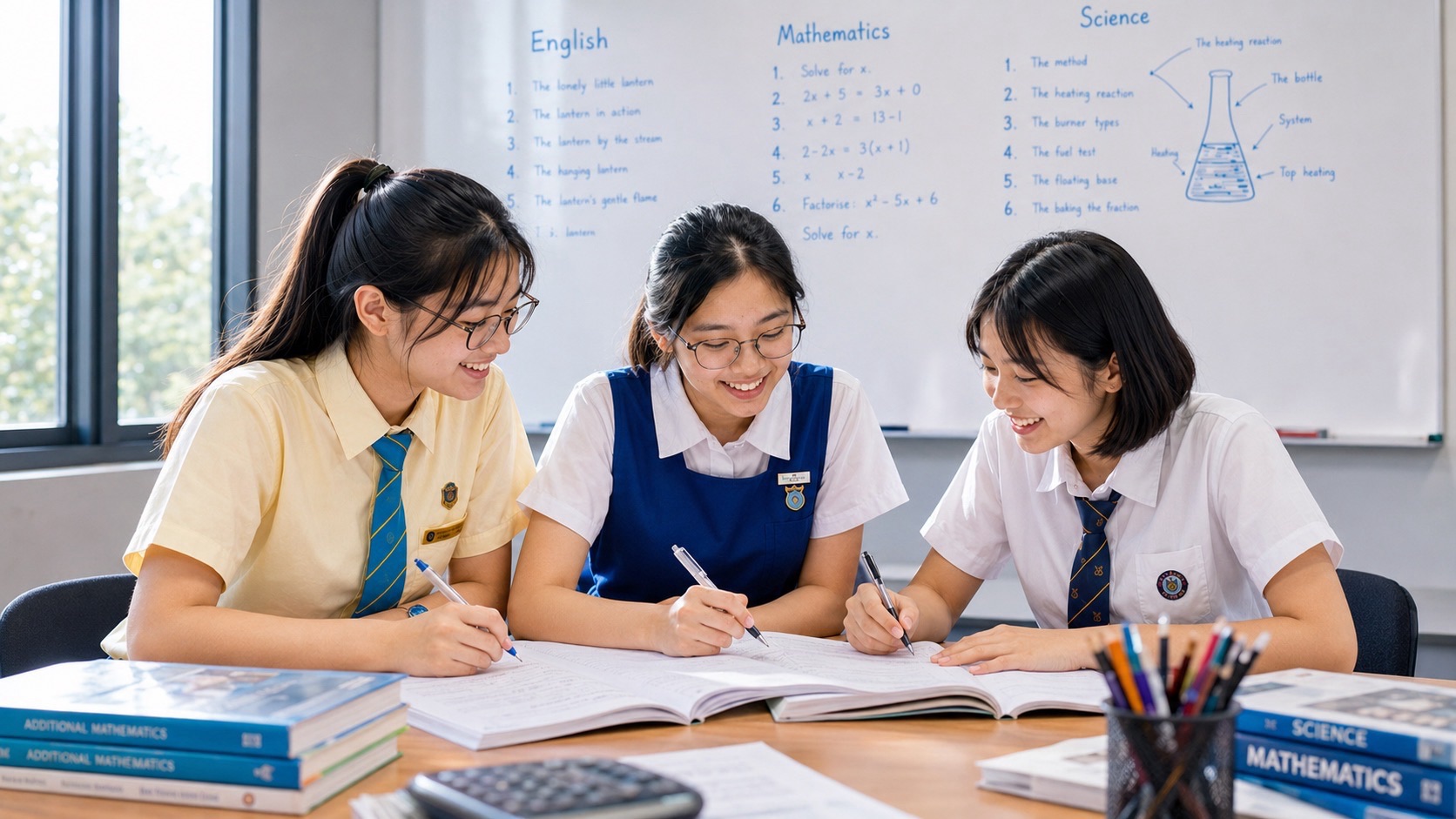
How to get better at Mathematics is one of the most common questions families ask when a child is working hard but the marks are not moving. In Punggol, the answer is rarely “do more worksheets.” A Primary 2 child who is uncertain about place value, a Primary 5 child who cannot connect fractions to ratio and percentage, a Primary 6 child losing marks in PSLE problem sums, and a Secondary student struggling with algebra all need different repairs. The useful question is: where does the Mathematics first become unreliable?
This Mathematics Improvements in Punggol guide is written for parents who want a practical route from weak or inconsistent performance to more dependable mathematical thinking. It covers Primary 1 to Primary 6, PSLE Mathematics, and the transition into Secondary Mathematics. It uses the same principle behind strong Mathematics teaching internationally: build concepts, skills, problem-solving processes, metacognition and confidence together, rather than treating marks as a separate problem. Singapore’s current Primary Mathematics syllabus places mathematical problem solving at the centre of the curriculum, supported by concepts, skills, processes, metacognition and attitudes.
At eduKate Punggol, lessons are held at 83 Punggol Central, Singapore 828761, near Punggol MRT and Waterway Point. Our Mathematics tutorials use small groups of up to three students so the tutor can see not only whether an answer is wrong, but why it went wrong. That diagnosis matters because a child can improve only when practice is aimed at the real bottleneck. This article shows parents how to find that bottleneck, repair it, and measure whether the improvement is transferring into schoolwork and examinations.
The search phrase “how to get better at math” hides several different problems
A child can say “I am bad at Math” while actually having a narrow and repairable difficulty. Some students understand concepts but work too slowly. Some calculate accurately but cannot translate a word problem into a mathematical representation. Some remember procedures only when the question looks familiar. Some know the method but make recurring unit, sign, transfer or copying errors. Some can do homework with support but cannot retrieve the method independently during a test.
These are different failure modes, so they need different interventions. If a student has a place-value misconception, speed drills do not solve it. If a student understands fractions but misreads comparison language, another page of fraction computation may not help. If a Secondary 1 student can manipulate an equation but cannot form one from a situation, the missing skill is mathematical modelling and translation rather than algebraic manipulation itself.
The first improvement rule is therefore simple: do not prescribe practice before diagnosis. A useful diagnostic asks the child to explain what the question is asking, identify the quantities and relationships, choose a representation, solve, and then verify the result. The point is not to catch the child out. The point is to see exactly where the chain breaks.
Mathematics improvement is a chain, not a pile of topics
Mathematics accumulates. Later ideas reuse earlier structures. Place value supports the four operations. Fractions connect to ratio, percentage and proportion. Repeated patterns become algebraic expressions. Arithmetic relationships become equations. Coordinates become graphs. Rates become gradients. When an earlier link remains weak, later topics feel disproportionately difficult because the student is trying to learn new content while still compensating for an old instability.
This is why two students with the same test score may need completely different teaching. One may have forgotten a procedure taught recently. The other may have a foundational gap two or three years earlier. Their marks look similar, but their repair plans should not be.
Parents can explore the broader progression in Mathematics Is a Chain | From Primary Number Sense to E-Math, Algebra and Additional Mathematics in Punggol. This improvement article has a narrower job: turning that progression into an action plan when performance is weak, flat or inconsistent.
Start with the five layers of reliable Mathematics
1. Concept understanding
Concept understanding means the child knows what an idea represents and how it relates to other ideas. In Primary Mathematics, this may be the meaning of place value, equivalent fractions, ratio, area, volume or average. In Secondary Mathematics, it may be the meaning of a negative number, an algebraic variable, gradient, function, congruence or probability.
A conceptual gap often reveals itself when the numbers change. A child who has memorised a method may complete familiar examples but become stuck when the representation changes. Ask “Why does this step work?” or “Can you show the same idea another way?” If the student cannot explain the relationship behind the procedure, the knowledge may be too fragile for transfer.
2. Procedural skill
Procedural skill is the ability to execute methods accurately and efficiently. Understanding alone is not enough if every multiplication, fraction operation or algebraic manipulation consumes excessive attention. Fluency frees working memory for the harder part of the task: deciding what to do and why.
The goal is not mindless speed. It is dependable execution. A child should become sufficiently fluent in core operations that routine steps no longer dominate the entire problem. That is why well-designed practice still matters after teaching: it stabilises the method until it can be used without constant reconstruction.
3. Problem-solving process
Problem solving begins before calculation. The learner has to understand the situation, identify relationships, choose a representation, select a strategy, carry out the method, and verify the answer. The current MOE Primary Mathematics syllabus explicitly places problem solving at the centre of the curriculum. International high-traffic mathematics resources reflect the same architecture: Khan Academy organises extensive practice around multi-step word problems and algebraic representation, while Third Space Learning repeatedly treats fluency, reasoning and problem solving as connected but distinct capacities.
For parents, the practical implication is important: if a child keeps failing word problems, do not automatically assume the arithmetic is weak. Test the translation stage separately. Ask the child to explain the story without calculating. Ask what changes, what stays constant, what is being compared, and what must be found.
4. Metacognition and checking
Metacognition means noticing and regulating one’s own thinking. In Mathematics this includes recognising when an answer is unreasonable, deciding to draw a diagram, checking a unit, switching strategy after a dead end, or returning to the question when the solution no longer matches what was asked.
Students who lack this layer can know a lot of Mathematics and still lose marks because they do not monitor their work. Checking should therefore be taught as a procedure, not as an instruction shouted at the end. “Check your work” is vague. “Estimate the likely size, substitute your answer where possible, inspect units, and reread the exact question” is actionable.
5. Attitude, confidence and persistence
Confidence in Mathematics should not mean assuming every answer is correct. It means being willing to attempt, reason, revise and persist. A student who has experienced repeated failure may stop engaging before the mathematics begins. Conversely, a student who has been praised only for being “naturally good at Math” may avoid difficult problems that threaten that identity.
Good improvement work creates evidence of capability. The child learns one unstable idea, applies it successfully, revisits it later, and sees that the improvement holds. Confidence then follows performance rather than replacing it.
The Punggol Mathematics improvement diagnostic: find the first unreliable step
A useful diagnostic can be run with schoolwork, a recent test or a short mixed set. Choose questions that sample the current syllabus and earlier prerequisites. Do not help too quickly. Watch the child’s process.
- Can the student state what the question is asking before calculation begins?
- Can the student identify the relevant quantities, units and relationships?
- Can the student choose an appropriate representation: equation, model, table, diagram or graph?
- Can the student recall the required concept or method without heavy prompting?
- Can the student execute the arithmetic or algebra accurately?
- Can the student explain why the answer is reasonable?
- Can the student spot and correct an error after being told only that something is wrong?
The first point of failure is usually more useful than the final score. If a student cannot identify what a word problem is asking, the intervention starts with reading and representation. If the setup is correct but the fraction computation collapses, the intervention starts with fraction fluency. If the solution is correct but the student repeatedly omits units or answers the wrong quantity, the intervention starts with execution discipline and checking.
Improvement becomes faster when the lesson targets the first unstable link rather than the last visible mistake.
Primary 1 and Primary 2: improve quantity, place value and operation meaning first
In the first two primary years, parents often focus on whether a child can produce answers quickly. A more useful question is whether the child understands what numbers and operations mean. Counting, composing and decomposing numbers, comparing quantities, place value, addition and subtraction relationships, and early multiplication and division structures become the base for everything that follows.
If a Primary 1 or Primary 2 child regularly guesses operations in word problems, go back to the story of the quantities. Is something being combined, separated, compared, grouped or shared? Let the child represent the situation with objects, drawings or simple bars before moving to symbolic calculation. The representation is not a crutch; it is a bridge from concrete meaning to abstract notation.
For a deeper local route, see Primary 1 Mathematics at Home and Primary 2 Mathematics Practice Architecture. They give level-specific practice structures without turning this page into a competing year-level owner.
Primary 3 and Primary 4: improve multiplication, division, fractions and representation
By Primary 3 and Primary 4, the Mathematics system becomes wider. Multiplication and division become more demanding, fractions become more formal, measurement expands, and multi-step problems ask the student to coordinate several pieces of information. Students who previously survived through quick arithmetic can begin to struggle because the task now requires more organisation.
At this stage, improvement should connect facts to relationships. Multiplication tables matter, but so does understanding factors and multiples. Fraction procedures matter, but so does seeing fractions as numbers on a number line, parts of a whole, operators and comparisons. Decimal place value matters because later percentage work depends on it.
IXL’s Singapore-aligned Primary 4 mathematics coverage, for example, includes decimal place value, number-line representation, comparison and ordering. High-traffic international mathematics sites such as Maths Is Fun also organise large amounts of learner interest around the conversions between fractions, decimals and percentages. Those topics attract attention because they are not isolated tricks; they form a conversion network that is used repeatedly later.
Primary 5: repair fractions, ratio and percentage before the PSLE runway becomes steep
Primary 5 is often where an earlier weakness becomes expensive. Ratio and percentage depend on multiplicative reasoning and fraction understanding. Area, volume, rate and multi-step problems require students to connect concepts across topics. A child who is still treating every question as a new trick starts collecting methods without seeing the relationships among them.
The best improvement work in Primary 5 therefore does two things at once. It strengthens current syllabus content and audits the prerequisite chain. When a percentage question fails, ask whether the student understands the base quantity. When ratio fails, ask whether equivalent ratios and unitary reasoning are secure. When speed fails, ask whether units and rate relationships are understood.
The goal is to enter Primary 6 with fewer hidden fractures. That does not mean completing Primary 6 material early. It means making the Primary 5 foundation reliable enough that PSLE preparation can focus on integration, unfamiliar problems, timing and examination control rather than emergency repair.
Primary 6 and PSLE: improve integration, accuracy and exam control
PSLE Mathematics is not improved by paper volume alone. A student can complete many papers while rehearsing the same mistakes. Effective preparation separates question exposure from error repair. Every incorrect answer should generate a diagnostic: concept error, interpretation error, strategy error, execution error, unit error, or time-management error.
The official SEAB PSLE formats page confirms the current examination framework, while the MOE Primary Mathematics syllabus continues to place mathematical problem solving at the centre. These are useful anchors for parents because they keep preparation connected to the official curriculum rather than to rumours about “tricks.”
For a local PSLE tuition route, use PSLE Math Tuition | Latest PSLE Mathematics Tutor. For the improvement lane specifically, continue to Mathematics Improvements In Punggol | Surviving PSLE Mathematics When Marks Are Falling.
Secondary 1: improve the transition from arithmetic to algebraic structure
The move into Secondary Mathematics is not simply “harder Primary Math.” The language becomes more compressed and the representations become more abstract. Negative numbers, algebraic expressions, equations, graphs and proportional reasoning require students to manipulate relationships that may no longer be tied to a familiar story.
A common Secondary 1 failure pattern is procedural imitation without structural understanding. The student can follow an example while it is visible but cannot reconstruct the method independently. Improvement therefore requires explanation, varied examples and deliberate retrieval. The child should be able to answer questions such as: What does the variable represent? Why can these terms be combined? What operation preserves the equality? What does the gradient say about the relationship?
The transition is explored in Punggol Secondary 1 Mathematics Tuition | Preparing the Transition Shift.
SEC G1, G2 and G3 Mathematics: improve the correct pathway, not an imaginary average student
Singapore’s Secondary Education Certificate framework uses G1, G2 and G3 subject levels. Parents should work with the child’s actual school pathway and current syllabus rather than compare the student against a vague idea of what “Secondary Math” is supposed to look like. The official SEAB pages publish the current G1, G2 and G3 syllabuses.
Improvement does not mean forcing every learner through the same sequence at the same speed. It means making the current level reliable, identifying what is needed for the next school decision, and building enough conceptual and procedural strength that the learner can handle new questions independently. The specific parent roadmap is in Mathematics Improvements In Punggol | SEC G1, G2 and G3 Mathematics Improvement Plan.
Why random practice often produces slow improvement
Random practice feels productive because pages get completed. But completion is not the same as learning. If a child repeats questions that are already easy, there is little new learning. If the questions are too difficult, the child may rely on worked solutions without building independent capability. If mistakes are not classified and corrected, the same error pattern can survive across dozens of worksheets.
A more efficient practice cycle has five stages: targeted review, guided example, independent attempt, delayed retrieval, and mixed application. The delayed retrieval matters because a method that works immediately after teaching may still disappear two days later. The mixed application matters because real tests do not announce which method belongs to each question.
This is also why “more homework” is not automatically better tuition. The tutor’s job is to choose the next question for a reason. A good question either reveals a misconception, strengthens a method, tests transfer, or trains examination control. If the worksheet is just volume, the student may be busy without moving the bottleneck.
Use an error log that changes the next lesson
An error log should not be a scrapbook of wrong answers. It should drive action. Record the question type, the first wrong step, the error category, the repair, and the next test question. If the same category appears repeatedly, the teaching plan changes.
- Concept: the student misunderstood the mathematical relationship.
- Recall: the student knew the idea before but could not retrieve it.
- Representation: the student could not turn the situation into a model, equation, table or diagram.
- Strategy: the representation was reasonable but the chosen method was inefficient or unsuitable.
- Execution: arithmetic, algebra, sign, unit or transfer error during working.
- Reading: a condition, comparison, exception or requested quantity was misread.
- Checking: the answer was unreasonable but the student did not detect it.
- Timing: the student knew what to do but could not complete it under realistic constraints.
After correction, use a fresh parallel question rather than the same question from memory. That tests whether the repair has transferred. If the student can solve the new version later without help, the error is beginning to close.
The 20-minute home Mathematics routine for school nights
Parents do not need to become the child’s second Mathematics teacher. A short, well-structured home routine can support school and tuition without creating nightly conflict.
- 3 minutes: retrieve two or three recently learned facts, formulas or methods without notes.
- 7 minutes: solve two targeted questions from the current weak area.
- 5 minutes: correct one error properly and explain the cause.
- 3 minutes: solve one mixed question that requires choosing the method independently.
- 2 minutes: state what was learned and what still feels uncertain.
For younger pupils, shorten the routine and use more concrete or visual representation. For older students, the questions can be more demanding, but the structure remains useful: retrieve, apply, correct, transfer, reflect.
The important feature is continuity. Mathematics improves when the learner repeatedly reconstructs knowledge rather than repeatedly rereads it. A small amount of thoughtful work across the week usually reveals more than one large panic session before a test.
How a three-student Mathematics tutorial changes the feedback loop
In a large class, a student can copy, wait, or hide uncertainty. In one-to-one teaching, the tutor can see everything, but the format may be more intensive than some families need. A three-student small group sits between those extremes. There is enough visibility for diagnosis and enough independent space for the student to think before the tutor intervenes.
At eduKate Punggol, the useful unit is not “one worksheet per lesson.” It is a feedback loop: attempt, observe, diagnose, teach, retry, vary, retrieve. With only a few students, the tutor can notice whether a wrong answer came from concept, language, method or execution and can select the next question accordingly.
There is also useful social information. A student hears another learner explain a method, notices that there may be more than one valid representation, and learns to communicate mathematical reasoning. The tutor still has to protect individual thinking; the goal is not for the fastest child to narrate the lesson for everyone else.
What a 90-minute improvement lesson can look like
A strong 90-minute lesson does not have to use the same timing every week, but the architecture should make sense. One useful pattern begins with retrieval and a short diagnostic. The middle of the lesson repairs one or two high-value weaknesses through explanation, worked examples and guided practice. The final phase asks the student to solve independently, under less support, and then checks whether the learning holds in a mixed or unfamiliar question.
The tutor may also use schoolwork or a returned test as evidence. That keeps tuition connected to the child’s real performance. If a school paper shows recurring weakness in ratio, algebraic manipulation or graph interpretation, the lesson can address the prerequisite chain rather than simply giving another full paper.
Parents should be able to ask after several lessons: What was unstable? What was taught? What is now reliable? What still fails under transfer or time pressure? Those questions are more meaningful than asking how many pages were completed.
How to measure Mathematics improvement before the report book changes
Marks are important, but they are delayed and noisy indicators. A school test may contain a different topic mix, a harder paper or an unusual mistake. Parents should also watch leading indicators that show whether the learning system is becoming healthier.
- The child starts questions with less prompting.
- Explanations become more precise and use mathematical language correctly.
- Working becomes more organised and easier to audit.
- The same error appears less frequently.
- The child can solve a parallel question several days after teaching.
- The child chooses methods more independently in mixed practice.
- Checking catches implausible answers before submission.
- Timed completion improves without a rise in careless errors.
- The child is more willing to attempt unfamiliar questions.
When these indicators improve and remain stable across several weeks, marks usually have a better foundation from which to rise. When marks rise without these indicators, the gain may be fragile or topic-specific.
When Mathematics tuition is useful — and when the plan should change
Tuition is useful when the child needs diagnosis, sequencing, feedback or practice that school and home are not currently providing in sufficient depth. It can also be useful when the family wants a stable weekly structure or when a transition such as Primary 6 to Secondary 1 introduces demands that the student is not yet handling independently.
Tuition should not become a permanent substitute for independent learning. A good programme gradually transfers control back to the student. The child should need fewer prompts, recognise errors earlier, and become better at deciding what to revise. If the student remains equally dependent after a long period, the method should be reviewed.
Families considering local support can start at Mathematics Tuition at eduKatePunggol or Sign Up for Mathematics Tuition at eduKatePunggol. The commercial decision should come after the learning diagnosis, not before it.
A parent decision tree: what should we improve next?
If the child cannot explain basic concepts: reduce difficulty and rebuild meaning with representations and simple examples. If the child understands but is slow: strengthen fluency with short, accurate practice. If the child calculates well but fails word problems: train interpretation and representation. If the child gets correct methods but loses marks: build execution and checking routines. If the child performs at home but not in tests: introduce timed retrieval, mixed practice and exam-condition rehearsal.
If several problems appear at once, prioritise the earliest prerequisite with the greatest downstream effect. For example, unstable fractions can damage ratio, percentage, rate and algebraic manipulation. Repairing fractions may therefore improve several topics at once. This is a better use of time than treating every recent mistake as a separate emergency.
Frequently asked questions about improving Mathematics in Punggol
How long does it take to improve Mathematics?
There is no single timeline. A narrow procedural gap can improve quickly; a long-standing conceptual gap or weak study system takes longer because the learner needs repeated successful retrieval and transfer. The right measure is not the number of weeks alone but whether the targeted weakness is becoming reliably correct in fresh questions.
Should my child do assessment books every day?
Not automatically. Daily practice can be useful when it is short, targeted and corrected well. Large amounts of undiagnosed practice can waste time or entrench errors. Use the smallest amount of practice that reliably strengthens the next needed skill, then retest later.
Is speed important?
Yes, but only after enough understanding and accuracy exist. Speed built on unstable methods creates fast mistakes. Build a correct process, increase fluency, then train timing under mixed conditions.
What if my child says they understand but still cannot do the question?
Ask for an explanation without looking at notes. Understanding that disappears when the example is removed is not yet independently retrievable. Use a fresh question and ask the student to identify the relationship and first step before solving.
What if Mathematics marks suddenly fall?
Compare the new paper with earlier work. Was the decline concentrated in one topic, word problems, careless errors, timing, or question interpretation? A sudden fall often contains diagnostic information. Do not respond by doubling every type of practice at once.
Can a student improve without tuition?
Yes. Many students improve through good school teaching, thoughtful home routines and independent practice. Tuition becomes useful when the learner needs additional diagnosis, explanation, feedback, sequencing or accountability that is not currently available enough elsewhere.
The Mathematics Improvements in Punggol route
This series is designed as a parent-facing improvement lane rather than another set of competing tuition owners. Use the article that matches the current bottleneck:
- How to Solve Mathematics Word Problems and Improve Problem-Solving — when the child can calculate but cannot translate or organise unfamiliar questions.
- Surviving PSLE Mathematics When Marks Are Falling — when Primary 6 performance is becoming unstable close to school examinations or PSLE.
- SEC G1, G2 and G3 Mathematics Improvement Plan — when a Secondary student needs a pathway-specific repair and progression plan.
- Mathematics Article Index — for the wider eduKatePunggol Mathematics library.
The principle across all four routes is the same: diagnose the first unreliable step, repair it clearly, retrieve it later, apply it in a new context, and measure whether the improvement survives without help. That is how Mathematics becomes more reliable — and how a child moves from completing work to actually owning the method.
Official and learning references: MOE Primary Mathematics Syllabus · SEAB PSLE Formats 2026 · SEAB SEC Syllabuses · Khan Academy Mathematics · IXL Singapore Mathematics · Third Space Learning Problem-Solving Strategies · Maths Is Fun: Decimals, Fractions and Percentages.
Three worked diagnostic cases: how the same low mark can need three different repairs
Case A: Primary 2 — correct counting, weak place value
A Primary 2 pupil may appear to have an addition problem because two-digit calculations are frequently wrong. A closer diagnostic can reveal that the real issue is place value: tens and ones are not being held consistently when regrouping begins. The correct response is not a larger stack of addition worksheets. Return to quantity, bundles of ten, expanded form and the meaning of each digit, then reconnect that understanding to written addition and subtraction. When the place-value representation becomes reliable, the procedure usually becomes easier to stabilise.
Case B: Primary 5 — knows fraction procedures, cannot see the relationship
A Primary 5 pupil may complete routine fraction questions but fail ratio, percentage and multi-step problems. The learner can calculate when the operation is announced, yet cannot decide what the fraction represents in a new situation. The repair should mix representations: fraction bars, number lines, equivalent ratios, decimal and percentage forms, and short word problems that ask the pupil to identify the whole before calculating. The teaching target is not another isolated procedure; it is multiplicative reasoning that can travel across topics.
Case C: Secondary 1 — algebra works in examples but disappears independently
A Secondary 1 student may look fluent during worked examples and then become stuck on homework. The hidden problem is often cue dependence. While the teacher’s example is visible, the next step is obvious; when the cue disappears, the method cannot be reconstructed. Improvement requires retrieval without the model answer, varied examples that change the surface form, and translation between words, diagrams and equations. A fresh question after a delay is a better test of learning than immediate imitation.
These three pupils could all be described as “weak in Mathematics,” but that label is too broad to guide teaching. The Clementi-style diagnosis used in this lane asks what the student can already do, identifies the first unstable link, and repairs that link before adding difficulty.
A six-week Mathematics improvement cycle parents can understand
A useful improvement cycle is short enough to measure and long enough to include retrieval. Week 1 establishes the baseline: recent papers, schoolwork and a small diagnostic set are classified by error type. Weeks 2 and 3 repair the highest-value prerequisite and practise it with support. Week 4 reduces prompts and introduces mixed questions. Week 5 adds realistic timing and unfamiliar wording. Week 6 retests the original skill with fresh questions and compares performance with the Week 1 baseline.
- Baseline: identify the first wrong step, not only the final wrong answer.
- Repair: teach the concept or procedure directly and make the relationship visible.
- Retrieve: remove notes and examples so the learner reconstructs the method.
- Transfer: vary numbers, wording, context and representation.
- Pressure-test: introduce mixed work and realistic timing only after the method is stable.
- Review: keep what is reliable, reopen what still fails, then choose the next bottleneck.
This cycle gives parents something more meaningful than “we covered three chapters.” It allows the tutor and family to talk about evidence: fewer repeated errors, more independent starts, better transfer, stronger checking and more stable performance under time pressure. Those indicators are useful even before the next school examination provides a new mark.
For Punggol families, this also keeps tuition commercially honest. Small-group teaching has value when the small group changes the feedback loop—more observation, better diagnosis, targeted practice and faster adjustment. If the lesson is simply the same worksheet for everyone, the class size alone is not the mechanism of improvement.
Explore the Punggol Mathematics reading library for related guides.


