
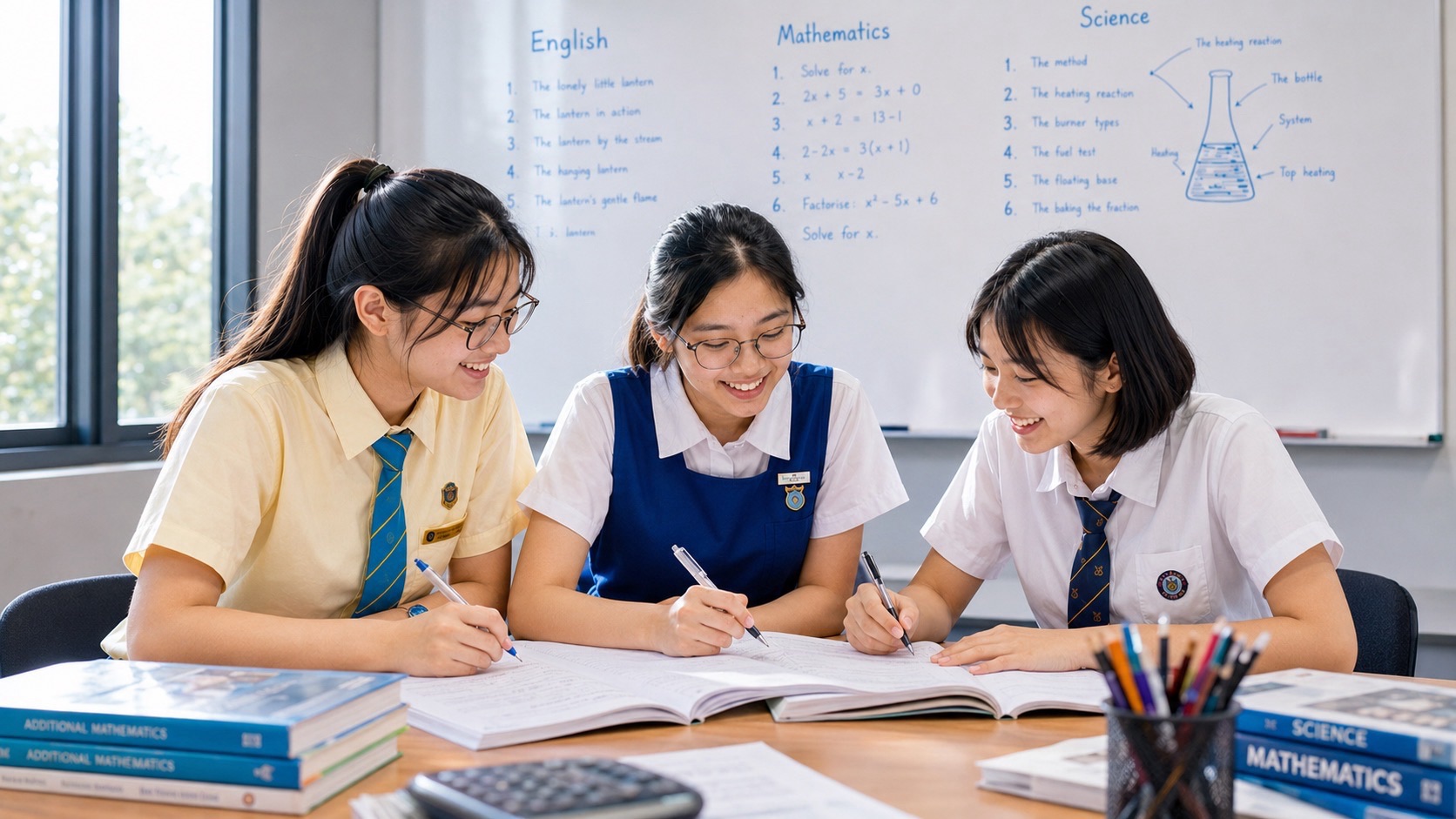
Help can solve a problem.
Too much help can hide the learning problem.
Mira pauses in the middle of an equation.
The tutor can say:
Subtract 5 from both sides.
That may get the answer moving.
But perhaps a smaller hint would have been enough:
What do you need to preserve here?
Or smaller still:
Check the relationship between the two sides.
The educational difference is important.
Training cue hierarchy is the deliberate ordering of prompts from least specific to most supportive so the learner receives only enough help to restart productive thinking.
The purpose is not to make help scarce.
It is to make help diagnostic.
Quick Read: Least Help First
Pause → General Cue → Targeted Cue → Partial Step → Worked Step → Full Model → Fresh Independent Attempt
The hierarchy should answer one question:
What is the smallest amount of assistance that lets the learner continue correctly?
If a general cue works, do not give a partial solution.
If a targeted cue works, do not demonstrate the entire task.
If no cue works because the learner lacks the model, stop hinting and teach.
Cue Hierarchy Is Different From Prompt Fading
The wider eduKate estate already owns prompt fading as the gradual removal of support over time.
Training Cue Hierarchy asks a narrower question inside one attempt:
How much help should enter right now?
Prompt fading concerns the direction of support across learning.
Cue hierarchy concerns the resolution of support at a specific stuck point.
The Seven-Level Cue Ladder
Level 0: Silence.
Give the learner a short thinking window. The first cue may be unnecessary.
Level 1: General orientation.
“What is the question asking?” “What relationship matters?” “What should you check?”
Level 2: Targeted attention cue.
“Look at the sign.” “Return to the evidence.” “Which variable changed?”
Level 3: Structural cue.
“Which rule links these two quantities?” “Which sentence provides the evidence?”
Level 4: Partial completion.
Provide the first step or one missing element, then ask the learner to continue.
Level 5: Worked step with explanation.
Demonstrate the specific blocked transition.
Level 6: Full model.
When the learner lacks the route, teach the complete structure rather than pretending another hint will fix it.
After any successful cue, use a fresh attempt.
Otherwise the tutor knows only that the learner could continue with help.
Why Small Cues Are Informative
The smallest successful cue tells us something about the learner state.
If Mira restarts after “check the sign,” the algebraic method is probably present.
If she requires the exact next transformation, the route is less stable.
If even a partial step does not help, a deeper model may be missing.
The cue hierarchy therefore works as a diagnostic instrument.
Stepwise Retrieval Research Supports the Logic
A 2025 study in Learning and Instruction used stepwise worked examples where learners were prompted to retrieve and execute each upcoming step before it was revealed. The prompted group showed better delayed recall and problem-solving performance than learners who studied the examples without those retrieval prompts.
The study does not establish one universal hint hierarchy for school tuition.
It supports the more modest training principle used here:
Before revealing a step, protect an opportunity for the learner to generate it.
Mathematics Cue Hierarchy
Mira is solving:
3x + 5 = 17
She stops.
Possible cue ladder:
- “What is your goal?”
- “What needs to happen to the +5?”
- “How can you preserve equality?”
- Write: 3x + 5 − 5 = 17 − 5.
- Explain why subtracting 5 from both sides is valid.
Stop as soon as Mira can continue correctly.
Then give:
7y − 4 = 31
No cue.
The fresh problem tests whether the route returned to Mira.
Cue Hierarchy for Method Selection
Mira knows factorisation, completing the square and the quadratic formula but cannot choose.
Do not say:
Factorise this.
That removes the exact decision being trained.
Use:
- “What do you notice about the coefficients?”
- “Which method would expose the roots most directly?”
- “Does this expression factorise cleanly?”
The cue should point attention without announcing the answer whenever possible.
English Cue Hierarchy
Jonas gives an inference that is too strong.
Possible ladder:
- “Check your evidence.”
- “Which phrase supports your adjective?”
- “Does the passage support ‘furious’ or something weaker?”
- Offer two candidate words: “concerned” / “furious.”
- Model how claim strength should match evidence strength.
If Jonas can repair after the first cue, do not supply the alternatives.
Science Cue Hierarchy
Nadia is analysing an experiment but cannot justify the conclusion.
- “What changed?”
- “What was measured?”
- “What remained controlled?”
- “Which data point supports your claim?”
- Provide the structure: Condition → Evidence → Mechanism → Conclusion.
Again, stop at the smallest successful cue.
Cue Hierarchy and Training Branching
Training Branching decides which instructional path should follow the learner’s response.
Cue hierarchy is one branch.
If the learner is close but stuck, cue.
If repeated cueing fails, branch to explanation, decomposition or prerequisite repair.
If the learner succeeds with minimal cueing, branch toward independence and fresh testing.
Cue Hierarchy and Training Readiness
The same cue can be too small for one learner and too large for another.
This is why Training Readiness matters.
A novice may require a structural cue or partial model.
An advanced learner may need only:
Check.
The learner’s state determines where on the ladder to begin.
Cue Hierarchy and Independence
The final level of a cue hierarchy is self-cueing.
Mira notices her own hesitation and asks:
What relationship am I trying to preserve?
Jonas notices an inference becoming strong and asks:
What exact evidence pays for this word?
Nadia asks:
What changed, what was measured, and what can I actually conclude?
The tutor’s cue has become the learner’s internal control routine.
This is the destination described in Training Independence.
Do Not Cue Too Fast
A learner hesitates for two seconds.
The tutor rescues.
The learner never practises recovery.
Protect a reasonable thinking window.
The exact duration depends on task and learner.
The principle is simply that hesitation is not automatically failure.
Do Not Cue Too Late
The opposite mistake is watching a novice rehearse an incorrect route for several minutes.
If the learner has no workable model, intervene.
Good struggle requires a route to learn from.
Unstructured failure is not automatically productive.
Do Not Confuse Hint Resistance With Independence
A student refuses help but continues repeating the same wrong path.
That is not necessarily productive independence.
Use a small diagnostic cue.
If the learner can use it and then complete the task, the intervention protected learning without taking over the task.
Do Not Use a Hint That Removes the Target Decision
If method selection is the target, do not name the method.
If evidence selection is the target, do not point directly to the sentence.
If variable identification is the target, do not label the variable.
A cue should reduce irrelevant blockage while preserving the decision we want the learner to practise.
Mira’s Cue Audit
Mira needs four prompts on Monday.
Two on Wednesday.
One general cue on Friday.
No cue the following week.
The falling cue level is itself a training signal.
Support dependence is shrinking.
A Parent Cue Audit
- Does my child get the answer because someone effectively tells them what to do?
- What is the smallest prompt that helps?
- Are the prompts becoming less specific over time?
- Can the child restart after a general cue?
- Does a fresh no-help problem follow?
- Is the child learning to generate the cue independently?
A Tutor Cue Audit
- Have I protected a thinking window?
- What is the least specific useful cue?
- Does my hint preserve the target decision?
- What did the smallest successful cue tell me about learner state?
- Do I need to branch to teaching rather than keep hinting?
- What fresh attempt will test independence?
- Is cue intensity falling across sessions?
The Deeper Idea: Help Should Reveal the Edge of Independence
The best tutoring is not measured by how quickly the tutor can make the page correct.
It is measured partly by whether the learner becomes able to generate the route without the tutor.
A cue hierarchy helps us find that edge.
Too little help and the learner may remain blocked.
Too much help and the tutor becomes the hidden engine of performance.
The right cue is the smallest intervention that returns the problem to the learner.
Research Foundations
Useful current anchors include the 2025 Learning and Instruction study on retrieval prompts inside stepwise worked examples, the 2026 study of intelligent-tutoring-system scaffolding in Grade 7 Mathematics, and the wider literature on worked-example fading, scaffolding and retrieval. The eduKateSG article Primary English Prompt Fading owns the broader progression from tutor support to independent control. This article’s narrower contribution is the moment-by-moment hierarchy: choose the least assistance needed to restart correct thinking, then verify with a fresh independent attempt.
Continue Through How Training Works
Read this alongside Training Branching, Training Readiness, Training Decomposition, Training Repetition and Training Independence.


