
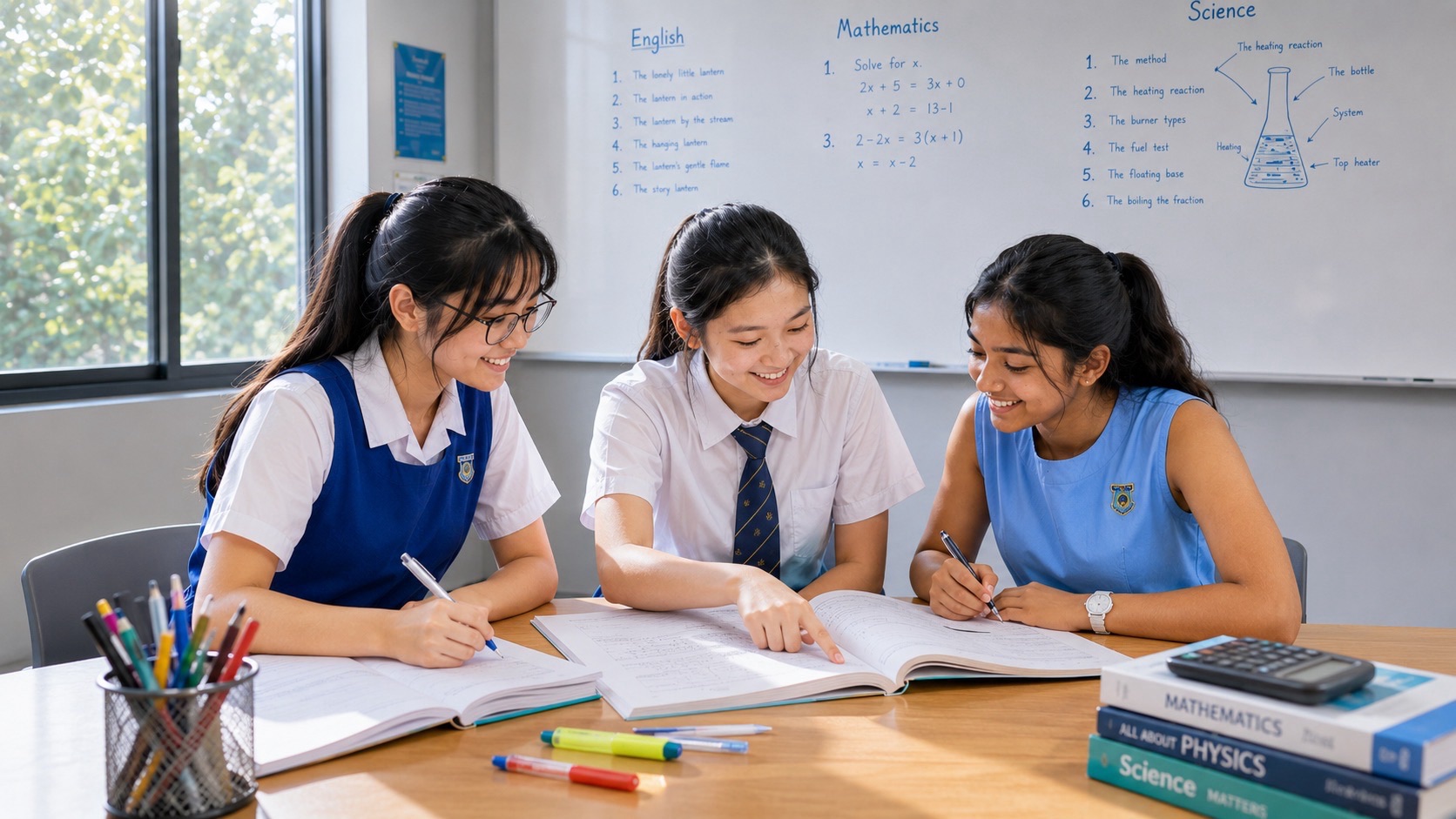
Nadia checked every line.
Then she checked the answer.
Then she checked the line she had already checked because she was no longer sure whether the first check had been careful enough.
By the time she reached the next question, she had spent almost as much time verifying as solving.
Her tutor changed the question.
Where would one unnoticed mistake do the most damage?
Nadia stopped checking uniformly.
She started checking economically.
Verification Has a Cost
Checking improves reliability only if the benefit exceeds the time and attention it consumes.
Every check has a cost.
Time.
Attention.
Working-memory disruption.
Opportunity cost.
In this eduKatePunggol series, verification economy means allocating checking effort to the points where a cheap check can prevent the greatest expected error cost.
Do not check everything equally. Check what matters most, at the moment when the check can still save the work.
Verification Economy and Error Propagation
The previous article on Error Propagation explains why early mistakes can contaminate large amounts of later work.
Verification economy places checks before those high-cost propagation points.
Check the equation before ten lines of algebra.
Check the interpretation before three paragraphs of writing.
Check the variable relationship before explaining the entire Science result.
The earlier check is usually cheaper than the later repair.
A Good Check Has Three Properties
- Cheap: it costs little relative to the work it protects.
- Diagnostic: failure of the check tells the learner something useful.
- Independent enough: it is not merely repeating the same mistake in the same form.
A check that simply redoes the same reasoning identically may reproduce the same error.
A stronger verification route often changes representation, reverses the operation, estimates magnitude or uses a different evidence source.
Verification Economy in Mathematics
Mathematics offers many cheap checks.
- substitute the answer back;
- estimate expected magnitude;
- check sign;
- check units;
- inspect whether the graph shape matches the algebra;
- verify the modelling equation before long calculation.
The best check depends on the failure mode.
A sign check will not repair a wrong model.
A full re-solve is unnecessary when a unit check would detect the main risk.
Verification Economy in English Reading
A reading answer can often be verified cheaply by returning to the exact evidence relationship.
- Does the pronoun actually refer to that noun?
- Does the quoted sentence support cause or merely sequence?
- Does the inference require assumptions not present in the passage?
- Does a later sentence contradict the current interpretation?
High-performing readers do not reread the entire passage after every answer.
They return to the evidence point with the highest diagnostic value.
Verification Economy in Writing
Writers can waste large amounts of time polishing low-risk details while a structural failure remains untouched.
The verification order should follow leverage.
- Does the response answer the prompt?
- Does the argument or narrative have a coherent route?
- Does each paragraph perform a useful function?
- Is evidence relevant?
- Then inspect language and local accuracy.
Do not perfect a sentence inside a paragraph that may need to disappear.
Verification Economy in Science
Science answers can be checked against the evidence chain.
- What changed?
- What was measured?
- Does the conclusion match the data?
- Does the explanation claim more certainty than the experiment supports?
- Are units and scales correct?
A brief check of the causal structure can prevent an entire polished explanation from resting on a false premise.
Verification Economy and Evidence Weighting
Evidence Weighting helps decide which check should influence the answer most.
A weak consistency check should not override a decisive contradiction.
Verification is economical when the learner uses evidence in proportion to its diagnostic power.
Verification Economy and Information Gain
Information Gain asks which next question will reduce uncertainty most.
A good verification check is often exactly that question.
Instead of checking every detail, ask the one thing whose failure would invalidate the largest part of the solution.
Verification Economy and Failure Forecasting
Failure Forecasting tells the learner where personal risk is concentrated.
If sign errors recur at negative brackets, install the check there.
If reading errors cluster around contrast, verify that relationship.
If writing repeatedly drifts from the task, verify the prompt alignment before drafting too far.
The Risk-Weighted Check
Checking priority can be thought of as a simple combination:
likelihood of error × cost if missed × cheapness of detection.
No arithmetic formula is necessary.
The model simply reminds the learner that a frequent, expensive error with a cheap check deserves attention.
Independent Checks Are Stronger
If the same mental route created the answer and checks it, the same blind spot may survive.
Use another route when practical.
Equation → graph.
Calculation → estimate.
Interpretation → contradictory passage evidence.
Science claim → actual measured variable.
This is where Strategy Portfolio creates verification power.
Checking Can Become a Performance Problem
Overchecking has costs.
It consumes time.
It can erode justified confidence.
It can cause students to change correct answers without evidence.
It can make a timed paper impossible to finish.
High performance therefore needs a stop condition for verification too.
The Verification Stop Rule
Stop checking when:
- the highest-risk points have passed;
- an independent check supports the result;
- no new contradictory evidence has appeared;
- additional checking is repeating the same route without new information;
- the opportunity cost of more checking exceeds the expected benefit.
This is Uncertainty Control applied to verification.
The Verification Ladder
- Identify the most costly possible failure.
- Locate where it would first appear.
- Choose the cheapest reliable check.
- Prefer an independent representation or route when useful.
- Run the check before large downstream work.
- If it passes, continue.
- If it fails, repair upstream.
- Stop once remaining checks have poor expected value.
The Examination Version
Under time pressure, verification should become more selective, not disappear.
Protect:
- high-mark branch points;
- known personal error zones;
- unit and answer-form requirements;
- final answers whose magnitude is easy to sanity-check.
Do not spend equal checking time on every routine line.
The Home-Study Version
During learning, verification can be more diagnostic.
After an error, ask which earlier checkpoint would have detected it most cheaply.
Then practise placing the check there on future examples.
The mistake becomes part of the learner’s verification architecture.
The Parent Version
When a child repeatedly asks, “Is this right?” avoid becoming the permanent verification system.
Ask:
What is the cheapest way you could check it yourself?
This transfers verification back to the learner.
The Tutor Version
For every recurring high-cost error, design one small verification routine.
Then fade external reminders until the learner triggers the check independently.
Verification becomes part of performance rather than a teacher action after performance.
Nadia Stops Checking Everything
Nadia identified her three highest-risk zones.
Method selection on mixed Mathematics questions.
Units in Science.
Prompt alignment in writing.
Her checks became shorter and earlier.
She stopped rereading every line simply because uncertainty was uncomfortable.
Paradoxically, she checked less and caught more of the mistakes that mattered.
The Verification Economy Test
- Which errors have the highest downstream cost?
- Where can those errors first be detected?
- What is the cheapest reliable check?
- Can the check use an independent route?
- Does the learner check before propagation rather than only at the end?
- Are checks concentrated on known risk zones?
- Can the learner distinguish necessary verification from anxiety-driven repetition?
- Is there a stop rule?
- Does verification improve reliability without destroying pacing?
- Can the learner perform the checks independently?
Batch Ten: Control the Boundary, Search, Error Chain and Check
- Boundary Conditions: know when a familiar rule stops applying.
- Information Gain: seek the question or observation that reduces uncertainty most.
- Error Propagation: identify early mistakes capable of contaminating large amounts of later work.
- Verification Economy: place cheap checks at the points where they can prevent the greatest damage.
Together they describe a learner who knows not only how to solve, but where to question the rule, where to seek information, where an error can spread and where a small check can protect the whole performance.
Research Note
“Verification economy” is an eduKatePunggol reader-facing systems term. Its underlying logic draws on metacognitive monitoring, error detection, verification, opportunity cost and reliability engineering: checking effort is most valuable when it is diagnostic, relatively cheap and positioned before high-cost downstream consequences. The article does not propose one universal checking formula; verification should match the task, learner and consequences of error.
Series Note
“High performance learning” is used descriptively throughout this eduKatePunggol series. The series does not claim affiliation with or reproduce any third-party branded educational framework using similar terminology.


