
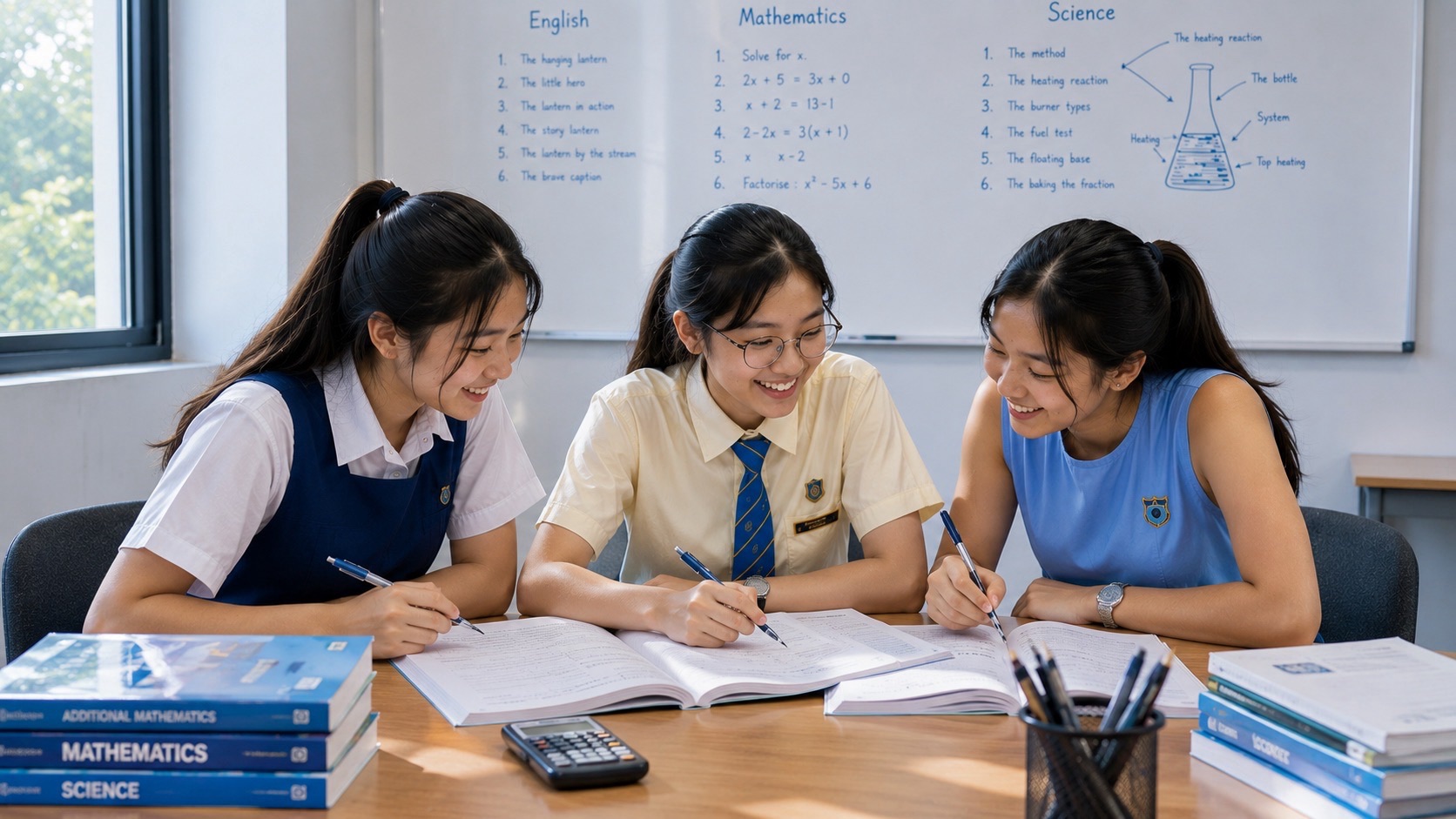
Mira could often explain her mistakes perfectly after they happened.
That was useful.
Then her tutor asked a harder question:
Which mistake are you most likely to make before you begin?
Mira laughed.
Then she thought about it.
Negative signs in algebra.
Rushed endings in composition.
Overlooking the unit on Science graphs.
She already knew where her system tended to fail.
She had simply been using that knowledge only after the fact.
High Performance Moves Error Knowledge Forward in Time
Most correction happens after performance.
Something goes wrong.
The learner analyses it.
That is necessary.
But mature learning asks whether recurring error knowledge can be used prospectively.
In this eduKatePunggol series, failure forecasting means predicting the most likely breakdowns before or during a task, using evidence from prior errors, known bottlenecks, task structure and performance conditions.
The strongest correction is sometimes the one that arrives before the mistake.
Forecasting Is Not Worrying
There is an important boundary.
Worry says:
Something will probably go wrong.
Failure forecasting says:
This type of question often triggers my sign error, so I will protect that transition.
One is diffuse anxiety.
The other is targeted risk management.
The Forecast Needs Evidence
A useful forecast comes from a history.
- Which errors recur?
- Which question types create them?
- Which conditions increase them?
- What happens when time is short?
- What fails late in long papers?
- Which representations are fragile?
This links directly to Error Budgeting. Recurring, expensive failures deserve more forecasting attention than rare low-cost slips.
Forecast the First Weak Link
Failure cascades often begin at one early point.
The wrong interpretation produces the wrong method.
The wrong method produces complex working.
The complex working produces execution errors.
The learner eventually sees only the final wrong answer.
Forecasting asks which early branch is likely to produce the cascade.
Protect that point.
Failure Forecasting in Mathematics
Mathematics is particularly suitable because error signatures are often visible in working.
A learner can build a small personal list:
- negative brackets;
- unit conversions;
- premature rounding;
- method selection when two approaches are plausible;
- answer-form requirements;
- forgetting domain restrictions.
Before a high-risk question, the learner does not reread the entire syllabus.
They perform one targeted pre-mortem:
Where do I usually lose this?
Failure Forecasting in English Reading
A reader may know that certain relationships are consistently difficult.
Perhaps contrast is misread as cause.
Perhaps pronoun reference becomes unreliable in dense paragraphs.
Perhaps inference answers become too broad when the evidence is indirect.
The forecast changes attention:
This passage is dense. I need to watch relationships, not just individual facts.
Failure Forecasting in Writing
Writers can forecast structural failure.
“When I start without an ending in mind, my last two paragraphs rush.”
“When the prompt is unfamiliar, I over-plan and lose drafting time.”
“When I use ambitious vocabulary under pressure, precision falls.”
These are not identity statements.
They are performance forecasts with corresponding controls.
Failure Forecasting in Science
Science forecasting can identify where a model is likely to be overextended.
“I tend to jump from correlation to cause.”
“I forget to distinguish the measured variable from the changed variable.”
“I describe the graph without explaining the mechanism.”
The forecast creates a targeted check before the answer is finalised.
Forecasting and Signal Detection
Signal Detection tells the learner which cues matter.
Failure forecasting adds memory:
Which cues have historically predicted my own breakdown?
The learner begins recognising risk patterns before the failure is visible in the final answer.
Forecasting and Performance Envelope
The Performance Envelope maps conditions where a skill begins to deteriorate.
Those edges are forecasting information.
If accuracy regularly drops under tight timing, time pressure is a risk condition.
If transfer fails after representation change, representation is a risk condition.
The envelope becomes a map of likely failure zones.
Forecasting and State Robustness
State Robustness reveals which errors become more likely when the learner is tired, distracted or under pressure.
A strong forecast can therefore include state:
I am tired tonight. My checking usually deteriorates before my core knowledge does.
Now the learner protects checking rather than declaring the entire session useless.
The Three-Level Forecast
- Task risk: What does this kind of task usually tempt me to do wrong?
- State risk: What changes when I am tired, rushed or uncertain?
- History risk: Which failure has recurred despite previous correction?
A thirty-second forecast can save much more than thirty seconds if it prevents a known cascade.
Do Not Forecast Everything
A learner who lists twenty possible failures before every question will create a new form of overload.
Forecast only the few risks with high probability, high cost or strong personal history.
Forecasting should narrow attention, not fill it with fear.
The Parent Version
After a test, ask not only “What did you get wrong?”
Ask:
Which of these mistakes could you have predicted from your past work?
That moves reflection from history into preparation.
The Tutor Version
Before a representative task, ask the learner to name one risk.
Afterward, compare forecast and outcome.
- Was the predicted risk real?
- Did another failure appear instead?
- Was the safeguard useful?
- Did the learner overpredict danger?
This improves both forecasting and calibration.
Mira Learns to Place the Check Before the Error
On her next Mathematics paper, Mira saw a negative bracket.
She did not panic.
She simply knew this was one of her high-risk transitions.
She slowed for two seconds, wrote the transformation clearly and continued.
The check had moved from the end of the paper to the moment where it had the highest value.
The Failure Forecasting Test
- Can the learner name recurring high-cost errors?
- Can they identify tasks that trigger those errors?
- Can they identify state conditions that increase risk?
- Can they forecast one or two likely failures before performance?
- Does the forecast place attention at the first weak link?
- Can the learner distinguish useful forecasting from general worry?
- Can they compare predicted and actual failures afterward?
- Does forecasting improve checking efficiency?
- Do recurring errors become less frequent?
- Does the forecast become more accurate over time?
Next: Build More Than One Route
Forecasting becomes more useful when the learner has alternatives available if the default route fails.
Next: How High Performance Learning Works | Strategy Portfolio — Build More Than One Route to the Answer.
Research Note
Failure forecasting is an eduKatePunggol systems concept informed by research on metacognition, prospective monitoring, error management, implementation intentions and adaptive control. Its educational purpose is to convert recurring error history into targeted anticipatory attention without encouraging excessive worry or indiscriminate checking.
Series Note
“High performance learning” is used descriptively throughout this eduKatePunggol series. The series does not claim affiliation with or reproduce any third-party branded educational framework using similar terminology.


