
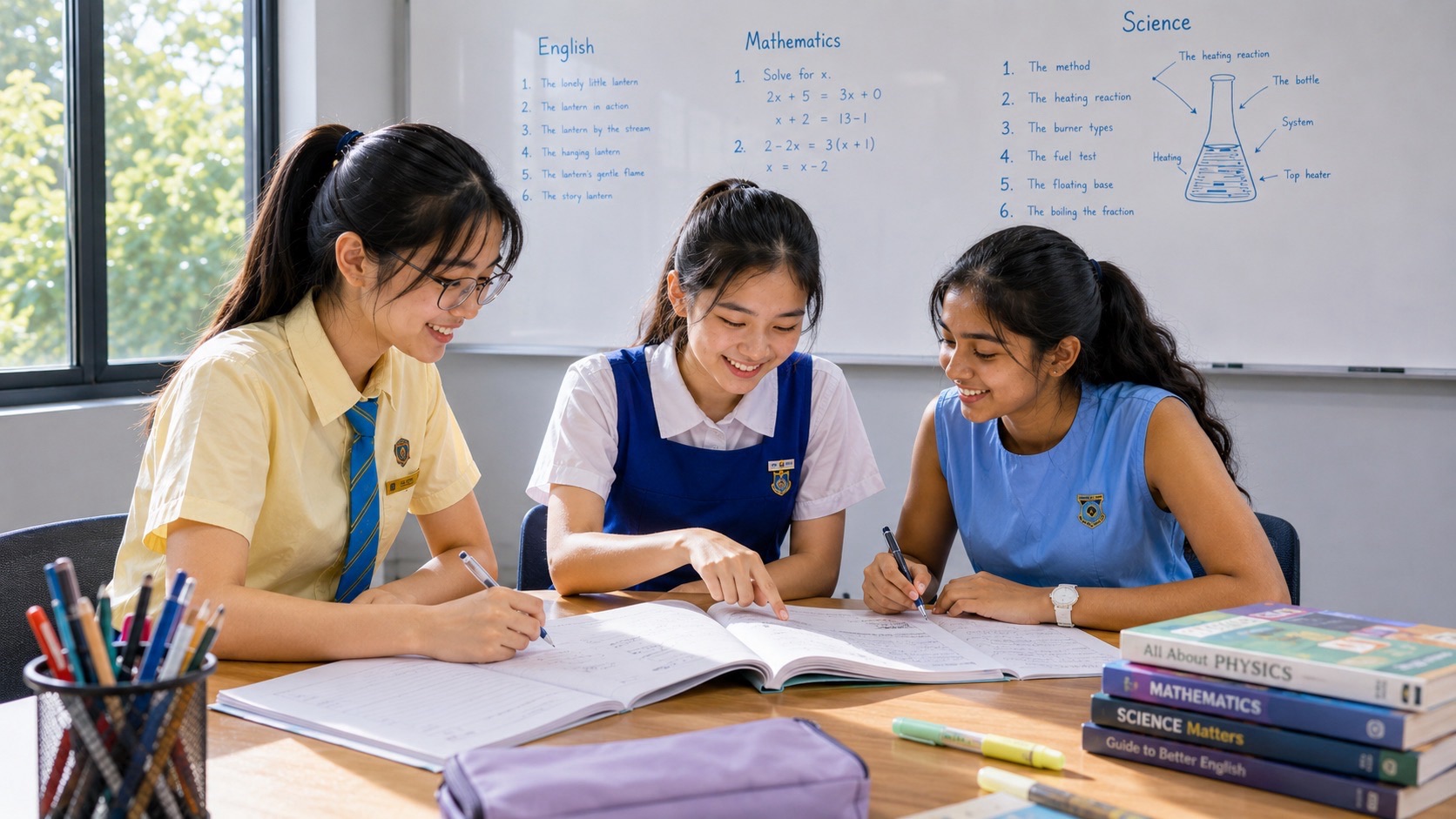
At 7.06 p.m., Mira was reading the same paragraph for the fourth time.
The words were not difficult.
She could pronounce every one of them. She knew most of the vocabulary. Nothing in the passage was beyond her level.
Yet when her tutor asked what the paragraph meant, Mira looked down and realised that her eyes had travelled through the text while her mind had not.
Outside, somebody pushed a chair across the corridor. A phone vibrated inside a school bag. Jonas turned a page. Mira thought briefly about a message she had not answered. Then she remembered tomorrow’s Science test. Then she noticed she was thinking about the Science test.
Nothing dramatic had happened.
Attention had simply moved.
High Performance Depends on What Gets Access to the Mind
Attention is often described as concentration, but concentration is only part of the story.
High-performance learning requires the learner to select what matters, resist or postpone what does not, hold a goal active, notice when attention has wandered, and return without spending the next ten minutes being angry about having wandered.
In this eduKatePunggol series, attentional control means the learner’s growing ability to direct limited attention toward the information and decisions that matter for the current learning goal.
That includes at least five moves:
- Select: identify the relevant signal.
- Sustain: keep the task goal active long enough to make progress.
- Inhibit: avoid acting on every competing stimulus or impulse.
- Switch: move attention deliberately when the task changes.
- Return: recover when attention drifts.
The fifth is especially important because no learner maintains perfect attention continuously.
High performance is not never losing focus. It is losing it less expensively.
Attention Is Limited, but It Is Also Selective
A classroom contains more information than a learner can process equally.
The teacher is speaking. Notes are on the board. Another student coughs. A diagram contains labels. A question contains numbers, units and irrelevant context. The learner has a memory of the previous problem and a worry about the next one.
Attention acts partly as a selection system.
Contemporary attention research describes control as emerging from several influences rather than from a single mental switch. Goals matter. Salient stimuli matter. Prior selection history matters. What has repeatedly captured or guided attention before can shape what becomes easy to prioritise now.
This makes educational habits important.
If a student repeatedly studies while checking notifications every few minutes, the device is not merely interrupting individual sessions. The learner is also rehearsing a pattern in which the study goal repeatedly loses priority.
If a Mathematics student repeatedly scans for familiar keywords instead of reading the whole condition, attention becomes trained toward the wrong cue.
If a Science student looks only at the final graph value and ignores axes and units, visual attention itself can become poorly routed.
Attention is therefore not separate from learning. What we repeatedly select becomes part of how we later perceive the task.
The Student Can Be Looking and Still Not Be Processing
Mira’s eyes were moving across the paragraph.
That did not prove comprehension was occurring.
This distinction matters because visible study behaviour can look convincing.
The book is open.
The student is seated.
The highlighter is moving.
Forty minutes have passed.
But attention may have alternated between the task, internal thoughts, environmental stimuli and low-level page processing without a stable model of the material being built.
One reason retrieval practice is useful is that it reveals whether enough processing occurred to make knowledge available later.
Mind Wandering Is Normal; Unnoticed Wandering Is Expensive
Recent systematic work on mind wandering and self-regulated learning emphasises that sustained attention requires learners to regulate cognitive, motivational and behavioural processes over time.
The problem is not that minds sometimes wander.
The problem becomes larger when the learner does not notice the shift and continues performing low-quality work.
There is a simple difference between:
“I lost focus for twenty seconds and returned.”
and
“I spent twelve minutes reading without constructing meaning.”
Attentional control reduces the second kind of loss.
Attention Needs a Target
“Focus” is difficult advice because it does not specify what attention should select.
Compare these instructions:
Focus on the Science question.
versus:
Before answering, identify which variable changed, which variable was measured, and what relationship the data support.
The second instruction gives attention a job.
High-performance learners increasingly learn to generate these targets themselves.
Attentional Control in Reading
Reading is not a single attentional task.
The reader must select words, integrate sentences, maintain a developing model of the text, monitor contradictions, track referents and shift between local detail and global meaning.
A weak reader can allocate attention too locally.
Every difficult word becomes an event. By the time it is resolved, the relationship between paragraphs has disappeared.
Another learner can allocate attention too globally.
They understand the general story but miss one qualifying word that changes the answer.
High performance requires zoom control.
Read the sentence.
Return to the paragraph.
Return to the whole passage.
Then zoom back to the evidence required by the question.
Attentional Control in Mathematics
Mathematics problems contain attractive distractions.
A familiar number pattern.
A recently practised formula.
A diagram that looks like the one from tuition.
A keyword associated with a standard method.
Strong students are not those who notice nothing else.
They increasingly notice the discriminating feature that determines what to do.
This connects with Adaptive Expertise. A routine method becomes dangerous when attention is captured by superficial resemblance and fails to inspect the changed condition.
A useful Mathematics attention routine is:
- What is given?
- What is required?
- Which condition constrains the method?
- What representation makes the relationship visible?
- What result would be impossible?
These questions point attention toward structure rather than decoration.
Attentional Control in Science
Science frequently requires coordinated attention across text and visual representations.
A 2025 review of eye-tracking research in Science education synthesised 170 studies and highlights how visual attention can reveal the way learners process diagrams, graphs and text. Another 2025 systematic review and meta-analysis of K–12 scientific text–picture reading reported that stronger learners tend to show better selective attention, integration and monitoring across text and pictures.
The educational implication is not that every classroom needs eye-tracking equipment.
It is that where students look—and whether they integrate the things they look at—matters.
When reading a graph, attention should not jump straight to the line.
- Read the title.
- Inspect both axes.
- Read units.
- Notice scale.
- Identify the pattern.
- Connect the pattern to the mechanism.
The sequence protects against visually obvious but scientifically weak answers.
Attentional Control in Writing
Writing requires attention to move across levels.
The writer must think about purpose, ideas, order, sentence construction, vocabulary, grammar, punctuation and revision.
A novice who attempts to control all levels simultaneously can become overloaded.
This is why planning is a form of attentional engineering.
Planning resolves some high-level decisions before sentence production begins. Automaticity makes lower-level language decisions cheaper. Revision then moves attention back upward and downward deliberately.
A useful writing sequence is:
- Decide what the piece is trying to do.
- Plan the major route.
- Draft with primary attention on meaning and continuity.
- Revise structure.
- Edit known language-risk areas.
The learner does not ignore grammar while drafting. They avoid letting every micro-correction destroy the larger thought.
Distraction Is Not Only External
Phones are obvious.
Internal distraction is often harder.
Worry.
Planning what to do after tuition.
Thinking about the previous mistake.
Imagining the examination result.
These thoughts can compete with the task even in a perfectly silent room.
So attention training cannot be reduced to removing devices.
The learner also needs return routines.
The Return Routine
When Mira noticed she had read without processing, her first instinct was frustration.
“I did it again.”
That sentence extended the distraction.
Her tutor taught a cheaper routine:
- Notice.
- Name the current task.
- Locate the exact point of return.
- Continue.
No moral judgement.
No internal speech about being unfocused.
The return becomes procedural.
High performers often look calm not because nothing disrupts them, but because they spend less time negotiating with disruption.
Environment Can Reduce Unnecessary Competition
Attentional control should not become an excuse for poorly designed environments.
If a desk contains five open devices, multiple active chats, television noise and three unrelated textbooks, the learner is being asked to spend executive control on avoidable competition.
Environmental design can make the right behaviour cheaper.
- Put only the current materials on the desk.
- Silence nonessential notifications.
- Define the next task before beginning.
- Keep needed references available so attention is not repeatedly broken by searching.
- Use visible boundaries between work and break periods.
This is not weakness.
It is good systems design.
But Students Must Eventually Work in Imperfect Environments
An examination hall will contain coughing, paper movement, chair noise and other candidates.
School classrooms are not laboratories.
Home can contain siblings and family activity.
Therefore high-performance training should not require perfect silence forever.
Build the capability under controlled conditions first.
Then allow realistic variation.
This follows the same logic as Performance Reliability: a capability is stronger when it survives expected variation.
Task Switching Has a Cost
Students often study in fragments.
Five minutes of Mathematics.
Reply to a message.
Back to Mathematics.
Check tomorrow’s timetable.
Open English.
Return to the unfinished equation.
Each switch requires the learner to reconstruct the task state.
Some switching is educationally useful. Interleaving can strengthen discrimination between problem types.
But random interruption is not the same as designed interleaving.
One trains selection.
The other leaks attention.
Attention and Automaticity
The first article in this series, Automaticity — Make the Basics Cheap, explains why stable lower-level skills should require less conscious effort.
Automaticity is therefore an attention technology.
If decoding is fluent, more attention can go to meaning.
If algebraic manipulation is fluent, more attention can go to structure.
If sentence conventions are fluent, more attention can go to argument.
High performance does not attempt to focus harder on everything.
It makes some things cheaper so attention can be spent where judgement matters.
Attention and Knowledge Compression
Knowledge Compression makes the same point from another direction.
When many details are organised into meaningful schemas, the learner does not have to attend to every element as an unrelated item.
The internal structure guides selection.
An expert sees the feature that matters because the subject has become organised enough to make relevance visible.
Attention and Calibration
Calibration helps the learner decide where attention should go next.
If a topic is secure, repeated checking has low value.
If confidence is high but evidence is weak, attention should move toward testing.
If one recurring error consumes marks, attention should be concentrated there.
Good calibration turns attention into a scarce resource that can be allocated intelligently.
The Attention Budget
A useful student model is to treat attention as a budget rather than an infinite supply.
Spend it on:
- new concepts;
- discriminating features;
- high-risk steps;
- meaningful feedback;
- transfer decisions;
- checking known failure modes.
Do not spend unnecessary amounts on:
- searching for misplaced materials;
- constant notification checking;
- reconstructing routines that should be automated;
- repeatedly validating already-secure answers;
- thinking about whether you are focused instead of returning to the task.
The goal is not austerity.
It is allocation.
Study Blocks Should Have an Attentional Job
“Study Science for one hour” is an activity description.
“Retrieve three mechanisms, compare two similar concepts, then analyse one unfamiliar experiment” is an attentional route.
The second is easier to enter because the learner knows what to select.
Good task definition reduces the attentional cost of deciding what to do while already trying to do it.
Breaks Should Restore, Not Fragment
A break can support attention by allowing genuine recovery.
But a break that introduces a highly compelling competing stream can make return harder.
The useful question is not whether screens are morally good or bad.
It is whether the chosen break makes re-entry cheaper or more expensive for this learner.
Some students return easily after ten minutes of messaging.
Others lose another twenty minutes trying to detach from the stream.
Calibration applies here too.
Attention Under Examination Conditions
Examinations add several competitors for attention.
The clock.
The previous question.
The candidate turning pages nearby.
The thought that one answer may be wrong.
The thought about the grade.
High-performance examination routines create attentional anchors.
- Read the current question from the beginning.
- Identify the task verb.
- Mark the required units or answer form.
- Return to the present item after checking the clock.
- Use a pre-decided recovery routine after a difficult question.
The purpose is to stop the examination from becoming one continuous stream of competing thoughts.
Attention Should Be Trained in the Subject
General concentration exercises may have uses, but the attentional demands of school are domain-specific.
A Mathematics learner needs to attend to constraints and structure.
A reader needs to attend to meaning, evidence and linguistic cues.
A Science learner needs to coordinate variables, diagrams, measurements and mechanisms.
A writer needs to shift between idea-level and sentence-level control.
So train attention inside authentic tasks.
The Three-Pass Attention Routine
For difficult school material, a simple three-pass routine can help.
- Orient: What is this task asking me to do?
- Work: What information deserves attention right now?
- Monitor: Does my current output still match the task?
The third pass prevents attention from remaining trapped inside a method after the method has stopped serving the goal.
Mira Learns to Return
A month later, Mira still occasionally discovered that she had read a paragraph without processing it.
The difference was what happened next.
She no longer restarted the whole page.
She no longer spent thirty seconds criticising herself.
She looked at the final sentence she could explain, named the question she was trying to answer, and resumed from there.
Her attention had not become perfect.
Her recovery had become cheap.
The Attentional Control Test
- Can the learner state what the current task requires?
- Can they identify which information matters most?
- Can they ignore or postpone irrelevant cues?
- Can they sustain attention long enough for the task?
- Can they switch deliberately when the task changes?
- Can they notice mind wandering?
- Can they return without excessive delay?
- Can they coordinate text, diagrams and other representations?
- Can they preserve attentional control under realistic examination variation?
- Are important lower-level operations becoming cheap enough that attention can move upward?
Next: How Far Can Learning Travel?
Attention can be perfectly directed at a familiar problem and the learner can still fail when the context changes.
The next question is transfer distance: how far knowledge can travel from the conditions in which it was learned before performance begins to break.
Next: How High Performance Learning Works | Transfer Distance — How Far Can Learning Travel?
Research Notes
This article uses attentional control as a practical educational concept informed by research on selective attention, executive functions, mind wandering and self-regulated learning. A 2026 theoretical review, The Attention Habit II, describes attentional allocation as shaped jointly by goal-directed control, stimulus-driven factors and selection history. A 2026 systematic review, Mapping Mind Wandering to the Self-Regulated Learning Process, places attentional lapses within the broader problem of learner regulation. In Mathematics, a 2025 systematic review of executive functions reports small-to-moderate associations with performance and highlights working memory, inhibition and cognitive flexibility. In Science education, a 2025 review of 170 eye-tracking studies and a later K–12 review illustrate the importance of selective attention and integration across complex visual information.
These sources do not imply that attention is fully under voluntary control or that every distraction can be eliminated through willpower. The educational aim is to improve task selection, environmental design, monitoring and recovery where training can make those processes more reliable.
Series Note
“High performance learning” is used descriptively throughout this eduKatePunggol series. The series does not claim affiliation with or reproduce any third-party branded educational framework using similar terminology.


