
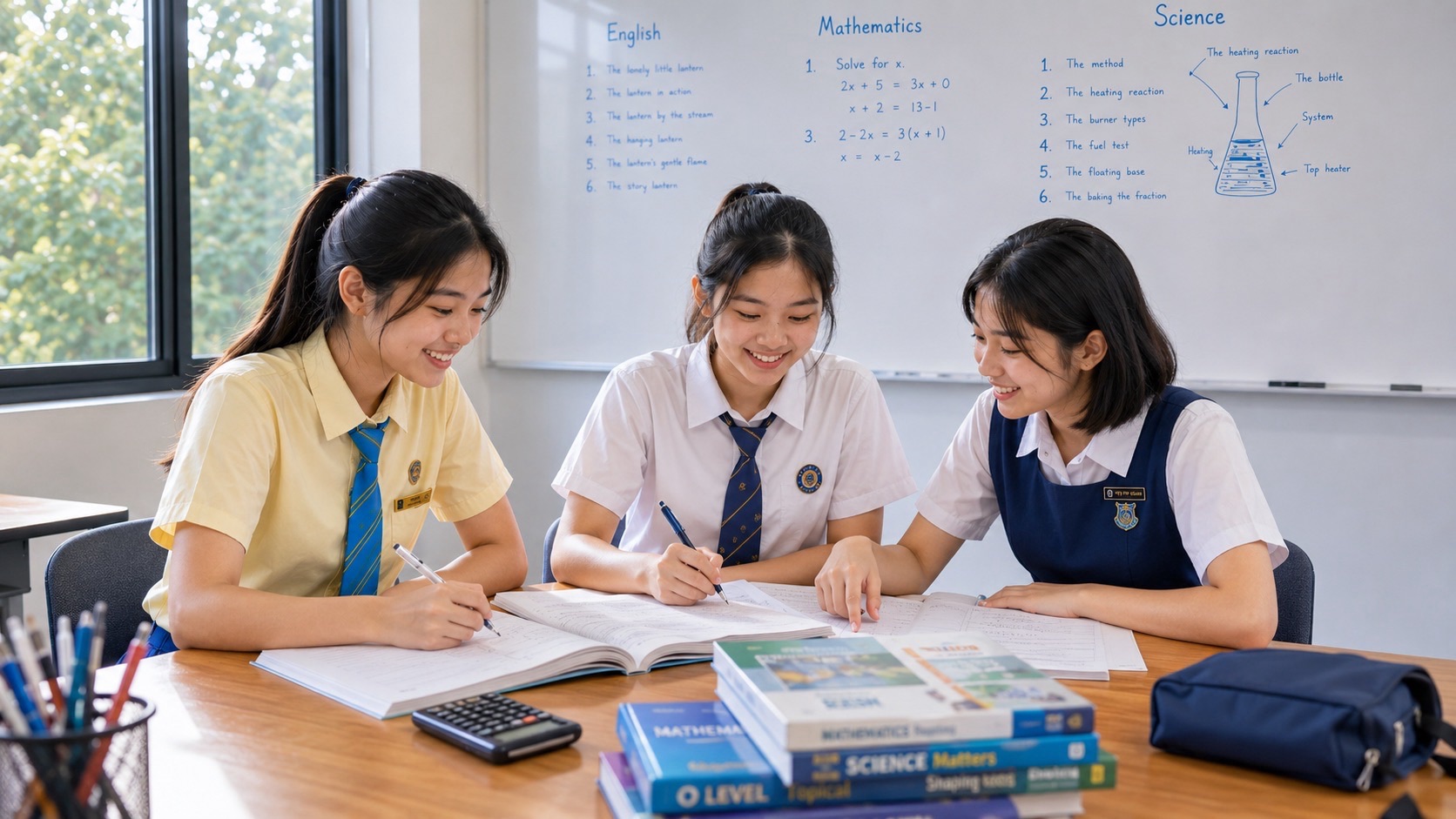
Jonas liked questions that behaved themselves.
If the chapter was algebra, he expected algebra. If the worksheet had just demonstrated simultaneous equations, he expected the next question to require simultaneous equations. If the teacher had spent twenty minutes on a particular method, Jonas was happy to use that method ten times in a row.
He was good at it too.
Then one afternoon in Punggol, a question changed one small condition.
Nothing in the question was beyond the syllabus. Jonas knew every ingredient. He recognised the symbols. He remembered the relevant formulas. Yet the familiar method produced an awkward result, and instead of treating the awkwardness as information, he pushed harder.
He repeated the same approach more carefully.
It failed more carefully.
Then he checked the arithmetic and tried again.
Same method. Same structural mistake.
His problem was not a lack of knowledge. It was that his knowledge had become attached too tightly to one familiar route.
This is where high performance becomes more interesting.
High Performance Is Efficiency Plus Adaptation
The previous article in this series, Automaticity — Make the Basics Cheap, examined how accurate, fluent foundations protect attention for larger problems.
Automaticity is powerful because routine operations become less expensive.
But routine expertise has a boundary.
A learner can become extraordinarily efficient at solving the problems they have seen before and still struggle when the problem changes. The next level is adaptive expertise: using what is known efficiently while remaining capable of recognising novelty, revising assumptions, changing representation, selecting another route and learning from the mismatch.
A 2025 realist review of adaptive expertise describes this balance in terms of efficiency and innovation. Fluent knowledge matters. So does the capacity to recognise when familiar knowledge is insufficient in a novel, complex or uncertain situation and then refine or change the approach.
For a student, the practical translation is simple:
Can you use what you know when the question stops looking like the practice?
The Worksheet Often Tells You Too Much
School practice frequently contains hidden assistance that students do not notice.
The chapter title tells them the topic.
The worked example tells them the method.
The first exercise tells them what the next ten exercises probably require.
The teacher’s explanation tells them which recent idea matters.
The layout groups similar problems together.
All of this is useful during acquisition. Novices need guidance. Worked examples and carefully sequenced practice can reduce unnecessary cognitive load while new schemas are being built.
But eventually the scaffolding has to disappear.
An examination does not usually write above Question 9:
Please use the technique your teacher showed you last Thursday.
The learner has to decide.
That decision is part of expertise.
Knowing a Method and Selecting a Method Are Different Skills
Nadia knew three ways to solve a particular family of problems.
During revision, she could demonstrate all three. Yet when the methods were mixed into a longer paper, she sometimes selected an inefficient one and became trapped in unnecessary algebra.
Her knowledge was not missing.
The routing was weak.
This distinction appears across subjects.
- A student knows several comprehension techniques but cannot decide which relationship the question is testing.
- A Science student remembers several concepts but chooses the one associated with a surface keyword rather than the mechanism in the experiment.
- A writer knows persuasive techniques but applies them mechanically to a reflective prompt.
- A Mathematics student knows several formulas but uses the most recently practised one instead of analysing the structure.
Adaptive expertise therefore includes selection before execution.
The First Adaptive Move Is Often to Stop
Strong routine expertise can create momentum. Momentum is useful until it is pointed in the wrong direction.
When a familiar method begins producing strange results, the high-performing learner does not always accelerate. Sometimes the best move is to interrupt the routine and ask:
- What assumption am I making?
- Which feature of this question made me choose this method?
- Has that feature actually been satisfied?
- Is there another representation?
- What would I expect the answer to look like?
- What is the question really asking me to preserve, compare, infer or prove?
This stop is not hesitation in the weak sense. It is controlled interruption.
The learner notices that reality and routine have separated.
Adaptive Expertise Is Not Random Creativity
The word adaptive can sound as though students should invent a new method every time.
That would be exhausting and usually unnecessary.
Expertise begins with a repertoire of dependable knowledge. Adaptation matters when the current situation does not fit the routine well enough.
A high-performing learner therefore does not worship novelty. They use the cheapest reliable route when it fits and change route when evidence says it does not.
This gives us a useful pair:
Routine expertise asks: How efficiently can I perform a known solution?
Adaptive expertise asks: What should I do when the known solution no longer fits?
The strongest learner needs both.
Transfer Is Where Learning Leaves Its Original Room
Transfer occurs when knowledge learned in one context helps performance in another.
This can be near transfer: the new situation resembles the original one.
Or it can be further transfer: the surface features change and the learner has to recognise a deeper relationship.
Students often experience a painful surprise when the second form appears. They say, “We never learned this.” Sometimes they are right. Sometimes every required component was taught, but the learner never practised recombining them.
That difference matters.
Teaching content and teaching transfer are not identical.
Surface Features Can Mislead
Novices often classify problems by what they look like. Experts are more likely to notice structural relationships.
A Mathematics question about a water tank and another about money may look unrelated on the surface while sharing the same proportional structure.
A Science question about a plant and another about a cooling object may both require the learner to reason about controlled variables and evidence.
Two English passages may contain completely different stories while asking the reader to infer motive from a contrast between what a character says and what the character does.
Adaptive expertise grows when students learn to ask:
What is this problem structurally similar to, even if it looks different?
Change the Representation Before Changing the Knowledge
One of the most powerful adaptive moves is representational.
A problem that is confusing in words may become obvious in a diagram.
A table may reveal a pattern hidden in a paragraph.
An algebraic expression may become clearer when graphed.
A Science explanation may become easier after drawing the system boundary and marking what enters, leaves or changes.
A composition may become manageable when the student converts a vague prompt into a timeline of decisions and consequences.
The underlying knowledge has not necessarily changed. The interface to the knowledge has.
This is why translation between representations should be trained deliberately rather than left to chance.
Adaptive Mathematics: From Procedure to Structure
Mathematics offers a clear progression from routine to adaptive performance.
At first, the learner needs explicit methods. A novice solving linear equations benefits from stable steps. A student learning differentiation needs reliable rules. A learner meeting trigonometry needs clear definitions and standard identities.
But high performance cannot stop at procedure.
The learner gradually has to recognise structure:
- Can this expression be rewritten into something simpler?
- Is symmetry available?
- Would a graph reveal the relationship?
- Does the problem ask for an exact value or a numerical approximation?
- Is the obvious method legal under the stated domain?
- Can a result be checked by substitution, estimation or another representation?
These questions are not additional decoration around Mathematics. They are the moves that let known mathematics survive unfamiliar problems.
Students can explore the broader subject architecture through eduKatePunggol’s Mathematics Learning Pathway and How Mathematics Works.
Adaptive English: Meaning Changes with Context
English punishes rigid transfer in a different way.
A vocabulary word does not behave identically in every sentence. A persuasive technique does not have equal effect on every audience. A narrative device that strengthens one composition may feel forced in another. A comprehension strategy that works for explicit cause and effect may not resolve irony or implied motive.
The adaptive English learner therefore carries principles rather than scripts.
Instead of memorising “always begin with dialogue,” the learner asks what opening best serves this story.
Instead of memorising “use difficult vocabulary,” the learner asks which word expresses the intended meaning precisely.
Instead of assuming every question containing why asks for a cause, the learner examines the relationship demanded by the passage and wording.
The rule becomes subordinate to meaning.
Adaptive Science: Models Are Tools, Not Reality Itself
Science education depends heavily on models. Models are powerful because they simplify. They are also dangerous when students forget that they are simplifications.
A diagram of particles is not literally a photograph of matter. A circuit diagram omits physical detail to preserve electrical relationships. A food web is a representation of selected feeding relationships, not every ecological event in an ecosystem.
An adaptive Science learner understands both the usefulness and the boundary of the model.
When evidence does not fit the expected result, the learner does not simply force the memorised conclusion into the answer. They inspect the method, variables, measurement, assumptions and alternative explanations.
That habit is educationally important far beyond an examination. It is part of scientific reasoning itself.
Adaptive Writing: A Template Should Be Scaffolding, Not a Cage
Templates help novices because a blank page contains too many choices.
A paragraph frame can reduce cognitive demand. A planning structure can help students remember necessary components. A model text can make invisible conventions visible.
But high performance eventually requires controlled departure from the template.
The learner needs to recognise that a short, forceful paragraph may sometimes be better than a balanced five-sentence paragraph. A reflective response may need uncertainty rather than a rigid argumentative tone. A narrative may benefit from withholding information instead of presenting events in chronological order.
The template teaches the grammar of the form. Adaptive expertise lets the writer use that grammar intentionally.
Variation Is the Training Ground for Adaptation
If every practice problem is nearly identical, the learner can succeed by matching surface patterns.
Variation forces the learner to identify what remains invariant.
For example, a teacher can vary:
- the numbers while preserving the structure;
- the context while preserving the relationship;
- the representation while preserving the concept;
- the wording while preserving the required inference;
- the irrelevant information while preserving the key evidence;
- the order of familiar components;
- one critical condition so that the old method no longer applies.
The last variation is especially valuable because it teaches the learner to detect boundaries.
Contrast Makes Boundaries Visible
Students learn not only from examples but from carefully chosen non-examples.
Place two problems next to each other that look similar but require different methods. Ask what changed.
Place two sentences next to each other in which the same word carries different force. Ask what context changed.
Show two Science investigations with one design difference. Ask why one supports the conclusion more strongly.
Contrast trains discrimination. Discrimination is the ability to see the feature that matters.
Without it, learners overgeneralise.
Error Is Especially Valuable When It Reveals a Bad Rule
Not all errors deserve equal attention.
A slipped digit and a wrong model are different failures.
The adaptive learner needs to ask what kind of mistake occurred:
- Did I not know something?
- Did I know it but fail to retrieve it?
- Did I choose the wrong method?
- Did I use the right method incorrectly?
- Did I fail to notice a changed condition?
- Did I misread the question?
- Did I use a model beyond its valid boundary?
- Did I fail to check whether the result made sense?
This turns correction into model revision.
A student who merely copies the corrected solution can miss the real learning event: discovering why the original route looked plausible and what cue should trigger a different decision next time.
Ask for the Reason Behind the Method
One simple way to strengthen adaptive expertise is to ask learners to justify method selection.
Not every step. Not constantly. That can become burdensome. But strategically.
Why did you choose this equation?
What feature told you this was a comparison rather than a cause?
Why is this variable controlled?
Why does this paragraph belong here?
What would have to change before your method stopped working?
The last question is particularly powerful. It teaches boundaries rather than just rules.
“What Would Change Your Mind?”
This question deserves a section of its own.
High-performing learners need confidence, but confidence should remain responsive to evidence.
Ask a Science student what observation would make the current explanation less likely.
Ask a reader what line in the passage would weaken the interpretation.
Ask a Mathematics student what result would indicate that an assumption was wrong.
Ask a writer what audience reaction would show that the chosen tone had failed.
This builds intellectual reversibility: the learner can commit to an answer without becoming trapped by it.
Adaptive Expertise Needs Knowledge
There is an important misconception in modern discussions of learning: that flexible thinking somehow replaces factual knowledge.
It does not.
You cannot flexibly reason with knowledge you do not possess.
A student trying to interpret a difficult text needs vocabulary and background knowledge. A Mathematics student needs number relationships, algebraic structures and known methods. A Science student needs concepts and models. A writer needs language resources and genre knowledge.
Adaptive expertise is not ignorance plus creativity.
It is a rich knowledge base organised well enough to be recombined when circumstances change.
Adaptive Expertise Also Needs Automaticity
The relationship between the first two articles in this series is therefore not competitive.
Routine expertise and adaptive expertise cooperate.
The 2025 work-based learning review notes that adaptive expertise balances efficiency with innovation, while recent classroom research on experienced teachers similarly describes routine and adaptive expertise as cooperative rather than mutually exclusive.
This makes intuitive sense.
If every elementary operation still consumes full attention, there is little capacity left for adaptation. Fluent foundations create the spare cognitive room in which alternatives can be considered.
So the sequence is not:
routine or creativity.
It is:
reliable routine → spare attention → structural recognition → informed adaptation.
When Strong Students Become Brittle
Brittleness can hide behind high marks.
A student may dominate familiar school exercises because the training environment and assessment environment are closely aligned. The problem appears only when one of several things changes:
- the question is phrased differently;
- several chapters are combined;
- the obvious cue disappears;
- the expected method becomes inefficient;
- the learner has to explain rather than calculate;
- the learner has to calculate rather than explain;
- the context is unfamiliar;
- the available data are incomplete or noisy.
This is one reason enrichment should not merely mean “teach next year’s content earlier.”
Sometimes the richer challenge is to deepen flexibility within the current knowledge.
Do Not Rescue Too Quickly
When a learner meets a novel problem, adults often help by naming the method immediately.
That can be appropriate if the learner lacks prerequisites or the task has become unproductively difficult. But rescuing too early can remove the exact cognitive work that transfer requires.
A better prompt might be:
- What do you recognise?
- What is different from the example?
- Can you draw it?
- What information is fixed?
- What are you trying to find?
- Which method almost fits?
- Why does it not fit completely?
These prompts preserve ownership while reducing the search space.
But Do Not Worship Struggle Either
The opposite error is romanticising difficulty.
Productive struggle is only productive when the learner has a plausible route to progress. A recent review comparing desirable difficulties with cognitive load theory emphasises that challenge must be calibrated to the learner and the complexity of the material. Difficulty that forces useful retrieval or discrimination can strengthen learning; difficulty that overwhelms the learner can simply consume resources.
Adaptive expertise is not built by abandoning students in confusion.
It is built by giving enough support for the learner to engage in the right problem.
The Tutor’s Adaptive Question
A tutor also needs adaptive expertise.
If every student receives the same explanation because that is the explanation prepared for the lesson, teaching can become routine expertise without sufficient adaptation.
The more useful question is:
What is preventing this learner from crossing this particular step?
For Mira, the issue might be retrieval.
For Jonas, it might be method selection.
For Nadia, a misconception.
For Evan, reading the problem representation.
Same curriculum. Different bottleneck. Different repair.
This is one reason eduKatePunggol’s How Tuition Works pathway emphasises diagnosis before intervention.
Teach Students to Build a Repertoire
Adaptive learners benefit from having more than one route available, but a repertoire should be organised rather than accumulated randomly.
For each important problem family, students can learn:
- the default efficient method;
- an alternative method;
- the conditions under which each method works;
- the signals that one method is becoming awkward;
- a quick way to check the result;
- a representation that reveals the underlying structure.
Now knowledge becomes navigable.
Ask Students to Predict Before Solving
Prediction creates a model against which the result can be checked.
Before calculating, estimate whether the answer should be large or small, positive or negative, increasing or decreasing.
Before reading the final paragraph, predict how the argument may develop.
Before running through a Science explanation, predict what should happen if the proposed mechanism is correct.
When prediction and outcome disagree, the learner has a reason to investigate.
Without prediction, strange answers can pass unnoticed because there is no expectation to violate.
Build Transfer by Removing Labels
One simple training progression is to remove the labels that normally tell the learner what to do.
- Practise one method with clear labelling.
- Mix it with one neighbouring method.
- Remove chapter headings.
- Change surface context.
- Change representation.
- Add irrelevant information.
- Ask for method choice before execution.
- Include one problem where neither familiar route fits cleanly.
This gradually transfers responsibility for routing from the worksheet to the learner.
Build Transfer by Requiring Explanation
Performance can be brittle when knowledge exists only in one form.
A student who can calculate but cannot explain may lack a sufficiently explicit model. A student who can explain verbally but cannot formalise may lack procedural control.
Alternating between doing and explaining can therefore reveal hidden gaps.
Explain why the method works.
Draw the relationship.
Give an example.
Give a non-example.
State the boundary.
Now solve.
These translations create more routes into the same knowledge.
Adaptive Expertise and Examination Questions
Examination setters can increase difficulty without introducing new content simply by reducing cues.
They can combine familiar ideas.
They can use an unfamiliar context.
They can require two representations.
They can include plausible but irrelevant information.
They can ask the learner to justify rather than recall.
They can present a problem in which a standard shortcut no longer applies.
This is why high-performing revision should contain mixed and unfamiliar work before the examination, not as a surprise during it.
Adaptive Expertise Across Primary School
Adaptive expertise does not need to wait until Secondary school.
A Primary learner can compare two solution methods and discuss which is clearer.
They can retell a story from another character’s viewpoint.
They can predict how a Science outcome would change if one variable changed.
They can solve a word problem whose surface story differs from the worked example.
The key is to calibrate novelty. A seven-year-old should not be given adult uncertainty simply because uncertainty is educationally interesting.
The environment should stretch the learner just beyond routine while keeping enough structure for successful reasoning.
Adaptive Expertise Across Secondary School
Secondary school expands the opportunity because subjects become more specialised and representations more abstract.
Students can be asked to connect algebra with graphs, language with argument, experimental evidence with model limitations, and chapter-level knowledge with cumulative examination demands.
At this stage, one of the biggest transitions is from being told which knowledge is relevant to identifying relevance independently.
That transition deserves deliberate training.
The “Same, Same, Different” Routine
A simple classroom routine can expose structure.
Give two problems and ask three questions:
- What is the same?
- What looks the same but is actually different?
- Which difference changes what you should do?
This can be used with equations, passages, experiments, diagrams, essay prompts and data sets.
The routine trains attention toward discriminating features instead of superficial resemblance.
The “Reverse It” Routine
Another useful method is reversal.
Instead of asking students to solve a problem, give an answer and ask what problem could produce it.
Instead of asking for an inference, give an inference and ask which evidence would justify it.
Instead of asking what happens in an experiment, give the outcome and ask what mechanisms are compatible with it.
Instead of asking for a strong paragraph, show a paragraph and ask what question it could answer well.
Reversal reveals whether the learner understands relationships in both directions.
The “Break the Rule” Routine
Once a rule is stable, ask students to construct a case where it does not apply.
This should not be done with every rule and every novice. But for mature knowledge it is extremely useful.
What condition would make this shortcut invalid?
What sentence would make this interpretation impossible?
What measurement result would contradict this model?
What audience would react badly to this rhetorical move?
A learner who understands where a rule breaks usually understands the rule at greater resolution.
Metacognition: Knowing What You Know Is Part of Adaptation
Adaptive performance requires some awareness of one’s own state.
If a learner cannot distinguish “I understand this” from “this looks familiar,” they may not allocate revision appropriately.
If they cannot tell whether a method is becoming inefficient, they may persist too long.
If they cannot detect uncertainty, they cannot decide when checking is valuable.
Self-regulated learning research commonly treats monitoring and regulation as central components of independent learning. The learner plans, acts, observes evidence about performance and changes strategy when necessary.
Adaptive expertise therefore depends not only on having alternatives but on knowing when to deploy them.
Calibration: Confidence Should Track Evidence
A useful exercise is to ask students to predict confidence before checking an answer.
Not because every lesson needs a percentage score, but because repeated comparison between confidence and correctness teaches calibration.
A student who is confidently wrong needs a different repair from a student who is correctly uncertain.
The first may have a misconception or overlearned rule.
The second may need more retrieval, feedback and evidence of competence.
Both can have identical marks on one question. Their next learning move should differ.
The Cost of Adaptation
Adaptation is cognitively expensive.
It requires comparison, inhibition of familiar responses, search for alternatives and evaluation of outcomes. This is why learners cannot operate in maximum novelty all the time.
High-performance training therefore needs rhythm.
Some work should consolidate.
Some work should retrieve.
Some work should discriminate.
Some work should transfer.
Some work should stretch.
Some work should be easy enough that the learner can experience fluency and recover.
This takes us toward the next article: training load.
The Adaptation Ladder
- Copy: I can follow the demonstrated route.
- Recall: I can reproduce the route without the example.
- Select: I can recognise when the route belongs.
- Contrast: I can distinguish it from neighbouring routes.
- Transfer: I can use it when the surface changes.
- Translate: I can move between representations.
- Monitor: I can detect when the route is failing.
- Switch: I can choose another known route.
- Combine: I can assemble several known ideas.
- Adapt: I can modify what I know to fit a genuinely new situation.
The ladder does not imply that every school question should reach Stage 10. It gives us a way to see why a student who looks strong on routine exercises may still have substantial room to grow.
A Family Conversation About “Harder Work”
Suppose a parent says, “My child is already getting 90%. Should we move to next year’s syllabus?”
Sometimes acceleration is appropriate.
But first ask what the 90% represents.
Can the learner retrieve the knowledge after a month?
Can they explain why methods work?
Can they solve mixed problems without chapter labels?
Can they respond when the representation changes?
Can they find and repair their own errors?
Can they compare methods?
Can they handle a problem that requires two familiar ideas to be combined?
If not, there may be enormous depth available without racing ahead.
Jonas Tries Again
Back at the Punggol table, Jonas’s tutor did not show him the alternative method immediately.
Instead, she asked why he had chosen his first method.
Jonas pointed to a familiar-looking feature.
Then she asked what was different from the examples he had practised.
He looked again.
One condition had changed.
That condition was enough to make his usual route clumsy.
They drew the problem another way. The new representation exposed a relationship that the original layout had hidden. Jonas recognised a second method he already knew.
The lesson was not “use Method B.”
The lesson was:
When the result becomes strange, inspect the assumptions before repeating the routine.
That lesson can travel far beyond one Mathematics question.
High Performance Is a Learner Who Can Move
Education sometimes treats mastery as a fixed possession.
You either know it or you do not.
But high performance is better understood dynamically.
The learner can move from example to problem.
From one representation to another.
From routine to novelty.
From error to repair.
From confidence to reconsideration when evidence demands it.
From what was explicitly taught to what can now be inferred.
That movement is one of the deepest reasons to educate.
The Adaptive Expertise Test
Before calling a learner adaptively strong, ask:
- Can the learner perform the routine efficiently?
- Can the learner explain the structure underneath it?
- Can the learner recognise when the routine applies?
- Can the learner recognise when it does not?
- Can the learner translate the problem into another representation?
- Can the learner select from more than one route?
- Can the learner combine familiar knowledge under novel conditions?
- Can the learner treat strange results as evidence rather than nuisance?
- Can the learner revise a plan without losing control?
- Can the learner learn something from the mismatch that improves the next attempt?
That is much richer than “can do difficult questions.”
Next: How Much Difficulty Is Useful?
Once we value adaptation, it becomes tempting to keep increasing challenge.
More novelty. More mixed work. More pressure. More questions. Harder questions. Longer sessions.
That can easily become bad training.
The next high-performance problem is calibration: enough load to produce growth, not so much that the learner spends the entire session overloaded, inaccurate or unable to consolidate.
Next article: How High Performance Learning Works | Training Load — Hard Enough to Grow, Light Enough to Learn.
Research Notes
Useful research foundations for this article include Groenier, Khaled, Kamphorst and Tankink’s 2025 open-access realist review, Adaptive Expertise Development during Work-Based Learning in Higher Education, which discusses adaptive expertise as a balance between efficiency and innovation; recent work examining routine and adaptive expertise as cooperative capabilities in teaching; and contemporary research on cognitive load, self-regulation, retrieval, transfer and desirable difficulty. A 2025 Singapore-linked study of Science teachers also operationalised adaptive expertise through dimensions including flexibility, alignment, explicitness, strategic use and adequacy, illustrating how adaptation can be examined as observable performance rather than a vague personality trait.
For difficulty calibration, see the open-access review Does Difficulty Moderate Learning?. For spacing and retrieval practice, see Carpenter, Pan and Butler’s review in Nature Reviews Psychology.
Terminology Note
In this eduKatePunggol series, “high performance learning” is used in its ordinary descriptive sense for learning that becomes increasingly accurate, durable, efficient, transferable and adaptable. It does not describe an affiliation with, or reproduce the architecture of, any third-party educational framework using similar terminology.


