
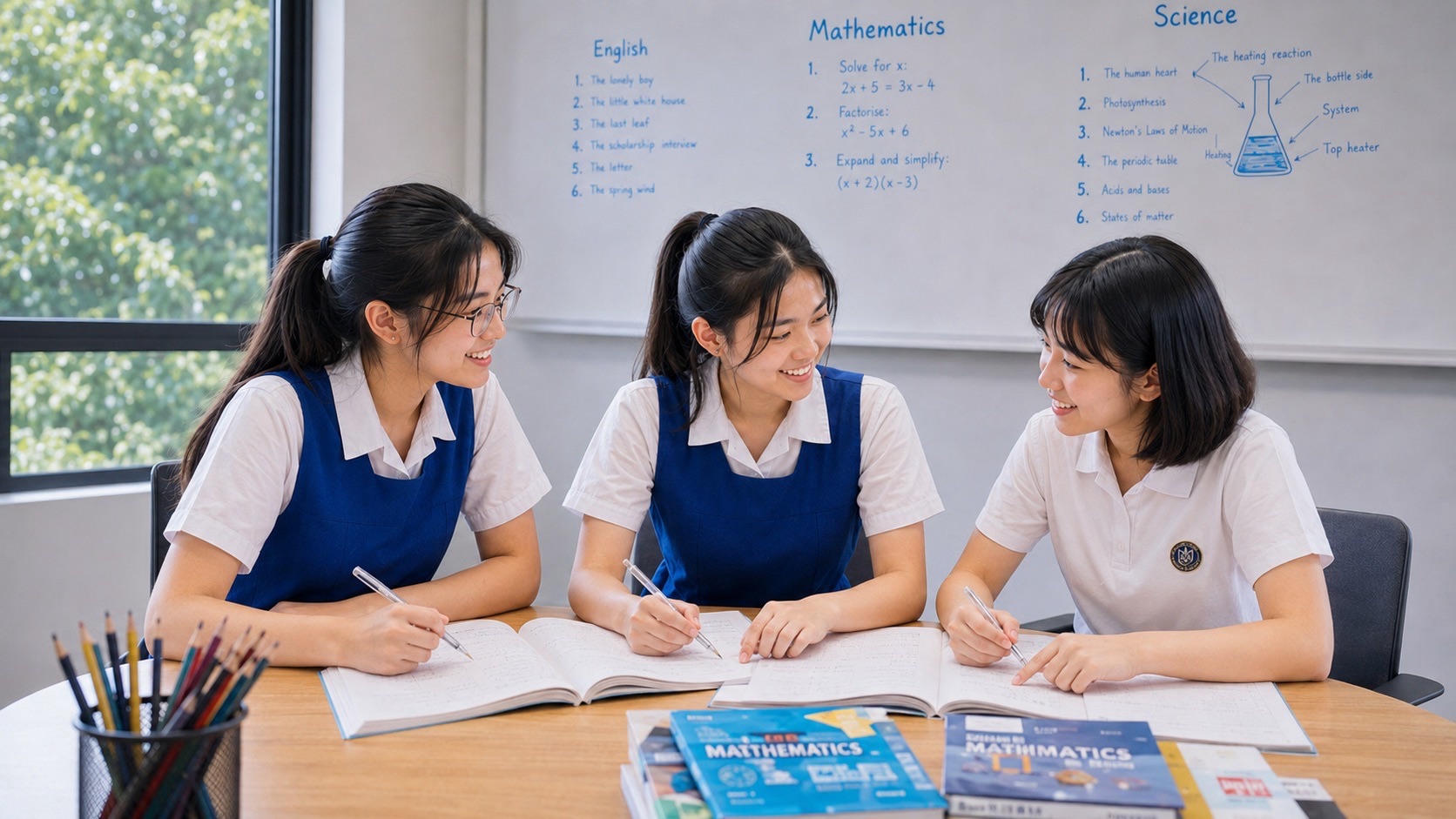
Primary 6 English discussion is useful only until the learner can carry the same language decisions alone. A three-student class can sharpen evidence selection, expose weak interpretations and improve writing judgement. But PSLE English is ultimately completed by one child, under time, without peer rescue.
This page focuses on one P6 transition: Discussion Mode → Silent Mode. The goal is not to remove collaboration too early. It is to know when collaboration has finished teaching the skill and has started masking dependence.
Discussion Mode Has a Clear Job
Discussion is valuable when students compare interpretations, explain evidence, test language choices and notice why one answer is stronger than another.
| Discussion still adds value when… | Silent mode should increase when… |
|---|---|
| question interpretation differs | the learner identifies question jobs reliably |
| evidence choices remain inconsistent | evidence selection is stable |
| writing decisions need comparison | paragraph planning survives without prompts |
| students cannot explain why an answer is weak | self-correction begins independently |
| the tutor is still diagnosing the language bottleneck | the bottleneck has shifted to timing and execution |
Private First Attempt Before Peer Talk
Every discussion should begin with an individual attempt. For comprehension, each learner identifies the question job and evidence. For writing, each learner plans before seeing another student’s approach. For oral, each learner forms an answer before hearing the group.
Discuss Decisions, Not Finished Answers
Instead of comparing whole polished responses, compare one decision at a time: Which evidence is enough? Why does this paragraph belong here? Which word is more precise? What does the question actually require?
Silent Mode Is the Ownership Test
After discussion, remove the social support. Use a changed passage, new writing prompt or unfamiliar oral stimulus. If the same method survives, the skill is becoming owned.
- no peer answer first;
- no tutor strategy label;
- no model response visible;
- normal time pressure;
- independent checking at the end.
Paper 1: Writing
Discussion can help students compare topic angles, audience decisions and paragraph architecture. Silent mode should increase when the learner can generate, organise and revise without waiting for another child’s idea.
Paper 2: Language Use and Comprehension
Peer comparison is useful for evidence boundaries and near-miss answers. But by the final PSLE runway, the learner should identify grammar, vocabulary and comprehension demands independently and manage uncertainty without group confirmation.
Listening and Oral
Listening is inherently individual during the examination. Oral preparation can include discussion, but the student must eventually retrieve ideas, organise them and respond to follow-up questions without rehearsed peer content.
Use Three Modes, Not One
| Mode | Purpose |
|---|---|
| Discuss | expose interpretations and repair judgement |
| Silent Retest | prove independent transfer |
| Timed Simulation | test whole-paper execution |
Current 2026 PSLE English Context
The 2026 PSLE English examination includes Writing, Language Use and Comprehension, Listening Comprehension and Oral Communication. Paper 1 is 1 hour 10 minutes, Paper 2 is 1 hour 50 minutes, with Listening and Oral assessed separately. The assessment remains aligned with MOE’s emphasis on effective language use for different purposes, audiences and contexts.
Families can review the SEAB 2026 PSLE formats and the MOE English Language Syllabus 2020.
The Exit Test
- Can the learner begin without hearing a peer?
- Can the method survive a new text or prompt?
- Can the student self-correct before tutor feedback?
- Can timing increase without answer quality collapsing?
- Can the learner explain why a discarded answer is weaker?
The Goal Is Independent Language Control
A small group should make thinking visible, not make thinking communal forever. Use discussion to sharpen judgement. Then fade it. Before PSLE, the student should be able to make the same language decisions when the other two chairs are quiet.


