
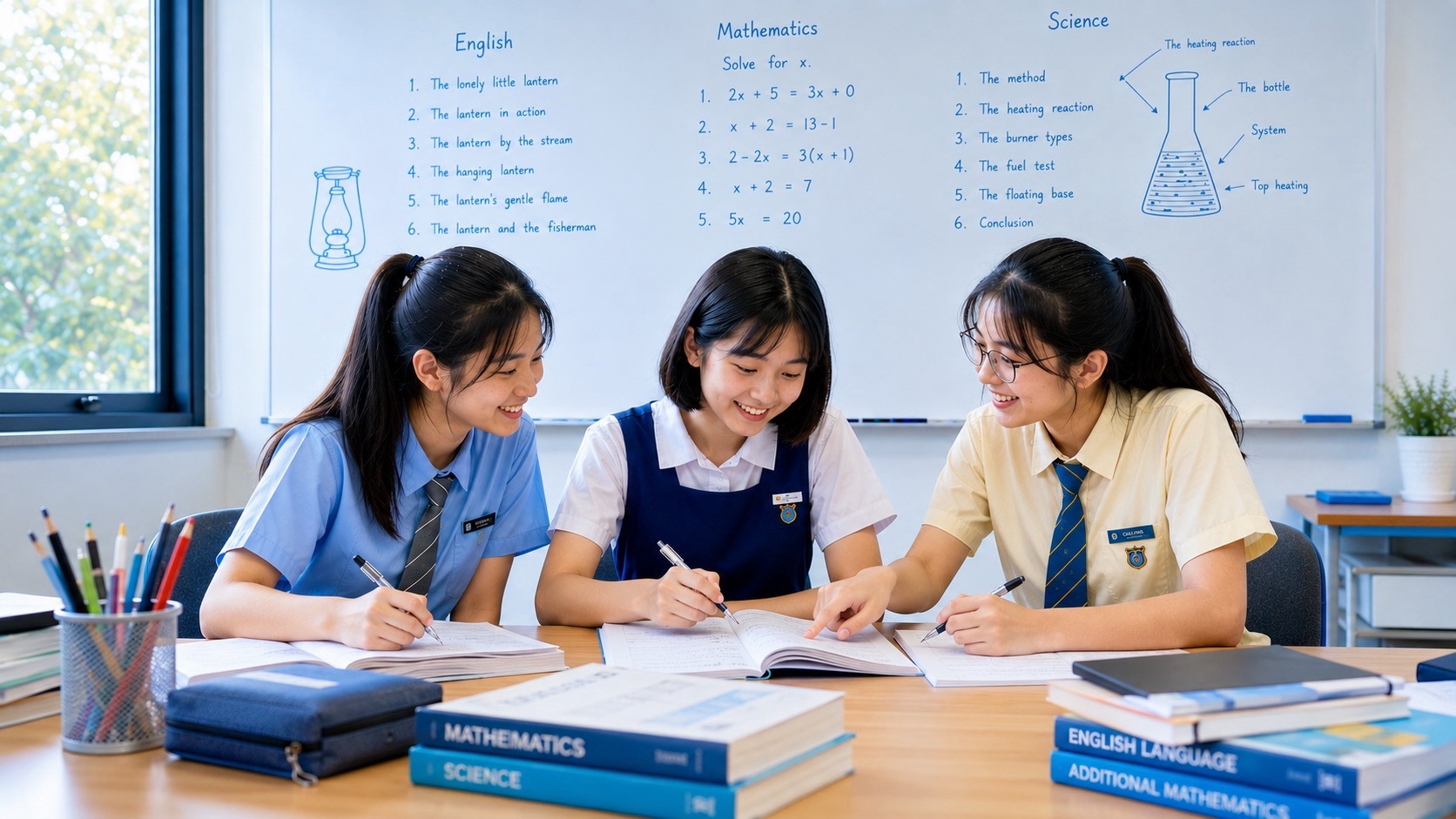
Primary 3 Science becomes more powerful when three students can look at the same evidence and produce three different explanations before anyone is told the answer. The point of a small group is not simply that there are fewer students. It is that each child’s scientific thinking becomes visible enough to compare, challenge and retest.
This page has one job: show how a 3-pax Primary 3 Science lesson can use One Observation → Three Hypotheses → Independent Prediction → Evidence Check to build inquiry without turning peer discussion into copying.
For current programme information, continue to Punggol Primary Science Tuition P3–P6. eduKatePunggol’s current model is up to three students, typically for 1.5 hours.
The direct answer: small-group Science is useful when thinking stays individual first
Three students can create more useful contrast than one tutor repeatedly explaining the same concept. But the order matters. If the most confident child speaks first, the other two may simply adopt that explanation. A high-resolution small-group routine therefore begins with independent observation and prediction before discussion.
- same object or diagram;
- three private observations;
- three possible explanations;
- three predictions;
- shared evidence check;
- fresh individual retest.
The class becomes a small scientific comparison space rather than one shared answer sheet.
Step 1: one observation
Begin with something concrete: a plant, material, magnet, life-cycle image, simple system, photograph or age-appropriate experiment. Ask every student to write what is directly observed.
- What can you see?
- What is different?
- What changed?
- What stayed the same?
- What can be counted or measured?
- What cannot be known from the evidence yet?
This separates observation from explanation. “The leaf is yellow” is an observation. “It is yellow because it lacks a nutrient” is already an inference that needs support.
Step 2: three hypotheses
At Primary 3, “hypothesis” does not need to become heavy terminology. The child can simply ask, “What might explain this?”
Three students may generate three possibilities:
- Student A thinks the amount of light matters.
- Student B thinks the amount of water matters.
- Student C thinks the type of plant matters.
The value is not that all three ideas are equally likely. The value is that the tutor can now see which causal models the children are using.
The tutor should not vote for the “best” idea too early
If the tutor immediately announces which hypothesis is correct, the inquiry collapses back into answer delivery. Instead, ask what evidence would help distinguish the possibilities.
- If light matters, what should we change?
- If water matters, what should stay the same?
- If plant type matters, what comparison would be fair?
- What result would support each idea?
The children begin learning that an explanation earns strength from evidence, not from confidence.
Step 3: independent prediction
Before the demonstration or result is revealed, every student records a prediction privately.
I predict ___ because ___.
The reason matters more than whether the prediction is correct. A wrong prediction with a coherent reason gives the tutor something useful to repair. A correct prediction with no reason may be a guess.
Step 4: evidence check
Once the result is available, the class compares evidence with the three predictions.
- Which prediction is supported?
- Which prediction is weakened?
- What remains uncertain?
- Was the comparison fair?
- Could another factor still explain the result?
This prevents the child from treating one result as proof of everything.
A simple worked example: which material absorbs more water?
Three students observe pieces of different materials after exposure to water.
- Student A predicts the thickest material absorbs the most.
- Student B predicts the material with visible pores absorbs the most.
- Student C predicts all three absorb the same amount.
The tutor now asks how absorption should actually be measured. “Looks wetter” may be too subjective. The group must decide what evidence would make the comparison more dependable.
The scientific learning is therefore larger than the material fact. Students learn how observation becomes a claim and how a claim needs evidence.
Why three students can be better than one shared discussion
The educational advantage comes from contrast with accountability.
- three observations expose what each learner notices;
- three explanations expose different mental models;
- three predictions create testable disagreement;
- peer discussion reveals alternative reasoning;
- individual retesting prevents borrowed understanding.
If all three simply complete one answer together, the small-group advantage is largely lost.
Peer disagreement should remain evidence-based
Students should learn to disagree with a claim without attacking the person.
- “I think the evidence supports…”
- “This condition is different…”
- “That explanation does not account for…”
- “What result would change your mind?”
This is an early form of scientific argumentation: claims are compared by evidence and explanatory strength.
Do not confuse variety with randomness
Three hypotheses are useful only if they are plausible enough to be examined. The tutor can reject ideas that do not match the evidence while still respecting the attempt.
A useful response is: “That is possible in another situation, but what in this setup supports it?”
The independent return is compulsory
After group discussion, each student receives a fresh task alone.
- new object, same observation skill;
- new setup, same prediction structure;
- new diagram, same evidence question;
- new classification, same need for a defensible criterion.
The tutor is checking whether the reasoning returned to the individual learner after the social discussion.
What a P3 tutor should watch
- Who observes before guessing?
- Who copies another student’s wording?
- Who changes a prediction when evidence changes?
- Who treats every first idea as certain?
- Who can say what remains unknown?
- Who needs the tutor to name the concept?
These observations create a more useful learning map than “participated well”.
How this aligns with current Primary Science
MOE’s current Primary Science syllabus is built around scientific knowledge, practices and values, with the vision to Inspire, Inquire and Innovate. It emphasises asking questions, using evidence, communicating reasoning and applying core ideas rather than treating Science as a fact list.
Official reference: MOE Primary Science Teaching and Learning Syllabus.
When small-group P3 Science tuition may help
- the child guesses before observing;
- scientific vocabulary is copied without meaning;
- the learner rarely explains why;
- peer answers are followed automatically;
- the student is curious but questions remain broad and untestable;
- schoolwork shows repeated observation/inference confusion.
If the child is already learning independently and school feedback is being used effectively, additional tuition may not be necessary simply because Primary 3 is the first Science year.
Progress receipts
- observations become more precise;
- students propose explanations rather than wait for one;
- predictions include reasons;
- evidence changes the learner’s model;
- peer disagreement becomes scientific rather than personal;
- fresh individual retests improve.
One observation. Three minds. Then back to one learner.
The best reason to use a small group is not that three children can hear one explanation together. It is that three different models become visible, can be compared against evidence, and can then be returned to each student for independent reconstruction.
That is the learning loop this rebuilt page now owns: One Observation → Three Hypotheses → Independent Prediction → Evidence Check → Individual Transfer.
Browse the Primary 3 Science Article Index for related year-level guides.


