
Primary 5 Science becomes difficult when every new chapter quietly pushes the previous chapter out of reach. The student may understand water in March, electrical systems in June and human systems in August, yet struggle when a mixed paper asks for all three.
This page has one job: explain how Punggol Primary 5 Science classes can keep knowledge usable through retrieve → connect → apply → revisit.
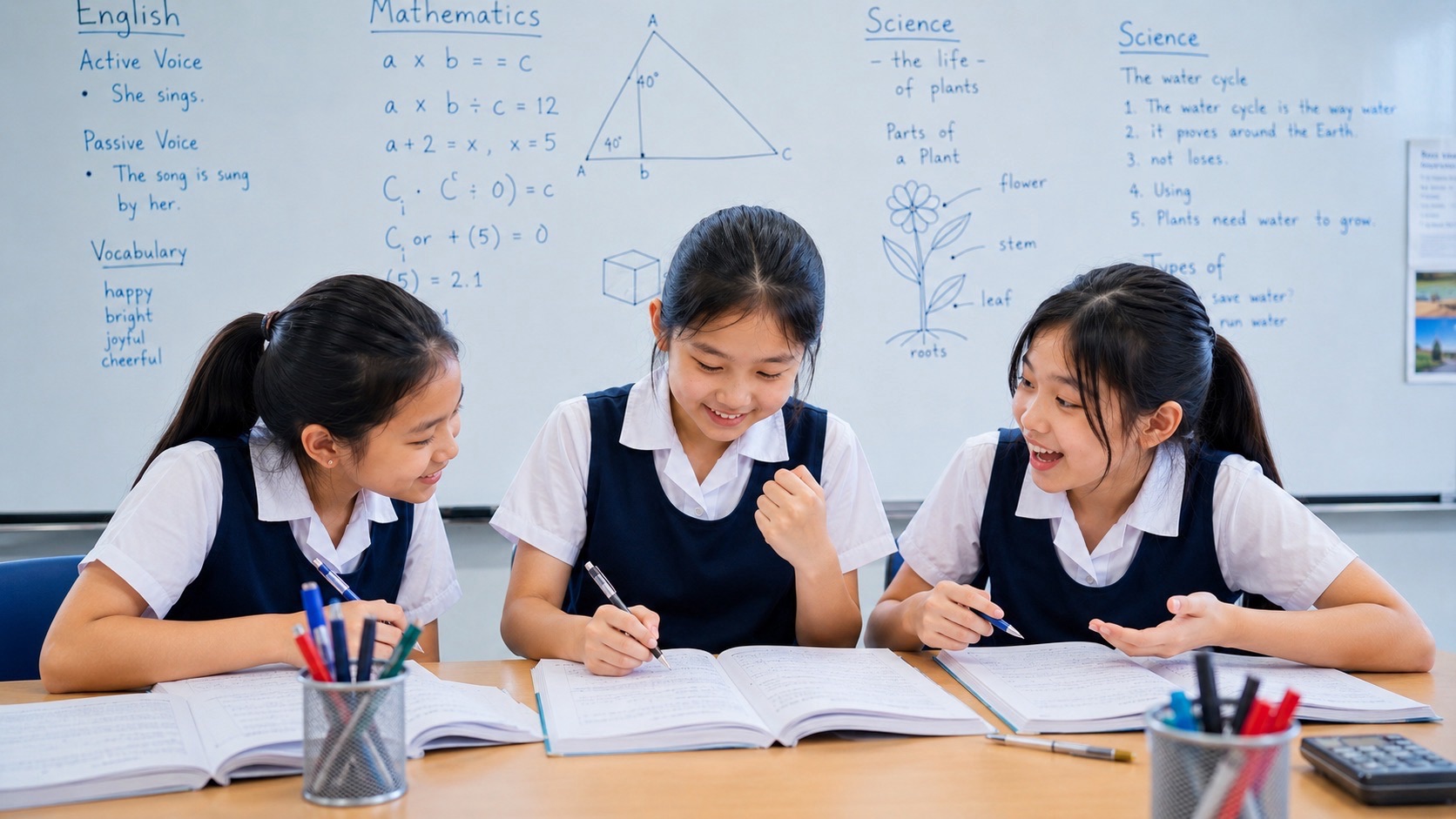
At eduKatePunggol, Primary Science is taught in groups of up to three students. The small group allows the tutor to see whether a forgotten answer reflects weak understanding, weak retrieval, confused connections or difficulty selecting the idea in a mixed question.
Current timetable and programme information should be checked through the live pages rather than historical details attached to this 2019 URL.
The One-Sentence Answer
A useful Primary 5 Science class retrieves older concepts without notes, connects them to current learning, applies them in changed questions and revisits them after enough time has passed to test real retention.
Understanding Once Is Not the Same as Remembering Later
A student can follow an explanation and complete the worksheet while the concept is active in working memory. That success matters, but it does not yet show that the idea will be available in a later assessment.
Retrieval asks the learner to reconstruct the idea before looking at the notes. The effort makes the current state visible and strengthens access when the concept is revisited properly.
Retrieve: Start With a Small Recall Job
- draw a simple system from memory;
- state the relationship between two processes;
- label one diagram;
- explain one earlier misconception;
- read a short table using an older concept; or
- answer one open-ended question before opening the notes.
The retrieval should be short enough to use regularly. Its purpose is not to recreate a full examination every lesson.
Connect: Give the Old Idea a New Neighbour
Knowledge becomes easier to retrieve when it belongs to a network of relationships. Heat connects to evaporation and condensation. Plant parts connect to transport and reproduction. Respiration connects to circulation and activity. Conductors connect to complete circuits and component behaviour.
The student should state how the ideas connect, not merely place two chapter names beside each other.
Apply: Use the Retrieved Idea in a Changed Question
Retrieving a definition is useful. Applying it provides stronger evidence. We change the representation, object or context while preserving the scientific relationship. The learner must decide how the recalled concept helps solve the new task.
This prevents retrieval practice from becoming another form of flashcard familiarity detached from real questions.
Revisit: Return After Other Learning Has Intervened
A delayed return is more informative than immediate repetition. When several days or topics have passed, the student must reconstruct the route again. If retrieval fails, the tutor can decide whether a brief cue is enough or whether the concept needs rebuilding.
Spacing and Interleaving Do Different Jobs
Spacing returns to learning after time. Interleaving mixes different topics or question types so the student must choose which method applies. Both are useful, but they should not be confused.
A concept should become reasonably stable before heavy mixing. Otherwise every wrong choice may come from missing knowledge rather than weak selection.
Worked Example: Water Returns During Heat
While studying a current heat question, the class retrieves earlier states-of-matter knowledge. Students identify the starting state, heating or cooling condition and resulting change. The old concept now serves the new explanation.
Worked Example: Plant Parts Return During Systems
When plant transport is taught, the learner retrieves the functions of roots, stems and leaves. The class then connects those functions into a system and applies the model when one part or condition changes.
Worked Example: Measurement Returns During Investigation
An investigation question requires a reliable measured outcome. The student revisits scale reading, units and clear recording before interpreting the result. An earlier P4 skill becomes part of P5 inquiry.
Why Rereading Can Feel Better Than It Works
Rereading makes the page familiar. Familiarity can be mistaken for availability. When the notes close, the student may still be unable to reconstruct the concept.
We use rereading strategically after an attempted retrieval, not as the only revision method. The learner first discovers what is missing, then reviews with a purpose.
Common Retention Failures
- understanding a lesson but never retrieving it later;
- rereading notes without attempting recall;
- revising only the current chapter;
- mixing too many unstable topics too early;
- memorising keywords without relationships;
- retrieving facts but never applying them; and
- assuming a successful chapter test means permanent mastery.
Diagnose Why the Concept Was Not Available
- Encoding problem: the concept was never understood clearly.
- Retrieval problem: the idea is understood but difficult to access.
- Connection problem: the fact remains isolated.
- Selection problem: the learner recalls several ideas but chooses the wrong one.
- Representation problem: the concept is available only in one format.
- Interference problem: similar terms or processes are confused.
- Transfer problem: recall does not become usable performance.
Why Three Students Help With Retrieval
Each student retrieves independently before discussion. The class can then compare what was remembered, where the routes diverged and which explanation best preserves the relationship. Peer recall should not occur before individual effort, or one learner may cue the others too strongly.
The tutor can also give different return questions according to each student’s history of forgotten or confused concepts.
A Cumulative Weekly Structure
- Current topic: teach the main school-aligned concept.
- Near return: retrieve something from the previous lesson.
- Far return: retrieve an older concept connected to the current work.
- Application: use one retrieved idea in a changed question.
- Mixed selection: include a small number of questions where the method is not named.
- Record: note which concept needs another return.
What Parents Can Ask
- What older concept returned this week?
- Could you explain it before opening the notes?
- What current topic connects to it?
- Can you use it in a different question?
- Which similar concepts do you confuse?
- When will this idea return again?
- Did the same knowledge appear in school work?
When Primary 5 Science Tuition May Help
Additional support may be useful when the child repeatedly relearns old chapters, performs well topically but poorly in mixed work, or needs a more deliberate system for retrieval and connection before Primary 6.
Tuition may be less necessary when the learner already maintains older knowledge through independent retrieval and applies it flexibly across school tasks.
Progress Receipts
- older concepts are recalled with fewer cues;
- similar processes are confused less often;
- the student explains cross-topic relationships;
- mixed questions become easier to classify;
- retrieved knowledge appears in fresh applications;
- revision depends less on rereading alone; and
- the learner enters the PSLE year with a more connected knowledge base.
Related eduKatePunggol Science Guides
- Primary 5 Concept → Connection → Application → Retest
- Primary 5 Systems Thinking
- Primary 5 Fair Investigations
- Current Punggol Primary Science Overview
Retrieve → Connect → Apply → Revisit
Retention improves when old knowledge is asked to work again. Retrieve before rereading. Connect the idea to its neighbours. Apply it in a changed question. Revisit it after time has passed. Then let mixed practice test whether the student can select it independently.


Punggol Primary 5 Science Classes | Retrieve → Connect → Apply → Revisit is built for the point where Science stops behaving like a row of separate chapters. By Primary 5, students may understand each topic when it is fresh and still struggle when a mixed paper asks them to choose the right concept without a chapter heading. The class therefore needs to keep old knowledge accessible and connected.
For families looking for Primary 5 Science classes in Punggol, the working architecture is Retrieve → Connect → Apply → Mix → Revisit. Retrieval brings the knowledge back without notes. Connection shows how concepts relate. Application changes the surface. Mixed practice removes chapter cues. Revisit checks whether the repaired model still works after time.

Why Primary 5 Needs More Than Topic Completion
A student can finish a chapter and still be unprepared for mixed Science. Completion tells us that the material was taught. It does not tell us whether the concept can be retrieved after a month, recognised inside an unfamiliar diagram or selected when several plausible topics are present.
This is why the weekly class should treat memory, connection and selection as part of Science learning rather than as final-exam extras.
Retrieve: Can the Concept Be Produced Without Notes?
Retrieval can be short: explain one mechanism, interpret one graph region, identify one controlled variable or classify one piece of evidence. The key is that the learner starts from memory. If notes are opened first, familiarity can hide what is missing.
The tutor does not need to turn every class into a quiz. Retrieval is a small recurring pulse that keeps earlier concepts alive.
Connect: Link the Concept to the System Around It
Primary 5 becomes easier when students see shared structures across topics. Heat, transport, forces, circuits, plant systems and data questions all involve conditions, mechanisms and outcomes. Graphs and tables both encode variable relationships. Material properties become useful through function and constraints.
Connections reduce memory load because the learner stores relationships rather than isolated facts. The tutor can ask: “What is the same reasoning job here, even though the topic looks different?”
Apply: Change the Surface
Application means using the concept in a question that does not look identical to the example. A mechanism first shown in a paragraph may later appear in a diagram or graph. A property first learned with a familiar material may be tested on an unfamiliar object.
A fresh surface is the quickest way to see whether understanding is flexible.
Mix: Remove the Chapter Cue
Mixed questions force selection. The learner cannot rely on the worksheet heading to tell them which concept to use. This is a major shift in upper-Primary readiness. Strong students recognise the relationship before they name the chapter.
Mixing should begin only after individual concepts are stable enough. Mixing unstable knowledge can produce confusion rather than flexibility.
Revisit: Test Durability
A repair is not complete because the child succeeds immediately. The class should revisit the mechanism after a delay and in a different context. Stable learning survives both time and surface change.
A Deep Retrieve–Connect–Apply Library
Evaporation
Retrieve: Retrieve factors affecting rate. Connect: Connect to surface area and moving air. Apply: Apply to unfamiliar container setup. Revisit: Revisit in graph/table. The purpose is to make one scientific relationship usable across time and representation rather than leave it attached to the chapter in which it was first taught.
The tutor can increase or reduce difficulty at each stage. If retrieval fails, repair before mixing. If retrieval is strong but application fails, change the surface and work on transfer. The sequence gives the class a diagnostic map as well as a learning rhythm.
Heat transfer
Retrieve: Retrieve conductor/insulator roles. Connect: Connect to material suitability. Apply: Apply to pan body vs handle. Revisit: Revisit in changed material question. The purpose is to make one scientific relationship usable across time and representation rather than leave it attached to the chapter in which it was first taught.
The tutor can increase or reduce difficulty at each stage. If retrieval fails, repair before mixing. If retrieval is strong but application fails, change the surface and work on transfer. The sequence gives the class a diagnostic map as well as a learning rhythm.
Circuits
Retrieve: Retrieve complete-path model. Connect: Connect to switch/component function. Apply: Apply to redrawn circuit. Revisit: Revisit in mixed PSLE-style item. The purpose is to make one scientific relationship usable across time and representation rather than leave it attached to the chapter in which it was first taught.
The tutor can increase or reduce difficulty at each stage. If retrieval fails, repair before mixing. If retrieval is strong but application fails, change the surface and work on transfer. The sequence gives the class a diagnostic map as well as a learning rhythm.
Forces
Retrieve: Retrieve direction and effect. Connect: Connect to friction and motion. Apply: Apply to new surface. Revisit: Revisit under timing. The purpose is to make one scientific relationship usable across time and representation rather than leave it attached to the chapter in which it was first taught.
The tutor can increase or reduce difficulty at each stage. If retrieval fails, repair before mixing. If retrieval is strong but application fails, change the surface and work on transfer. The sequence gives the class a diagnostic map as well as a learning rhythm.
Plant water uptake
Retrieve: Retrieve root function. Connect: Connect to transport pathway. Apply: Apply to damaged-root scenario. Revisit: Revisit in changed condition. The purpose is to make one scientific relationship usable across time and representation rather than leave it attached to the chapter in which it was first taught.
The tutor can increase or reduce difficulty at each stage. If retrieval fails, repair before mixing. If retrieval is strong but application fails, change the surface and work on transfer. The sequence gives the class a diagnostic map as well as a learning rhythm.
Plant light condition
Retrieve: Retrieve photosynthesis-related role. Connect: Connect to growth data. Apply: Apply to graph. Revisit: Revisit with alternate light direction. The purpose is to make one scientific relationship usable across time and representation rather than leave it attached to the chapter in which it was first taught.
The tutor can increase or reduce difficulty at each stage. If retrieval fails, repair before mixing. If retrieval is strong but application fails, change the surface and work on transfer. The sequence gives the class a diagnostic map as well as a learning rhythm.
Food chains
Retrieve: Retrieve feeding link. Connect: Connect to population change. Apply: Apply to changed prey/predator condition. Revisit: Revisit with competing explanation. The purpose is to make one scientific relationship usable across time and representation rather than leave it attached to the chapter in which it was first taught.
The tutor can increase or reduce difficulty at each stage. If retrieval fails, repair before mixing. If retrieval is strong but application fails, change the surface and work on transfer. The sequence gives the class a diagnostic map as well as a learning rhythm.
Material absorbency
Retrieve: Retrieve property meaning. Connect: Connect to towel function. Apply: Apply to unfamiliar material. Revisit: Revisit with misaligned test. The purpose is to make one scientific relationship usable across time and representation rather than leave it attached to the chapter in which it was first taught.
The tutor can increase or reduce difficulty at each stage. If retrieval fails, repair before mixing. If retrieval is strong but application fails, change the surface and work on transfer. The sequence gives the class a diagnostic map as well as a learning rhythm.
Water resistance
Retrieve: Retrieve test evidence. Connect: Connect to rain-cover function. Apply: Apply to container. Revisit: Revisit with claim boundary. The purpose is to make one scientific relationship usable across time and representation rather than leave it attached to the chapter in which it was first taught.
The tutor can increase or reduce difficulty at each stage. If retrieval fails, repair before mixing. If retrieval is strong but application fails, change the surface and work on transfer. The sequence gives the class a diagnostic map as well as a learning rhythm.
Transparency
Retrieve: Retrieve light transmission. Connect: Connect to window function. Apply: Apply to frosted/opaque comparison. Revisit: Revisit in diagram. The purpose is to make one scientific relationship usable across time and representation rather than leave it attached to the chapter in which it was first taught.
The tutor can increase or reduce difficulty at each stage. If retrieval fails, repair before mixing. If retrieval is strong but application fails, change the surface and work on transfer. The sequence gives the class a diagnostic map as well as a learning rhythm.
Elasticity
Retrieve: Retrieve stretch-and-return. Connect: Connect to force/deformation. Apply: Apply to unknown material. Revisit: Revisit with over-stretch boundary. The purpose is to make one scientific relationship usable across time and representation rather than leave it attached to the chapter in which it was first taught.
The tutor can increase or reduce difficulty at each stage. If retrieval fails, repair before mixing. If retrieval is strong but application fails, change the surface and work on transfer. The sequence gives the class a diagnostic map as well as a learning rhythm.
Sound and vibration
Retrieve: Retrieve causal relation. Connect: Connect to source behaviour. Apply: Apply to different vibrating object. Revisit: Revisit with stop-vibration question. The purpose is to make one scientific relationship usable across time and representation rather than leave it attached to the chapter in which it was first taught.
The tutor can increase or reduce difficulty at each stage. If retrieval fails, repair before mixing. If retrieval is strong but application fails, change the surface and work on transfer. The sequence gives the class a diagnostic map as well as a learning rhythm.
Dissolving
Retrieve: Retrieve visibility vs existence. Connect: Connect to separation/recovery. Apply: Apply to new solute. Revisit: Revisit with changed temperature. The purpose is to make one scientific relationship usable across time and representation rather than leave it attached to the chapter in which it was first taught.
The tutor can increase or reduce difficulty at each stage. If retrieval fails, repair before mixing. If retrieval is strong but application fails, change the surface and work on transfer. The sequence gives the class a diagnostic map as well as a learning rhythm.
Filtration
Retrieve: Retrieve property-based separation. Connect: Connect to mixture components. Apply: Apply to new mixture. Revisit: Revisit with method critique. The purpose is to make one scientific relationship usable across time and representation rather than leave it attached to the chapter in which it was first taught.
The tutor can increase or reduce difficulty at each stage. If retrieval fails, repair before mixing. If retrieval is strong but application fails, change the surface and work on transfer. The sequence gives the class a diagnostic map as well as a learning rhythm.
Graph rising trend
Retrieve: Retrieve axis/units. Connect: Connect to variable relation. Apply: Apply to unfamiliar science context. Revisit: Revisit with plateau. The purpose is to make one scientific relationship usable across time and representation rather than leave it attached to the chapter in which it was first taught.
The tutor can increase or reduce difficulty at each stage. If retrieval fails, repair before mixing. If retrieval is strong but application fails, change the surface and work on transfer. The sequence gives the class a diagnostic map as well as a learning rhythm.
Graph plateau
Retrieve: Retrieve phase change. Connect: Connect to limiting condition. Apply: Apply to table equivalent. Revisit: Revisit with instrument-limit alternative. The purpose is to make one scientific relationship usable across time and representation rather than leave it attached to the chapter in which it was first taught.
The tutor can increase or reduce difficulty at each stage. If retrieval fails, repair before mixing. If retrieval is strong but application fails, change the surface and work on transfer. The sequence gives the class a diagnostic map as well as a learning rhythm.
Outlier
Retrieve: Retrieve anomaly handling. Connect: Connect to repeat/reliability. Apply: Apply to new data set. Revisit: Revisit with repeated outlier. The purpose is to make one scientific relationship usable across time and representation rather than leave it attached to the chapter in which it was first taught.
The tutor can increase or reduce difficulty at each stage. If retrieval fails, repair before mixing. If retrieval is strong but application fails, change the surface and work on transfer. The sequence gives the class a diagnostic map as well as a learning rhythm.
Controlled variable
Retrieve: Retrieve causal role. Connect: Connect to fair test. Apply: Apply to plant/material investigation. Revisit: Revisit with background-vs-control. The purpose is to make one scientific relationship usable across time and representation rather than leave it attached to the chapter in which it was first taught.
The tutor can increase or reduce difficulty at each stage. If retrieval fails, repair before mixing. If retrieval is strong but application fails, change the surface and work on transfer. The sequence gives the class a diagnostic map as well as a learning rhythm.
Changed variable
Retrieve: Retrieve deliberate factor. Connect: Connect to outcome. Apply: Apply to unfamiliar experiment. Revisit: Revisit in method evaluation. The purpose is to make one scientific relationship usable across time and representation rather than leave it attached to the chapter in which it was first taught.
The tutor can increase or reduce difficulty at each stage. If retrieval fails, repair before mixing. If retrieval is strong but application fails, change the surface and work on transfer. The sequence gives the class a diagnostic map as well as a learning rhythm.
Measured variable
Retrieve: Retrieve observed outcome. Connect: Connect to instrument/data. Apply: Apply to table. Revisit: Revisit in graph. The purpose is to make one scientific relationship usable across time and representation rather than leave it attached to the chapter in which it was first taught.
The tutor can increase or reduce difficulty at each stage. If retrieval fails, repair before mixing. If retrieval is strong but application fails, change the surface and work on transfer. The sequence gives the class a diagnostic map as well as a learning rhythm.
Observation vs inference
Retrieve: Retrieve distinction. Connect: Connect to claim strength. Apply: Apply to data point. Revisit: Revisit in open-ended answer. The purpose is to make one scientific relationship usable across time and representation rather than leave it attached to the chapter in which it was first taught.
The tutor can increase or reduce difficulty at each stage. If retrieval fails, repair before mixing. If retrieval is strong but application fails, change the surface and work on transfer. The sequence gives the class a diagnostic map as well as a learning rhythm.
Mechanism chain
Retrieve: Retrieve condition→process→effect. Connect: Connect across topics. Apply: Apply to heat/circuit/plant cases. Revisit: Revisit with keywords removed. The purpose is to make one scientific relationship usable across time and representation rather than leave it attached to the chapter in which it was first taught.
The tutor can increase or reduce difficulty at each stage. If retrieval fails, repair before mixing. If retrieval is strong but application fails, change the surface and work on transfer. The sequence gives the class a diagnostic map as well as a learning rhythm.
Property→function
Retrieve: Retrieve material property. Connect: Connect to design constraint. Apply: Apply to unfamiliar object. Revisit: Revisit with function changed. The purpose is to make one scientific relationship usable across time and representation rather than leave it attached to the chapter in which it was first taught.
The tutor can increase or reduce difficulty at each stage. If retrieval fails, repair before mixing. If retrieval is strong but application fails, change the surface and work on transfer. The sequence gives the class a diagnostic map as well as a learning rhythm.
Diagram literacy
Retrieve: Retrieve labels/arrows. Connect: Connect to model boundaries. Apply: Apply to redrawn system. Revisit: Revisit in mixed visual. The purpose is to make one scientific relationship usable across time and representation rather than leave it attached to the chapter in which it was first taught.
The tutor can increase or reduce difficulty at each stage. If retrieval fails, repair before mixing. If retrieval is strong but application fails, change the surface and work on transfer. The sequence gives the class a diagnostic map as well as a learning rhythm.
Table reading
Retrieve: Retrieve variables/units. Connect: Connect to trend. Apply: Apply to exception. Revisit: Revisit with changed units. The purpose is to make one scientific relationship usable across time and representation rather than leave it attached to the chapter in which it was first taught.
The tutor can increase or reduce difficulty at each stage. If retrieval fails, repair before mixing. If retrieval is strong but application fails, change the surface and work on transfer. The sequence gives the class a diagnostic map as well as a learning rhythm.
Classification
Retrieve: Retrieve criterion. Connect: Connect to property evidence. Apply: Apply to boundary case. Revisit: Revisit with new criterion. The purpose is to make one scientific relationship usable across time and representation rather than leave it attached to the chapter in which it was first taught.
The tutor can increase or reduce difficulty at each stage. If retrieval fails, repair before mixing. If retrieval is strong but application fails, change the surface and work on transfer. The sequence gives the class a diagnostic map as well as a learning rhythm.
Measurement
Retrieve: Retrieve scale/unit. Connect: Connect to comparison. Apply: Apply to new instrument. Revisit: Revisit under time. The purpose is to make one scientific relationship usable across time and representation rather than leave it attached to the chapter in which it was first taught.
The tutor can increase or reduce difficulty at each stage. If retrieval fails, repair before mixing. If retrieval is strong but application fails, change the surface and work on transfer. The sequence gives the class a diagnostic map as well as a learning rhythm.
State vs process
Retrieve: Retrieve role distinction. Connect: Connect to causal sequence. Apply: Apply across heat/circuits. Revisit: Revisit with changed wording. The purpose is to make one scientific relationship usable across time and representation rather than leave it attached to the chapter in which it was first taught.
The tutor can increase or reduce difficulty at each stage. If retrieval fails, repair before mixing. If retrieval is strong but application fails, change the surface and work on transfer. The sequence gives the class a diagnostic map as well as a learning rhythm.
Prediction before MCQ
Retrieve: Retrieve model first. Connect: Connect to distractor resistance. Apply: Apply to new options. Revisit: Revisit in timed set. The purpose is to make one scientific relationship usable across time and representation rather than leave it attached to the chapter in which it was first taught.
The tutor can increase or reduce difficulty at each stage. If retrieval fails, repair before mixing. If retrieval is strong but application fails, change the surface and work on transfer. The sequence gives the class a diagnostic map as well as a learning rhythm.
Teach-back
Retrieve: Retrieve without tutor wording. Connect: Connect to mechanism. Apply: Apply to changed condition. Revisit: Revisit after delay. The purpose is to make one scientific relationship usable across time and representation rather than leave it attached to the chapter in which it was first taught.
The tutor can increase or reduce difficulty at each stage. If retrieval fails, repair before mixing. If retrieval is strong but application fails, change the surface and work on transfer. The sequence gives the class a diagnostic map as well as a learning rhythm.
Weak vocabulary
Retrieve: Retrieve ordinary meaning. Connect: Connect precise term. Apply: Apply in written answer. Revisit: Revisit without word bank. The purpose is to make one scientific relationship usable across time and representation rather than leave it attached to the chapter in which it was first taught.
The tutor can increase or reduce difficulty at each stage. If retrieval fails, repair before mixing. If retrieval is strong but application fails, change the surface and work on transfer. The sequence gives the class a diagnostic map as well as a learning rhythm.
Weak retention
Retrieve: Retrieve old topic weekly. Connect: Connect to current topic. Apply: Apply in mixed set. Revisit: Revisit 48h and 1 week. The purpose is to make one scientific relationship usable across time and representation rather than leave it attached to the chapter in which it was first taught.
The tutor can increase or reduce difficulty at each stage. If retrieval fails, repair before mixing. If retrieval is strong but application fails, change the surface and work on transfer. The sequence gives the class a diagnostic map as well as a learning rhythm.
Strong but narrow student
Retrieve: Retrieve quickly. Connect: Connect to adjacent mechanisms. Apply: Apply to counterexample. Revisit: Revisit with ambiguity. The purpose is to make one scientific relationship usable across time and representation rather than leave it attached to the chapter in which it was first taught.
The tutor can increase or reduce difficulty at each stage. If retrieval fails, repair before mixing. If retrieval is strong but application fails, change the surface and work on transfer. The sequence gives the class a diagnostic map as well as a learning rhythm.
Repeated misconception
Retrieve: Retrieve original model. Connect: Connect to counterevidence. Apply: Apply corrected mechanism. Revisit: Revisit without prompt. The purpose is to make one scientific relationship usable across time and representation rather than leave it attached to the chapter in which it was first taught.
The tutor can increase or reduce difficulty at each stage. If retrieval fails, repair before mixing. If retrieval is strong but application fails, change the surface and work on transfer. The sequence gives the class a diagnostic map as well as a learning rhythm.
School test error
Retrieve: Retrieve the exact failed skill. Connect: Connect to underlying mechanism. Apply: Apply simplified then school-level. Revisit: Revisit on fresh surface. The purpose is to make one scientific relationship usable across time and representation rather than leave it attached to the chapter in which it was first taught.
The tutor can increase or reduce difficulty at each stage. If retrieval fails, repair before mixing. If retrieval is strong but application fails, change the surface and work on transfer. The sequence gives the class a diagnostic map as well as a learning rhythm.
One-off error
Retrieve: Retrieve lightly. Connect: Connect only if pattern appears. Apply: Apply minimal probe. Revisit: Revisit only if needed. The purpose is to make one scientific relationship usable across time and representation rather than leave it attached to the chapter in which it was first taught.
The tutor can increase or reduce difficulty at each stage. If retrieval fails, repair before mixing. If retrieval is strong but application fails, change the surface and work on transfer. The sequence gives the class a diagnostic map as well as a learning rhythm.
Mixed paper selection
Retrieve: Retrieve several concepts. Connect: Connect shared cues. Apply: Apply without chapter headings. Revisit: Revisit timed. The purpose is to make one scientific relationship usable across time and representation rather than leave it attached to the chapter in which it was first taught.
The tutor can increase or reduce difficulty at each stage. If retrieval fails, repair before mixing. If retrieval is strong but application fails, change the surface and work on transfer. The sequence gives the class a diagnostic map as well as a learning rhythm.
Over-answering
Retrieve: Retrieve command word. Connect: Connect to evidence boundary. Apply: Apply short response. Revisit: Revisit in mixed paper. The purpose is to make one scientific relationship usable across time and representation rather than leave it attached to the chapter in which it was first taught.
The tutor can increase or reduce difficulty at each stage. If retrieval fails, repair before mixing. If retrieval is strong but application fails, change the surface and work on transfer. The sequence gives the class a diagnostic map as well as a learning rhythm.
Under-answering
Retrieve: Retrieve mechanism requirement. Connect: Connect to mark/job. Apply: Apply complete sentence. Revisit: Revisit with different command. The purpose is to make one scientific relationship usable across time and representation rather than leave it attached to the chapter in which it was first taught.
The tutor can increase or reduce difficulty at each stage. If retrieval fails, repair before mixing. If retrieval is strong but application fails, change the surface and work on transfer. The sequence gives the class a diagnostic map as well as a learning rhythm.
Anxiety on unfamiliar questions
Retrieve: Retrieve known structure. Connect: Connect new surface to old model. Apply: Apply stepwise. Revisit: Revisit independently. The purpose is to make one scientific relationship usable across time and representation rather than leave it attached to the chapter in which it was first taught.
The tutor can increase or reduce difficulty at each stage. If retrieval fails, repair before mixing. If retrieval is strong but application fails, change the surface and work on transfer. The sequence gives the class a diagnostic map as well as a learning rhythm.
Final-term consolidation
Retrieve: Retrieve across all themes. Connect: Connect systems and evidence skills. Apply: Apply mixed questions. Revisit: Revisit active weaknesses only. The purpose is to make one scientific relationship usable across time and representation rather than leave it attached to the chapter in which it was first taught.
The tutor can increase or reduce difficulty at each stage. If retrieval fails, repair before mixing. If retrieval is strong but application fails, change the surface and work on transfer. The sequence gives the class a diagnostic map as well as a learning rhythm.
A P5 Class Error Map
If old topics disappear, retrieval is weak. If facts are remembered but remain isolated, connections are weak. If familiar questions are easy but new contexts fail, application is weak. If mixed papers collapse performance, selection is weak. If same-day corrections look good but return errors recur, revisit is weak.
Why 3-Pax Small Groups Help
Three learners can share the same mixed Science corridor while carrying different retrieval and transfer gaps. The tutor can ask every student for a private first attempt, compare mechanisms, then target prompts without losing the shared lesson.
Peer explanation is useful only after individual thinking is visible. Otherwise recognition can masquerade as understanding.
A Six-Week P5 Rhythm
Week one can audit retrieval. Week two connects current and older concepts. Week three changes representations. Week four introduces mixed selection. Week five revisits repaired mechanisms after delay. Week six combines mixed and lightly timed work.
The exact order can flex with school assessments. The principle remains: stable concepts move into mixed practice; unstable ones return to repair.
Frequently Asked Questions
When should mixed practice begin?
When the individual concepts are stable enough that the main challenge is selection. Mixing too early can create noise; mixing too late can leave students dependent on chapter cues.
Why does my child forget old topics so quickly?
Knowledge that is only reread may feel familiar without becoming easily retrievable. Short recurring closed-book retrieval and delayed return help keep concepts accessible.
Should tuition always follow school topics?
Current schoolwork should inform priorities, but P5 classes also need systematic return to older knowledge because mixed upper-Primary questions depend on it.
How does this prepare for P6?
Primary 6 demands coverage, repair, mixed selection and timed execution. P5 retrieve–connect–apply–revisit creates the foundation for that architecture.
The Handoff to the Wider Science System
This page keeps its original 2019 URL and title while now operating as a deeper P5 class-architecture guide inside eduKatePunggol. Related pages include Punggol Primary 5 Science Tuition | When a Graph Trend Breaks and P5 Science Tutorials Punggol | Mechanism First.
For current programme details, use Science Tuition at eduKatePunggol.
About eduKatePunggol
eduKatePunggol uses very small-group learning to keep Primary 5 Science alive across time: retrieve it, connect it, apply it, mix it and revisit it.
The objective is not to finish more chapters. It is to make the chapters continue talking to one another when the worksheet headings disappear.
Explore the Primary 5 Science Article Index for related guides.


