
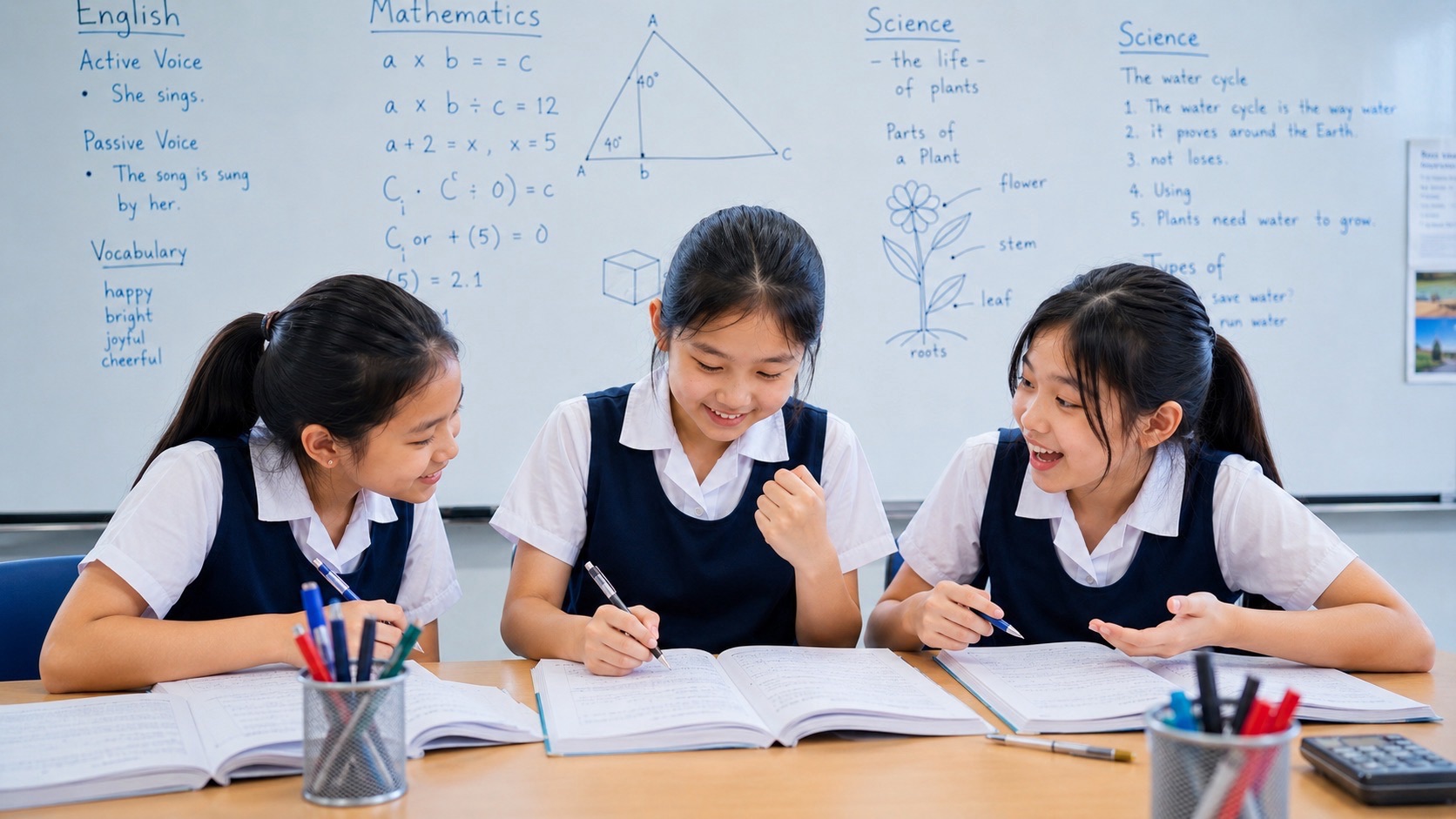
Primary 5 is where Science stops behaving like a tidy collection of separate chapters. A plant question can require knowledge of structures, transport and environmental conditions. A water question can involve heat, changes of state and evidence from an investigation. A circuit question can combine components, connections and system outcomes.
This page has one job: explain how Punggol Primary 5 Science tuition can help a learner move through concept → connection → application → retest before the PSLE year compresses the available repair time.
At eduKatePunggol, Primary Science is taught in small groups of up to three students. The small class allows one shared topic to support different next steps: one learner may need concept rebuilding, another may need representation practice, while a third is ready for unfamiliar application.
Current schedules and programme arrangements should be checked through eduKatePunggol’s live pages rather than relying on historical details attached to this 2019 URL.
The One-Sentence Answer
Good Primary 5 Science tuition should stabilise the concept, connect it to related ideas, apply it through changed representations and verify the learning with a fresh question rather than assume that a corrected worksheet proves mastery.
Why Primary 5 Can Expose Hidden Gaps
Earlier gaps do not always look serious when questions are direct. A child may remember plant parts, identify states of matter or recognise a circuit symbol. Primary 5 asks the learner to connect those pieces into systems and processes.
A weak foundation can therefore remain hidden until the student must explain what happens when one condition changes. The visible P5 mistake may have started in an earlier concept that was memorised but never integrated.
Step 1: Stabilise the Concept
The learner should be able to explain the idea in ordinary language, use the correct scientific terms, draw or interpret a simple model and retrieve the concept after the notes are closed. Recognition is not enough. The child needs a model that can be reconstructed.
If a student can only repeat the textbook sentence, application work is being built on a fragile base. The first repair is meaning.
Step 2: Connect the Concept to Its Neighbours
Science knowledge becomes more usable when the learner knows what the concept connects to. Water links to heat and changes of state. Plant transport links roots, stems, leaves and environmental conditions. Human respiration connects to circulation, activity and the transport of gases. Electrical systems connect components, conducting paths and energy changes.
Connections should not become random association. The student needs to state the relationship: which idea affects which process, under what condition, and what outcome follows.
Step 3: Change the Representation
A concept may appear as a labelled diagram, a table, a graph, a paragraph or an experimental setup. We move the same scientific relationship across these forms. The student should be able to explain what remains invariant even when the surface changes.
This helps distinguish a concept gap from a representation gap. A learner may understand a circuit physically but fail to read the schematic. Another may understand a graph trend but not connect it to the relevant biological process.
Step 4: Apply the Idea Without a Chapter Label
Topical worksheets tell the student which concept to use. Mixed and unfamiliar questions require the learner to select the concept independently. We therefore remove obvious chapter cues and ask what relationship the evidence is testing.
Application is not merely a harder version of recall. It includes task recognition, evidence selection and judgement about which part of the model belongs.
Step 5: Retest on a New Surface
A corrected answer can be repeated from short-term memory. A fresh retest changes the object, number, diagram orientation or context while preserving the underlying job. The learner has to rebuild the route.
If the student succeeds only when the worked example remains open beside the question, the knowledge is familiar but not yet transferable.
Worked Example: Plant Transport as a System
A child may know that roots absorb water and that stems support the plant. A Primary 5 question may change one condition and ask for a later effect. The learner needs to identify the affected part, state its function, follow how the change travels through the system and explain the outcome.
We then redraw the plant, change the environmental condition or ask the question from the outcome backwards. The relationship should survive the new form.
Worked Example: Respiratory and Circulatory Connections
A student may know the respiratory and circulatory systems separately. Application requires the child to connect gas exchange, blood transport and the needs of body cells. During more vigorous activity, the explanation must move through the increased demand and transport relationship rather than stop at “the heart beats faster”.
The tutor checks whether the student can preserve the direction of the causal chain and use only the links required by the question.
Worked Example: Water and Heat
A question about drying clothes may involve evaporation, heat gain, surface area, air movement or surrounding conditions. The child first identifies which condition changed and what evidence is provided. The scientific explanation is selected only after the comparison is clear.
This prevents the learner from writing the same evaporation paragraph regardless of the actual setup.
Worked Example: Electrical Systems
Two circuit diagrams may contain the same components but different connections. The student traces the path, identifies component functions and predicts the outcome. When the drawing is rotated or simplified, the child should still recognise the same topology.
Common P5 Transfer Failures
- the student knows definitions but cannot recognise the concept in a new context;
- a familiar diagram is understood but a redrawn one is treated as a new topic;
- chapter facts are recalled but not connected into a causal chain;
- the learner selects a concept from the picture rather than the evidence;
- topical work is strong but mixed questions cause confusion;
- corrections succeed once but fail after a delay; and
- the child copies model language whose conditions do not fit the question.
Diagnose Which Bridge Is Weak
- Meaning bridge: the concept itself is unstable.
- Retrieval bridge: the concept is understood but not available without notes.
- Connection bridge: related ideas remain isolated.
- Representation bridge: the meaning is lost across diagrams, tables or words.
- Selection bridge: the learner cannot decide which concept applies.
- Explanation bridge: the causal relationship does not reach the page.
- Transfer bridge: success disappears when the surface changes.
These are different learning problems. More worksheets are useful only after the bridge that keeps failing has been identified.
Why Three Students Can Be a Useful P5 Format
One shared question can reveal three different states. Student A may need the concept rebuilt. Student B may understand the concept but misread the representation. Student C may be ready to compare two models or evaluate an unfamiliar application.
The tutor can keep the class on one scientific spine while changing the follow-up question for each learner. Peer explanations create contrast, but every student must still perform the final transfer independently.
A 90-Minute Primary 5 Science Lesson
- Retrieval: recall an earlier concept without notes.
- Connection check: state how it links to the current topic.
- Concept teaching: clarify the scientific model.
- Representation switch: move from words to diagram, table or causal chain.
- Guided application: use the idea in a changed example.
- Independent retest: remove prompts and alter the surface.
- Delayed return: revisit the same relationship in a later lesson.
Teaching Ahead Without Building on Confusion
A calm first encounter before school can be helpful when the supporting ideas are ready. Teaching ahead becomes harmful when new content is stacked on top of unresolved gaps simply to claim faster coverage.
The correct pace is the pace at which the student can understand, retrieve, connect and apply—not merely the pace at which pages can be completed.
When Mixed Practice Should Begin
Mixed practice becomes useful after the individual concepts and methods are reasonably stable. It trains selection: the learner must decide what kind of problem is present before solving it.
If mixed practice begins too early, every wrong answer may reflect a concept gap. If it begins too late, knowledge remains trapped inside chapter-labelled worksheets. The sequence should be understand → vary → mix → time.
What Parents Can Ask
- Can you explain the concept without reading the notes?
- What other topic does this idea connect to?
- Can you draw the relationship simply?
- Which evidence tells you this concept belongs?
- What remains the same when the diagram changes?
- Can you solve another question without the worked example?
- Did the same repair survive after a week?
When Primary 5 Science Tuition May Help
Additional support may be useful when the child knows notes but struggles with unfamiliar questions, when earlier gaps are beginning to interfere with P5 systems and processes, or when corrections repeatedly fail to transfer.
Tuition may be less necessary when the learner already retrieves concepts, connects topics and solves changed questions independently. More workload is not automatically the correct response to a harder school year.
Progress Receipts
- concepts can be explained without copying notes;
- diagrams and tables are translated more reliably;
- the learner identifies useful cross-topic connections;
- mixed questions cause less method-selection confusion;
- answers use evidence rather than chapter recognition alone;
- fresh retests succeed with fewer prompts;
- older concepts remain available after new chapters begin; and
- the student enters Primary 6 with fewer unresolved conceptual debts.
How This Fits Current Primary Science
Singapore’s Primary Science curriculum is organised through connected themes such as Diversity, Cycles, Systems, Interactions and Energy. Primary 5 is a major build year because students increasingly need to combine content knowledge with scientific practices and application.
Parents may refer to the MOE Primary Science Teaching and Learning Syllabus.
Related eduKatePunggol Science Guides
- Primary 5 Fair Investigations
- Primary 5 Electrical Circuits
- Primary 5 Systems Thinking
- Current Punggol Primary Science Overview
Concept → Connection → Application → Retest
Primary 5 becomes more manageable when the learning sequence is clear. Build the concept. Connect it to neighbouring ideas. Apply it to a changed surface. Retest it without the original prompt. Then return later and see whether the knowledge still works.
That is the difference between completing a chapter and building Science that can travel.


Punggol Primary 5 Science Tuition | Concept → Connection → Application → Retest is the architecture for the year when Science stops behaving like a set of separate chapters. A learner may understand each topic while it is fresh and still struggle when questions combine systems, data, diagrams and unfamiliar conditions. Strong tuition therefore has to do more than explain the current worksheet.
For families looking for Primary 5 Science tuition in Punggol, the working route is Concept → Prerequisite → Connection → Application → Changed Condition → Mixed Selection → Retest. The tutor first stabilises the idea, checks the prerequisite beneath it, connects it to related concepts, applies it on a fresh surface, changes one condition, removes the chapter cue and then retests after time has passed.
Concept: Build the Core Relationship
The learner should be able to state the concept in ordinary language and then in precise scientific language. If the concept itself is weak, advanced application only multiplies errors. The tutor should therefore make the core mechanism visible before increasing question complexity.
Prerequisite: Repair What the New Topic Depends On
A Primary 5 difficulty often begins earlier than the current chapter. Graph interpretation may fail because scale reading is weak. Plant-system questions may fail because root and stem functions are not connected. Circuit application may fail because the learner still relies on page layout rather than connectivity.
Repairing the prerequisite is often more efficient than drilling more questions from the current topic.
Connection: Link Concepts Into a Usable Network
Connections reduce memory load. Property→function links material Science to design. Condition→mechanism→effect links heat, plants, circuits and forces. Variable→trend→exception links graphs and investigations. Systems thinking links parts, functions and interactions.
The tutor should make only useful connections — ones that help the learner solve future questions — rather than creating an impressive but distracting web.
Application: Change the Surface
A concept understood in one representation should survive another. Turn a paragraph into a diagram, a diagram into a table, a familiar object into an unfamiliar one, or a direct question into a changed-condition problem. Application is where understanding starts to separate from memory.
Retest: Prove That the Learning Travels
Immediate success after explanation is weak evidence. A repair should be checked on a fresh question, a changed context and after a delay. Only then should the tutor treat the concept as stable enough for heavier mixed practice.
A Deep Concept–Connection–Application Library
Heat transfer
Concept: Concept: heat moves from warmer to cooler regions in the relevant model. Prerequisite: Prerequisite: distinguish heat transfer from temperature. Connection: Connection: link conductors/insulators to material suitability. Application: Application: pan body and handle. Changed condition: Changed condition: swap materials. Mixed: Mixed: combine with temperature graph. Retest: Retest: delayed explanation.
The tutor should stop and repair if the prerequisite fails. Application and mixed practice are useful only when the learner has enough of the underlying model to transfer rather than guess.
Insulation
Concept: Concept: poorer conduction reduces heat transfer rate. Prerequisite: Prerequisite: understand temperature measurement. Connection: Connection: material property→function. Application: Application: cup covering. Changed condition: Changed condition: same material but different thickness only if supported. Mixed: Mixed: compare pan and container cases. Retest: Retest fresh.
The tutor should stop and repair if the prerequisite fails. Application and mixed practice are useful only when the learner has enough of the underlying model to transfer rather than guess.
Evaporation surface area
Concept: Concept: exposed surface can affect evaporation rate. Prerequisite: Prerequisite: distinguish amount from rate. Connection: Connection: fair testing and water-loss data. Application: Application: shallow vs narrow containers. Changed condition: Changed condition: air movement added. Mixed: Mixed: graph interpretation. Retest: Retest delayed.
The tutor should stop and repair if the prerequisite fails. Application and mixed practice are useful only when the learner has enough of the underlying model to transfer rather than guess.
Moving air
Concept: Concept: moving air can support evaporation by removing water vapour near the surface. Prerequisite: Prerequisite: evaporation model. Connection: Connection: drying and fair tests. Application: Application: wet cloth. Changed condition: Changed condition: temperature also differs. Mixed: Mixed: identify confound. Retest: Retest.
The tutor should stop and repair if the prerequisite fails. Application and mixed practice are useful only when the learner has enough of the underlying model to transfer rather than guess.
Condensation
Concept: Concept: water vapour changes to liquid on cooling. Prerequisite: Prerequisite: state changes. Connection: Connection: heat transfer and evidence source. Application: Application: cold bottle. Changed condition: Changed condition: crack introduced. Mixed: Mixed: alternative explanations. Retest: Retest.
The tutor should stop and repair if the prerequisite fails. Application and mixed practice are useful only when the learner has enough of the underlying model to transfer rather than guess.
Circuits
Concept: Concept: a complete conducting path allows current flow in the simple model. Prerequisite: Prerequisite: circuit symbols/components. Connection: Connection: systems and connectivity. Application: Application: redrawn circuit. Changed condition: Changed condition: one connection opens. Mixed: Mixed: faulty-component alternative. Retest: Retest delayed.
The tutor should stop and repair if the prerequisite fails. Application and mixed practice are useful only when the learner has enough of the underlying model to transfer rather than guess.
Switches
Concept: Concept: switch state changes path completeness. Prerequisite: Prerequisite: circuit path. Connection: Connection: component function. Application: Application: multiple-switch diagram. Changed condition: Changed condition: switch toggled. Mixed: Mixed: unfamiliar layout. Retest: Retest.
The tutor should stop and repair if the prerequisite fails. Application and mixed practice are useful only when the learner has enough of the underlying model to transfer rather than guess.
Plant roots
Concept: Concept: roots absorb water/minerals and support the system. Prerequisite: Prerequisite: plant part functions. Connection: Connection: transport through stem. Application: Application: damaged roots. Changed condition: Changed condition: light kept constant. Mixed: Mixed: growth data. Retest: Retest.
The tutor should stop and repair if the prerequisite fails. Application and mixed practice are useful only when the learner has enough of the underlying model to transfer rather than guess.
Plant stem
Concept: Concept: transport pathway connects roots and other parts. Prerequisite: Prerequisite: root uptake. Connection: Connection: systems reasoning. Application: Application: blocked stem. Changed condition: Changed condition: blockage location changes. Mixed: Mixed: plant diagram and graph. Retest: Retest.
The tutor should stop and repair if the prerequisite fails. Application and mixed practice are useful only when the learner has enough of the underlying model to transfer rather than guess.
Plant light
Concept: Concept: light affects the relevant plant process and growth under stated conditions. Prerequisite: Prerequisite: fair comparison. Connection: Connection: resource→process→outcome. Application: Application: controlled plant groups. Changed condition: Changed condition: water also changes. Mixed: Mixed: diagnose confound. Retest: Retest.
The tutor should stop and repair if the prerequisite fails. Application and mixed practice are useful only when the learner has enough of the underlying model to transfer rather than guess.
Food chains
Concept: Concept: feeding relationships connect population dependencies. Prerequisite: Prerequisite: direction of feeding link. Connection: Connection: graph trends. Application: Application: prey decreases. Changed condition: Changed condition: alternative food added. Mixed: Mixed: ecosystem graph. Retest: Retest.
The tutor should stop and repair if the prerequisite fails. Application and mixed practice are useful only when the learner has enough of the underlying model to transfer rather than guess.
Magnet poles
Concept: Concept: facing poles determine magnet-magnet attraction/repulsion. Prerequisite: Prerequisite: pole identification. Connection: Connection: interaction and direction. Application: Application: rotating one magnet. Changed condition: Changed condition: distance changes. Mixed: Mixed: material-attraction distinction. Retest: Retest.
The tutor should stop and repair if the prerequisite fails. Application and mixed practice are useful only when the learner has enough of the underlying model to transfer rather than guess.
Magnetic materials
Concept: Concept: magnetic response must be tested. Prerequisite: Prerequisite: observation vs appearance. Connection: Connection: classification criteria. Application: Application: unfamiliar objects. Changed condition: Changed condition: same object at another distance. Mixed: Mixed: materials set. Retest: Retest.
The tutor should stop and repair if the prerequisite fails. Application and mixed practice are useful only when the learner has enough of the underlying model to transfer rather than guess.
Forces
Concept: Concept: force direction and magnitude influence motion. Prerequisite: Prerequisite: reading arrows. Connection: Connection: friction and fair testing. Application: Application: same object, different push. Changed condition: Changed condition: surface changes too. Mixed: Mixed: identify confound. Retest: Retest.
The tutor should stop and repair if the prerequisite fails. Application and mixed practice are useful only when the learner has enough of the underlying model to transfer rather than guess.
Friction
Concept: Concept: interaction between surfaces affects motion. Prerequisite: Prerequisite: controlled comparison. Connection: Connection: roughness, forces, data. Application: Application: same object on surfaces. Changed condition: Changed condition: push changes. Mixed: Mixed: motion table. Retest: Retest.
The tutor should stop and repair if the prerequisite fails. Application and mixed practice are useful only when the learner has enough of the underlying model to transfer rather than guess.
Sound
Concept: Concept: vibration of a source produces sound. Prerequisite: Prerequisite: observation/inference. Connection: Connection: causal chains. Application: Application: ruler/tuning source. Changed condition: Changed condition: source stops vibrating. Mixed: Mixed: mechanism comparison. Retest: Retest.
The tutor should stop and repair if the prerequisite fails. Application and mixed practice are useful only when the learner has enough of the underlying model to transfer rather than guess.
Dissolving
Concept: Concept: solute remains present though no longer individually visible. Prerequisite: Prerequisite: matter persistence. Connection: Connection: separation/recovery. Application: Application: salt/water. Changed condition: Changed condition: solvent removed. Mixed: Mixed: filtration comparison. Retest: Retest.
The tutor should stop and repair if the prerequisite fails. Application and mixed practice are useful only when the learner has enough of the underlying model to transfer rather than guess.
Filtration
Concept: Concept: filter separates based on material/particle properties. Prerequisite: Prerequisite: mixture components. Connection: Connection: method selection. Application: Application: muddy water. Changed condition: Changed condition: dissolved solute present. Mixed: Mixed: choose separation method. Retest: Retest.
The tutor should stop and repair if the prerequisite fails. Application and mixed practice are useful only when the learner has enough of the underlying model to transfer rather than guess.
Absorbency
Concept: Concept: material takes in water. Prerequisite: Prerequisite: test evidence. Connection: Connection: towel function. Application: Application: unfamiliar fabric. Changed condition: Changed condition: function changes to rain cover. Mixed: Mixed: property selection. Retest: Retest.
The tutor should stop and repair if the prerequisite fails. Application and mixed practice are useful only when the learner has enough of the underlying model to transfer rather than guess.
Water resistance
Concept: Concept: material resists water passage. Prerequisite: Prerequisite: distinguish from absorbency. Connection: Connection: function and test alignment. Application: Application: rain cover. Changed condition: Changed condition: pressure/time changes if stated. Mixed: Mixed: material design. Retest: Retest.
The tutor should stop and repair if the prerequisite fails. Application and mixed practice are useful only when the learner has enough of the underlying model to transfer rather than guess.
Transparency
Concept: Concept: light passes sufficiently for clear viewing. Prerequisite: Prerequisite: separate reflection from transmission. Connection: Connection: window function. Application: Application: frosted/clear materials. Changed condition: Changed condition: privacy function. Mixed: Mixed: optical properties. Retest: Retest.
The tutor should stop and repair if the prerequisite fails. Application and mixed practice are useful only when the learner has enough of the underlying model to transfer rather than guess.
Elasticity
Concept: Concept: material returns toward original shape after deformation. Prerequisite: Prerequisite: flexibility distinction. Connection: Connection: force-response. Application: Application: bands/materials. Changed condition: Changed condition: overstretch. Mixed: Mixed: property-function. Retest: Retest.
The tutor should stop and repair if the prerequisite fails. Application and mixed practice are useful only when the learner has enough of the underlying model to transfer rather than guess.
Graph trend
Concept: Concept: describe relationship within shown range. Prerequisite: Prerequisite: axes and units. Connection: Connection: variable roles. Application: Application: unfamiliar topic graph. Changed condition: Changed condition: plateau appears. Mixed: Mixed: graph set. Retest: Retest.
The tutor should stop and repair if the prerequisite fails. Application and mixed practice are useful only when the learner has enough of the underlying model to transfer rather than guess.
Graph outlier
Concept: Concept: unusual point should be investigated, not automatically discarded. Prerequisite: Prerequisite: whole-set scan. Connection: Connection: repeated trials/reliability. Application: Application: new dataset. Changed condition: Changed condition: repeat confirms outlier. Mixed: Mixed: claim strength. Retest: Retest.
The tutor should stop and repair if the prerequisite fails. Application and mixed practice are useful only when the learner has enough of the underlying model to transfer rather than guess.
Table reading
Concept: Concept: headings, units and variable roles organise evidence. Prerequisite: Prerequisite: navigation. Connection: Connection: graph conversion. Application: Application: dense table. Changed condition: Changed condition: transposed layout. Mixed: Mixed: data questions. Retest: Retest.
The tutor should stop and repair if the prerequisite fails. Application and mixed practice are useful only when the learner has enough of the underlying model to transfer rather than guess.
Fair test
Concept: Concept: change intended factor, control other relevant influences. Prerequisite: Prerequisite: causal relevance. Connection: Connection: variable roles. Application: Application: material/plant experiment. Changed condition: Changed condition: extra factor changes. Mixed: Mixed: method critique. Retest: Retest.
The tutor should stop and repair if the prerequisite fails. Application and mixed practice are useful only when the learner has enough of the underlying model to transfer rather than guess.
Claim-test alignment
Concept: Concept: measurement must answer the claim. Prerequisite: Prerequisite: property meaning. Connection: Connection: experimental design. Application: Application: absorbency test. Changed condition: Changed condition: claim changes to drying rate. Mixed: Mixed: method selection. Retest: Retest.
The tutor should stop and repair if the prerequisite fails. Application and mixed practice are useful only when the learner has enough of the underlying model to transfer rather than guess.
Observation vs inference
Concept: Concept: direct evidence differs from explanation. Prerequisite: Prerequisite: evidence language. Connection: Connection: claim strength. Application: Application: diagram/table. Changed condition: Changed condition: new clue added. Mixed: Mixed: evaluate explanations. Retest: Retest.
The tutor should stop and repair if the prerequisite fails. Application and mixed practice are useful only when the learner has enough of the underlying model to transfer rather than guess.
Mechanism writing
Concept: Concept: condition→mechanism→effect. Prerequisite: Prerequisite: concept accuracy. Connection: Connection: every causal topic. Application: Application: heat/plant/circuit. Changed condition: Changed condition: reverse one factor. Mixed: Mixed: open-ended set. Retest: Retest.
The tutor should stop and repair if the prerequisite fails. Application and mixed practice are useful only when the learner has enough of the underlying model to transfer rather than guess.
Evidence selection
Concept: Concept: use only evidence that supports the requested claim. Prerequisite: Prerequisite: command reading. Connection: Connection: answer economy. Application: Application: dense stimulus. Changed condition: Changed condition: distractor fact becomes relevant. Mixed: Mixed: short answers. Retest: Retest.
The tutor should stop and repair if the prerequisite fails. Application and mixed practice are useful only when the learner has enough of the underlying model to transfer rather than guess.
State/describe/explain
Concept: Concept: command determines response job. Prerequisite: Prerequisite: observation/mechanism distinction. Connection: Connection: answer boundary. Application: Application: same diagram three commands. Changed condition: Changed condition: mark demand changes. Mixed: Mixed: command set. Retest: Retest.
The tutor should stop and repair if the prerequisite fails. Application and mixed practice are useful only when the learner has enough of the underlying model to transfer rather than guess.
Compare
Concept: Concept: use same criterion for both cases. Prerequisite: Prerequisite: feature selection. Connection: Connection: tables and diagrams. Application: Application: A vs B. Changed condition: Changed condition: criterion changes. Mixed: Mixed: compare/explain. Retest: Retest.
The tutor should stop and repair if the prerequisite fails. Application and mixed practice are useful only when the learner has enough of the underlying model to transfer rather than guess.
Changed-condition reasoning
Concept: Concept: preserve stable parts and update dependent link. Prerequisite: Prerequisite: original mechanism. Connection: Connection: transfer. Application: Application: familiar setup altered. Changed condition: Changed condition: second factor later changes. Mixed: Mixed: application set. Retest: Retest.
The tutor should stop and repair if the prerequisite fails. Application and mixed practice are useful only when the learner has enough of the underlying model to transfer rather than guess.
Model boundaries
Concept: Concept: representations omit or simplify features. Prerequisite: Prerequisite: diagram literacy. Connection: Connection: evidence strength. Application: Application: not-to-scale image. Changed condition: Changed condition: symbol legend changes. Mixed: Mixed: visual set. Retest: Retest.
The tutor should stop and repair if the prerequisite fails. Application and mixed practice are useful only when the learner has enough of the underlying model to transfer rather than guess.
Keyword dependence
Concept: Concept: relationships matter more than term count. Prerequisite: Prerequisite: vocabulary meaning. Connection: Connection: mechanism writing. Application: Application: same keywords, opposite causal chains. Changed condition: Changed condition: keyword removed. Mixed: Mixed: explain/compare. Retest: Retest.
The tutor should stop and repair if the prerequisite fails. Application and mixed practice are useful only when the learner has enough of the underlying model to transfer rather than guess.
Chapter-cue dependence
Concept: Concept: choose method from evidence, not heading. Prerequisite: Prerequisite: stable individual concepts. Connection: Connection: mixed selection. Application: Application: unlabeled question. Changed condition: Changed condition: plausible alternative concept. Mixed: Mixed: mini-paper. Retest: Retest.
The tutor should stop and repair if the prerequisite fails. Application and mixed practice are useful only when the learner has enough of the underlying model to transfer rather than guess.
Peer dependence
Concept: Concept: commit before discussion. Prerequisite: Prerequisite: own evidence use. Connection: Connection: confidence calibration. Application: Application: peer disagreement. Changed condition: Changed condition: majority is wrong. Mixed: Mixed: group then solo. Retest: Retest.
The tutor should stop and repair if the prerequisite fails. Application and mixed practice are useful only when the learner has enough of the underlying model to transfer rather than guess.
Tutor dependence
Concept: Concept: prompts should fade. Prerequisite: Prerequisite: self-check routine. Connection: Connection: retrieval. Application: Application: reduced cue. Changed condition: Changed condition: no cue. Mixed: Mixed: independent set. Retest: Retest.
The tutor should stop and repair if the prerequisite fails. Application and mixed practice are useful only when the learner has enough of the underlying model to transfer rather than guess.
Self-correction
Concept: Concept: pause→reread→compare→repair. Prerequisite: Prerequisite: enough concept knowledge. Connection: Connection: error ledger. Application: Application: fresh wrong answer. Changed condition: Changed condition: new error type. Mixed: Mixed: checking. Retest: Retest.
The tutor should stop and repair if the prerequisite fails. Application and mixed practice are useful only when the learner has enough of the underlying model to transfer rather than guess.
Over-answering
Concept: Concept: complete the job and stop. Prerequisite: Prerequisite: command recognition. Connection: Connection: time management. Application: Application: one-mark item. Changed condition: Changed condition: two-mark item. Mixed: Mixed: response lengths. Retest: Retest.
The tutor should stop and repair if the prerequisite fails. Application and mixed practice are useful only when the learner has enough of the underlying model to transfer rather than guess.
Under-answering
Concept: Concept: complete all scientific jobs. Prerequisite: Prerequisite: mechanism/evidence. Connection: Connection: command words. Application: Application: explanation. Changed condition: Changed condition: evidence required too. Mixed: Mixed: open-ended. Retest: Retest.
The tutor should stop and repair if the prerequisite fails. Application and mixed practice are useful only when the learner has enough of the underlying model to transfer rather than guess.
Immediate success only
Concept: Concept: same-day correction is weak evidence. Prerequisite: Prerequisite: retrieval practice. Connection: Connection: spaced learning. Application: Application: 48-hour fresh item. Changed condition: Changed condition: new surface. Mixed: Mixed: later set. Retest: Retest one week later.
The tutor should stop and repair if the prerequisite fails. Application and mixed practice are useful only when the learner has enough of the underlying model to transfer rather than guess.
Strong recall, weak transfer
Concept: Concept: remembered rule must generalise. Prerequisite: Prerequisite: core mechanism. Connection: Connection: invariant structure. Application: Application: unfamiliar context. Changed condition: Changed condition: representation changes. Mixed: Mixed: cross-topic. Retest: Retest.
The tutor should stop and repair if the prerequisite fails. Application and mixed practice are useful only when the learner has enough of the underlying model to transfer rather than guess.
Strong topical, weak mixed
Concept: Concept: method execution is not concept selection. Prerequisite: Prerequisite: stable topic knowledge. Connection: Connection: cue recognition. Application: Application: unlabeled set. Changed condition: Changed condition: distractor concept. Mixed: Mixed: broader set. Retest: Retest.
The tutor should stop and repair if the prerequisite fails. Application and mixed practice are useful only when the learner has enough of the underlying model to transfer rather than guess.
Strong mixed, weak speed
Concept: Concept: execution is now bottleneck. Prerequisite: Prerequisite: accuracy/stability. Connection: Connection: timing and answer economy. Application: Application: timed micro-set. Changed condition: Changed condition: hard item inserted. Mixed: Mixed: timed block. Retest: Retest.
The tutor should stop and repair if the prerequisite fails. Application and mixed practice are useful only when the learner has enough of the underlying model to transfer rather than guess.
One-off error
Concept: Concept: not every mistake is a pattern. Prerequisite: Prerequisite: surrounding stability. Connection: Connection: evidence-based priority. Application: Application: one fresh probe. Changed condition: Changed condition: none unless recurrence. Mixed: Mixed: normal maintenance. Retest: Retest lightly.
The tutor should stop and repair if the prerequisite fails. Application and mixed practice are useful only when the learner has enough of the underlying model to transfer rather than guess.
Recurring error
Concept: Concept: repeated mechanism needs active repair. Prerequisite: Prerequisite: diagnose first divergence. Connection: Connection: error ledger. Application: Application: cross-topic fresh probes. Changed condition: Changed condition: boundary case. Mixed: Mixed: delayed set. Retest: Retest until stable.
The tutor should stop and repair if the prerequisite fails. Application and mixed practice are useful only when the learner has enough of the underlying model to transfer rather than guess.
Boundary case
Concept: Concept: when two ideas fit partly, evidence must discriminate. Prerequisite: Prerequisite: both concepts known. Connection: Connection: confidence calibration. Application: Application: ambiguous stimulus. Changed condition: Changed condition: add decisive clue. Mixed: Mixed: evaluation. Retest: Retest with another ambiguous pair.
The tutor should stop and repair if the prerequisite fails. Application and mixed practice are useful only when the learner has enough of the underlying model to transfer rather than guess.
A P5 Tuition Error Map
If the concept is weak, rebuild it. If the concept is strong but prerequisites fail under representation change, repair the prerequisite. If the learner applies correctly topically but fails mixed questions, selection is weak. If immediate correction works but delayed retest fails, retention is weak.
This map prevents all P5 difficulties from being treated as ‘needs more practice’.
Why 3-Pax Small Groups Help
A three-student group can share the same Science topic while carrying different next steps. One learner may need concept rebuilding, another a changed representation and another mixed selection. The tutor can keep the shared lesson while differentiating the proof task.
Private attempts remain necessary so peer discussion does not hide individual selection or retrieval gaps.
A Six-Week Concept-to-Retest Cycle
Week one can identify concept and prerequisite gaps. Week two connects the current topic to earlier knowledge. Week three changes representation. Week four changes conditions. Week five removes chapter cues and mixes. Week six retests delayed stability and retires successful repairs.
The exact calendar should flex with school assessment timing. The architecture remains the same.
Frequently Asked Questions
Should P5 tuition focus more on content or application?
Both, in sequence. Application is useful only when the underlying concept and prerequisites are sufficiently stable. Strong tuition moves from concept to transfer rather than choosing one side permanently.
Why does my child know topics but struggle in mixed papers?
The learner may have a concept-selection problem. Topic headings have been supplying the retrieval cue. Mixed practice should gradually remove those cues.
How do we know a concept is stable?
The learner can retrieve it without notes, explain it, use it on a fresh surface, adapt when a condition changes and still select it later in mixed work.
How does this prepare for P6?
P6 compresses repair time. Building connected, transferable P5 knowledge reduces how many foundations need emergency repair in the PSLE year.
The Handoff to the Wider Science System
This page keeps its existing 2019 URL and title while now operating as a deeper P5 tuition architecture guide inside eduKatePunggol. Related pages include Punggol Primary 5 Science Small Group | Attempt → Explain → Compare → Revise and Punggol Primary 5 Science Tutors | Map → Connect → Challenge → Verify.
For current programme information, use Science Tuition at eduKatePunggol.
About eduKatePunggol
eduKatePunggol uses very small-group learning to move Primary 5 Science from isolated facts into connected models that can survive unfamiliar questions.
The larger aim is a learner who can retrieve the concept, see its connections, apply it, adapt it and still reproduce it after the tutor’s explanation has faded.
Explore the Primary 5 Science Article Index for related guides.


