
Some English questions are difficult because they contain two jobs inside one sentence. A student may answer the first condition well and lose the second, or include both but bury them inside unnecessary retelling. Strong question handling begins by separating the conditions before writing.
This page is an English learning guide for families searching from Choa Chu Kang. Its distinct job is two-condition question handling: identify A and B, decide what evidence each needs, and build the minimum complete response. It does not imply that eduKate operates a physical branch in Choa Chu Kang.
Two Conditions Can Hide in Ordinary Wording
A question may ask, “How did the character react, and what does this show about her?” The first part asks for behaviour; the second asks for interpretation. Writing only the reaction is incomplete. Writing only the trait may lack evidence.
| Question form | Condition A | Condition B |
|---|---|---|
| What happened and why? | Event | Cause |
| How are they different and why? | Difference | Reason/explanation |
| What did she do and what does it reveal? | Action | Inference |
| State your choice and justify it | Choice | Supporting reason/evidence |
Step 1: Split the Question Before Answering
Students can mark the two jobs mentally or on paper during practice. The aim is to create two answer slots before language generation begins.
- What must I state?
- What must I explain?
- What evidence belongs to each part?
- Can one sentence answer both clearly, or are two sentences safer?
Step 2: Build the Minimum Complete Answer
A complete answer contains every required component, but does not need the whole passage. The learner should keep the response as short as possible without deleting a condition.
This is a useful compression skill: completeness first, then concision.
Step 3: Make the Relationship Between A and B Explicit
Some questions do not merely request two facts; they ask how the facts connect. “What happened and why?” needs a causal link. “What does this action reveal?” needs an inference link. The connector is part of the reasoning.
Do Not Answer the Easier Part Twice
Students sometimes repeat condition A in different words because it is easier, creating the illusion of a developed answer while condition B remains missing.
A quick final check should ask, “Where exactly is my answer to part B?”
Do Not Overwrite to Protect Against Uncertainty
When unsure, students may add several explanations, hoping one will earn credit. This can weaken precision. The better process is to identify the evidence and choose the explanation that the question supports.
Two-Condition Thinking in Situational Writing
Writing tasks also contain multiple conditions: audience, purpose, required content and tone. Students can treat these as a small checklist before drafting. A beautifully written message that misses a required point is still incomplete.
Two-Condition Thinking in Composition
A composition may need to address the theme while making the picture or stimulus meaningfully relevant. Mentioning the theme only in a final moral or mentioning the picture once without affecting the plot can fail the integration job.
Primary → Secondary: Conditions Become Less Explicit
Primary questions often make the two parts visible in the wording. Secondary tasks increasingly expect the learner to infer conditions from purpose, audience, evidence and command words. Learning to decompose questions early makes that transition easier.
MOE Primary English Context
MOE’s English Language Syllabus 2020 (Primary) develops purposeful communication and increasingly independent language use. Task fulfilment depends on understanding what the question or writing situation actually requires. Families can review the public syllabus at MOE.
Why Three Students Helps
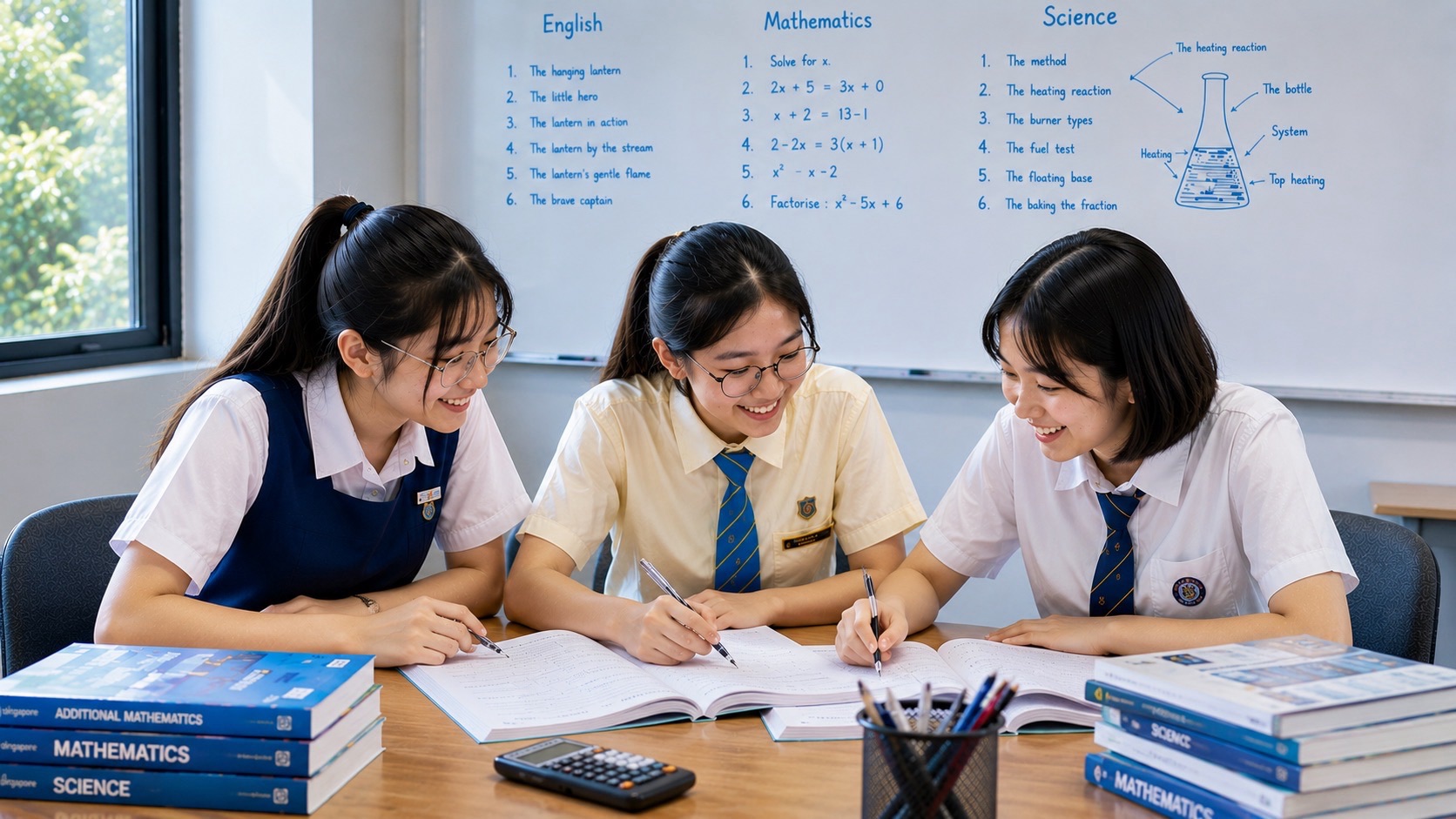
In a three-student tutorial, one learner may answer A only, another B only, and a third both but with unnecessary material. Comparing the three reveals that completeness and concision are separate skills.
For Choa Chu Kang Families
Families searching from Choa Chu Kang should confirm the current teaching location, timing and availability directly. eduKate’s location-targeted pages organise learning information but do not imply a physical branch in every named neighbourhood.
The Goal Is Two Jobs, One Controlled Response
Split the question, allocate evidence, connect the two parts, then stop when both conditions are complete. This small habit prevents many avoidable English errors and scales naturally into more demanding Secondary tasks.
About eduKate
eduKate uses very small groups to make question boundaries visible and help students answer every required condition without losing precision or independence. Our core values are Integrity, Empathy, Critical Thinking and Responsibility.


