
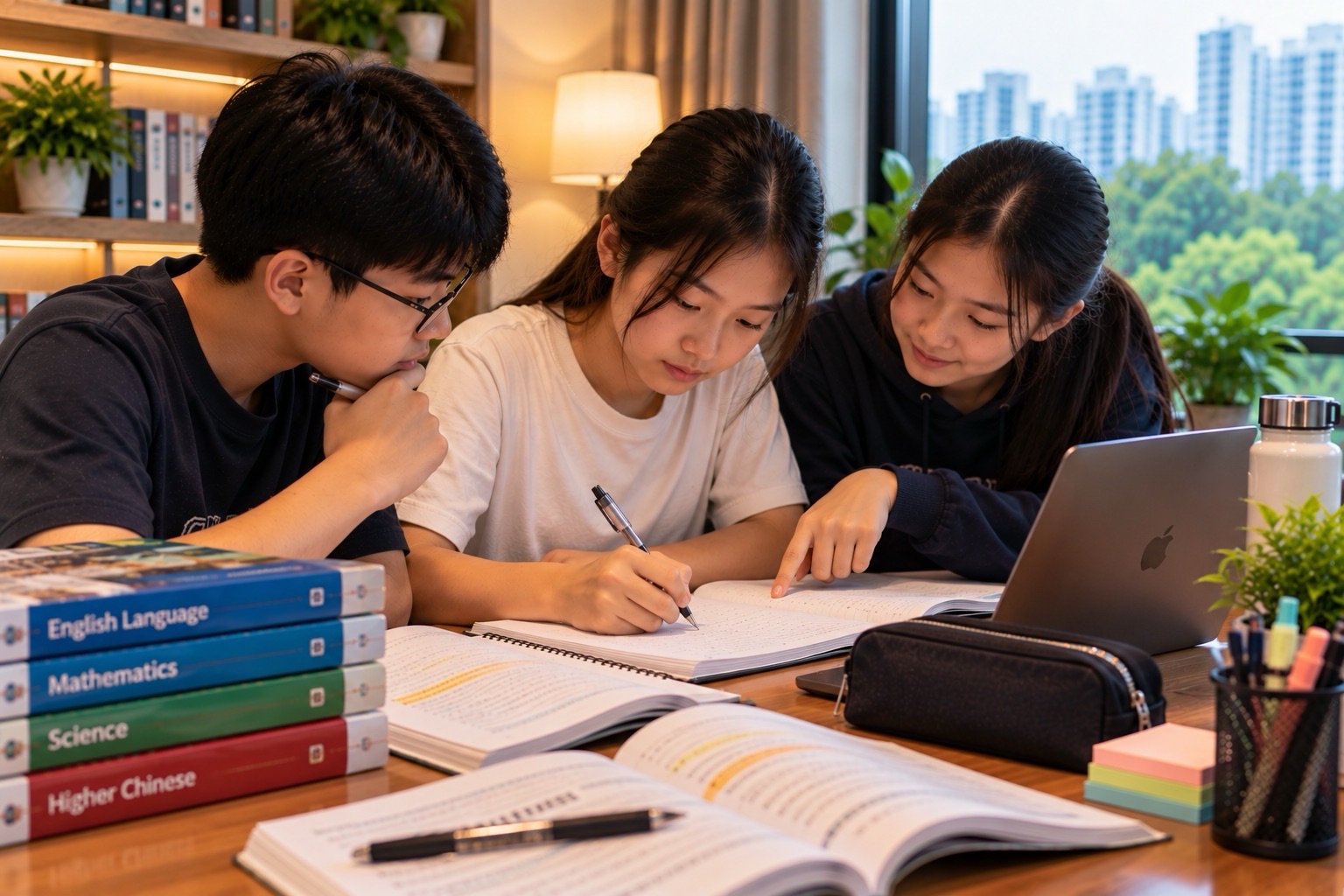
Punggol English enrichment should make language bigger than the worksheet, then bring the learning back into school performance. A child needs more than passages and answer boxes to develop English deeply. Language grows through reading, conversation, observation, place, people, stories, ideas, signs, instructions, disagreement, humour and real reasons to communicate.
The challenge is that “enrichment” can become vague. An outing, book discussion or creative project may feel interesting without producing durable language growth. The opposite mistake is to turn every real-world experience into another worksheet and remove the curiosity that made it useful in the first place.
This rebuilt legacy page keeps its existing 2017 title and URL while giving it one clear job: take English outside the worksheet, then bring the learning back. The enrichment cycle is encounter → notice → discuss → capture → transform → retrieve → transfer. The objective is not entertainment. It is richer language that eventually improves reading, vocabulary, oral communication, writing and school independence.
Why English needs a world outside worksheets
Worksheets are useful because they isolate skills and create efficient practice. They are less effective at supplying the full range of language experiences a child needs. Real language contains incomplete information, unfamiliar vocabulary, different voices, social context and genuine reasons to ask questions.
A child who only meets English in school exercises can become good at recognising expected answers while remaining less flexible with unfamiliar situations.
Enrichment expands the language world. Tuition should then help the child convert that expansion into usable control.

The enrichment cycle: encounter
An encounter is any meaningful language-rich experience: reading a story, observing a public space, listening to an explanation, discussing a news idea, following instructions, visiting a library, noticing a sign, comparing two advertisements, hearing a disagreement, watching how people use a place.
The encounter should contain something worth thinking or talking about. English is not added afterwards; language is how the child makes sense of the experience.
The enrichment cycle: notice
Students often move through the world without noticing language deliberately. Enrichment teaches selective attention. Which word is unfamiliar? Which sentence is persuasive? Which detail changes the story? Which sign assumes the reader already knows something?
Noticing converts exposure into material.
The enrichment cycle: discuss
Conversation gives the learner a low-cost place to test understanding. The child can explain, ask, disagree, compare and revise before formal writing is required.
A tutor can hear vocabulary gaps, reasoning gaps and unclear sentence relationships during discussion and decide which deserve attention.
The enrichment cycle: capture
Not every experience needs pages of notes. Capture only what has future value: one new word family, one interesting observation, one strong sentence pattern, one question, one possible story mechanism or one claim worth developing.
The notebook becomes a reservoir rather than a transcript.
The enrichment cycle: transform
Transformation is where the child turns raw experience into language work. An observation becomes a paragraph. A conversation becomes an argument. A place detail becomes a composition setting. A new word appears in a fresh sentence.
Transformation prevents enrichment from remaining pleasant exposure only.
The enrichment cycle: retrieve
Return later without the original support. Can the child remember the word, idea, observation or sentence structure? Retrieval tells us whether the experience entered durable access.
The enrichment cycle: transfer
Finally, the student should use the learning in another environment: a school composition, oral discussion, comprehension response, Secondary argument or unfamiliar reading.
Transfer closes the loop. Enrichment has become capability rather than memory of an activity.
Enrichment through reading
Wide reading remains one of the strongest forms of English enrichment because it simultaneously supplies vocabulary, syntax, knowledge, narrative structure and ideas. The child encounters language at a scale worksheets cannot reproduce.
The tutor does not need to interrogate every chapter. Some reading should remain immersive enough that the student wants to continue.
Reading enrichment should include variety
- Stories and novels.
- Narrative non-fiction.
- Biography and memoir.
- Science and nature writing.
- History and place writing.
- Age-appropriate journalism.
- Essays and opinion pieces for older learners.
- Comics and graphic narratives where language and image interact.
Variety expands the range of voices, topics and sentence structures the learner can recognise.
Reading enrichment should include choice
A child who chooses some reading material is more likely to develop genuine volume. Tutor-selected texts remain useful for deliberate vocabulary or comprehension work, but the reading life should not be completely externally controlled.
Reading enrichment should occasionally slow down
Close reading is different from wide reading. One paragraph can be examined for word choice, rhythm, viewpoint, evidence or structure.
Students should experience both modes: read widely for volume and occasionally read closely for craft.
Enrichment through observation
Observation creates original language material. Students can notice movement, sound, human interaction, public behaviour, weather, objects and spatial constraints in ordinary Punggol life.
The goal is not tourism description. Ask what the detail does. Does it create delay, conflict, mood, information or choice?
Observation can improve composition originality
Students who repeatedly write from memorised plots often lack raw material. Real observation provides mechanisms the child can transform: waiting, misunderstanding, a lost object, sudden rain, a blocked route, a conversation overheard partially.
The writer borrows function, not private biography.
Observation can improve vocabulary
Words become easier to remember when attached to something seen or experienced. Hesitate, weave, queue, shelter, spill, signal, glance and drift become concrete when the child has watched the action.
Observation can improve oral language
Ask the student to describe what changed, explain why it mattered and compare two interpretations. This turns ordinary experience into spontaneous language practice.
Enrichment through conversation
Real conversation is less predictable than worksheet response. The child must listen, interpret tone, retrieve vocabulary, respond to a new point and sometimes change their view.
This flexibility supports oral communication and later argument writing.
Conversation should move beyond “What did you do today?”
- What surprised you?
- What did you notice that another person might miss?
- What do you disagree with?
- What would you change?
- What evidence supports that view?
- What might another person say?
These questions create richer thinking without turning home into another classroom.
Enrichment through explanation
Ask the child to teach something they know: a game rule, a route, a Science concept, a hobby or how to make something. Explanation demands sequence, audience awareness and precise vocabulary.
The listener can ask where instructions are ambiguous. The child learns that clear language changes what another person can do.
Enrichment through real instructions
Recipes, assembly guides, signs, maps and rules all teach procedural language. Students can compare which instructions are clear and which assume too much.
This is practical English: sequence, conditions, warnings and audience.
Enrichment through public language
Advertisements, notices, menus, transport instructions and public messages show how language changes with purpose. Students can ask what action the text wants, what information is omitted and which words create urgency or reassurance.
Older learners can begin noticing persuasion and framing.
Enrichment through storytelling
Families can retell experiences, family stories or remembered incidents. The child learns sequence, viewpoint and detail selection.
Retelling does not need to be formally corrected every time. The first aim is coherent meaning; precision can be refined later.
Enrichment through comparison
Compare two descriptions of the same event, two headlines, two advertisements, two story openings or two explanations. Ask what changed and what effect the change creates.
Comparison is one of the fastest ways to make language choices visible.
Enrichment through disagreement
Age-appropriate disagreement teaches the child to state a position, listen, qualify and respond. The tutor can model how to disagree with the idea rather than attack the person.
This becomes useful later in Secondary argument writing and oral discussion.
Enrichment through questions
Curiosity creates language demand. A child who wants to know how something works has a reason to read, ask and explain.
Enrichment should therefore reward good questions, not only correct answers.
The enrichment notebook should be light
A heavy notebook requirement can turn curiosity into administration. Keep short entries: one word, one observation, one question, one sentence worth studying, one idea to revisit.
The value comes from later retrieval and transformation, not decorative note-taking.
The enrichment notebook should have categories
- Words.
- Observations.
- Questions.
- People and behaviour.
- Places.
- Story mechanisms.
- Arguments and examples.
- Sentence craft.
- Things to read next.
Categories make old material easier to reuse.
The enrichment notebook should be mined later
A P5 composition prompt can use an observation recorded months earlier. A Secondary argument can use an example first discussed in Primary school. A vocabulary word can reappear in oral practice.
This is how enrichment compounds.
Enrichment should not become endless collection
Students must transform material. If the notebook grows but nothing enters speech, writing or reading analysis, enrichment remains passive.
Bring enrichment back into school composition
Choose one observation or story mechanism and use it inside a school-style prompt. The student learns to adapt real material without turning the piece into a travel diary.
Originality becomes selection and transformation.
Bring enrichment back into comprehension
Wide reading gives students more vocabulary and background knowledge. Close reading teaches them to notice evidence and viewpoint. These habits should improve unfamiliar comprehension passages over time.
Bring enrichment back into oral
Use current reading, observations or ideas as material for spontaneous discussion. The child becomes less dependent on memorised oral scripts.
Bring enrichment back into vocabulary
Words collected outside school should appear in spaced retrieval and fresh use. The tutor can check nuance, collocation and register so the vocabulary becomes accurate rather than merely memorable.
Bring enrichment back into grammar
A sentence noticed in reading can become a craft model. Students reconstruct the relationship with original content instead of copying the sentence.
Grammar is then experienced as a tool writers use, not only a rule sheet.
Bring enrichment back into argument
Older students can transform observations, reading and conversations into examples for claims. The tutor should teach them to explain why the example supports the position.
Real-world material becomes evidence, not anecdote alone.
P1–P2 enrichment: language abundance
For younger learners, enrichment should emphasise stories, talk, vocabulary, reading enjoyment, description and simple explanation. The goal is not to formalise every experience.
Children need abundant language before they need sophisticated analysis of it.
P3–P4 enrichment: observation and connection
Middle Primary students can begin keeping small idea banks, comparing words, building paragraph material and connecting reading with writing.
The tutor can introduce more deliberate transfer without turning the programme into exam drilling.
P5 enrichment: broaden before the PSLE funnel narrows
P5 is a good year to build reading volume, vocabulary and creative material before P6 assessment pressure increases. Enrichment can also repair weak writing or comprehension through richer contexts.
P6 enrichment: preserve language life during exam preparation
PSLE preparation requires papers, timing and targeted repair. The danger is allowing every English minute to become exam rehearsal.
Short reading, discussion and observation keep vocabulary and ideas alive while the programme becomes more execution-focused.
Secondary enrichment: ideas become more abstract
Secondary students can discuss argument, viewpoint, bias, evidence, register and social issues. Enrichment moves beyond story material into intellectual material.
The same outside→inside cycle remains: encounter, discuss, capture, transform, retrieve, transfer.
Enrichment should sometimes be deliberately ungraded
If every creative or discussion task receives a mark, students may optimise for safety. Low-stakes spaces allow experimentation and language risk.
The tutor can still give feedback without converting everything into a score.
Enrichment should sometimes use formal assessment criteria
After exploration, students need to know whether the learning transfers to school. Use a fresh composition, oral task or comprehension response under relevant constraints.
The contrast between free exploration and formal execution is educationally useful.
Enrichment should distinguish exposure from mastery
Seeing a word once is exposure. Discussing it is deeper exposure. Retrieving it later is learning evidence. Using it accurately in a new context is stronger mastery evidence.
The same principle applies to ideas and sentence structures.
Enrichment should distinguish fun from value
An activity can be enjoyable and educational, enjoyable but shallow, demanding and educational, or demanding without much value. The tutor should ask what language process the activity actually changed.
Enjoyment is valuable but not the only criterion.
Enrichment should distinguish novelty from growth
New places, books and projects can create excitement. Growth appears when the child notices more, retrieves more, explains more clearly or writes with greater range because of those experiences.
Novelty opens attention; teaching turns it into capability.
A three-student group can enrich without becoming noisy
Give each student the same image, text or observation and ask for different responses. One notices movement, another social tension, another vocabulary.
Private first thinking protects originality. Discussion then expands the group’s possibilities.
Peer discussion should create more options, not one group answer
In enrichment mode, the group should leave with a wider idea bank. Each learner then selects or transforms material independently.
The tutor should protect quiet students
Some students generate better ideas in writing before speaking. Give private note time before group discussion so verbal speed does not become the only form of participation.
The tutor should protect fast students from shallow novelty
A quick student may generate many ideas but fail to develop any. Ask for consequence, evidence or a second layer before moving to the next idea.
Depth is another form of enrichment.
The tutor should protect developing students from overload
Enrichment does not require maximum complexity. One interesting word, one observation and one clear paragraph can be enough.
The task should stretch without burying the learner.
A monthly enrichment cycle
Week 1: encounter
Read, observe or discuss something beyond ordinary worksheets.
Week 2: capture and expand
Build vocabulary, questions, observations and possible writing material.
Week 3: transform
Use the material in original oral or written work.
Week 4: transfer
Apply one part of the learning to a school-style task with reduced support.
A term enrichment audit
- Is the child reading more widely?
- Is vocabulary becoming more precise?
- Does the learner notice useful details independently?
- Are ideas more varied?
- Can real-world material enter writing naturally?
- Does oral discussion become more spontaneous?
- Does school work show any transfer?
- Is the child still curious?
The audit keeps enrichment connected to real language development.
What parents can do without turning home into tuition
- Keep books accessible.
- Talk about what the child notices.
- Ask one genuine question instead of a quiz.
- Let the child explain something they know.
- Visit ordinary places with attention rather than constant teaching.
- Allow some reading for pleasure with no worksheet.
- Model curiosity about words.
The home role can remain light and human.
Frequently asked questions
Is English enrichment the same as English tuition?
Not exactly. Tuition often repairs or prepares for school demands. Enrichment broadens language and ideas. A strong programme can use both modes deliberately.
Does enrichment help exams?
Yes when vocabulary, reading, ideas and craft are deliberately transferred back into school tasks. Enrichment should not remain disconnected from performance.
Should every enrichment outing have a worksheet?
No. Some experiences should remain conversational or observational. Capture only what has future language value.
What if my child already reads a lot?
Enrichment can shift toward discussion, writing craft, argument, vocabulary nuance or new genres rather than simply increasing book volume.
What if my child dislikes reading?
Use interests, shorter texts, audio-supported reading, graphic narratives or real-world topics to lower access friction while gradually increasing volume.
How do I know enrichment is working?
Look for broader vocabulary, more original material, stronger questions, richer discussion and transfer into fresh writing or reading tasks.
Related eduKatePunggol reading
- Singapore Creative Writing Enrichment | Exploration Mode vs Exam-Writing Mode
- Creative Writing Holland Village | Use Urban Observation Without Turning Composition Into a Travel Brochure
- How to Get Your Child to Read
- eduKate Punggol Contents & Learning Routes
The deeper rule: leave the worksheet, collect language, then return stronger
English enrichment works when it enlarges what the child can notice, understand, discuss and express. The worksheet remains useful, but it is no longer the whole language world.
Encounter something real. Notice carefully. Talk about it. Capture what matters. Transform it into language. Retrieve it later. Use it in a new task.
That cycle keeps enrichment from becoming entertainment and keeps tuition from becoming a closed stack of exercises.
Take English outside the worksheet. Then bring the learning back.
Enrichment should have a return path before the activity begins
Before choosing an enrichment activity, the tutor should know what kind of language return is possible. A visit, discussion, reading or observation may return as vocabulary, oral explanation, narrative detail, argument material, sentence craft or comprehension knowledge.
This does not mean every experience needs a pre-written worksheet. It means the tutor can recognise what language value emerges and create one purposeful follow-up instead of letting the experience disappear.
The return path should be smaller than the experience
A two-hour outing does not need a two-hour written reflection. One paragraph, one vocabulary cluster, one oral retelling or one story scene may be enough to capture the highest-value language.
Compression is part of learning. The child chooses what matters rather than documenting everything.
Enrichment should build background knowledge as well as language
Reading comprehension becomes easier when students know something about the world described by the text. Science, history, places, people, technology and social life all give language somewhere to attach.
A student who knows more can often infer more because unfamiliar words and ideas sit inside a richer mental network.
Background knowledge should be broad, not exam-predicted
The purpose is not to guess the exact topic that will appear in a school paper. Broad knowledge makes unfamiliar texts less unfamiliar overall.
This is one reason wide reading and real-world discussion matter even when they do not produce an immediate score increase.
Enrichment should strengthen question quality
Young learners often ask factual questions. Older learners can begin asking comparative, causal and evaluative questions: Why is this designed this way? What changed? Who benefits? What would happen if the condition changed? Which explanation is stronger?
Question quality is one of the clearest signs that language and thinking are developing together.
Enrichment should make vocabulary more relational
Instead of collecting isolated words, students can group them by meaning, tone, function and contrast. Hesitant, reluctant, cautious and uncertain overlap but are not identical. Efficient, effective and economical point to different ideas.
Relational vocabulary becomes more useful in comprehension, oral response and later analytical writing.
Enrichment should make sentence craft more visible
When students encounter an effective sentence, ask what made it work. Was the important information delayed? Did a short sentence follow a long build? Did the writer use contrast, repetition or an unexpected verb?
Then recreate the structural move with completely different content. The learner borrows craft rather than copying wording.
Enrichment should make audience visible
The same idea can be explained differently to a younger child, a teacher, a friend or an unfamiliar reader. Ask students to adjust vocabulary, amount of context and tone.
Audience awareness improves oral communication, writing and register control.
Enrichment should make purpose visible
A public notice wants action. An advertisement wants persuasion. A story wants immersion and meaning. A scientific explanation wants causal clarity. An opinion piece wants a defensible position.
Recognising purpose helps students understand why language changes across genres.
Enrichment should include real choices
Let students choose between two books, two writing directions, two questions to investigate or two formats for presenting an idea. Choice creates ownership and reveals preference.
The tutor can still preserve the same learning objective underneath the choice.
Enrichment should include revision, not only first attempts
A real-world paragraph, story scene or argument should sometimes be revisited. Students can improve clarity, vocabulary, sequence or evidence after discussion.
Revision teaches that enrichment is not simply generating more material. It is also making language more precise.
Enrichment should include retrieval after the excitement is gone
One week later, ask what word, idea or observation still remains. Can the child explain it without reopening the notebook? Can the idea be used in a different context?
This separates memorable experience from durable learning.
Enrichment should include transformation across modes
Turn reading into discussion, discussion into notes, notes into a paragraph, a paragraph into an oral retelling, or an observation into a story scene.
Moving the same idea across modes strengthens flexible language control.
Enrichment should not depend on expensive outings
A bus stop, supermarket queue, library shelf, park bench, school corridor, public notice or family conversation can contain enough language and observation material.
The educational value comes from attention and transformation, not the prestige of the location.
Enrichment should not require constant novelty
Returning to the same place or topic can produce deeper noticing. The child may see different patterns once vocabulary and attention improve.
Depth is often built by revisiting, not only by moving on.
Enrichment should not become entertainment without reflection
Fun activities can be worthwhile, but language growth requires some cognitive return: explain, compare, retrieve, write, question or transform.
The return can be brief. It still needs to exist.
Enrichment should not become school disguised as fun
If every outing ends with a long comprehension worksheet and every story discussion becomes an assessment, students learn that “enrichment” simply means more schoolwork in a different location.
Keep some space genuinely exploratory and use only the highest-value follow-up.
Enrichment should not become a portfolio for adults
Beautiful displays, elaborate project boards and polished journals can consume more adult effort than learner thinking. A rough page of original observations may contain more educational value.
Judge the language process, not the presentation alone.
The enrichment tutor should know when to step back
When the child is exploring an idea productively, immediate correction can interrupt generation. Let the learner develop the thought first and return to grammar or precision later.
Enrichment needs room for imperfect first language.
The enrichment tutor should know when to intervene
If a misconception blocks understanding or a word is being used with the wrong meaning repeatedly, direct correction may be necessary before the error becomes embedded.
Freedom and guidance should alternate according to the learning state.
The enrichment tutor should make learner interests useful
A child interested in football can read match reports, compare commentary and explain strategy. A child interested in animals can read science writing, describe behaviour and build vocabulary. A child interested in games can analyse instructions and narrative worlds.
Interest lowers access friction. The tutor then broadens beyond the interest so the learner does not become linguistically narrow.
The enrichment tutor should protect students from being trapped by one interest
Interest can begin the journey, but English competence requires range. Gradually connect the familiar topic to new genres, themes and viewpoints.
Enrichment should expand the learner’s world rather than only decorate the existing one.
P1–P2: enrichment should feel abundant and safe
Stories, read-alouds, conversation, simple observation and playful vocabulary are enough. The objective is to create a child who expects English to carry interesting meaning, not only school demands.
P3–P4: enrichment should begin building reusable banks
Students can keep light vocabulary, observation and idea notes, then reuse them in short writing and oral tasks. The connection between outside experience and school English becomes more deliberate.
P5–P6: enrichment should protect breadth under assessment pressure
As exam work increases, enrichment becomes a counterbalance to narrowing. Reading, discussion and idea generation keep the learner supplied with language and material while paper execution becomes more disciplined.
Secondary: enrichment should become intellectual as well as creative
Students can compare viewpoints, inspect evidence, discuss social issues, analyse persuasion and explore how language frames ideas. This feeds argument, comprehension and oral communication.
A strong enrichment programme has two modes
Exploration mode widens language, ideas and experience. Transfer mode asks the learner to use that material under school-style constraints.
Both are necessary. Exploration without transfer can become disconnected. Transfer without exploration can become narrow and repetitive.
A weekly enrichment rhythm
- Encounter one interesting text, observation or idea.
- Discuss what matters.
- Capture one or two reusable items.
- Transform one item into original language.
- Retrieve something from a previous week.
- Use one element in a school-relevant task.
This rhythm is light enough to sustain and structured enough to compound.
A term-end enrichment review
Look back at what entered the learner’s repertoire. Which words are now used naturally? Which observations became writing material? Which reading habits expanded? Which discussion skills improved? Which school tasks became easier because of broader knowledge?
Do not judge enrichment only by the number of projects completed.
A strong enrichment programme should make the learner more generative
The child should produce more possible words, examples, story directions, questions and explanations before needing adult input. This generative capacity is one of the most valuable long-term outcomes because it supports unfamiliar tasks.
A strong enrichment programme should make the learner more selective too
More ideas are useful only if the student can choose. The child should learn which observation fits the composition, which example supports the argument and which word matches the tone.
Enrichment expands options; judgement turns them into good language.
A strong enrichment programme should reduce dependence on memorised model material
As the child builds a real bank of reading, observation and vocabulary, there is less need to rely on fixed “good phrases” or pre-written plots.
The learner can generate from experience and reconstruct from principles.
A final enrichment transfer test
Give the student a fresh school-style prompt or passage. Do not remind them what enrichment material to use. Observe whether vocabulary, ideas, examples, sentence craft or background knowledge appear naturally.
If the learner can draw from the wider language world independently, enrichment has transferred.
The final Punggol English enrichment standard
English enrichment should make the learner’s language world larger and the learner’s control over that world stronger. The child reads more widely, notices more precisely, discusses more thoughtfully, captures more selectively and writes with more original material.
Then the learning returns to school: clearer vocabulary, richer examples, stronger oral response, more flexible writing and less dependence on memorised answers.
The enrichment class succeeds when the worksheet becomes one place where English is used—not the only place where English exists.
The enrichment programme should teach students to reuse old material
One of the strongest signs of real enrichment is reuse. A word collected in one month appears naturally in a later composition. An observation from a park becomes a setting detail in another story. An idea discussed during reading becomes an example in a Secondary argument.
Reuse proves that enrichment material has entered the learner’s repertoire rather than remaining attached to one activity.
The enrichment programme should teach students to adapt, not copy
Material gathered from reading or observation should be transformed. The child changes the setting, viewpoint, consequence, vocabulary or purpose. This prevents real-world experience from becoming disguised copying.
Adaptation is a key bridge between exposure and original production.
Enrichment should strengthen comprehension by widening knowledge
Students understand texts more easily when they recognise the concepts, situations and vocabulary inside them. Wide reading and discussion therefore improve comprehension indirectly as well as directly.
The benefit may not appear as one obvious worksheet skill. It can appear as faster access to unfamiliar passages and better inference because the student has more knowledge available.
Enrichment should strengthen writing by increasing available material
Writers struggle when they have nothing to say. Enrichment creates a bank of places, people, conflicts, explanations, examples and vocabulary from which school writing can draw.
This is why reading and observation are not separate from composition. They supply the content and language that composition later selects.
Enrichment should strengthen oral by making responses less scripted
A child who has discussed real ideas regularly has more practice retrieving language under uncertainty. Follow-up questions become less threatening because spontaneous response is normal.
The student no longer needs to memorise one perfect answer to feel prepared.
Enrichment should strengthen vocabulary by making words useful
Words become durable when they solve communicative problems. The child needs a more precise verb, a better contrast, a term for an idea or a way to express uncertainty.
Enrichment creates those needs naturally, which makes later retrieval more meaningful than memorising disconnected definitions.
Enrichment should strengthen independence by making curiosity self-propelled
At first, adults choose the book, question or observation. Later, the learner should bring a word, article, idea or question into class independently.
This is a powerful progress signal because the student is beginning to generate the input for further learning rather than waiting for every stimulus to arrive from the tutor.
The parent role should become lighter as enrichment works
Parents can provide access to books, conversation and ordinary experiences. They should not need to plan elaborate projects every weekend. A child who has learned how to notice and ask questions can extract language value from ordinary life.
The system becomes sustainable because enrichment no longer depends on constant adult production.
The tutor role should become more curatorial over time
As the learner becomes more independent, the tutor can spend less time generating material and more time curating: which book is worth reading next, which observation deserves development, which vocabulary cluster should be deepened, which school task offers the best transfer opportunity.
This is a higher level of teaching because the tutor is managing the learner’s growing repertoire rather than supplying every piece of it.
The final enrichment audit should ask what survived
- Which words are still retrieved months later?
- Which observations became writing material?
- Which reading habits continue without prompting?
- Which questions does the child now ask independently?
- Which school tasks became easier because of wider knowledge?
- Which sentence or craft principles can the learner recreate without copying?
Survival is the evidence that enrichment has moved beyond exposure.
The final rule for Punggol English enrichment
Do not judge enrichment by how unusual the activity looked. Judge it by what language the learner can still use later, in a different task, without the original experience in front of them.
The best enrichment leaves traces: richer vocabulary, stronger questions, more original material, wider reading, better explanation and more independent curiosity.
Take English into the world. Let the learner notice something worth keeping. Then bring that language back into school, writing, reading and thought.
The last transfer is from tutor-led enrichment to self-directed enrichment
A child who has learned the enrichment process should eventually be able to choose a text, notice an unfamiliar word, ask a question, record one useful idea and use it later without waiting for the tutor to create the sequence. That is when enrichment becomes part of the learner’s own operating system.
The student may bring an article to class, mention an interesting phrase from a novel, notice a public sign with unusual wording or connect a school topic to something read months earlier. These moments show that language learning is no longer confined to assigned work.
A strong enrichment programme should eventually need fewer enrichment instructions
At first, the tutor may say, “Notice three details”, “record two words” or “turn this observation into a paragraph”. Later, the learner should know which part of an experience is worth capturing and how it might be reused.
Prompt fading therefore applies to enrichment just as it applies to exam skills. Independence is the final transfer.
For Punggol families, that is the deepest reason to enrich English beyond worksheets. The child learns that language is not a school subject that appears only when a book is opened. It is a tool for noticing, thinking, questioning, remembering and creating across ordinary life.
When that habit survives without the tutor, enrichment has done its work.
The final enrichment question is whether the learner now finds language opportunities without being told
After several months, parents and tutors should notice a change in attention. The child asks what a word means, notices how a sentence sounds, brings up an idea from reading, questions a claim, observes something useful for writing or connects a new school topic with earlier knowledge.
These behaviours are not decorative extras. They show that the learner has begun generating their own language input. Once that happens, English can keep growing between lessons because the world itself supplies material.
The programme should then shift from constant stimulation toward curation and refinement. The tutor helps the student choose which questions are worth pursuing, which words deserve deeper retrieval and which observations can become strong writing or discussion material.
That is the quiet end state of enrichment: wider language, sharper attention, stronger transfer and a learner who increasingly knows how to turn ordinary experience into English growth without waiting for another worksheet.
When a child can independently notice, question, collect, transform and reuse language across reading, conversation and school work, enrichment has become self-sustaining. The tutor no longer has to manufacture every interesting language moment because the learner has acquired the habit of finding them. That is a far more durable outcome than completing another enrichment project: the child now carries a method for turning ordinary life into vocabulary, ideas, questions and writing material that can keep compounding long after the original class has ended.
That is enrichment turning into independent language growth.


