
The first twelve weeks after Primary English should not be treated as a race to start O-Level drilling. Secondary English changes the job before it changes the exam. Texts become denser, vocabulary becomes more abstract, responses require more interpretation, writing asks for stronger organisation and the learner is expected to manage more of the process independently.
A student who performed well in Primary school can therefore feel unexpectedly slow in Secondary 1 without having “become weak”. The language system is being asked to carry more load. The right first-term response is to test transfer, repair the Primary skills that do not survive the new load, build new analytical habits, and reduce scaffolds carefully rather than panic and add volume.
This rebuilt legacy page keeps its existing 2017 title and URL while giving it one clear job: map the first twelve weeks after Primary English. The sequence is designed for Singapore families choosing Secondary English tuition who want a transition programme that develops reading depth, evidence, argument, writing independence and self-management before high-stakes examination preparation takes over.
The transition problem: Primary competence does not automatically become Secondary control
Primary English already requires comprehension, vocabulary, grammar, writing, listening and oral communication. Secondary English does not replace those capabilities. It asks them to work under different conditions: longer texts, greater abstraction, more viewpoint, more information density, more independent planning and more complex written response.
The first twelve weeks should therefore answer one question: which Primary capabilities remain portable, and which collapse when the load rises?
Secondary English should begin by testing transfer, not by assuming either strength or weakness from the PSLE result.

Week 1: establish the new baseline
Collect one recent Primary writing sample, a comprehension or school paper, and one fresh Secondary-level reading task. Do not begin by assigning a full battery of tests. The tutor needs enough evidence to compare old and new demand.
Observe reading speed, vocabulary breakdown, inference quality, sentence control, planning independence and prompt depth.
The Week 1 output should be a provisional learner map, not a grade prediction.
What to look for in reading
- Can the student maintain meaning across longer paragraphs?
- Does abstract vocabulary interrupt comprehension?
- Can pronoun and reference chains be tracked?
- Can paragraph purpose be identified?
- Does the student infer from evidence or guess from general impression?
What to look for in writing
- Can the student generate a position or plan without heavy prompting?
- Are paragraphs organised around one function?
- Does sentence grammar remain stable when ideas become more complex?
- Can examples be explained rather than merely mentioned?
- Does the writing remain relevant to the task?
Week 2: strengthen text navigation
Secondary texts can feel difficult because students process every sentence at equal intensity. Teach navigation: paragraph purpose, connectives, shifts, repeated ideas, examples and claims.
The learner should begin asking what each paragraph is doing, not only what each sentence says.
This reduces cognitive load and makes later summary and analysis easier.
Week 3: make evidence non-negotiable
Primary comprehension may have rewarded accurate answer retrieval. Secondary response increasingly needs the student to justify interpretation with textual evidence and explain the link.
Teach a simple discipline: claim → evidence → explanation. The exact response format may vary, but the relationship remains useful.
Students should learn that quoting is not the same as analysing.
Week 4: move vocabulary from definition to nuance
Secondary English contains more abstract language and more words whose meaning depends on tone, register and context. Knowing a dictionary definition is no longer enough.
Students should compare near-synonyms, connotation and usage. Assertive is not identical to aggressive. Skeptical is not identical to cynical. Efficient is not identical to effective.
Vocabulary becomes a tool for precision in reading and writing.
Week 5: build paragraph function
A Secondary paragraph should do a job. It may make a claim, explain an idea, provide evidence, develop an example, address a counterpoint or create narrative movement.
Students who write by adding sentence after sentence often produce long paragraphs without direction.
Teach the learner to name the paragraph’s function before expanding it.
Week 6: introduce analytical explanation
Students can identify techniques without analysing them. “The writer uses repetition” is only a label. The learner must explain what the choice makes the reader notice and how that supports meaning or purpose.
A useful chain is feature → effect → larger meaning.
The tutor should avoid turning analysis into a list of literary terms.
Week 7: move from opinion to argument
Secondary writing increasingly benefits from claims that can be justified and challenged. Students should learn to distinguish personal preference from defensible position.
A strong argument uses evidence or examples, reasoning and qualification. The child should explain why the evidence matters rather than expecting the example to speak for itself.
This is a major transition from expressive Primary writing into more formal Secondary thinking.
Week 8: teach counterargument without formula
Students often learn a token “however” paragraph and believe balance has been achieved. A real counterargument should create pressure on the original position.
Teach the learner to represent another view fairly, explain why it matters and decide whether the original claim should be defended, narrowed or revised.
This builds mature judgement instead of template compliance.
Week 9: reduce planning scaffolds
By this point, the tutor should start removing some of the frames used earlier. If every essay still depends on a supplied paragraph template, the learner is not yet controlling the writing process.
The student should increasingly identify the task, generate reasons, select evidence and order the response independently.
Prompt fading is part of the transition, not an optional extra.
Week 10: add timed execution carefully
Timing should not dominate the first weeks because an unstable process becomes worse when rushed. Once reading and writing routines are more secure, add short timed sections.
Time the part that is ready: a paragraph, a comprehension section, a summary or a plan. Then inspect whether accuracy degrades and why.
Speed is added to stable thinking rather than used to create it.
Week 11: test transfer with unfamiliar texts and issues
Remove chapter cues and familiar topics. Use a new article, narrative or prompt. The student should recognise when evidence, analysis, argument or comparison is required.
This week answers whether the first ten weeks built portable processes or only local familiarity.
Prompt depth should also be lower.
Week 12: build the next-term learning map
Return to the original baseline. Which Primary habits survived? Which new Secondary processes are stable? Where does the learner still depend on scaffolds?
The tutor should identify one or two active bottlenecks for the next term rather than continuing every intervention indefinitely.
The first twelve weeks end with a new learner map, not with the declaration that transition is complete forever.
The transition should protect reading accuracy before analysis depth
Students can become eager to produce sophisticated interpretations and skip literal reading. Secondary English still depends on accurate comprehension.
If a complex answer is built on a misread pronoun, paragraph or sentence, return to the text.
Depth rests on accuracy.
The transition should protect sentence control before stylistic complexity
Students often try to sound more “Secondary” by writing longer sentences. If clause control is unstable, complexity increases errors faster than sophistication.
Teach the learner to build clear complete sentences first, then combine them deliberately.
Sentence architecture should become more flexible without becoming less readable.
The transition should protect vocabulary meaning before difficulty
Advanced words are not a shortcut to advanced English. A simpler precise word is stronger than a difficult word used with the wrong connotation.
Secondary vocabulary development should improve distinctions and conceptual thinking, not merely increase word length.
The transition should protect reading volume
Secondary school brings more homework and subject load. Independent reading can easily disappear. That is risky because wider reading continues building vocabulary, knowledge, syntax and argument material.
A good first-term plan protects some reading beyond worksheets.
Reading volume is long-term infrastructure for Secondary English.
The transition should protect oral language too
Students often think Secondary English is mainly writing. Discussion remains valuable because oral explanation exposes reasoning before the learner has to package it formally.
The student can test an interpretation, defend a view, listen to disagreement and refine language before writing.
Oral work should feed written independence.
The transition should not overreact to the first weak school result
Secondary 1 assessments often expose new load. One disappointing mark may reflect adjustment, timing or unfamiliar task format rather than a broad English collapse.
Analyse the error families. What did the child understand? Where did the process fail?
Use the result as evidence, not identity.
The transition should not ignore repeated weakness either
If the same reading, evidence or sentence problem appears across several tasks, the programme should repair it directly.
Adjustment is not an excuse for indefinite instability.
The distinction is recurrence.
Primary habits that often transfer well
- Regular reading.
- Basic sentence control.
- Vocabulary curiosity.
- Answering the actual question.
- Planning before writing.
- Oral explanation.
- Checking for recurring grammar errors.
The transition should preserve these strengths and deepen their use.
Primary habits that may need upgrading
- Copying evidence without analysis.
- Using fixed composition plots.
- Memorising “good phrases”.
- Writing one-point paragraphs without reasoning.
- Waiting for teacher prompts before starting.
- Treating comprehension as answer hunting only.
- Treating vocabulary as definitions rather than nuance.
These habits may have worked under earlier demands and become restrictive later.
The tutor should distinguish new demand from old gap
A student may struggle because Secondary English introduces a genuinely new type of reasoning. Another may struggle because an old Primary vocabulary or sentence problem has finally become expensive.
The repair depends on which layer is responsible.
New demand needs teaching. Old gap needs rebuilding.
Reading-density problems can look like motivation problems
Longer texts require more sustained attention. A child who once completed Primary passages quickly may now appear reluctant because every page costs more.
Build reading stamina gradually and improve navigation rather than assuming the learner has become lazy.
Abstract vocabulary can look like comprehension weakness
If a paragraph depends on words such as implication, contradiction, marginal, ethical or disproportionate, the child may understand the sentence structure but lack the concepts.
Vocabulary teaching should therefore include idea-building, examples and contrasts.
Weak evidence use can look like weak thinking
A student may have a strong interpretation orally but fail to support it in writing. The bottleneck is evidence integration, not necessarily reasoning.
Compare oral and written responses before reteaching the whole text.
Weak paragraph control can look like lack of ideas
A child may have several relevant points but no way to organise them. The writing wanders because paragraph roles are unclear.
Teach structure as a temporary thinking scaffold, then fade it.
Weak timing can look like weak English
A student can write well untimed and collapse under a school clock. Timing is an execution layer.
Build it only after the writing architecture is stable enough to compress.
The first twelve weeks should lower tutor dependence
If the student reaches Week 12 needing the tutor to identify every evidence point, supply every essay reason or correct every sentence, the transition has not gone far enough.
The tutor should deliberately remove prompts and observe what remains.
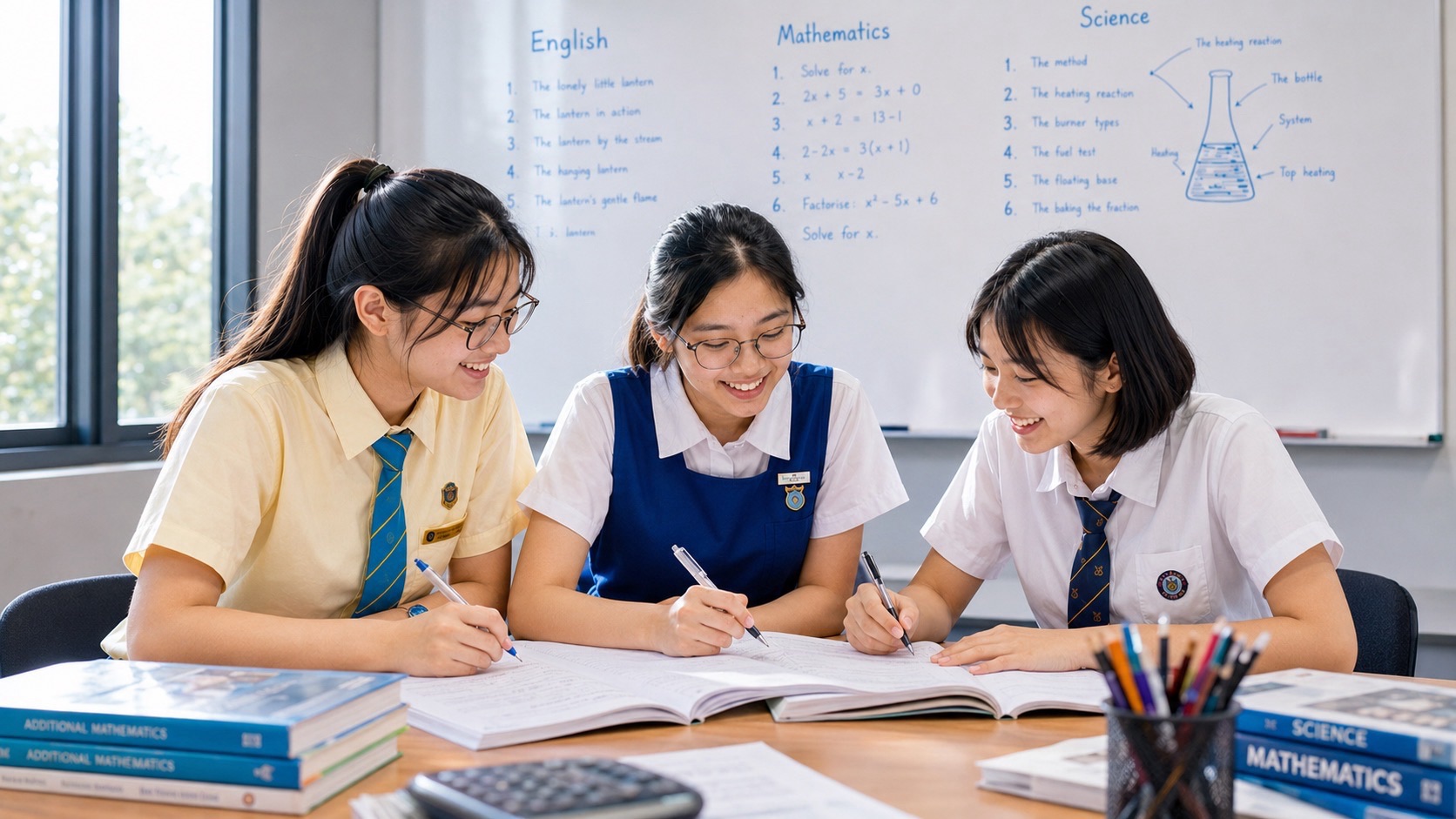
A three-student group can support the transition efficiently
One shared text can be read at different depths. One student works on literal accuracy, another inference, another analytical effect. The group can compare interpretations while preserving independent written proof.
Small groups also allow the tutor to hear each learner explain and track prompt depth across weeks.
Do not let the strongest reader answer first every time
Secondary discussion can hide weaker learners if one student supplies the interpretation. Use private annotation or written first responses before discussion.
The group should deepen thought, not distribute answers.
The first twelve weeks should create an error ledger
- Reading/reference error.
- Vocabulary/concept gap.
- Inference unsupported.
- Evidence copied but unexplained.
- Paragraph function unclear.
- Sentence or grammar instability.
- Argument too broad.
- Counterargument tokenised.
- Timing problem.
- Prompt dependence.
The ledger should identify recurring patterns and retire them when stable.
The first twelve weeks should create a prompt ledger too
Track whether the learner needs a full model, strong cue, light cue or no prompt for major processes.
Prompt reduction is one of the clearest signs that Secondary independence is developing.
The first twelve weeks should create a reading routine
School texts alone may not provide enough breadth. Establish a realistic routine for fiction, non-fiction, essays or journalism appropriate to the learner.
The objective is sustainable language exposure, not another daily conflict.
The first twelve weeks should create a revision routine
Secondary workload increases. Students need a repeatable way to revisit vocabulary, old errors, model paragraphs and reading notes without rereading everything passively.
Retrieval and spaced return become more important as subjects accumulate.
The first twelve weeks should create a help-seeking routine
“I don’t understand” is a starting point. The student should become more precise: which word, sentence, relationship or writing decision is unclear?
Better questions make teacher and tutor support more efficient.
The first twelve weeks should create an independent-start routine
Read the task, identify the demand, mark relevant evidence, write a brief plan and begin. The exact routine can vary, but the student should not wait passively for an adult to unlock every task.
Task initiation is part of Secondary readiness.
The first twelve weeks should create a checking routine
Checking should remain short and targeted. One learner checks question relevance, another tense, another evidence integration.
Generic “check your work” instructions should become personal checks based on error history.
The O-Level endpoint should inform but not dominate Secondary 1
The 2026 GCE O-Level English Language syllabus remains a later examination endpoint for relevant students, but Secondary 1 tuition should not reduce the first term to repeated O-Level papers. The early job is to build the reading, writing and independent-learning system that later examination performance will depend on.
Families can view the current 2026 O-Level syllabus listing on the Singapore Examinations and Assessment Board website.
What parents should ask at Week 4
- What Primary skills transferred well?
- What new Secondary demand is causing the most friction?
- Which error family is recurring?
- How much prompting is still needed?
- What is being deliberately deprioritised?
What parents should ask at Week 8
- Is the child using evidence more independently?
- Can paragraphs be planned without a full template?
- Is vocabulary becoming more precise?
- Has reading stamina improved?
- Which scaffold will be removed next?
What parents should ask at Week 12
- What is now stable?
- What still fails under changed texts or time?
- Has prompt depth reduced?
- Does school work show transfer?
- What are the one or two next-term bottlenecks?
- Does the current tuition format still fit?
Frequently asked questions
Should Secondary 1 students start O-Level practice immediately?
Not as the main programme. Early Secondary should strengthen transfer, reading depth, writing architecture and independence before high-volume examination rehearsal.
Why did my child’s English mark drop after Primary school?
The demand may have changed faster than the learner’s processes adapted. Analyse the specific error pattern before concluding that the whole subject is weak.
Should grammar still be taught?
Yes where it is unstable, especially inside authentic writing. Grammar should support sentence control rather than live only in isolated worksheets.
How important is reading?
Very important. Reading supports vocabulary, background knowledge, syntax, inference and argument material. The routine should remain sustainable alongside Secondary workload.
How do I know tuition is building independence?
Prompts, templates and parent rescue should reduce while performance remains stable in fresh tasks.
What should happen after the first twelve weeks?
The tutor should use the new learner map to choose a smaller set of next-term priorities rather than repeating the transition programme indefinitely.
Related eduKatePunggol reading
- Punggol English Tuition for Primary & Secondary | Move From Repair to Analysis as the Learner Grows
- Secondary English Tutorials | One Shared Text, Different Depths of Interpretation
- Secondary English Tuition | Move From Text Evidence to Independent Argument
- eduKate Punggol Contents & Learning Routes
The deeper rule: Secondary English begins by changing who carries the thinking
Primary skills remain valuable, but the learner is now expected to carry more reading, planning, evidence selection, interpretation and checking independently.
The first twelve weeks should therefore be a controlled transfer of responsibility. The tutor still teaches explicitly where needed, but every scaffold has a future removal date.
By Week 12, the student does not need to look like a finished Secondary 4 writer. The learner should simply be more capable of meeting Secondary English without relying on Primary-era shortcuts or constant adult rescue.
That is a strong first term: accurate reading, emerging analysis, clearer argument, more independent writing and a learning system ready to deepen.
Phase 1, Weeks 1–4: preserve strengths while exposing the new load
The first month should feel diagnostic without becoming remedial by default. A student who arrives from Primary school with good reading habits, clear sentences and strong oral language should keep those strengths. Tuition should not force the learner to restart from basic grammar simply because Secondary school has begun.
The purpose of Phase 1 is contrast. Give the student tasks that resemble earlier demands and tasks that introduce more Secondary-like density. Compare what changes. If vocabulary collapses but sentence control remains strong, protect sentence work from unnecessary remediation. If reading stays fluent but written evidence is weak, focus there.
Phase 2, Weeks 5–8: build the Secondary response architecture
The middle month should turn comprehension into explanation and ideas into organised paragraphs. Students begin learning that a Secondary response is not simply longer Primary writing. It is more accountable to evidence, paragraph purpose, reasoning and audience.
The tutor can use one shared text to practise several layers: literal meaning, inference, evidence selection, analysis and response. Writing tasks can then borrow one idea from the text and turn it into a structured paragraph.
Phase 3, Weeks 9–12: remove supports and add execution pressure
The final month of the transition should test what remains when scaffolds disappear. Templates become lighter. Questions become less leading. Texts become less familiar. Short timed sections appear. The learner must initiate more of the process.
This phase is important because a programme can look excellent while the tutor still carries too much invisible structure. Weeks 9–12 expose whether the student can reconstruct the system independently.
Reading should move from sentence tracking to text architecture
Primary students often focus on the sentence or question directly in front of them. Secondary reading increasingly rewards seeing the architecture of the whole text: introduction, development, contrast, example, shift, conclusion.
Teach students to ask what role a paragraph plays and how one section prepares the next. This makes longer texts easier because the learner has a map rather than a collection of sentences.
Reading should move from locating evidence to weighing evidence
At first, students need to find the relevant line. Later, they should ask whether the evidence is strong, direct, partial, limited or contradicted elsewhere.
This is a significant Secondary shift because interpretation becomes more nuanced. The student is no longer only asking “where is the answer?” but “how much does this evidence justify?”
Reading should move from theme words to developed ideas
A student may identify “friendship”, “technology” or “responsibility” as a topic. Secondary reading should deepen this into a statement about the topic: friendship may be tested by competing loyalties; technology may increase efficiency while reducing direct contact in some contexts; responsibility may become visible when convenience conflicts with duty.
This shift from topic to proposition supports both analysis and argument writing.
Vocabulary should move from memory lists to conceptual networks
Secondary students need words that carry abstract relationships: consequence, contradiction, implication, restraint, disproportion, credibility, autonomy, obligation, marginal, cumulative. These words become useful when attached to examples and contrasts.
A tutor can build word families and semantic contrasts so vocabulary supports thought rather than decoration.
Grammar should move from exercise accuracy to sentence architecture
Secondary writing requires students to manage more information within and across sentences. Grammar becomes a tool for organising thought: coordination, subordination, reference, modification and punctuation all affect clarity.
A student who scores well in isolated grammar exercises may still need help carrying grammar into analytical or argumentative paragraphs.
Writing should move from “what happened?” to “what is the paragraph doing?”
In narrative writing, a paragraph might establish pressure, reveal motive or show consequence. In argumentative writing, a paragraph might advance a reason, explain evidence or address a limitation.
Students should learn to see paragraphs as functional units rather than arbitrary blocks of text.
Writing should move from examples to explained examples
A Secondary paragraph can include a relevant example and still be weak if the student never explains why it matters. Teach the reasoning bridge explicitly.
Ask: what does this example demonstrate, under what conditions, and why should the reader accept the claim because of it?
Oral discussion should become rehearsal for written reasoning
Students can discuss a claim, offer evidence, hear a counterpoint and refine their position before writing. This externalises reasoning and gives the tutor a chance to correct logic before sentence-level work begins.
The final written response should still be independent. Oral work is the rehearsal space, not the final proof.
Listening should remain active even when the programme feels reading-heavy
Secondary students need to follow explanations, discussions and spoken information across subjects. Listening can be strengthened through note-taking, retelling, identifying main ideas and distinguishing supporting detail.
This also helps students manage classroom teaching where information arrives only once and cannot always be reread.
Secondary English should support other subjects through language control
As History, Geography and Science become more text-heavy, students need to parse instructions, interpret sources, explain causality and write clearly. Strong English does not replace subject knowledge, but it reduces the language friction around that knowledge.
This cross-subject transfer is one reason reading and evidence habits deserve early attention in Secondary 1.
The first twelve weeks should identify the new highest-carry bottleneck
Not every weakness deserves equal time. A reading-density problem can affect several subjects. Weak evidence integration can affect English and Humanities. Sentence control can affect almost every written response.
The tutor should rank bottlenecks by frequency, cost, transfer, prerequisite value and repairability.
Do not assume Secondary difficulty means harder vocabulary is the answer
Students often respond to a lower mark by collecting difficult words. Vocabulary matters, but the actual problem may be text navigation, paragraph structure, evidence, timing or prompt dependence.
Diagnose before prescribing.
Do not assume Secondary difficulty means more comprehension passages are the answer
If every passage reveals the same inference or evidence error, stop accumulating passages and repair the mechanism. Then return to full texts to test transfer.
Volume is useful after the process is sufficiently stable.
Do not assume Secondary difficulty means the child needs an O-Level paper
A Sec 1 learner may be challenged enough by ordinary school texts and new response demands. A distant exam paper can add difficulty without isolating the actual transition problem.
Use the later exam as an endpoint reference, not as the starting curriculum.
Do not preserve Primary scaffolds simply because they once worked
Sentence frames, model phrases, fixed story arcs and teacher-led planning may have helped earlier. Some can remain temporarily, but the student should not carry every Primary scaffold indefinitely into Secondary school.
The first twelve weeks are a good period for deliberate scaffold review.
Do preserve Primary habits that compound
Reading regularly, asking about unfamiliar words, planning before writing, correcting errors, speaking in complete ideas and reviewing school feedback remain valuable.
Transition should deepen good habits, not erase them in the excitement of “Secondary-level” work.
The learner should become responsible for materials and deadlines
Secondary school increases organisational demand. Students should gradually manage school papers, writing drafts, vocabulary notes and assignment deadlines with less parent reconstruction.
This operational independence supports academic independence because the tutor can work from complete evidence rather than missing materials.
The learner should become responsible for identifying uncertainty
Instead of saying “I don’t get the passage,” the student should locate the problem: unfamiliar word, confusing reference, unclear paragraph purpose, weak inference or uncertain question demand.
Precise uncertainty leads to more efficient help.
The learner should become responsible for first revision
Before the tutor corrects a paragraph, the student can perform one self-check. Is the point clear? Is there evidence? Does the sentence say what was intended? Has the task been answered?
The tutor then works on what the learner could not catch independently.
The tutor should track what no longer needs to be said
At Week 1, the tutor may remind the student to identify paragraph purpose. By Week 6, the prompt should be lighter. By Week 12, the learner may annotate function independently.
Disappearing prompts are evidence of successful transition.
A twelve-week programme should not produce twelve disconnected topics
The weeks should form a cumulative system. Text navigation supports evidence. Evidence supports analysis. Analysis feeds argument. Vocabulary sharpens all of them. Prompt fading makes the whole system independent.
Students should feel that each week builds on the last rather than resets with a new worksheet theme.
A strong Week 12 student may still have lower marks than expected
Marks are important, but transition can reveal leading indicators before a major assessment changes. Reading may be faster, paragraphs clearer, prompts fewer and error patterns more specific.
These changes matter because they indicate the learning system is becoming stronger even if the next school paper has not yet arrived.
A strong Week 12 student should be easier to diagnose
The learner should be able to explain what is still difficult. The tutor should have a smaller and more precise error ledger. Parents should know what the next term is for.
Clarity is itself a transition outcome.
A useful Week 12 parent update
“Reading accuracy is secure and vocabulary is improving. The current bottleneck is analytical explanation: your child identifies the feature and evidence but still needs one prompt to connect effect to purpose. Planning is now independent, so we are removing the paragraph frame next term.”
This kind of update shows continuity, independence and next action.
A weak Week 12 update
“We covered comprehension, grammar, vocabulary and composition.” This describes curriculum exposure but not learner change.
The first twelve weeks should leave the family with more than a list of topics.
The final twelve-week checklist
- Primary strengths preserved.
- Secondary reading density tested.
- Evidence use made explicit.
- Vocabulary moved toward nuance and concepts.
- Paragraph functions understood.
- Analysis introduced without technique hunting.
- Argument and counterargument begun.
- Scaffolds reduced.
- Timing introduced after stability.
- Fresh texts used for transfer.
- Prompt depth tracked.
- Next-term bottlenecks named.
If these twelve conditions are visible, the transition has a coherent shape.
The final transition standard
Secondary English should make the learner more capable of carrying meaning across longer texts, supporting claims with evidence, organising paragraphs deliberately and beginning tasks with less external prompting.
The first term does not need to prove final examination readiness. It needs to build the reading and writing operating system from which later readiness can grow.
That is the right ambition for the first twelve weeks after Primary English: not premature examination drilling, but a controlled transfer into deeper, denser and more independent language work.
The Week 12 transfer test should look unfamiliar
A transition programme is only convincing if the student can carry its routines into a text or prompt that was not rehearsed. Use a new genre, unfamiliar issue or fresh writing demand. Remove some of the headings and sentence frames used earlier.
The learner should still know how to locate the main idea, select evidence, distinguish inference from assertion, organise a paragraph and ask a precise question when genuinely stuck.
The Week 12 transfer test should not be a surprise exam
The purpose is diagnosis, not punishment. Students should know they are being asked to use the same processes in a changed context. What changes is the surface material and the amount of external support.
This lets the tutor see whether the learner owns the method rather than whether the learner can endure an unexpected stress test.
The Week 12 writing test should separate thinking from sentence accuracy
A student may have a strong argument and weak grammar, or polished grammar and shallow reasoning. Mark these layers separately enough that the next term can target the correct one.
Secondary English improves faster when “writing” is not treated as one undifferentiated skill.
The Week 12 reading test should separate access from depth
If vocabulary and sentence density still consume most of the student’s attention, analysis will remain expensive. If reading access is now fluent but interpretations remain unsupported, the next bottleneck is deeper.
The programme should know which layer has become the new constraint.
The Week 12 independence test should look at adult help outside tuition
Ask whether homework still requires a parent to sit beside the child, whether the student can start reading tasks independently, whether school deadlines are being tracked and whether the learner can bring the correct materials without repeated adult rescue.
Secondary readiness includes operational independence as well as language skill.
A successful transition should create fewer emergency interventions
At the beginning of Secondary 1, every new text or task can feel urgent because the student has not yet built stable routines. By the end of a strong first term, fewer assignments should require last-minute rescue.
The learner begins recognising task types, planning earlier, asking better questions and recovering from difficulty without immediately escalating to an adult.
A successful transition should make later exam preparation cheaper
Students who learn evidence, paragraph function, reading navigation, argument and self-checking early do not need to rebuild all of those systems in Secondary 4. Later exam preparation can focus more on integration, timing and refinement.
This is why the first twelve weeks matter even though they are not high-stakes examination preparation. They reduce future repair cost.
A successful transition should preserve curiosity
Secondary English becomes more analytical, but it should not become emotionally narrower. Students should still encounter interesting stories, ideas, debates and language. Analysis works better when the child has something worth thinking about.
A programme that turns every text into an exam drill too early may improve compliance while weakening reading life.
The learner should finish the first twelve weeks with a usable self-description
A mature transition statement might sound like: “I can understand the text, but I still need to explain evidence more clearly,” or, “My ideas are fine, but my paragraphs drift because I do not decide their function first.”
This is much more useful than “Secondary English is hard”. The child now has a specific problem and a specific next move.
That is the final outcome worth carrying into the next term: a student who knows more about how Secondary English works, knows more about how they personally work, and needs less invisible adult structure to connect the two.
The final first-term question
At the end of Week 12, parents do not need to ask whether the child has already become an O-Level student. The better question is whether the learner now carries Secondary English with less friction than in Week 1.
Can the student read a denser text without losing the paragraph structure? Can evidence be selected without the tutor pointing to the line? Can one analytical paragraph be built without a full template? Can a writing task begin independently? Can the learner identify a personal error before an adult does?
If those answers are increasingly yes, the transition is working. Later years can build more sophisticated argument, style and examination execution on top of a system that is already becoming self-managed.
The first twelve weeks should therefore end with less rescue, better questions, stronger transfer and a smaller set of clearly named next problems. That is a far stronger foundation than simply having completed twelve weeks of harder worksheets.
One final sign of success is that the child can explain the transition in specific language. Instead of “Secondary English is harder,” the learner can say that texts are denser, evidence must be explained, paragraphs need a clearer function, vocabulary is more abstract, or timing becomes harder when the task mixes several language demands. That self-description is useful because it turns difficulty into something observable and repairable.
From there, the next term can deepen rather than restart. The tutor knows what is stable, the student knows what still requires attention, and parents can evaluate the programme from changed work rather than from the idea that more difficult worksheets automatically mean better preparation.
The transition is complete enough when the learner no longer needs Primary-era certainty for every task. New texts can be approached, uncertainty can be located, evidence can be tested and writing can begin before an adult supplies the whole route. Secondary English then becomes a system the student can enter independently rather than a subject that must be unlocked from outside each time.
That shift matters because later Secondary success depends less on how much support a student once received and more on how much of the reading, reasoning, planning and checking process the learner can now carry alone. A good first-term tuition programme should therefore leave the child with stronger English and with a more independent way of doing English.


