
Dialogue should do more than make a composition look lively. A useful line of speech reveals what a character wants, changes another character’s understanding, increases pressure or causes the next action. If the dialogue can be removed without changing the story, it may be decoration.
This page has one job: help families around Punggol Green Primary use dialogue to reveal intention, change the scene and move the story forward.
Independence note: eduKatePunggol is an independent tuition provider. This page serves families searching around Punggol Green Primary and does not imply affiliation with, endorsement by or representation of Punggol Green Primary School.
For current Primary English programme information, continue to Primary English Tuition in Punggol. This legacy school-area URL now owns purposeful dialogue.
Dialogue needs a job
- reveal a goal;
- give a warning;
- create disagreement;
- hide information;
- ask for help;
- change a decision;
- show a relationship;
- trigger the next event.
“Let’s go,” is weak unless going somewhere matters. “If we leave now, we can still reach the gate before it closes,” reveals urgency and creates a decision.
Use dialogue to expose intention
Characters become more believable when the reader understands what they are trying to achieve.
- “Don’t tell Mum yet.” → wants to hide a mistake.
- “We should hand it in.” → values responsibility.
- “Just one more round.” → wants to keep playing despite risk.
- “Wait here. I’ll get help.” → chooses a practical response.
The line works because it changes how we understand the character.
Dialogue should interact with action
Speech becomes stronger when it causes something.
- Character speaks.
- Another character reacts.
- A choice follows.
- The situation changes.
This creates a live scene rather than a transcript floating inside the story.
Avoid dialogue that explains what everyone already knows
Students sometimes write unnatural lines to deliver background information:
“As you know, we have been best friends since Primary One and today is our school carnival.”
Real people rarely speak this way. Put necessary background into narration unless there is a believable reason for a character to say it.
Speech tags should stay simple
Students do not need a different dramatic verb for every line.
- said;
- asked;
- replied;
- whispered;
- shouted;
Use a stronger tag only when volume or manner matters. Often the dialogue and surrounding action should carry the emotion.
Action beats can replace speech tags
Instead of “she said nervously”, show behaviour:
Mei kept her eyes on the floor. “Maybe we should put it back.”
The action reveals hesitation. The speech reveals intention.
Punctuation must support readability
Primary students should learn a reliable dialogue format rather than creative punctuation experiments. The exact convention taught should remain consistent with standard written English: quotation marks around speech, punctuation placed correctly, and a new paragraph when the speaker changes.
Sentence control matters more than using many lines of speech.
The three-line dialogue test
Ask a student to write only three lines of dialogue. Each line must change something.
- Line 1 introduces pressure or a goal.
- Line 2 creates disagreement or new information.
- Line 3 produces a decision.
This teaches purpose before quantity.
Dialogue and character relationships
Speech can show hierarchy, familiarity and tension.
- friend-to-friend language can be direct;
- child-to-adult language may be more careful;
- someone hiding a mistake may avoid clear answers;
- someone angry may shorten responses;
- someone trying to persuade may give reasons.
The student should think about who is speaking to whom, not merely insert quotation marks.
Current PSLE writing context
For 2026 PSLE English Language 0001, Continuous Writing requires a composition based on the given topic and at least one of three pictures. Dialogue is optional. It should appear only when it supports the student’s chosen story and overall language control.
Official reference: 2026 PSLE English Language syllabus.
P3–P6 dialogue progression
- P3: correct quotation format and simple purposeful speech.
- P4: dialogue begins to create cause-and-effect.
- P5: speech can reveal motivation and relationship.
- P6: dialogue remains concise and purposeful under time.
What a 3-pax writing class can do
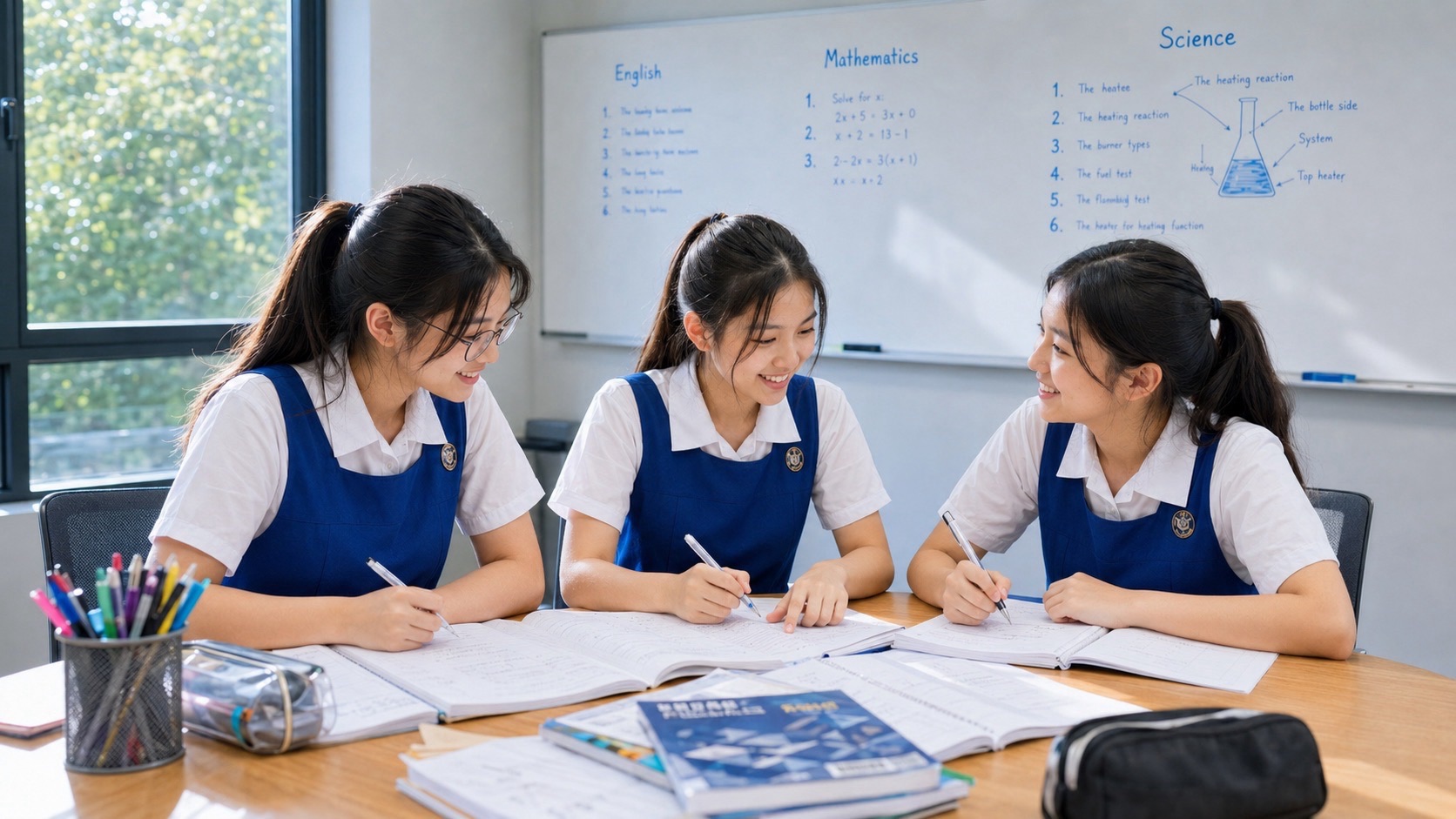
eduKatePunggol’s current model is up to three students, typically for 1.5 hours. Dialogue works well in a small group because students can hear whether speech sounds natural.
- one student reads a line aloud;
- another identifies the speaker’s intention;
- a third predicts the next action;
- the tutor checks punctuation and relevance;
- each student rewrites the exchange individually.
Oral testing exposes unnatural dialogue quickly.
When dialogue practice may help
- dialogue appears only to decorate;
- characters talk without changing the story;
- background is delivered unnaturally;
- speech tags are overcomplicated;
- punctuation is unstable;
- every scene becomes a long conversation;
- characters all sound the same.
Progress receipts
- dialogue becomes shorter but more useful;
- speaker intention is clearer;
- speech triggers believable action;
- punctuation errors decrease;
- characters sound more distinct;
- students remove dialogue that does no story work.
Continue to current Primary English tuition
For current programme information, continue to Primary English Tuition in Punggol.
About this rebuilt legacy page
The original Punggol Green-area page was another school-name copy with outdated 4–6-student positioning and an unsupported 2–5-grade claim. This 2026 update removes those elements and gives the URL one distinct craft job: dialogue that reveals intention and changes the story.


