
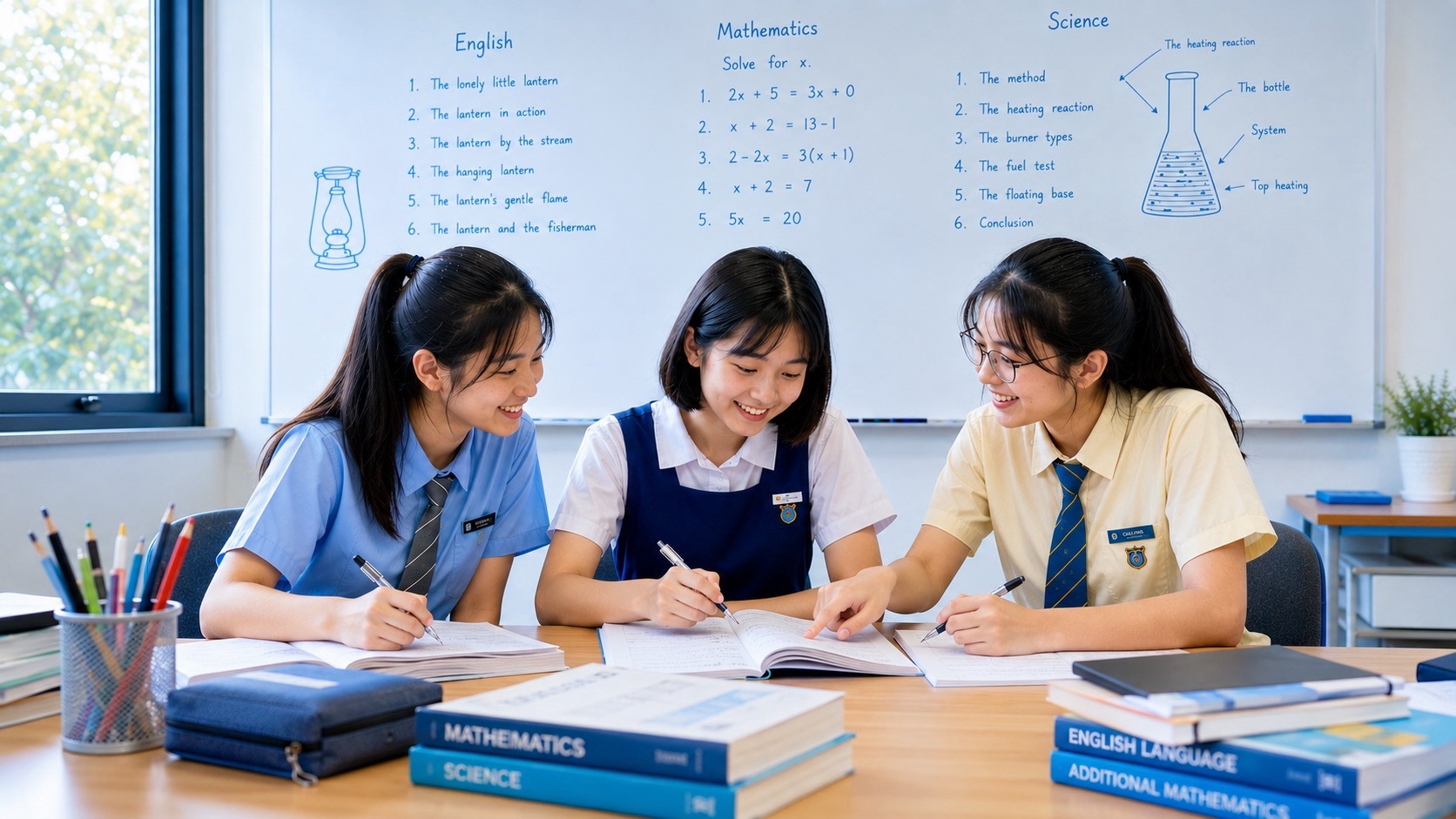
A composition opening has one main job: get the reader into the right story quickly. It does not need thunder, screaming, a dictionary word or a memorised quotation. A strong Primary-school opening establishes enough of the situation for the first meaningful change to matter.
This page has one job: help families around Punggol Cove Primary teach openings that establish situation → pressure → disturbance without relying on memorised hooks.
Independence note: eduKatePunggol is an independent tuition provider. This page serves families searching around Punggol Cove Primary and does not imply affiliation with, endorsement by or representation of Punggol Cove Primary School.
For current Primary English programme information, continue to Primary English Tuition in Punggol and, for Primary 6, Primary 6 PSLE English Tuition. This legacy school-area URL now owns opening craft.
Start with the story state
Before something can change, the reader needs to know what was normal. That does not require a long background paragraph. Two or three precise pieces of information can be enough:
- where the character is;
- what the character wants;
- what the character is doing;
- who else matters;
- what small pressure already exists.
Example: a student at a school fair wants to win a game before the crowd becomes too large. That already creates setting, goal and pressure. The story can move.
The opening should create a useful disturbance
A disturbance is the moment that changes the normal state. It may be small.
- a warning is ignored;
- an object is lost;
- a friend makes a risky suggestion;
- a message arrives;
- the weather changes;
- someone needs help;
- a misunderstanding begins.
The disturbance gives the middle of the story something to develop. An opening that is beautiful but causes nothing can leave the writer stranded.
Four opening types students can control
1. Action opening
Begin with an action already connected to the main event. This works when the student can orient the reader quickly.
2. Situation opening
Establish place, people and goal, then introduce the disturbance. This is reliable for many Primary writers.
3. Dialogue opening
Use dialogue only if it immediately reveals a goal, warning, disagreement or important information. “Good morning!” is rarely enough on its own.
4. Observation opening
Begin with one meaningful detail that affects the character: the empty seat, the darkening sky, the locked gate, the unfamiliar bag. The detail must connect to the story.
Why memorised hooks become dangerous
Memorised hooks feel safe because students can reproduce them under pressure. The problem is relevance.
- weather descriptions appear even when weather does not matter;
- dramatic quotations are unrelated to the topic;
- “It was a bright and sunny day” delays the real story;
- the same opening appears in every composition;
- students spend time adapting a memorised paragraph rather than planning the actual prompt.
A useful opening is specific enough that it belongs to this story.
Use the deletion test
Delete the first paragraph and ask: does the story lose important information? If almost nothing changes, the opening may be decorative.
Then try the opposite test: can the opening be shortened while preserving situation, goal and disturbance? If yes, make it leaner.
Openings should match the PSLE topic and picture interpretation
For 2026 PSLE English Language 0001, Continuous Writing provides a topic and three pictures, and the composition must be based on at least one of the pictures. The opening should make the student’s interpretation of the topic visible early enough that relevance is clear.
Official reference: 2026 PSLE English Language syllabus.
The first-paragraph planning card
- Where are we?
- Who matters?
- What does the main character want?
- What pressure already exists?
- What changes?
Those five answers are usually more useful than trying to memorise “interesting beginnings”.
P3 to P6 progression
- P3: clear situation and simple disturbance.
- P4: opening begins to establish cause and pressure.
- P5: more selective detail and stronger character goal.
- P6: relevance and story direction become clear quickly under time.
What a 3-pax writing class can do
eduKatePunggol’s current model is up to three students, typically for 1.5 hours. One prompt can generate three different openings.
- Student A uses action.
- Student B establishes situation first.
- Student C uses purposeful dialogue.
- The group checks which details are necessary.
- Each continues into an individual story.
The point of comparison is judgement, not choosing one “best” opening for everyone to copy.
When opening practice may help
- the student spends too long on the first paragraph;
- every composition begins the same way;
- the story starts far before the important event;
- the opening is dramatic but irrelevant;
- the student cannot transition from opening into conflict;
- timed writing gets stuck before the middle begins.
Progress receipts
- openings become shorter and more specific;
- the main situation is clear quickly;
- the disturbance appears earlier;
- memorised weather and quotation hooks decline;
- students transition into the middle without losing direction;
- different prompts produce genuinely different openings.
Continue to current Primary English tuition
For current programme information, continue to Primary English Tuition in Punggol.
About this rebuilt legacy page
The original Punggol Cove-area page was a large school-name creative-writing advertisement with outdated 4–6-student language and an unsupported 2–5-grade improvement claim. This 2026 update removes those elements and gives the legacy URL one distinct craft job: build an opening that starts the actual story.


