
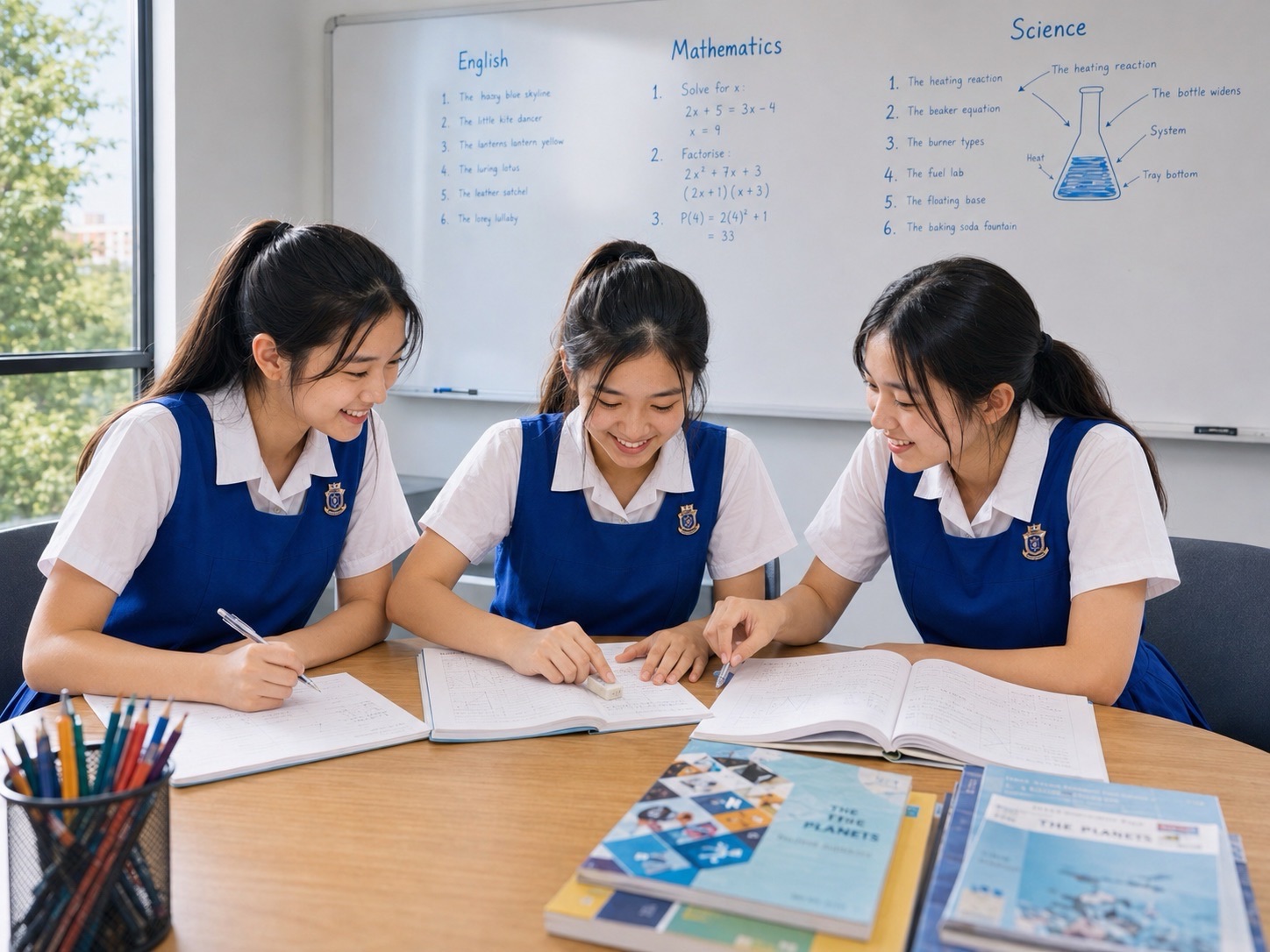
In PSLE Continuous Writing, the pictures are not three stories waiting to be copied. They are three possible angles into one topic. The student’s job is to choose at least one picture, interpret it in a way that fits the topic, and build an original composition whose events remain relevant from beginning to end.
This page has one job: help families around Edgefield Primary understand how to choose among the three PSLE pictures and turn the choice into a coherent original story rather than a picture-by-picture description.
Independence note: eduKatePunggol is an independent tuition provider. This page is for families searching around Edgefield Primary and does not imply affiliation with, endorsement by or representation of Edgefield Primary School.
For current Primary English programme information, continue to Primary 6 PSLE English Tuition and the wider Primary English Tuition route. This legacy school-area page now owns picture selection and original story construction.
What the current PSLE format actually asks
For 2026 PSLE English Language 0001, Continuous Writing gives candidates a topic and three pictures offering different angles of interpretation. The composition must be based on at least one of the pictures and contain at least 150 words.
Official reference: 2026 PSLE English Language syllabus.
That means the pictures are prompts, not a sequence that must all appear.
Step 1: read the topic before the pictures
Students sometimes choose a picture immediately because it looks interesting. The topic is the governing condition.
- What is the exact topic?
- What kinds of events would still be relevant?
- What kinds of stories would drift away from it?
- What emotional or social situation does the topic allow?
The topic determines whether a picture interpretation is useful.
Step 2: interpret each picture as a possibility
For each picture, generate one or two possible story functions.
- setting;
- problem trigger;
- important object;
- character relationship;
- turning point;
- consequence.
A picture of a phone, for example, could be a distraction, a communication tool, evidence, a source of misunderstanding or a way to seek help. Interpretation should remain plausible and relevant.
Step 3: choose the picture with the strongest story potential for you
The “best” picture is not universal. Choose the one that gives the student:
- a clear situation;
- a believable problem;
- a manageable number of characters;
- enough vocabulary and knowledge;
- a resolution the student can actually complete.
Do not choose the picture that looks most dramatic if the child cannot build a coherent story from it.
Step 4: decide the picture’s job in the story
Before drafting, state the function clearly.
- “This picture triggers the problem.”
- “This picture is the setting.”
- “This object causes the misunderstanding.”
- “This is what the character discovers.”
If the picture has no clear job, it may be inserted awkwardly just to satisfy the format.
Step 5: build a cause-and-effect chain around the picture
- Normal situation
- Picture-linked trigger
- Character response
- Consequence
- Escalation or decision
- Resolution
The picture can appear once and still support the entire composition if it genuinely causes the story.
You do not get extra quality by forcing all three pictures
Using all three pictures can work when they fit naturally. It can also create an overloaded story with too many objects, characters or events.
The question should be:
- Does this additional picture strengthen the story?
- Does it create a useful consequence?
- Can I integrate it without losing the topic?
If not, one well-used picture is enough under the current syllabus requirement.
Avoid picture description as composition
A composition is not a caption. Students can use details from the image, but the story must move beyond what is visibly shown.
- What happened before?
- Why is this moment important?
- What choice follows?
- What changes because of it?
- How will the event resolve?
Avoid the memorised-story trap
Some students see a picture and try to map it onto a memorised composition. That can create relevance problems.
Use this deletion test:
- If I remove the topic, does my story still look exactly the same as a previous composition?
- If I replace the picture, would almost nothing change?
If yes, the story may be too pre-built.
Originality does not mean strange
An original story can be ordinary and believable. Originality comes from the student’s choices, details, character behaviour and voice—not from inventing an extreme plot.
- a misunderstanding;
- a lost item;
- a broken promise;
- a moment of responsibility;
- a difficult decision;
- an unexpected act of help.
Simple situations can produce strong writing when they are developed well.
The two-minute picture triage
Under timed conditions, picture selection cannot consume the whole planning window. Practise a fast triage:
- Read topic.
- Look at all three pictures.
- Generate one possible story job for each.
- Reject the options that feel forced or too complex.
- Choose the clearest route.
- Plan the ending before drafting.
What a 3-pax writing class can do
eduKatePunggol’s current model is up to three students, typically for 1.5 hours. A three-picture prompt is especially useful for peer comparison.
- each student chooses a different picture;
- each explains the picture’s story job;
- the group checks relevance to topic;
- the tutor challenges weak causal links;
- each student writes independently.
The same prompt should produce three plausible but different stories.
When tuition may help
- the student chooses pictures randomly;
- all three pictures are forced into every story;
- writing becomes picture description;
- memorised stories override the actual topic;
- planning takes too long;
- the child cannot identify how the chosen picture affects the story.
A student who already interprets prompts flexibly and writes relevant original stories may not need separate tuition for this skill.
Progress receipts
- picture choice becomes faster and more deliberate;
- the picture has a clear role in the plot;
- stories stay relevant to the topic;
- fewer unrelated details are forced in;
- different prompts produce genuinely different stories;
- students can explain why their chosen picture works.
Continue to current PSLE English tuition
For current Primary 6 class information, continue to Primary 6 PSLE English Tuition at eduKatePunggol.
About this rebuilt legacy page
The original Edgefield-area creative-writing page was one of several near-identical school-name copies and claimed general 2–5-grade improvement. This 2026 update removes that claim and assigns a unique job: picture selection and original story construction under the current PSLE Continuous Writing format.


