
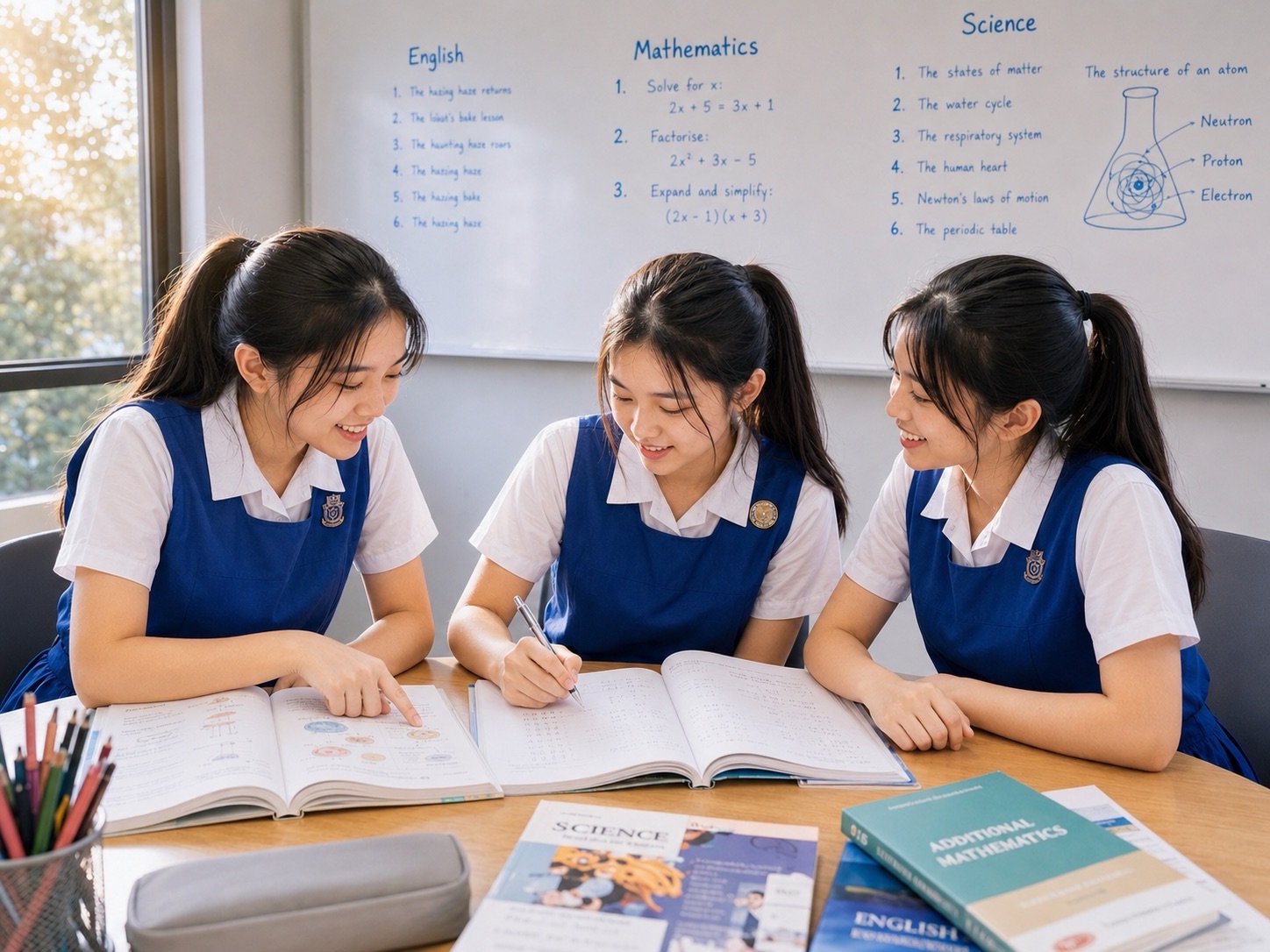
Real-world examples can make English, Mathematics and Science easier to understand—but only when the example clarifies the underlying idea. A story about a market, a train journey, a museum, a storm or a city can create meaning. It can also become decorative noise if the student remembers the story but not the concept.
This legacy page has one job: help Punggol families understand when real-world context improves transfer across English, Mathematics and Science, and when tuition should return quickly to the abstract skill or syllabus concept.
For current subject programmes, use the individual English, Mathematics and Science routes. This older multi-subject page now owns real-world-context transfer.
Context has one educational job: make structure easier to see
A useful context gives the student something concrete enough to reason with.
- English: a real situation supplies vocabulary, viewpoint and purpose.
- Mathematics: a journey, purchase or map supplies quantities and relationships.
- Science: an observed phenomenon supplies evidence for a model or mechanism.
Once the structure is understood, the student should be able to use it in another context. That is the transfer test.
English: context builds knowledge and language
English becomes easier when students have enough background knowledge to understand texts and generate ideas.
- a market can introduce language of trade, crowd movement and description;
- a heritage site can support vocabulary about place, culture and observation;
- a transport problem can generate discussion about responsibility or inconvenience;
- a news article can build informational reading and viewpoint.
The tutor should then ask the student to reuse the language or idea in a new text, oral response or writing task.
English failure mode: the interesting story replaces the language job
A class can discuss a fascinating place for twenty minutes and still produce little English learning. The context needs a language output.
- new vocabulary used accurately;
- a paragraph summarised;
- a viewpoint explained;
- a writing detail transferred;
- an oral response developed.
If the student cannot identify what language skill improved, the context may have become entertainment.
Mathematics: context reveals relationships
Real-world Mathematics can help students understand why quantities relate.
- speed from distance and time;
- percentage through discounts or change;
- ratio through mixtures or scale;
- area and volume through design or packaging;
- graphs through changing quantities;
- statistics through real data.
The context is useful when it helps the student build a representation—table, model, equation, diagram or graph.
Mathematics failure mode: context adds reading load
Some students understand the Mathematics but become confused by a long story around it. In that case, simplify the context until the relationship is visible.
- strip away irrelevant detail;
- label the quantities;
- draw the relationship;
- solve the abstract core;
- return to the original context.
The context should support the Mathematics, not hide it.
Science: context connects models to observations
Science is especially dependent on the relationship between model and observation.
- condensation on a cold surface;
- friction in movement;
- plant responses to light;
- energy changes in everyday devices;
- water movement through systems;
- forces in familiar objects.
The tutor can ask: what do we observe, which scientific concept explains it, and what mechanism connects the two?
Science failure mode: anecdote replaces evidence
A personal experience may be memorable but is not automatically good scientific evidence. Students need to distinguish an observation from a conclusion and a story from a controlled investigation.
Real-world examples should return to scientific vocabulary, variables and mechanisms.
The three-step context test
- Clarify: did the context make the idea easier to understand?
- Abstract: can the student state the underlying rule, relationship or language skill?
- Transfer: can the student use it in a different context?
If step two or three fails, the context has not yet become learning.
Use local, ordinary experiences
Real-world learning does not require expensive travel. Punggol itself provides useful contexts.
- weather and water;
- transport and travel time;
- parks and ecosystems;
- shops and percentage;
- architecture and geometry;
- community events and English writing;
- graphs from everyday data.
The educational value comes from observation and reasoning, not prestige of location.
A useful field-note format
- What did I notice?
- What question does it raise?
- Which English, Math or Science idea connects?
- What evidence supports the connection?
- How could I use this idea in a school task?
This turns ordinary experience into reusable learning material.
Real-world examples should become less necessary over time
A context can be a scaffold. Once the student understands the underlying structure, the learner should also be able to work with abstract representations.
- Math: move from shopping story to percentage equation.
- Science: move from cold-drink condensation to particle/process explanation.
- English: move from one travel anecdote to general control of description and viewpoint.
If the learner always needs the same story, the scaffold has not faded.
How a 3-pax class can use context
eduKatePunggol’s current model is up to three students, typically for 1.5 hours. A shared context can produce different subject reasoning.
- English student describes and interprets;
- Math student quantifies and represents;
- Science student explains mechanism and evidence.
Within one subject class, three students can also offer different interpretations or representations, then test which one transfers best.
What to preserve from the old 2017 travel archive
The original page was almost entirely a large travel-photo archive. The useful principle behind those images was that the world can supply material for learning. This rebuild keeps that principle but removes the implication that travel itself is the lesson. Ordinary observation is enough.
When context-rich tuition may help
- the student memorises rules without understanding;
- English ideas and vocabulary are thin;
- Math word problems feel detached from relationships;
- Science facts are known but mechanisms are not;
- the learner needs a bridge from concrete experience to abstract school work.
A student who already transfers confidently may need less context and more abstract or examination practice. Context is a tool, not a permanent teaching style.
Progress receipts
- students can state the underlying idea after the example;
- the same idea works in a new context;
- English vocabulary becomes more usable;
- Mathematical relationships become easier to represent;
- Science explanations connect observation to mechanism;
- interesting examples no longer distract from the learning job.
Continue to current subject routes
For current programme information, continue to the English, Mathematics and Science pathways.
About this rebuilt legacy page
The original “English Math Science Tuition Punggol” page was dominated by travel photographs. This updated 2026 version of the guide extracts the educational principle worth preserving: real-world context helps only when it clarifies a subject structure and transfers back into independent English, Mathematics or Science.


