
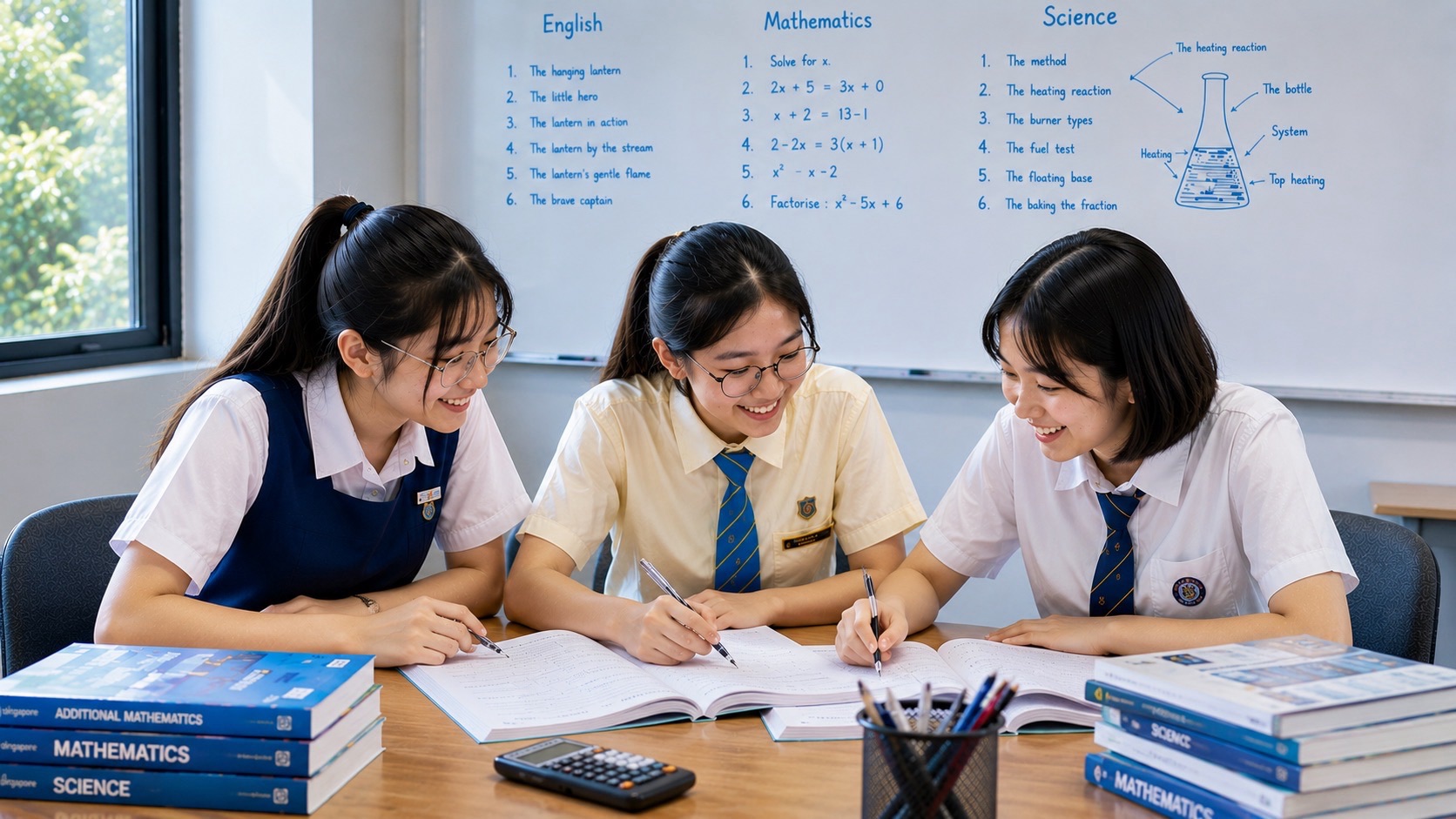
A Secondary Mathematics tutor should not teach a Sec 1 student and a Sec 4 student in the same way. The subject develops from foundation-building and representation into cumulative retrieval, method selection, examination timing and—where taken—Additional Mathematics. The tutor’s role should change as the learner becomes more capable.
This legacy page has one job: show Punggol families how the tutor’s role should evolve from Sec 1 through Sec 4 instead of remaining a permanent source of explanations and first-step prompts.
For current level-specific programme information, use The Secondary Pathway and the current Mathematics pages. This older URL now owns the tutor-role progression.
Sec 1: translate the new mathematical language
Sec 1 students are crossing from Primary Mathematics into a more symbolic subject. The tutor’s job is to make that change intelligible.
- connect arithmetic to algebra;
- explain negative numbers and equivalence clearly;
- show how equations represent relationships;
- make working inspectable;
- teach the student to start unfamiliar questions without panic.
The tutor should initially provide more structure, but even here the goal is to remove support once the student understands the language.
Sec 2: test whether the foundation transfers
By Sec 2, the tutor should spend less time translating every step and more time checking whether the student can retrieve and select methods independently.
- mix older and current topics;
- ask the student to explain why a method applies;
- compare equation, graph and geometric representations;
- track recurring algebra errors;
- prepare the student for the upper-secondary jump.
Sec 2 is a useful year to discover whether the learner can operate without chapter labels.
Sec 3: manage the load
Sec 3 often increases the mathematical load sharply, especially for students taking Additional Mathematics. The tutor should now help the student prioritise.
- repair prerequisites before they spread;
- separate E-Math maintenance from A-Math repair;
- increase mixed-topic retrieval;
- teach more efficient working;
- begin realistic timed sections without turning every lesson into exam drill.
The tutor’s job becomes partly architectural: keep the student’s Mathematics system coherent while new topics arrive.
Sec 4: become a calibration partner
In Sec 4, the tutor should increasingly stop being the main source of content and become a high-resolution calibration partner.
- analyse prelim and practice-paper errors;
- rank the repair queue;
- distinguish knowledge from execution failure;
- train timing, checking and recovery;
- protect stable topics from rusting;
- reduce prompts so exam performance becomes independent.
A Sec 4 student who still needs the tutor to identify the first step of most questions has not completed the handoff to examination independence.
The tutor should change the amount of help, not only the worksheet difficulty
Progression is not simply easier questions becoming harder questions. The support level should change too.
- model the method;
- solve jointly;
- use one discriminating prompt;
- observe an independent attempt;
- retest later without support;
- use a changed context to test transfer.
The student should require less tutor intervention for the same type of decision over time.
Current national examination context
For 2026 O-Level school candidates, SEAB lists Mathematics as 4052 and Additional Mathematics as 4049. From 2027, school candidates move into the Secondary Education Certificate framework, so the tutor should follow the student’s actual cohort and subject level rather than outdated streaming labels.
Official references: SEAB 2026 O-Level syllabuses and SEAB 2027 SEC G3 syllabuses.
A tutor should diagnose failure states, not personalities
“Careless”, “weak at Math” or “not confident” are too broad. Better labels describe what failed:
- concept missing;
- prerequisite missing;
- method not recognised;
- working invalid;
- knowledge not retrieved;
- question misread;
- time decision poor;
- checking absent.
The teaching move should match the failure.
When the tutor should teach from scratch
Teach from scratch when the underlying concept is genuinely missing. Do not restart an entire chapter because the student made one execution error.
- restart meaning when equivalence is misunderstood;
- repair fractions if they repeatedly break algebra;
- return to coordinate basics if graphs are unstable;
- rebuild a geometry property if the student cannot justify its use.
Once the prerequisite is restored, return to age-appropriate work quickly.
When the tutor should teach ahead
Teach ahead when current work is independent, retained and transferable. Preview can lower school friction. It should not become a prestige metric or a way to avoid consolidation.
What a 3-pax Secondary Math lesson can look like
eduKatePunggol’s current model is up to three students, typically for 1.5 hours. The tutor can give a shared mathematical core while adjusting support and demand.
- Student A receives prerequisite repair.
- Student B completes the normal task independently.
- Student C gets a harder transfer question.
- All compare methods and error types.
- The tutor records who still needs first-step prompting.
The tutor’s value lies in choosing the right intervention, not keeping all three students equally busy.
Parent questions by stage
- Sec 1: Is my child understanding the new mathematical language?
- Sec 2: Can my child retrieve and mix topics?
- Sec 3: Are prerequisites and E/A-Math workload being managed?
- Sec 4: Is the tutor reducing prompts and improving exam execution?
When tuition may help
- school pace is ahead of the actual foundation;
- the same mathematical failure repeats across topics;
- the learner needs closer observation than school work provides;
- Sec 3–4 workload needs better prioritisation;
- exam-paper errors are not becoming repairs.
A student who is progressing independently and using school consultation effectively may not need another weekly class.
What this page no longer claims
The original page used aggressive distinction language and framed tuition as constant pressure towards being “the best”. This rebuild removes that framing. Strong Mathematics education should increase competence, judgement and independence—not dependence on external pressure.
Progress receipts
- Sec 1 students need less translation of basic algebra;
- Sec 2 students retrieve older topics more reliably;
- Sec 3 students manage E/A-Math without one erasing the other;
- Sec 4 students make better paper decisions;
- the tutor’s prompts become fewer and less specific over time.
Continue through the current Secondary pathway
For current level-specific Mathematics pages, continue through The Secondary Pathway.
About this rebuilt legacy page
The original “Secondary Maths Tutor Punggol” page was a broad distinction-oriented sales page. This 2026 update gives it a durable reader job: explaining how the tutor’s role should evolve from foundation translator in Sec 1 to examination-calibration partner in Sec 4.


