
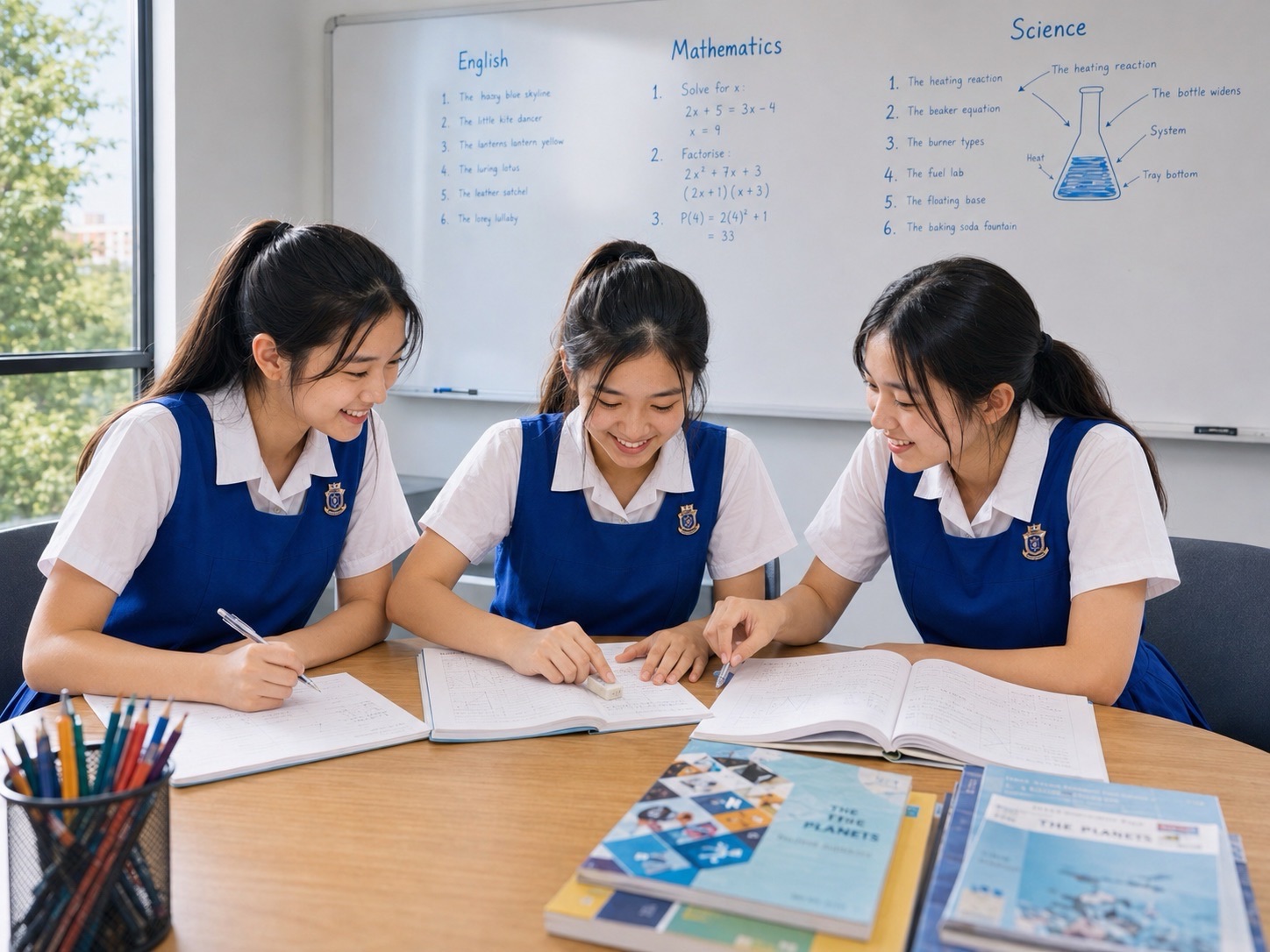
Primary English and Secondary English are the same language, but they are not the same learning job. The transition does not replace reading, vocabulary, grammar, writing and oral communication. It changes the resolution at which those skills must operate.
A Primary student may be asked to understand what happened and support an inference. A Secondary student increasingly has to interpret denser texts, distinguish viewpoints, explain how language works, sustain an argument, adapt register and revise with greater independence. The foundations remain. The demand rises.
This legacy Punggol English Tuition page now owns one precise job: the Primary 6 → Secondary English handoff. It is not a generic Punggol English sales page. Its purpose is to explain what should stay, what should deepen and what scaffolds should begin to disappear as a learner moves into Secondary school.
The Handoff Question: What Must Survive the Change of School Level?
PSLE preparation can make Primary 6 English feel like the end of a system. It is not. The most valuable outcomes are the language capabilities that remain useful after the examination format disappears.
- reading for meaning;
- vocabulary depth and retrieval;
- grammar and sentence control;
- evidence-based inference;
- clear organisation of ideas;
- awareness of audience and purpose;
- revision and self-correction;
- oral reasoning and responsive communication.
A strong transition protects these capabilities while increasing the complexity of the texts and decisions built on top of them.
Primary English: Build the Language Operating System
Across Primary school, the learner is building a dependable language system: access print, build meaning, use vocabulary, form sentences, explain evidence, organise writing, listen, speak and revise.
By P5 and P6, the aim should increasingly be independent coordination. Grammar should survive composition load. Vocabulary should travel across reading, oral and writing. Comprehension should rely on evidence rather than familiar question patterns. Feedback should become a self-check rather than a permanent tutor instruction.
Secondary English: The Text Becomes Denser and the Judgement Becomes Stronger
Secondary English asks the same language system to operate under greater conceptual and textual load.
- texts become longer, denser and more varied;
- inference becomes less locally obvious;
- vocabulary carries more nuance and register;
- writing requires more sustained development;
- audience and purpose become more explicit;
- summary and synthesis require stronger selection;
- viewpoint, tone and writer choices receive greater attention;
- independent revision becomes more important.
The transition is therefore not “harder worksheets”. It is deeper language control.
The Transition Problem: A Student Can Be Strong at PSLE English and Still Struggle Later
A student can become highly familiar with Primary examination formats while remaining dependent on narrow text types, fixed answering routines or composition templates. Once the familiar structure changes, performance becomes less predictable.
The handoff should therefore test portability:
- Can the learner read unfamiliar text types?
- Can vocabulary be inferred rather than only memorised?
- Can a response be organised without a fixed Primary template?
- Can evidence be selected and explained?
- Can the learner sustain a viewpoint across a longer piece?
- Can feedback be applied independently?
Reading: From What Happened to How the Text Works
Primary reading develops sequence, cause and effect, character, information retrieval and evidence-based inference. Secondary reading builds on those foundations but asks the learner to manage more complex relationships.
The question gradually expands from “What does this paragraph mean?” to questions such as “What viewpoint is being constructed?”, “How does this word choice shape tone?”, “What assumption connects these ideas?” and “Why is this evidence more persuasive than the alternative?”
The learner still needs literal accuracy. Deeper interpretation does not replace foundations; it depends on them.
Vocabulary: From Breadth Into Nuance, Register and Precision
Primary students benefit from building a wide usable vocabulary. Secondary English requires increasingly fine control of distinctions.
- What is the difference between two near-synonyms?
- Which word fits formal writing?
- Which expression sounds exaggerated or dismissive?
- What connotation does the writer create?
- How does a collocation sound natural or unnatural?
- How does word choice position the reader?
Vocabulary becomes both a comprehension tool and an analytical tool.
Grammar: From Correct Exercises to Control Under Complexity
Secondary students often know more grammar rules than their writing performance suggests. The difficulty is maintaining control while sentences become longer, ideas become denser and argument requires qualification.
A transition-ready learner should increasingly be able to manage clause relationships, reference, tense consistency, punctuation and sentence boundaries while focusing on meaning at the same time.
Writing: From Coherent Response to Sustained Control
Primary writing builds relevance, structure, development, vocabulary and sentence control. Secondary writing should retain those foundations while increasing flexibility and judgement.
- build a sustained line of thought;
- develop examples or evidence rather than mention them;
- control tone for audience and purpose;
- vary structure because the task requires it, not because a formula dictates it;
- revise at both sentence and paragraph level;
- manage a longer response within time.
A student who depended heavily on memorised introductions or model plots in Primary school may need to replace template dependence with a more adaptable planning system.
Comprehension: From Finding Evidence to Interpreting and Evaluating It
The useful Primary chain still applies: question → evidence → relationship → answer. Secondary English increases the complexity of the relationship.
- literal retrieval;
- inference;
- language effect;
- writer purpose;
- comparison of ideas;
- evaluation of viewpoint;
- synthesis across sections and texts.
The student increasingly has to explain not only what evidence says, but what the evidence does.
Oral Communication: From Prepared Response to Responsive Reasoning
Primary oral work should already build listening, articulation and explanation. Secondary oral communication increases the importance of responding to follow-up, sustaining a viewpoint, qualifying a claim and engaging with another person’s question rather than delivering a memorised speech.
A useful transition exercise is to require the student to explain a view, then face one genuine follow-up that changes the direction of the discussion.
The P6 → Sec 1 Summer Trap: Either Stop Everything or Race Ahead
After PSLE, families sometimes swing between two extremes: abandon English completely for several months, or immediately begin heavy Secondary examination drilling. Neither is necessary.
A healthier handoff keeps reading alive, broadens text types, strengthens vocabulary through context, encourages discussion, introduces more sustained writing and gently reduces Primary-specific scaffolds.
What to Preserve After PSLE
- regular reading beyond exam passages;
- vocabulary in real contexts;
- writing for actual purposes and audiences;
- oral discussion of books, current affairs and ideas;
- independent editing habits;
- curiosity about how language works.
These create a broader English base for Secondary demands than premature drilling alone.
What to Reduce After PSLE
- overdependence on fixed composition phrases;
- question techniques that work only on one familiar paper format;
- vocabulary memorised without context;
- tutor-supplied planning that removes student decision-making;
- constant reassurance after every answer.
A Twelve-Week Sec 1 Handoff
The first Secondary term can be treated as an evidence window rather than a panic period.
- Weeks 1–3: observe text density, vocabulary load, writing expectations and school feedback.
- Weeks 4–6: identify which Primary skills transferred and which collapsed.
- Weeks 7–9: repair one or two high-value gaps rather than expanding workload everywhere.
- Weeks 10–12: retest on changed texts and more independent writing.
The goal is to understand the learner’s new Secondary state before deciding how much support is justified.
Full Subject-Based Banding Changes the Labels, Not the Need for Precise Diagnosis
Singapore’s Secondary system now uses Full Subject-Based Banding, with subjects taken at different G1, G2 or G3 levels according to the student’s pathway and strengths. This makes old one-label assumptions less useful. English support should be matched to the learner’s actual subject level, school work and current demands rather than an outdated stream label.
2026 and 2027 Examination Transition
For 2026 school candidates sitting the GCE O-Level route, SEAB lists English Language as syllabus 1184. From 2027, the Singapore-Cambridge Secondary Education Certificate begins for school candidates; SEAB lists G3 English Language as K300, with 1184 shown as the reference code for 2026 and earlier.
Families should use current SEAB information for the student’s cohort rather than relying on old codes embedded in legacy tuition articles. See SEAB 2026 O-Level syllabuses and SEAB 2027 SEC G3 syllabuses.
Case Study: Strong PSLE Score, Weak Sec 1 Reading
A student enters Secondary school after a strong PSLE result but suddenly struggles with dense informational texts. The family assumes the child has “dropped”.
Closer analysis shows that literal comprehension is intact. The difficulty appears in vocabulary depth, reference across longer paragraphs and interpreting viewpoint. The student did not lose English; the task resolution changed. The repair should target those new demands.
Case Study: The Template Writer
Another learner enters Secondary school with polished Primary compositions built from familiar openings, dramatic phrases and memorised story shapes. When asked to write for a different audience or purpose, the student becomes uncertain.
The transition work is not “teach more phrases”. It is to rebuild writing from purpose, audience, controlling idea, paragraph jobs and independent revision.
Case Study: Grammar Collapses as Sentences Become Longer
A student performs well on discrete grammar exercises but produces unstable agreement, reference and punctuation in longer Secondary writing.
The grammar knowledge may already exist. The problem is transfer under increased writing load. Stabilisation inside authentic writing is more useful than returning automatically to basic worksheets.
A 3-Pax Class Across the Transition
A three-student class can support the handoff because students can compare interpretations and language choices while still producing independent work.
- Students can read the same text and defend different interpretations.
- Writing plans can be compared without supplying identical content.
- Vocabulary choices can be tested for nuance and register.
- Oral responses can receive real follow-up questions.
- The tutor can raise reasoning depth while keeping the learner’s own work visible.
When the Transition Has Not Happened
- the student waits for a fixed technique for every question;
- writing remains heavily templated;
- reading has narrowed to exam passages only;
- vocabulary is memorised as lists but rarely interpreted for tone;
- the student can answer but cannot explain language effect;
- tutor prompts remain necessary for first steps.
These are signals to rebuild flexibility rather than merely increase worksheet difficulty.
When Secondary English Tuition May Help
- a previously stable Primary student is unexpectedly inconsistent with denser Secondary texts;
- template dependence is limiting writing;
- vocabulary depth or inference has become a bottleneck;
- the learner needs closer feedback on viewpoint, tone or evaluation;
- grammar collapses under longer writing load;
- the student understands school lessons but cannot transfer independently.
A student who reads broadly, adapts well, responds to school feedback and is becoming more independent may not need tuition simply because Secondary school has begun.
Progress Receipts for the Handoff
- the student handles more varied and denser texts;
- answers explain evidence and viewpoint more precisely;
- writing becomes less template-dependent;
- vocabulary is used with better register and nuance;
- longer responses remain grammatically controlled;
- the learner revises more independently;
- Secondary English performance becomes less surprising and more explainable.
What This Page Does Not Own
This page owns the Primary 6 → Secondary English transition. It deliberately does not duplicate the full learning-chain diagnostic, Primary tutor observation or P1–P6 intervention-depth page.
- For the full English learning chain, see English Tuition Punggol | Input → Meaning → Output → Feedback → Transfer.
- For Primary tutor observation before correcting, see Punggol Primary English Tutor | Observe Task → Language → Strategy → Independence Before Correcting.
- For deciding intervention depth from P1 to P6, see Punggol Primary English Tuition Centre | Choose the Right Intervention Depth From P1 to P6.
Continue to Current English Routes
For current Primary English information, continue to Primary English Tuition in Punggol. For Secondary levels, use The Secondary Pathway.
The strongest handoff does not discard Primary English. It carries forward what still works, deepens the reasoning where Secondary English demands more, and removes scaffolds that the student no longer needs.


