
What Can Secondary Mathematics Tuition Do? | G1 G2 G3 Parent Decision Guide
Secondary Mathematics tuition is useful when it repairs the mathematical system underneath the marks. It is not useful simply because the student now has one more set of worksheets to finish every week.
This page owns the decision job across lower and upper secondary: what Mathematics tuition can realistically do under Full Subject-Based Banding, when it helps at G1/G2/G3, when E-Math or A-Math needs a different repair, and when parents should change, reduce or avoid adding tuition. eduKate Punggol’s current small-group model is three students for 1.5 hours; current location, timetable, fees and availability should be confirmed directly.
Quick answer
- Tuition can identify whether the real problem is concept, algebra, representation, method choice, reasoning or execution.
- Tuition can rebuild Primary-school dependencies that only become visible in Secondary Mathematics.
- Tuition can strengthen algebraic fluency before it becomes a bottleneck across many topics.
- Tuition can train students to translate language, diagrams and data into mathematical structure.
- Tuition can prepare students to work at the correct G1/G2/G3 subject level without confusing “harder” with “better”.
- Tuition can train visible working, checking and timed stability.
- Tuition cannot guarantee a grade or subject-level move.
- Tuition should reduce dependence as the student’s structure becomes more reliable.
The current Singapore pathway matters
Under Full Subject-Based Banding, Mathematics is offered at different subject levels. For the 2027 Secondary Education Certificate, SEAB lists Mathematics as K110 at G1, K210 at G2 and K310 at G3. Additional Mathematics is separately offered at G2 and G3, with 2027 subject codes K232 and K341 respectively.
Those labels tell you the formal lane. They do not tell you why a specific student is struggling. A G3 student may have a Primary-level fraction dependency. A G2 student may understand concepts well but be slow and inconsistent. A student taking Additional Mathematics may actually be losing marks because ordinary algebra is unstable.
The first job: identify the mathematical break
| Visible problem | Possible hidden cause | Useful test |
|---|---|---|
| “Algebra is weak” | Signs, brackets, fractions, equality, substitution or factorisation | Isolate each operation and retest in a mixed expression. |
| “Cannot do unfamiliar questions” | Method recognition / transfer weakness | Keep concept constant, change the surface form. |
| “Understands in tuition, fails tests” | Prompt dependence, timing or retrieval | Closed-book delayed retest under mild time pressure. |
| “Careless” | Working compression, sign error, calculator input, unit or question-reading problem | Classify the lost marks over several scripts. |
| “Cannot see what topic it is” | Representation and modelling weakness | Ask student to state quantities, relationships and constraints before calculating. |
| “A-Math is impossible” | Assumed G3 Mathematics floor may be unstable | Test the algebraic prerequisite before the A-Math technique. |
What tuition can do in Secondary 1
Secondary 1 is a systems transition. Mathematical language becomes more symbolic, algebra becomes central, working must be more explicit and students are expected to handle abstraction with less scaffolding. Tuition can be useful when it rebuilds the bridge from Primary Mathematics instead of simply racing ahead in the Sec 1 textbook.
- repair fractions, ratio, percentage and number sense where needed,
- make equality and variable meaning explicit,
- standardise algebraic working,
- teach how to translate words into equations or diagrams,
- build independence before bad habits harden.
What tuition can do in Secondary 2
Sec 2 is often where the cumulative structure becomes visible. Students may cope topic-by-topic but fail when algebra, graphs, geometry, data and proportional reasoning begin to interact. Tuition can help connect these shelves into one system and identify whether the learner is ready for the upper-secondary runway.
What tuition can do in Secondary 3–4 Mathematics
Upper-secondary tuition should become increasingly diagnostic and examination-aware. The student needs more than chapter knowledge: method selection, cross-topic connection, visible mathematical communication, calculator discipline where applicable, and paper stability under time.
For the 2026 O-Level cohort, SEAB lists Mathematics under syllabus 4052 and Additional Mathematics under 4049. The 2027 SEC transition changes subject codes, but the core educational requirement remains: students must apply, reason, communicate and execute mathematics reliably.
E-Math and A-Math need different tuition jobs
| Area | Typical E-Math job | Typical A-Math job |
|---|---|---|
| Algebra | Fluent equations, graphs, manipulation and application | Higher symbolic precision and transformation |
| Geometry | Measurement, coordinate and trigonometric application | Proof, identities and more abstract relationships |
| Problems | Translate context into mathematics | Select and combine techniques across strands |
| Working | Clear enough to show method and reduce errors | Essential symbolic working and mathematical communication |
| Transfer | Apply known ideas in unfamiliar contexts | Recognise structural equivalence across forms |
A student can need support in both subjects, but the tutor should not pretend they are the same problem.
Tuition can make mathematical thinking visible
A final answer hides the route. Good tuition asks the student to expose enough of the route that the tutor can see where the mathematics changed direction.
- What quantity or object are we solving for?
- What information is given?
- What relationship connects the known and unknown?
- Which representation makes that relationship visible?
- Which method is valid?
- What assumptions or restrictions matter?
- How can the result be checked?
This process builds reasoning and communication at the same time.
Tuition can build algebra as infrastructure
Algebra is not one topic. It is infrastructure used by equations, functions, graphs, geometry, trigonometry, statistics models and Additional Mathematics. Small weaknesses in sign control, brackets, fractions or factorisation propagate widely.
A strong tutor therefore repairs algebra at source and then deliberately retests the same algebra inside another topic. That is transfer.
Tuition can train route selection instead of shortcut dependence
Shortcuts are useful when the student understands why they are valid. They are dangerous when they replace structure. Secondary Mathematics increasingly rewards students who can recognise the form of the problem and select among several available methods.
A useful tutor may ask two students to solve the same question differently, then compare which route is shorter, clearer or more robust. That teaches method choice rather than loyalty to one template.
Why three students can work well for Secondary Mathematics
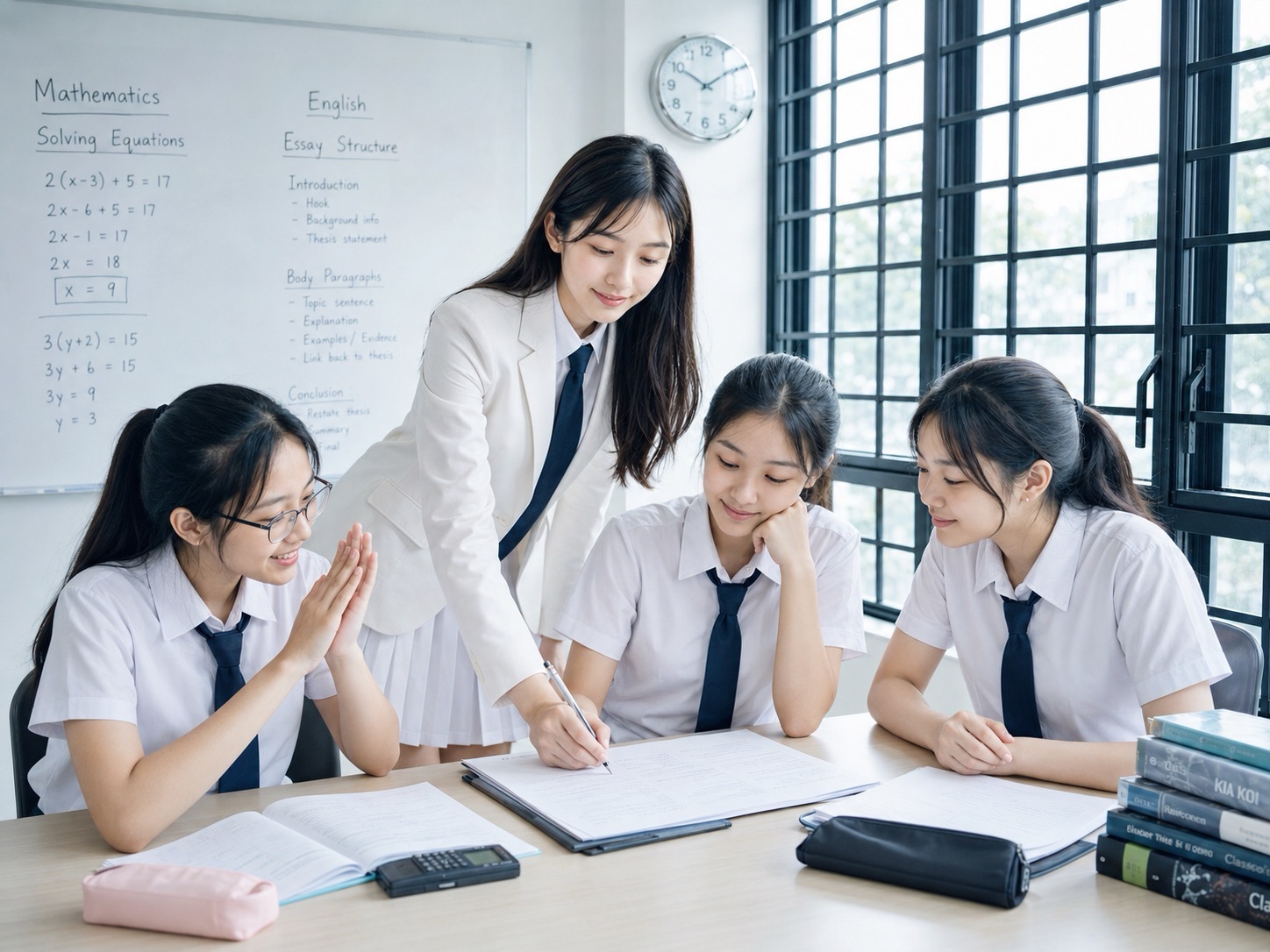
Three students provide enough variation for meaningful mathematical comparison while preserving individual visibility. One student may solve algebraically, another graphically, and a third may expose a common misconception. The tutor can inspect each route, correct it and run a changed-question retest within the same lesson.
- frequent board/paper explanation,
- visible mathematical working,
- peer comparison of valid methods,
- different difficulty or cue levels,
- fast error classification,
- less opportunity to hide behind passive listening.
What tuition cannot do
- It cannot guarantee a distinction or subject-level progression.
- It cannot make weak prerequisites disappear by jumping straight to harder questions.
- It cannot replace sleep, school attendance or independent consolidation.
- It cannot create transfer if every task remains identical to the model answer.
- It cannot build independence if the tutor permanently supplies the first step.
When Secondary Mathematics tuition may be useful
- marks have fallen sharply after the Primary-to-Secondary transition,
- algebra errors recur across multiple chapters,
- the student can imitate examples but cannot start unfamiliar questions,
- school corrections do not transfer,
- working is too compressed to diagnose or secure method marks,
- timed papers show a different performance from untimed practice,
- A-Math is failing because assumed Mathematics knowledge is unstable.
When changing tuition may be better than adding more
- the tutor cannot state what is currently being repaired,
- every lesson is generic worksheet completion,
- the same mistakes continue without changed-question retesting,
- difficulty is raised while prerequisites remain weak,
- the student performs only with tutor prompts,
- progress reports describe effort but not mathematical capability.
A four-week evidence window
- fewer repeated algebra or representation errors,
- clearer explanation of method choice,
- greater success on changed questions,
- more stable working under time,
- better delayed retrieval,
- less prompting,
- transfer appearing in school tests or homework.
The exit condition
Successful Secondary Mathematics tuition should gradually hand the work back. The student learns to identify the mathematical object, choose a route, execute visibly, check plausibility and diagnose recurring errors with less external help. The strongest evidence that tuition worked is not permanent attendance. It is increasing mathematical independence.





